


Sommaire
Introduction
In an economic environment where company value increasingly relies on intangible assets, the question of whether investment funds should own trademark rights has become particularly relevant. Long perceived as mere marketing tools, trademarks are now recognized as structuring legal and financial assets, capable of directly influencing valuation, risk mitigation, and investment profitability.
In our practice, we observe that many transactions fail or suffer significant value reductions due to inadequate management of industrial property rights, particularly trademarks. Conversely, a strong and well-structured trademark portfolio can transform a conventional investment into a high-potential strategic asset.
Accordingly, it is necessary to assess the true role of trademark rights within investment fund strategies. Are they merely protective tools, or do they constitute a fundamental driver of value creation ?
Trademark rights as essential strategic assets
For investment funds, holding or controlling trademarks is no longer simply a legal matter, but a genuine strategy for securing and enhancing investments.
Trademark law grants an exclusive right to use a distinctive sign, enabling the identification of the origin of goods or services and ensuring their uniqueness in the marketplace. This exclusivity serves as a key differentiation tool, particularly in highly competitive sectors. It protects the reputation of the target company while preventing third-party misappropriation.
From an investment perspective, trademarks thus become structural assets. They embody not only the commercial identity of a company but also its perceived value. A company lacking strong trademark protection presents an immediate legal risk that may jeopardize its operations and, consequently, the profitability of the investment.
The impact of trademarks on investment valuation and profitability
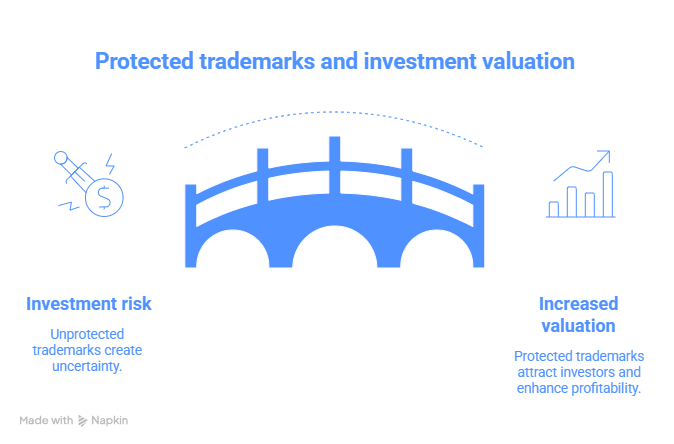
Trademark ownership directly affects company valuation, both at entry and exit stages. During acquisition processes, the existence of a secure trademark portfolio is an indicator of maturity and stability. It reassures investors and facilitates negotiations by reducing legal uncertainty.
Conversely, the absence of protection or the existence of potential trademark disputes may lead to a significant revision of the purchase price or even the abandonment of the transaction altogether. In this context, trademarks act as a crucial analytical filter during due diligence.
Beyond risk mitigation, trademarks also offer independent revenue-generating opportunities. They can be exploited separately from the core business, particularly through contractual arrangements such as licenses or commercial partnerships. This ability to generate indirect income gives trademarks a particularly attractive asset dimension for investment funds.
At the exit stage, the value of a trademark portfolio becomes a decisive factor. A strong, well-known, and legally protected trademark enhances company valuation and attracts strategic buyers. It reduces perceived risks and facilitates the successful completion of transactions.
For further insight into the impact of trademarks on company valuation, we invite you to consult our previously published article.
Holding trademark rights requires rigorous and continuous management. Unlike other assets, a trademark is not acquired permanently. It must be used, monitored, and renewed to remain valid.
Periodic renewal is an essential obligation. Failure to comply results in the loss of rights and opens the door to third-party appropriation. Such a situation may have significant financial consequences for an investment fund, particularly where brand value is critical.
In addition, monitoring infringements is a strategic necessity. Risks of counterfeiting, imitation, or cybersquatting are particularly high in a global digital environment. Funds must be able to detect such infringements promptly and respond effectively, whether through litigation or specific administrative procedures such as the Uniform Domain-Name Dispute Resolution Policy (UDRP).
Trademark protection must also be considered in light of digital challenges. Domain names, online platforms, and social media represent major points of vulnerability. A lack of coordination between trademark strategy and digital strategy exposes companies to increased risks of identity theft and fraud.
Strategies for managing and optimizing trademark portfolios
A strategic approach to trademark rights requires early integration of intellectual property into the investment process. Prior audits of intangible assets help identify risks and anticipate necessary corrective actions. This step is essential to secure transactions and optimize asset valuation.
The structuring of trademark portfolios is also a key optimization tool. A coherent strategy tailored to target markets maximizes protection while controlling costs. Centralizing rights within dedicated structures may also facilitate management and create tax optimization opportunities.
From an operational perspective, trademark management requires the involvement of specialized experts capable of ensuring ongoing monitoring and implementing appropriate enforcement strategies. Support from intellectual property professionals enables the transformation of a legal asset into a true value-creation tool.
Conclusion
Trademark law is now a fundamental component of investment fund strategy. It secures assets, enhances their value, and generates additional revenue streams. Its role goes far beyond mere legal protection, forming part of a broader framework of performance and competitiveness.
Dreyfus & Associés assists its clients in managing complex intellectual property matters by providing tailored advice and comprehensive operational support for the full protection of intellectual property rights.
Nathalie Dreyfus with the support of the entire Dreyfus team.
Q&A
1. Can an investment fund record a trademark as an asset on its balance sheet ?
Yes, a trademark may be recognized as an intangible asset if it is identifiable and expected to generate future economic benefits. Its valuation often requires specific methodologies and may be subject to audit.
2. What is the difference between a registered trademark and a trade name ?
A trademark grants an exclusive legal right, whereas a trade name serves to identify the business. Their legal scope and protection mechanisms differ significantly.
3. Can a trademark be transferred independently from a company ?
Yes, a trademark can be assigned separately from the business. This flexibility allows for strategic asset management and value optimization.
4. What are the costs associated with international trademark registration ?
Costs vary depending on jurisdictions and filing systems. They include official fees, professional fees, and ongoing maintenance costs.
5. Can a trademark be challenged after registration ?
Yes, a trademark may be subject to opposition, invalidity, or revocation proceedings. Its validity depends on distinctiveness and genuine use.
This publication is intended for general public guidance and to highlight issues. It is not intended to apply to specific circumstances or to constitute legal advice.