Intellectual Property

Claiming unregistered trademark rights on a geographical name is a difficult challenge in UDRP proceedings

While certain geographical names may, by exception, benefit from protection within the meaning of the UDRP rules, it should be remembered that they must be perceived as a trademark or service mark over which the applicant has rights. However, the mere use of a geographical name to identify certain goods and services as a territorial entity is not sufficient to demonstrate rights in a trademark or service mark within the meaning of the Guidelines, as the pannelist rightly pointed out in the present Decision.

In this case, the geographical name Solothurn (‘Soleure’ in French), corresponding to a city in Switzerland, was reproduced in its entirety in the domain name <solothurn.com>. It was registered in 1997 and has not been used since except to redirect to a “pay-per-click” page.

The applicants, the City of Solothurn and two associations under Swiss law promoting mainly tourism and unsurprisingly showing a strong interest in the domain name <solothurn.com>, claimed an unregistered trademark right on the sign “Solothurn”, which has been used extensively over the years. They also claimed protection of the name as “trademark-like” within the meaning of the Swiss law on unfair competition.

In this regard, they provided several documents attesting to the use of this geographical name by tourists since 1890 and its recognition as such. The applicants inferred that the use of the sign “Solothurn” constituted a trademark used to identify tourism and other related services. They also cited several decisions of the centre concerning geographical names, which are far from having argued in their favour.

The defendant, domiciled in the United States and known for his activities related to domains specializing in “geographical” domain names, had put the domain name <solothurn.com> up for sale. The defendant cited numerous decisions on how geographical names should be assessed (including a decision about the name <rouen.com>) and on the need to fulfill the function of a trade-mark.


Faced with this case and the question of whether the applicants could validly claim an unregistered trademark right in the name “Solothurn”, the panellists carried out a meticulous examination of the case law of the decisions of the WIPO panellists (overview) in the field of geographical names.

In particular, they recalled that according to the overview, “geographical terms used only in their ordinary geographical sense, except when registered as trademarks, do not, as such, provide standing to act in UDRP proceedings”. They also noted that in UDRP matters, it has generally been difficult for affiliates or entities responsible for a geographical territory to demonstrate trademark rights over that geographical name. However, the panellists noted that the decisions cited by the applicants all acknowledged that the geographical name was used in a purely descriptive way of a geographical location and not as a trademark.


On the other hand, they took note of the fact that some panellists have indicated that an unregistered trademark right in a geographical name may be granted to an official authority in exceptional circumstances. The circumstances in question cover the increasingly rare assumption that the geographical name would be used in connection with products and services but without any connection to the geographical location to which it corresponds. The idea is that the trade name should not generate an association with a geographical location in the minds of consumers, but rather an association with products and services, as the main function of the brand requires. For example, we can mention the products of the Ushuaïa brand, unrelated to Tierra del Fuego.


In the present case, the panellists noted that the applicants had not provided any proof of use of the name “Solothurn” in connection with products and services beyond those provided by the City of Switzerland. On the contrary, the applicants merely pointed out the use of the name “Solothurn” in connection with the name of the city of Switzerland and the tourist activities offered there. Consequently, the panellists could not validly conclude that the applicants had established that they had rights in the unregistered Solothurn trademark.


The panelist added that the applicants could not rely on the protection of this name as “trademark-like” within the meaning of the Swiss law on unfair competition insofar as Article 4.a. (i) of the Guidelines expressly refers to the “trade or service mark”.


Finally, the complaint was rejected as the applicants had not provided proof of trademark rights. However, this decision seems to be qualified by the panellists, who point out that it is a decision rendered under the UDRP principles, adapted to disputes between registrants and trademark owners whereas the solution could have been different under Swiss law and in matters of unfair competition.


The “morality” of this decision is not new; the UDRP procedure is not suitable for all disputes involving domain names and should not be systematically preferred to legal proceedings, even if it does have the advantage of being faster and less costly.


WIPO WIPO, Arbitration and Mediation Center, July 25, 2019, No. D2019-1164, Einwohnergemeinde Solothurn, Verein “Region Solothurn Tourismus”, Verein “Katon Solothurn Tourismus” c/ M.A. Stenzel,
Read More

Modification of the opposition procedure in France: an increased protection for the right holders

Opposition is a crucial procedure to ensure the protection of trademarks. It is a way to solve potential disputes quickly, simply and with reasonable costs and time limits.

Following the transposition of the « Trademark reform Package » into French law, modifications were made to the opposition procedure, ensuring right holders a broader protection against the infringement of their rights.


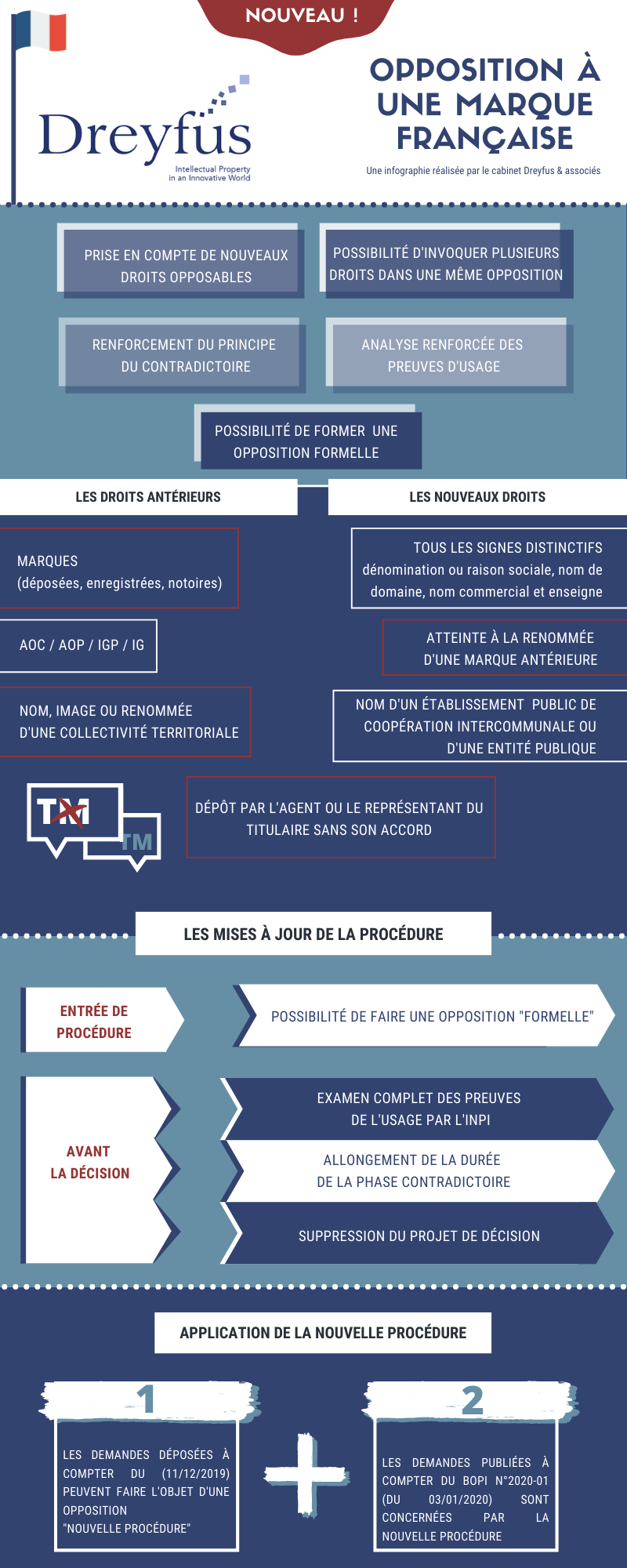
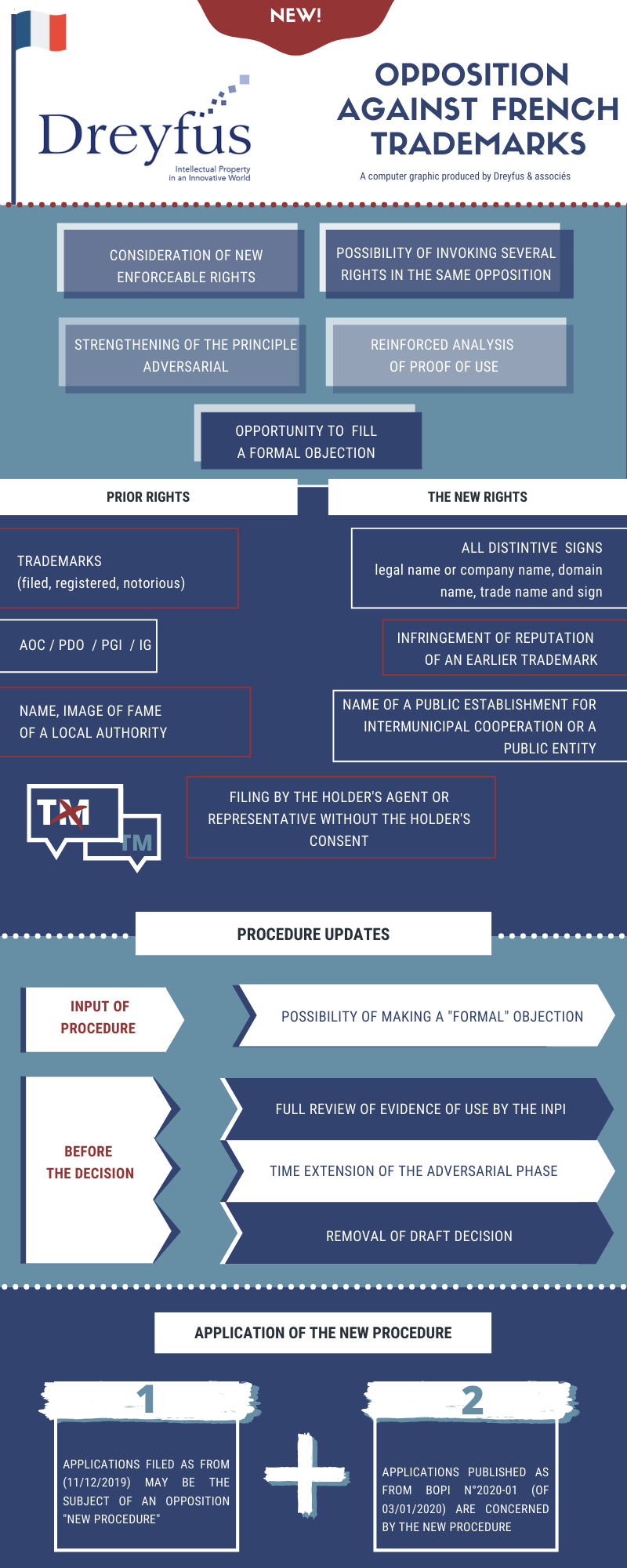
The first major change is the expansion of prior rights that can serve as the basis for the opposition before the French Trademark office. So far, it has only been possible to file an opposition on the basis of a prior trademark application, a prior registered or well-known trademark in the sense of article 6bis of the Paris Convention; an appellation of origin or a protected geographical indication; the name, the reputation or the image of a territorial collectivity.

From now on, article L712-4 of the French Intellectual Property Code, modified by the ordinance of November 13, 2019, allows for the opposition of the registration of a trademark on the basis of :


  • a prior trademark (French, of the European Union, or international designating France or the European Union; a well-known trademark; a trademark that enjoys repute in France or, in the case of a European trademark, a reputation in the European Union, subject to certain conditions);


  • a company name or a corporate name if there is a risk of confusion in the mind of the public,


  • a trade name, commercial sign or a domain name, the scope of which is not only local if there is a risk of confusion in the mind of the public,


  • an appellation of origin or  a  protected    geographical indication,


  • the name of a territorial collectivity or the name of a public establishment for inter-municipal cooperation,


  • the name of a public entity if there is a risk of confusion in the mind of the public.


This new legal provision also makes it possible for the opponent to invoke, if need be, several rights to form the opposition.

The second important transformation concerns the opposition process.

As in the former procedure, the opponent has a 2 month deadline from the date of publication of the trademark application to file an opposition. However, they now have an additional month to present their observation as well as the documents necessary to prove the existence and the scope of their rights. It will be qualified, firstly, as a “formal” opposition, as in the procedure before the EUIPO, until the statement of case on the merits is filed and, secondly, in the event that the Parties have not settled their dispute amicably in the meantime.

The adversarial phase of the opposition, during which the Parties exchange documents and their arguments in writing, subsequently begins. The parties may request an oral hearing at this time. However, no new pleas or documents may be presented during the hearing.

Depending on the number of exchanges between the Parties, this first phase of investigation may last anywhere between 6 months and a year. At the end of this period, the director of the French office must render a decision within 3 months.


The changes made by the transposition of the European directive into French law provide greater protection for rights holders. This new procedure is more precise because it has been limited by the stipulation of short and non-extendable deadlines. Furthermore, it makes it possible to base the opposition on a larger number of prior rights, thus putting the protection of holders at the forefront of this procedure.


This new opposition system applies to all trademark applications filed from December 11, 2019.


Dreyfus can assist you in the management of your trademarks portfolios in all countries of the world and accompany you in your opposition proceedings. Do not hesitate to contact us.


Read More

The blockchain offers a modern and simplified register for the traceability of your Intellectual Property rights

With the appearance of the blockchain, monitoring the life cycle of the creation of your Intellectual Property by setting a specific registration date and ensuring the traceability of its evolution is a lot simpler. Opening the account is easy, as is backing up and viewing the data embedded in it.


  • What is a blockchain ?

The Blockchain is a database (a growing list of records, called ‘blocks’) that are linked using cryptography. Each block contains a cryptographic hash of the previous block, a timestamp and transaction data.

It is a reliable and transparent registry which everyone can access and contains the history of exchanges between users. However, once recorded, the data in any given block cannot be altered retroactively without alteration of all subsequent blocks, which requires consensus of the network operators. Material can be saved on this decentralized and secure system for an unlimited period of time.


  • Easy monitoring of the registration cycle

The blockchain is of great practical use in the traceability of intellectual property rights.

On the one hand, it is low cost and speedy. The decrease in costs can be explained by the fact of intermediaries are bypassed. As for its speed, all you need to do is open an account and download the document that includes the data concerning creation of your Intellectual Property.

On the other hand, all the steps concerning the creation of your Intellectual Property should be recorded ; whether it is the date of the first application for registration, of the first use in trade or an assignment etc. Similarly, operations such as mergers or acquisitions are more easily recorded via the database.


  • Confidentiality of data

The document containing information about your creation of the Intellectual Property is not stored in the blockchain, only its digital footprint. Accordingly, it is impossible for third parties to access its content, you are the only one having access to it. You can therefore be confident that your data will be safe.


  • A revolution in evidence

Thanks to the blockchain, proof of creation is made easier and the procedure made faster, the Blockchain giving certainty of the time and date. It also makes it possible to trace the exploitation of digital works on the web.

Nevertheless, to acquire incontestable force of proof, it is necessary to have the evidence concerned established by a bailiff. The bailiff is able to establish an indisputable proof of origin and anteriority before a judge.


  • Fight against counterfeiting

The blockchain is a register which cannot be falsified, providing proof of the authenticity of the creation of your Intellectual Property and thus limiting the possibilities of counterfeiting. This system indicates who is the author of the creation and therefore is a significant piece of evidence to establish the actual date of the creation.


  • Fight against counterfeiting

The blockchain is a register which cannot be falsified, providing proof of the authenticity of the creation of your Intellectual Property and thus limiting the possibilities of counterfeiting. This system indicates who is the author of the creation and therefore is a significant piece of evidence to establish the actual date of the creation.


The blockchain has many advantages with regard to intellectual property rights. Whether it is security, transparency, lower cost, speed, ease of proof, confidentiality or even the certainty of authenticity : it has multiple strengths which are favourable to the protection of your creations.

With the service of the DreyfusBlockchain , we offer simple, effective and secure protection for your creations.


Read More

World Intellectual Property Forum, November 6-8 2019

Meet Nathalie Dreyfus at the World Intellectual Property Forum in Grand Hyatt Taipei, Taiwan, from November 6 to 8, 2019.

This year’s conference will be on the following theme: “IP as a Powerhouse for Innovation and Economic Growth“. This three-day forum will focus on recent developments in intellectual property and their synchronization with business objectives.

Nathalie Dreyfus will be speaking on November 8 from 1:30 pm to 3 pm on the following panel “How can emerging technologies be adopted in the current intellectual property law system? ».

As a reminder, the World Intellectual Property Forum is an opportunity to hear from intellectual property experts who will share the latest trends, ideas and strategies in patenting, litigation, trademarks and other current issues related to intellectual property. This forum also offers participants many opportunities to meet visionary entrepreneurs and industry experts from around the world.

More information: https://www.worldipforum.com/


Dreyfus can assist you in the management of your trademarks portfolios in all countries of the world. Do not hesitate to contact us.

Read More

FABA/FBA Paris Fashion Law and Innovation Conference, October 4th 2019

The Federal Bar Association, in collaboration with the French American Bar Association, is organizing the 2019 Fashion Law and Innovation Conference. This event will take place on Friday, October 4 at 8:30am at the Maison du Barreau in Paris.

Programming will feature a notable group of law experts and industry representatives who will discuss recent developments and current challenges from both the French and US perspective.

Nathalie Dreyfus will speak at 9am for a conference about The Five Senses: The growth of non-traditional brands in the fashion industry.

For more information and registration, please click here.

*Note that this conference is organized in collaboration with the French American Bar Association so it will be in English.


Information 

Where: Maison du Barreau, 2 Rue de Harlay, 75001 Paris

When: October 4th, 8 :30am – 12 :30pm

Read More

The Supreme Court of the Russian Federation adopted Resolution No. 10/2019 and thus provided welcome clarifications on domain names

On April 23rd 2019, the Russian Supreme Court adopted Resolution No. 10/2019, which clarified the provisions of Part 4 of the Russian Civil Code relating to intellectual property rights, and therefore to domain names, which are the subject of this article.


Among the clarifications provided, the Russian Supreme Court decided in particular that the commercial courts had jurisdiction to rule on disputes relating to distinctive signs (with the exception of appellations of origin, however), whether the party concerned is an individual person, a private entrepreneur or a company. Previously, the commercial courts and the general courts had jurisdiction based on the identity of the holders of intellectual property rights.

Furthermore, it is increasingly difficult to obtain information on the identity of Russian domain name registrants.

Indeed, although it is possible to make a request to registrars to disclose the identity of domain name registrants, obtaining this information has become increasingly complicated without legal action since many registrars refuse to disclose this information by taking refuge behind applicable legislation or requesting additional documents.

Resolution No. 10/2019 specifies that this information may be obtained through a court by filing a request for disclosure of personal data in legal proceedings. However, this is complicated when the identity of the domain name registrants is unknown. One solution would be to take legal action against registrars and then file a request for disclosure of personal data. It would be then possible to substitute the defendant.

In addition, with regard to infringement of a trademark by registration and use of a domain name, the Russian Supreme Court ruled that trademark infringement is characterized by the use of a domain name for goods and services similar to those designated by the trademark in question, and in some cases still, by registering the domain name only. Consideration should be given to the purpose behind registering the domain name to judge whether there is trademark infringement.

Finally, the Russian Supreme Court provides various additional clarifications. For example, a monetary claim may be filed against the current user of a domain name. In addition, it is possible to request provisional measures in respect of domain names. Finally, in cases concerning domain names, evidence consisting of printed screenshots of websites clearly showing i) the address of the websites in question, ii) the time at which the screenshots were taken and iii) whether they have been verified by the parties to the proceedings is admissible.


These clarifications are welcome. We will keep you informed of any further developments in this regard. Dreyfus is a specialist in domain name protection and defense strategy and can find solutions adapted to your needs. Do not hesitate to contact us.

Read More

RDAP replaces WHOIS

The WHOIS protocol now appears to be outdated due to the evolution of technical requirements in the digital era. Indeed, this tool, provided by registrars, is inter alia not capable of working with either encoding or with non-latin characters. Consequently, since 2015, ICANN in collaboration with the Internet Engineering Task Force (IEFT) has been working on the replacement of WHOIS through the RDAP (Registration Data Access Protocol), in compliance with the Temporary Specifications and the GDPR.

Like WHOIS, the RDAP provides registration data, although its implementation is different since it allows standardization, security data access and enquire response formats. As a result, it will be possible to search all the registration data available from various registrars, unlike WHOIS that is limited to the database being searched. It also takes into account the internationalisation of domain names.

The possibility of granting different accesses to the registration data is being considered. For instance, access for anonymous users could be limited whereas authenticated users could have full access to all data.

While some elements still have to be worked out, registrars are required to implement the RDAP service prior to August 26, 2019.

This brief was published in the July-August 2019 issue of the French magazine “Propriété industrielle”.

Read More

The respondent has a licence on a trademark corresponding to a disputed domain name

WIPO, Arbitration and Mediation Centre, March 11, 2019, No. D2019-0035, Pharnext versus Wang Bo, Xiang Rong (Shanghai) Sheng Wu Ke Ji You Xian Gong Si

On numerous occasions, we have noticed that even those complainants who are represented in UDRP proceedings, could have been better informed about the nature and extent of the rights on which the respondent may rely. Detailed research is an essential prerequisite to filing a complaint, otherwise, the success of the complaint is jeopardised.

On January 7, 2019, the French company Pharnext, whose main activity is in the biopharmaceutical industry, filed a UDRP complaint seeking the transfer of the name <pharnex.com>, which had been registered by a Chinese company.

The complainant contended that it had trademark rights in PHARNEXT through ownership of its “PHARNEXT” logo protected by an international trademark since 2013 and used on its website located at www.pharnext.com.

The respondent had registered the domain name <pharnex.com> in October 2017. At the time the complaint was submitted, the disputed name connected to a website in both English and Chinese indicating that PHARNEX is a platform to help medical companies set up operations in China.

The complainant claimed that the respondent must have had the “PHARNEXT” trademark in mind when registering the domain name, because in May 2017, its partnership with Tasly, one of the most recognised pharmaceutical companies in China, had been announced. The complainant also said there is no plausible explanation for the Respondent’s registration of the Domain Name.  It also claimed to have done searches which revealed no evidence that the respondent had any right or legitimate interest in the name.

However, the respondent, Xian Rong (Shanghai), firstly, proved that it had a licence on the “PHARNEXT” trademark for financial services, and secondly pointed to its active use of the trademark since December 2017.  Although the ownership of a trademark does not automatically confer a legitimate interest or rights on the respondent, the complainant bears the burden of proof throughout the complaint.

In the present case, the expert was “convinced that the PHARNEXT trademark was registered in good faith”. She further noted that the domain name was used, before the filing of the complaint, in connection with a genuine offer of goods and services. Hence, though the domain name was confusingly similar to the complainant’s trademark, the complaint could not be accepted.

The expert stressed that “her findings are made in the limited boundaries of the UDRP; any matters outside the scope of the Policy may be handled by the parties in a relevant court of law.. Quite simply, the complainant had not proved that the disputed domain name had been registered and used in bad faith.

This decision once again highlights that it is essential to carry out research on all aspects of the proposed complaint; including the respondent and the sign from which the disputed domain name has been derived. For example, researching the “PHARNEX” sign on the Chinese databases would have made the complainant aware of the existence of the word mark “PHARNEX” on which the respondent relied.  This would have alerted the complainant to a potential weakness in its case and enabled it to consider alternative strategies. It is essential to think of every possible defense a respondent may raise and be prepared to counter any such defense.

This brief was published in the July-August 2019 issue of the French magazine “Propriété industrielle”.

Read More

Audiovisual works: the protection of program titles by trademark law

Companies which specialise in the audiovisual sector often require protection for their program titles through trademark law. If granted, this protection obviously offers considerable advantages for the company, but it is necessary to take into consideration some limits to it.


  • The advantages of trademark protection

First, the term of protection of a title by trademark law. Trademark law initially grants protection for 10 years, but this term is renewable indefinitely (Art L712-1 CPI). Thus, provided the owner submits a renewal application within the time limit, the trademark can be protected indefinitely. Copyright, on the other hand, can grant protection up to 70 years after the death of the author of the work, but the ‘guarantees’ of protection may be less obvious than trademark law because there is no register of copyright.

On the other hand, while copyright imposes a condition of originality (Art.L711-2 CPI), trademark law requires a distinctive character (Art L711-2 CPI). Thus, if the title of TV show or audiovisual program is distinctive and acts as an indicator of origin, it may be protected. In contrast, for copyright, it is necessary to prove originality, which is more difficult to prove. Since copyright is not subject to registration, the condition of originality must always be demonstrated in the course of a dispute. Thus, copyright protection is never certain.


A title may be protected by trademark law if it does not directly designate the goods and services for which registration is sought. Thus, if the title is arbitrary, there is nothing to prevent the title from benefiting from this protection. Finally, it should be borne in mind that trademark protection is not an impediment to copyright protection; it is thus possible to combine both protections.


  • The limits of trademark protection


Some limitations to the protection of audiovisual programs’ titles by trademark law should nevertheless be noted. The protection conferred by trademark law grants a monopoly on the use of the registered terms (Art L-713-1 CPI) and therefore the right to oppose use by third parties. However, in order to do so, it is necessary to prove :


  • The use of the sign by a third party “as a trademark”


First, it must be proven that the use of the title by a third party was “as a trademark”. To illustrate this concept, we can refer to the judgment rendered about the series “Le Bureau des Légendes”. In this case, the Paris Court of First Instance (TGI) dismissed the infringement action brought against a book, using the title, devoted to the study of the series. The purpose here was not to offer goods and services designated in the registration, but simply to refer to the series as such (TGI Paris, réf., April 16, 2018, n°18/53176). Use as a trademark would have been in the context of the sale of derivative products in connection with the series.


  • A commercial use of the sign


Secondly, in order to oppose the use of a sign, the owner must provide proof of commercial use. This means that it is not sufficient to prove merely a reference to the title. The use must take place in the course of business and not only for illustrative purposes. There must be a genuine commercial link between the sign and the use made by a third party.


  • A risk of confusion in the mind of the public


Finally, the risk of confusion in the public mind must be shown. The use of the sign must raise doubts as to the origin of the goods and services offered. A trademark is intended to guarantee in particular the origin of the goods and service. Thus, the use of the sign by a third party must infringe this guarantee of origin, severing the direct link between the sign and its owner.


For instance, the judges considered that there was no likelihood of confusion between Canal+’s trademark “LE ZAPPING” and the trademark “LE Z#PPING DE LA TELE”. In view of the evidence provided, and the overall impression, there was no likelihood of confusion. The phonetic and visual differences of the two signs were sufficient to eliminate this risk (CA Versailles, 12th ch., July 3, 2018, n°18/02091).


However, the principle of speciality of the trademark may be used against  the owner of a trademark. Since a trademark is registered for specific categories of goods or services, the owner can only oppose the use of the sign for identical or similar goods or services. Thus, if a sign is used for a completely different area of activities, the owner will not be able to oppose this use of the sign. This was the case for Canal +, concerning its mark “LE ZAPPING”. The notoriety of this brand was certainly recognized by the Court, but only in the field of television broadcasts. Thus, it was not possible for Canal + to oppose the filing of a similar trademark for other categories of goods and services than those designated in registration of the trademark “LE ZAPPING”.


  • Conclusion


Trademark law grants additional protection to a title of an audiovisual program. It complements the protection that copyright can grant, in a more certain way through the requirement of registration. The point of filing a sign representing the title of an audiovisual work is therefore to acquire double protection, on both grounds. Admittedly, the conditions to be met in order to be able to bring an infringement action under trademark law may be difficult to achieve. Nevertheless, trademark law offers more means of action, and therefore of compensation for damage in the event of unjustified use by third parties.

Dreyfus law firm, expert in trademark law, will assist you in the management of your trademark portfolio.

Read More