

Introduction
The .fr domain name does not fall within a simple commercial reservation mechanism. It is part of a structured legal framework, based on the Naming Charter of the Association Française pour le Nommage Internet en Coopération (AFNIC), which sets out the rules governing the registration and management of French domain name extensions.
This Charter constitutes the normative foundation of the .fr extension. It governs not only the technical conditions of allocation, but above all the eligibility criteria, the obligations relating to registrant identification, the monitoring mechanisms, and the corrective powers vested in AFNIC. Unlike generic extensions, access to the .fr extension is therefore subject to legal requirements linked to territorial anchoring and registrant responsibility.
The new eligibility criteria applicable to .fr domain names, introduced by the Charter in 2011 and subsequently consolidated, reflect a profound evolution: opening the extension to European stakeholders while strengthening legal certainty, traceability, and the fight against abusive uses. These rules have direct implications for French companies, international groups, trademark owners, and legal and digital teams.
The legal and regulatory framework governing eligibility for .fr
AFNIC administers the .fr extension under a public service delegation. As such, its role is not limited to a technical function: it implements an allocation policy based on public-interest objectives, including the security of exchanges, the reliability of actor identification, and the protection of third-party rights.
The Naming Charter is binding on all registrars and registrants. It grants AFNIC the power to verify eligibility at any time, to request supporting documents, and, where appropriate, to suspend or delete a domain name in the event of non-compliance.
The .fr regime is grounded in the French Postal and Electronic Communications Code (CPCE). This legal basis gives the eligibility criteria binding legal force, going well beyond a simple contractual relationship between the registrant and the registrar.
The new eligibility criteria applicable to .fr domain names
The reform has profoundly changed the philosophy of eligibility. Nationality is no longer relevant. The decisive criterion is the existence of an objective territorial link with Europe.
A .fr domain name may be registered by:
- natural persons residing within the territory of one of the Member States of the European Union, or within Iceland, Liechtenstein, Norway, or Switzerland;
- legal entities established within those same territories.
Domain names registered prior to the entry into force of these criteria were not called into question. Historical registrants may continue to renew and use their domain names, even if they would no longer meet today’s eligibility conditions.
This grandfathering mechanism ensures legal stability and protects existing digital investments.
The new criteria are accompanied by heightened requirements regarding the quality and accuracy of registrant data. Registrants must be reachable and identifiable at all times. AFNIC may carry out spot checks or targeted audits, particularly in the event of a dispute or a report.
Eligibility in practice: natural persons and legal entities
A natural person is eligible provided that they can demonstrate effective residence in an eligible territory. A mere domiciliation or accommodation address is insufficient. AFNIC may require evidence establishing the reality of such residence.
Companies must demonstrate an effective establishment: registered office, branch, subsidiary, or permanent establishment. For international groups, the creation of a European entity often constitutes a strategic lever for securing a .fr domain name portfolio.
Alignment between domain name ownership and the company’s actual legal structure is therefore decisive.
Strategic impacts for businesses, trademarks, and SEO
The .fr extension remains a strong marker of credibility for French users. It enhances consumer trust, facilitates the identification of the economic operator, and improves local visibility on search engines.
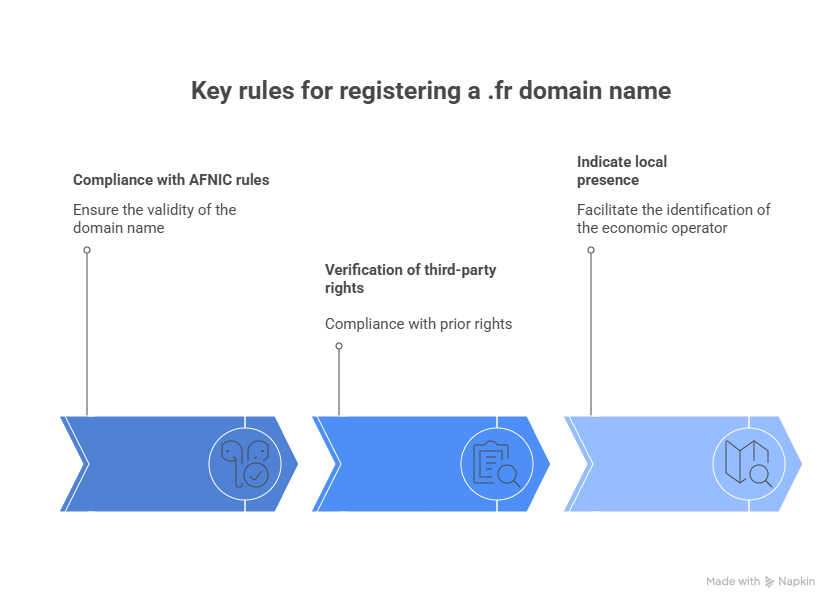
Eligibility does not confer any proprietary right. A domain name may be fully eligible while still infringing a prior trademark, a company name, or a trade name.
The analysis must therefore be twofold:
- Compliance with AFNIC eligibility criteria, on the one hand;
- Lawfulness with regard to prior rights, on the other.
Eligibility, compliance, monitoring and dispute mechanisms
Eligibility is not assessed solely at the time of registration. It constitutes a continuing obligation. Any change in circumstances (restructuring, relocation, transfer) may affect the validity of the domain name.
In cases of abusive or bad-faith registration, right holders have access to specific procedures enabling them to seek the cancellation or transfer of the domain name (including UDRP proceedings). Reliable identification of the registrant then becomes a major procedural advantage.
Conclusion
The new eligibility criteria for .fr domain names, as set out in AFNIC’s Naming Charter, reflect a clear objective: to maintain a reliable, traceable, and legally secure French digital space, while opening it to European economic actors.
The .fr extension remains a strategic asset, the management of which requires a rigorous and forward-looking legal approach.
Dreyfus & Associés law firm assists its clients in managing complex intellectual property cases, offering personalized advice and comprehensive operational support for the complete protection of intellectual property.
Nathalie Dreyfus with the support of the entire Dreyfus team.
FAQ
1. Is using a French service provider or registrar sufficient to meet the eligibility requirements?
No. Eligibility is assessed solely at the level of the domain name holder. Relying on an intermediary established in France does not satisfy the requirement of an effective territorial link.
2. Can a change in a group’s legal structure weaken a .fr domain portfolio?
Yes. A merger, assignment or transfer of activity may disrupt the alignment between the domain name holder and the eligible entity, exposing the domain name to a risk of non-compliance.
3. Does eligibility provide protection against trademark-based actions?
Absolutely not. Compliance with AFNIC rules does not exclude trademark infringement or unfair competition claims. A compliant domain name may still be challenged on the basis of prior rights.
4. Is the .fr extension suitable for an international digital strategy?
Yes, provided it is integrated into a coherent domain name architecture. The .fr extension should be coordinated with other TLDs to avoid conflicts and optimise territorial protection.
5. Why is legal anticipation essential when managing a .fr domain name?
Because the .fr extension is governed by a specific legal framework that goes beyond purely technical considerations. A proactive legal approach makes it possible to ensure compliance with AFNIC’s rules, prevent infringements of third-party rights, and secure both the ownership and the use of the domain name. It thereby reduces the risks of suspension, forced transfer or litigation, and ensures continuity of operations.
This publication is intended to provide general guidance to the public and to highlight certain issues. It is not intended to apply to specific circumstances or to constitute legal advice.