

Sommaire
Introduction
The expansion of new generic top-level domains (gTLDs) has revolutionized how businesses and individuals create unique digital identities. As a result, intellectual property holders face significant challenges in protecting their trademarks from cybersquatting. To address these concerns, the Uniform Rapid Suspension (URS) system was introduced, offering a fast and cost-effective way to resolve domain name conflicts. The National Arbitration Forum (NAF) was chosen in 2013 as the primary center to administer this procedure, playing a critical role in protecting trademarks in the digital world. Today, the Asian Domain Name Dispute Resolution Center (ADNDRC) is also responsible for some URS procedures, but its use is more marginal.
What is the Uniform Rapid Suspension (URS)?
The URS is a domain name dispute resolution procedure, introduced by the ICANN, designed to offer a quick and cost-effective solution for trademark holders seeking to suspend domain names that infringe upon their rights and are identical or confusingly similar to their registered trademarks. Unlike other dispute resolution mechanisms like the Uniform Domain Name Dispute Resolution Policy (UDRP), which may lead to the transfer of the disputed domain name, the URS only provides for the suspension of the domain name in question. The suspended domain name remains registered in the name of the defendant but is deactivated, can no longer be used or transferred, and the suspension lasts until the domain name expires.
The role of the National Arbitration Forum (NAF)
Founded in 1986, the NAF is one of the world’s leading providers of alternative dispute resolution services. Chosen by ICANN (Internet Corporation for Assigned Names and Numbers) in 2013 to manage the URS procedure, it is responsible for handling disputes related to new gTLDs (namely .online, .site, etc.), complementing the UDRP, which remains applicable for traditional gTLDs (e.g., .com, .net, .org).
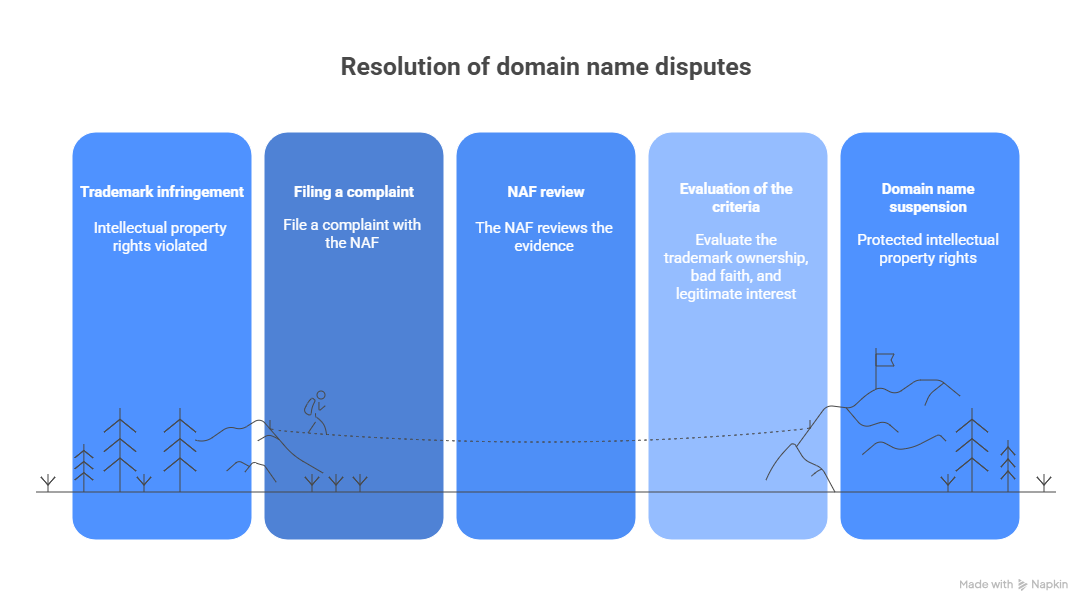
Trademark holders who believe their intellectual property rights are being violated can file a complaint with the NAF.
The NAF reviews the complaint and the evidence provided by both parties, considering, among other things:
- Trademark ownership: The complainant holds a valid, registered trademark that is identical or similar to the disputed domain name.
- Bad faith registration: The domain name was registered or is being used in bad faith, typically indicated by the intent to exploit the reputation of the trademark holder.
- Lack of legitimate interest or right to the domain.
If these criteria are met, the NAF will suspend the domain name for the remaining term of its registration. Although temporary, the suspension may be extended for an additional year.
The benefits of the URS for trademark holders
The URS, administered by the NAF, offers several benefits to trademark holders seeking to quickly and efficiently resolve cybersquatting issues:
- Speed and efficiency: The URS procedure is designed to be fast, with most cases resolved within 48 hours to 14 calendar days. This is particularly important when the infringement causes immediate harm (e.g., consumers are misled into thinking they are interacting with an official site or purchasing counterfeit products).
- Cost-effectiveness: Legal procedures and the UDRP can be expensive and time-consuming, especially for companies with limited resources. The URS provides a solution with reduced fees and streamlined administrative management.
- Temporary suspension: The URS allows for the temporary suspension of the disputed domain name, enabling the trademark holder to resolve the issue quickly and mitigate any reputational damage associated with the domain.
The NAF arbitration process
The NAF arbitrators are experts in domain name law and intellectual property. By offering a quick and affordable alternative to traditional litigation, the NAF ensures that trademark holders are not left without recourse in the face of cybersquatting and other malicious actors.
Conclusion
The URS, administered by the NAF, is a vital tool for trademark holders, allowing them to quickly and efficiently resolve domain name conflicts related to cybersquatting. The NAF is positioned as a key player in the protection of intellectual property rights online, and its role continues to grow, as new domain extensions are introduced. By providing trademark holders with an effective solution, the NAF ensures critical protection for online assets.
Dreyfus & Associés assists its clients in managing complex intellectual property cases, offering personalized advice and comprehensive operational support for the complete protection of intellectual property.
Nathalie Dreyfus with the support of the entire Dreyfus team.
FAQ
1. What types of cases can be handled by the URS?
The URS is designed to resolve conflicts where a domain name has been registered in bad faith, with the intent to exploit the reputation of an existing trademark. Typical cases include domain names that are identical or confusingly similar to registered trademarks.
2. Why procedure should be chosen between URS and UDRP ?
The URS and UDRP are both domain name dispute resolution mechanisms, but they differ in their goals and procedures. The URS only allows for the suspension of the domain name, while the UDRP may result in the transfer of the domain name to the trademark holder. The choice between the two depends on the trademark holder’s strategy. (For more information, refer to this article).
3. What evidence is required to initiate a URS procedure ?
To initiate a URS procedure, the complainant must prove that they own a valid, registered trademark, that the domain name is identical or similar to the trademark, and that the domain name was registered in bad faith. Evidence such as screenshots of the disputed domain’s website, copies of the trademark registration, or evidence of the intent to harm the trademark may be required.
4. What happens if a domain is suspended via the URS ?
If a domain is suspended through the URS, it will no longer be accessible to the public for the duration of its registration, but the domain holder does not necessarily lose ownership.
5. What remedies are available to a cybersquatter if its domain name is suspended under the URS?
If a cybersquatter believes the suspension of their domain is unjustified, they can challenge the decision through the appeal process provided by the URS. They will need to provide evidence demonstrating that they have a legitimate right to the domain, such as proof of commercial use of the domain or prior rights to the term.
This publication is intended for general public guidance and to highlight issues. It is not intended to apply to specific circumstances or to constitute legal advice.