


Introduction
Product placement is a widely used tool for companies seeking to enhance their visibility, particularly in a context of saturation of traditional advertising formats. Its effectiveness lies in its seamless integration into audiovisual and digital content; however, such integration is not legally neutral.
At the intersection of consumer law, European law and intellectual property law, its implementation requires careful consideration in order to secure operations and safeguard the company’s interests.
Product placement: a recognised and regulated marketing technique
Product placement is defined as the inclusion, in return for consideration, of a product, service or trademark within an audiovisual programme. This definition, derived from Article 1 of Directive 2007/65/EC of December 11, 2007 concerning the pursuit of television broadcasting activities, legally recognises this practice as a form of commercial communication.
Prior to this recognition, European law was grounded in a principle prohibiting product placement, subject to limited exceptions, notably in cinematographic works. This approach reflected a desire to preserve the separation between editorial content and advertising.
The 2007 Directive marked a turning point by authorising product placement while subjecting it to regulation. As a result, it can no longer be regarded as a mere narrative element; rather, it constitutes a regulated promotional practice, subject to a fundamental requirement: ensuring that the commercial nature of the content is identifiable by the audience.
What legal framework governs product placement in France?
The current legal framework for product placement in France originates in particular from the transposition of Directive 2007/65/EC (mentioned above), implemented by French law No. 2009-258 of March 5, 2009. This law introduced product placement into French law while setting clear limits on its use. This transposition does not amount to a liberalization, but rather to a regulated authorization. The legislator sought to reconcile the economic needs of the audiovisual sector with consumer protection, notably by imposing strict transparency requirements.
The implementation of this framework was further clarified by Decision No. 2010-4 of February 16, 2010 adopted by the CSA (now ARCOM), which governs practices in concrete terms by requiring that product placement be clearly disclosed to the public. This obligation constitutes the cornerstone of the regulatory regime.
This regime forms part of a broader European framework established by Directive 2010/13/EU of March 10, 2010 on audiovisual media services. This directive harmonizes the rules applicable within the European Union and enshrines the principle of regulated authorization for product placement, subject to several requirements:
• clear identification of product placement,
• prohibition of undue influence on editorial content,
• absence of direct encouragement to purchase,
• exclusion of certain sensitive products or programmes, particularly those aimed at children or news programmes.
It thus constitutes the harmonized foundation at the European Union level, on which French law is based, and which has been transposed through the adaptation of legislative and regulatory provisions.
Today, Directive (EU) 2018/1808 of November 14, 2018 has extended these principles to new digital environments and distribution platforms.
The rise of social media has profoundly transformed the modalities of product placement. Content disseminated on digital platforms such as YouTube, Instagram or TikTok now falls within the scope of the French Consumer Code, in particular Articles L.121-2 and L.121-3 relating to misleading commercial practices.
The principle is clear: any commercial communication must be identifiable as such. The absence of an explicit disclosure of a commercial partnership constitutes a concealment of commercial intent, likely to give rise to liability.
The French Directorate general for competition policy, consumer affairs and fraud control (DGCCRF) exercises increased scrutiny over these practices and regularly sanctions non-compliance. This framework has been further strengthened by Law No. 2023-451 of June 9, 2023, which specifically regulates commercial influence and imposes enhanced transparency obligations.
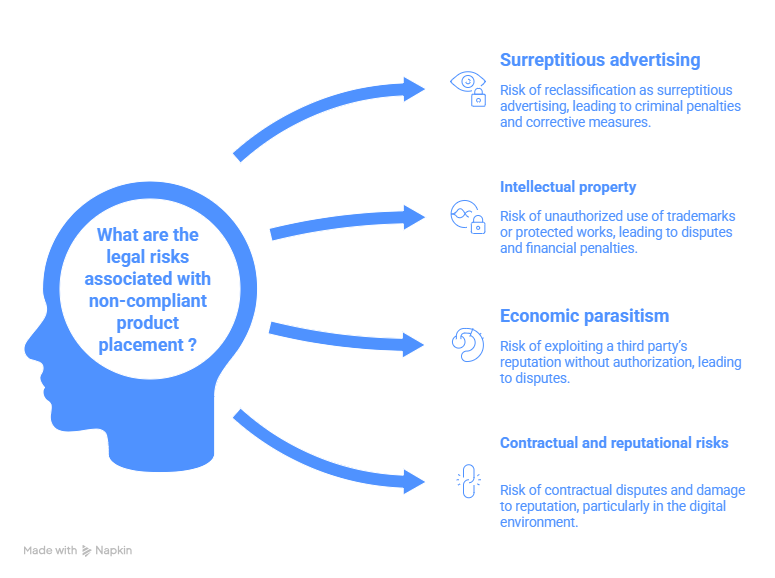
What are the legal risks associated with non-compliant product placement ?
The primary risk lies in the reclassification as surreptitious advertising, prohibited under Article 9 of Decree No. 92-280 of March 27, 1992 relating to audiovisual advertising. Such reclassification occurs where the commercial nature of the message is not clearly identifiable. In this respect, consumer law treats the concealment of commercial intent as a misleading commercial practice, capable of engaging the liability of its author.
Product placement also entails intellectual property risks. Article L.713-2 of the French Intellectual Property Code sanctions the unauthorised use of a trademark, while the incorporation of a protected work without authorisation constitutes infringement under Article L.335-2 of the same Code.
Case law has also recognised situations of commercial parasitism, notably in a decision of the French Supreme Court of January 26,1999 (Commercial Chamber, January 26, 1999, No. 96-22.457), where a party unlawfully exploited the reputation of a third party without authorisation or compensation.
Finally, contractual and reputational risks must be fully taken into account. Poorly managed campaigns may give rise to disputes between the parties and damage trademark image, particularly in a digital environment where virality amplifies controversies.
How can a product placement operation be secured ?
Securing a product placement operation primarily relies on a robust contractual framework. Agreements must clearly define the terms of dissemination, transparency obligations and the rights relating to the use of protected elements.
Prior regulatory compliance checks are essential. These must ensure compliance with obligations arising from audiovisual law and consumer law, particularly with respect to the identification of commercial communications.
Finally, ongoing legal monitoring enables anticipation of regulatory developments and adaptation of strategies accordingly. This approach ensures the secure and sustainable exploitation of product placement.
Conclusion
Product placement constitutes a highly effective communication tool, provided that it is legally controlled. It is not merely a marketing instrument, but a regulated mechanism whose implementation requires rigour and foresight.
An effective strategy relies on the alignment of legal compliance, editorial coherence and digital optimisation. Such an approach makes it possible to secure operations while maximising their impact.
Dreyfus & Associés assists its clients in managing complex intellectual property matters by providing tailored advice and comprehensive operational support for the full protection of intellectual property rights.
Nathalie Dreyfus with the support of the entire Dreyfus team.
Q&A
1. Must product placement necessarily be paid to qualify legally?
No. The legal qualification of product placement does not rely solely on the existence of financial compensation. A benefit in kind, such as the free provision of a product, a trip, or any other advantage, may be sufficient to characterize a commercial communication. In such cases, transparency obligations remain fully applicable.
2. Is sending a product to an influencer without any obligation to post regulated?
The situation is more nuanced. In the absence of a commitment to publish, there is not necessarily a formal commercial relationship. However, as soon as there is an expectation, even implicit, surrounding the sending of the product, or if the influencer chooses to communicate about it, rules relating to commercial practices may apply, particularly regarding transparency.
3. Can product placement concern something other than physical goods?
Yes. Product placement is not limited to tangible goods. It may relate to services, applications, digital platforms, or even the promotion of a trademark as such. From a legal perspective, what matters is the presence of a promotional intent embedded within the content.
4. Are there sector-specific restrictions?
Yes, sectors such as healthcare products, alcohol, and gambling are subject to strict regulations, and in some cases, prohibitions.
5. Can a trademark freely reuse content created as part of a product placement?
No. In principle, the content remains the property of its creator, unless otherwise agreed. Any reuse by the trademark, particularly for advertising purposes, requires prior authorization or a transfer of rights. Failing this, it may constitute an infringement of intellectual property rights.
This publication is intended to provide general guidance and highlight certain legal issues. It is not intended to address specific situations and does not constitute legal advice.