

Introduction
When a company purchases smartphones, computers, tablets or storage media, it may, often unknowingly, bear a private copying levy included in the price of such equipment. However, this mechanism is intended to compensate copies made by individuals for their personal use, not strictly professional uses.
This raises a practical question: in which situations must a company bear this cost, and when may it instead be exempt or entitled to reimbursement ? Answering this requires an understanding of the system, the stakeholders involved, and the applicable formalities.
This article provides a practical overview of private copying in a business context: its legal basis, the relevant obligations, exemption and reimbursement mechanisms, and the risks associated with improper compliance.
Understanding private copying and its legal framework
Private copying is an exception to copyright provided for under Article L.122-5 (2) of the French Intellectual Property Code. It allows the reproduction of a protected work without prior authorization from the rights holder, provided that such reproduction is made for strictly personal use and from a lawful source.
The requirement of a lawful source, stemming from EU law and confirmed by case law (CJEU, April 10, 2014, ACI Adam BV and Others v Stichting de Thuiskopie, Case C-435/12), means that the work must have been lawfully obtained. In other words, the private copying exception does not cover reproductions made from unlawful sources, such as unauthorized downloads or illegal streaming services.
In return, the legislator has established a compensation mechanism for rights holders : the private copying levy (Articles L.311-1 et seq. of the French Intellectual Property Code). The rationale is that where the law permits certain private reproductions without authorization, rights holders must receive fair compensation.
The applicable tariffs are set by the private copying Commission, an administrative body composed of representatives of rights holders, manufacturers and consumers.
This levy is not paid directly by individuals. It is collected upstream on certain recording devices and storage media and incorporated into their sale price. This applies, depending on the case, to equipment such as smartphones, tablets, hard drives and USB drives. In practice, manufacturers, importers or entities placing such products on the market declare and pay the levy, which is then passed on to the end purchaser (as recalled by the Paris Judicial Court, June 7, 2022, No. 15/14150, paras. 13–14).
This explains why businesses may be affected: even when acquiring media for strictly professional use, they may bear a levy originally designed to compensate private copying by individuals.
Accordingly, it is essential to determine precisely which businesses are concerned by this mechanism. Depending on whether they manufacture, import, acquire or distribute recording media, companies do not occupy the same position within the system and are not subject to the same obligations.
Who is affected by private copying in a business context?
In practice, three categories of stakeholders may be distinguished:
- entities placing recording media on the market
- distributors involved in the supply chain
- companies using such media for professional purposes
These categories are not affected in the same way. The first group may, depending on their role, be subject to reporting obligations and to payment of the private copying levy. The second group may pass on the cost along the distribution chain without necessarily being the primary debtor. Finally, user companies are not, in principle, directly liable for the levy, but may indirectly bear its cost when purchasing equipment or media intended for strictly professional use.
This distinction is therefore crucial, both for identifying applicable obligations and for assessing eligibility for exemption or reimbursement.
Reporting, payment and supporting documentation: what are the obligations?
Obligations relating to the private copying levy primarily fall on entities placing recording media on the market, notably manufacturers, importers and entities making intra-Community acquisitions.
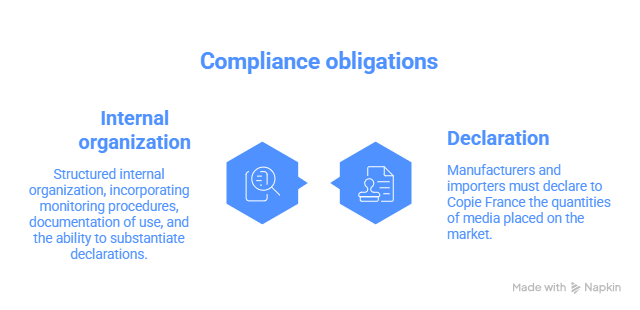
Manufacturers and importers must submit periodic declarations to Copie France, the body responsible for collecting the levy. These declarations concern the quantities of media placed on the French market.
This entails several requirements, including accurate identification of the relevant media, reliable and consistent reporting, and robust traceability of volumes marketed, enabling verification of the data provided to competent authorities at any time.
Compliance therefore goes beyond mere payment. It requires a structured internal organization, including:
- procedures for monitoring purchases and sales
- documentation of usage
- the ability to substantiate declarations in the event of an audit
Failure to declare or inaccuracies may result in significant adjustments.
Distributors and intermediaries, where they are not themselves placing products on the market, are in principle not subject to direct reporting or payment obligations. However, they may pass on the cost of the levy within the commercial chain, which requires clear identification of the relevant products in invoicing.
User companies are not, in principle, liable for the levy. Their main concern lies in retaining supporting documentation where they intend to apply for an exemption or reimbursement, particularly in cases of strictly professional use or export.
How to obtain an exemption or a refund?
The French system, notably Article L.311-8 of the Intellectual Property Code, provides mechanisms enabling professionals to reduce or neutralize the financial impact of the levy.
Where a company is not intended to ultimately bear the levy, two options may be considered: prior exemption and subsequent reimbursement.
Exemption is based on agreements concluded with collecting societies (such as ADAMI, SPEDIDAM or SACD) and allows, in certain cases, the levy not to be applied at the time of acquisition, particularly where the media are intended for strictly professional use. In practice, this requires entering into an agreement with Copie France, which defines the applicable conditions.
In the absence of prior exemption, companies may seek reimbursement of amounts already paid.
To do so, the company must be able to produce detailed purchase invoices, identify the relevant media, and demonstrate either their professional use or, where applicable, their export or delivery outside France.
The issue is primarily evidentiary. In the absence of sufficient supporting documentation, exemption or reimbursement claims are likely to be rejected. Companies are therefore advised to implement robust tracking of purchases, flows and uses in order to secure their claims and avoid unduly bearing the levy.
What are the risks of non-compliance?
Failure to comply with obligations relating to private copying exposes companies to multiple cumulative risks.
The financial risk is immediate : pursuant to Article L.335-4 of the Intellectual Property Code, failure to declare or under-declaration may lead to recovery of unpaid levies together with penalties.
In addition, disputes with collecting bodies may result in complex litigation, requiring significant internal resources.
Finally, reputational risk should not be underestimated. In an environment where regulatory compliance is a key indicator of credibility, failure may have lasting consequences for a company’s image.
Conclusion
Although originally designed to address private uses by individuals, the private copying levy has tangible implications for businesses. Depending on their position in the supply chain or the use of acquired media, companies may bear the cost, be subject to formal obligations, or be entitled to exemption or reimbursement.
The issue is therefore legal, operational and financial: identifying the applicable regime, securing relevant flows and gathering appropriate supporting documentation.
In this context, a proactive approach is essential. Entering into an agreement with Copie France upstream may secure an exemption, while a thorough analysis of purchases, uses and exports may enable recovery of unduly paid amounts.
Dreyfus & Associés assists clients with all issues relating to private copying, including the implementation of agreements for exemption, assessment of their situation, eligibility for reimbursement, and support in preparing and managing claims before Copie France.
Nathalie Dreyfus with the support of the entire Dreyfus team.
FAQ
1. Does private copying apply to content from streaming platforms?
Private copying does not generally apply to streaming content. It may only be invoked where an actual reproduction is made for strictly private use, from a lawful source, and within legal limits. Mere access to streaming content does not confer a general right to download or record it.
2. Can a company challenge the amount of the private copying levy?
Yes, in certain situations, particularly in cases of misclassification of media or disagreement regarding declared volumes. This requires prior legal and technical analysis.
3. Are refurbished or second-hand devices subject to the levy?
Refurbished devices may be subject to the levy, particularly for categories expressly covered (e.g. refurbished mobile phones or tablets), which are included in the list published by Copie France. Specific tariff decisions also apply. By contrast, purely second-hand goods are not, in principle, subject to the levy again upon resale.
4. Is there a time limit for requesting reimbursement?
Yes. In the absence of a specific limitation period, reimbursement claims are generally subject to the standard five-year limitation period. It is therefore advisable to act promptly and retain all supporting documentation.
5. Does private copying apply to professional data stored in the cloud?
Private copying concerns reproductions of protected works made from a lawful source for strictly personal use. It does not, as such, apply to the mere storage of professional data in the cloud.
This publication provides general guidance and highlights certain issues. It is not intended to address specific situations or constitute legal advice.