


Introduction
In a digital environment where social media platforms shape corporate communication strategies, the use of hashtags has become virtually systematic. Yet this seemingly innocuous practice may, depending on the circumstances, encroach upon the exclusive rights of third parties.
The question of whether a hashtag may constitute an act of trademark infringement has now been addressed, at least in part, by French case law. A decision rendered on February 12, 2026 by the Paris Judicial Court provides a particularly instructive illustration.
I. The hashtag: A sign at the frontier of trademark Law
A hashtag, namely the typographical sign “#” associated with a word or expression, primarily serves a classification and categorization function on digital platforms. It enables internet users to gather publications from different sources under a common thematic thread. This indexing function lies at the heart of the legal debate: can a hashtag constitute “use as a trademark” within the meaning of intellectual property law?
The origin function: cornerstone of trademark protection
Under trademark law, only the use of a sign “as a trademark” is capable of constituting infringement. This implies that the sign is used to identify the commercial origin of goods or services, namely to indicate to the public that such goods or services originate from a specific undertaking. Article L.713-3 of the French Intellectual Property Code is explicit in this regard: infringement presupposes use in the course of trade that goes beyond a mere reference to a phenomenon or event.
However, the specific nature of hashtags lies precisely in their referential dimension: they point to content, a theme, or an external event, without necessarily seeking to distinguish the goods or services of the company using them. In practice, the boundary between descriptive or illustrative use and use as a trademark is therefore extremely narrow.
A Legal framework still under construction
To date, no legislative provision expressly governs the legal status of hashtags. French and European courts are progressively developing a case-by-case body of case law by applying traditional trademark law criteria to these new digital uses. This casuistic approach makes the analysis all the more delicate, as the context of each publication plays a decisive role in the legal characterization adopted.
II. The FFT v. Printemps case: A hashtag that does not indicate origin
The facts: A live shopping operation against the backdrop of Roland-Garros
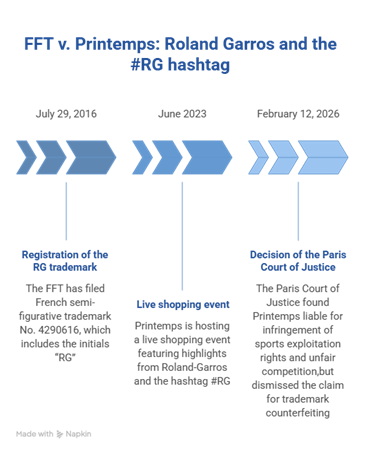
In June 2023, the French department store chain Printemps organized a “live shopping” promotional campaign during which it broadcast video excerpts from previous editions of the Roland-Garros tournament. These excerpts featured iconic elements of the sporting event, and the company’s Instagram publications included the hashtag #RG.
The French Tennis Federation (FFT), organizer of the tournament and owner of French semi-figurative trademark No. 4290616 incorporating the initials “RG” (filed on July 29, 2016, notably in Class 41), considered that the campaign infringed its exclusive rights and brought proceedings before the Paris Judicial Court on several grounds:
– infringement of sports exploitation rights,
– parasitism,
– trademark infringement.
The Paris Judicial Court decision of February 12, 2026
The Paris Judicial Court decision of February 12, 2026 upheld two of the three claims asserted by the FFT. It recognized an infringement of the exclusive exploitation rights attached to the tournament and sanctioned Printemps for parasitic conduct, finding that the latter had improperly appropriated the notoriety and investments of the FFT for its own commercial benefit.
However, with respect to trademark infringement, the Court adopted a more nuanced approach. According to the wording of the judgment itself, the disputed publications “in no way refer to the purchase or promotion of a specific product, but rather to an atmospheric visual whose hashtag is not intended to indicate origin but to identify the tournament organized by the claimant.”
In other words, the Court held that #RG functioned as a tool for identifying and referencing an event, rather than as a distinctive sign designating the commercial origin of the products marketed by Printemps. In the absence of use “as a trademark,” trademark infringement could not be established.
A Solution consistent with prior case Law
This decision is consistent with an emerging line of French and European case law. In its judgment , in L’Oréal v. Bellure, of June 18, 2009 Case C-487/07, the Court of Justice of the European Union established that the use of a sign similar to a reputed trademark does not necessarily constitute infringement where it does not adversely affect the essential functions of the trademark, foremost among them the origin function.
III. When can the use of a hashtag amount to trademark infringement?
Although the FFT v. Printemps judgment excludes infringement under the specific circumstances of the case, it would be incorrect to conclude that a hashtag can never infringe trademark rights. The legal characterization depends on a rigorous contextual analysis, notably involving the following factors.
Criteria for recharacterization as trademark use
• Direct promotion of goods or services: where the hashtag accompanies a publication primarily intended to market or commercially promote a specific offer, the risk of recharacterization significantly increases.
• Reproduction of a reputed trademark: the use of a hashtag reproducing identically or almost identically a well-known trademark in a commercial context may constitute unfair exploitation of the reputation of that trademark (Article L.713-3, paragraph 2 of the French Intellectual Property Code).
• Likelihood of confusion: where the public may believe that the goods or services promoted under the hashtag originate from the trademark owner or from an economically linked entity, infringement may be established.
• Overall context of the publication: the juxtaposition of the hashtag with other trademark elements (logos, colors, registered visuals) or its inclusion within a large-scale communication campaign may constitute aggravating factors.
Conclusion
The FFT v. Printemps case confirms that trademark law, when applied to digital uses, requires a refined and rigorous contextual analysis. A hashtag is not, by nature, use “as a trademark.” Its characterization depends on the role it concretely plays within the company’s communication strategy: whether it serves merely as a thematic referencing tool or as a distinctive sign identifying the commercial offer. Intellectual property in the age of social media calls for a proactive legal approach, whether to structure an effective protection strategy or to secure online commercial practices.
Dreyfus law firm assists its clients in securing creations arising from employment relationships, combining contractual engineering and litigation expertise to build frameworks tailored to each industry.
Nathalie Dreyfus, with the support of the entire Dreyfus team.
Q&A
Can a hashtag be registered as a trademark?
Yes. A hashtag composed of a distinctive sign may be registered as a trademark. The “#” symbol itself is considered non-distinctive, but the overall combination formed by the symbol and the accompanying term may be registered if the term is sufficiently distinctive to identify the goods or services of a particular undertaking.
Can trademark infringement be established without a likelihood of confusion?
Yes, in the case of reputed trademarks. Article L.713-3 paragraph 2 of the French Intellectual Property Code protects trademarks with a reputation even in the absence of a likelihood of confusion, where the use of the sign takes unfair advantage of, or is detrimental to, the distinctive character or reputation of the trademark.
What risks does a company incur when using, without authorization, the hashtag of a registered trademark?
The sanctions may be substantial: compensation for the damage suffered by the trademark owner, removal of the infringing publications, prohibition against further use of the sign, and, in the most serious cases, criminal penalties for trademark infringement (up to four years’ imprisonment and a fine of €400,000 for natural persons under French law). Acts of parasitism may also give rise to additional damages.
How can businesses protect themselves against disputes relating to hashtag use?
Protection involves systematic trademark clearance searches prior to any communication campaign, the implementation of internal legal validation procedures for digital content, and — for trademark owners — the registration of hashtags associated with their brand identity. Assistance from a specialized intellectual property law firm makes it possible to identify risks upstream and react swiftly in the event of infringement.
Can parasitism and trademark infringement be claimed cumulatively?
Yes, under certain conditions. French case law permits cumulative claims where the legal grounds are distinct and the alleged harm does not overlap. As illustrated by the FFT v. Printemps case, a single commercial operation may constitute parasitic conduct without necessarily amounting to trademark infringement, since these two legal characterizations are subject to different requirements.
This publication is intended to provide general guidance and highlight certain legal issues. It is not intended to apply to specific situations or to constitute legal advice.