

Introduction
The trademark revocation procedure in China has become a key strategic tool for companies facing trademarks that are registered but not actually used. Under a legal system based on the “first-to-file” principle, priority is granted to the first applicant regardless of whether the trademark is genuinely used in commerce. As a result, the Chinese trademark register has become extremely dense, with many trademarks filed for speculative or defensive purposes.
To address this situation, Chinese legislation, specifically Article 49 of the Trademark Law of the People’s Republic of China, provides a mechanism allowing any third party to request the revocation of a trademark that has remained unused for three consecutive years. This procedure not only enables the removal of inactive trademarks from the register but also ensures that registered trademarks correspond to genuine commercial activity. Recent developments in Chinese administrative practice, particularly since 2025, confirm the growing importance of this mechanism in trademark protection strategies.
Why initiate a trademark revocation procedure in China ?
Revocation for non-use has become a crucial instrument for companies seeking to secure their trademark strategy in the Chinese market. Because of the first-to-file rule, it is not uncommon for a trademark to be registered by a third party before the legitimate owner begins operating in China. In some cases, such registrations are made purely for speculative purposes, with the intention of reselling the trademark later or preventing a competitor from entering the market.
The revocation procedure serves to restore balance in such situations. When a registered trademark has not been used for a continuous period of three years, it may be removed from the register upon request by a third party. This possibility is particularly important for foreign companies planning to launch products in China and discovering that their trademark has already been registered by a local entity that does not actually use it.
In practice, revocation actions are often part of a broader trademark portfolio protection strategy. Before filing a new trademark or expanding into the Chinese market, companies frequently review the trademark register to identify potential obstacles and, where appropriate, initiate revocation proceedings.
Legal conditions for revocation due to non-use
Chinese trademark law provides that any registered trademark may be revoked if it has not been used for three consecutive years.
A notable feature of the procedure concerns the burden of proof. Unlike in some jurisdictions where the applicant must demonstrate non-use, Chinese law adopts a reversed approach. The applicant only needs to allege that the trademark has not been used. The trademark owner must then provide evidence demonstrating actual use of the trademark.
Such use must be genuine, commercial, and carried out within the territory of China. It must also correspond to the trademark as registered and relate to the goods or services covered by the registration. Authorities carefully assess whether the claimed use represents authentic commercial activity or merely an artificial attempt to maintain the trademark registration.
Procedure before the CNIPA
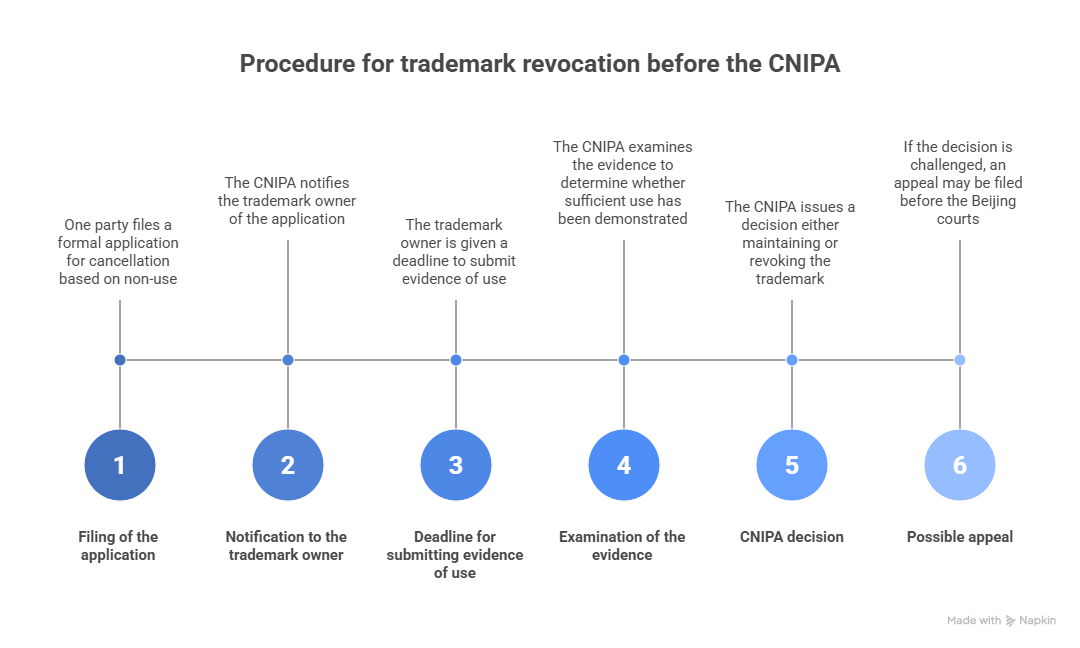
The revocation procedure is administered by the China National Intellectual Property Administration (CNIPA), the authority responsible for managing the trademark register in China. The process begins with the filing of a formal application requesting cancellation for non-use. Once the application is deemed admissible, the CNIPA notifies the trademark owner and grants a deadline to submit evidence of use.
The trademark owner must then provide documents demonstrating that the trademark has been used during the relevant period. The CNIPA examines these materials to determine whether the use is sufficient to maintain the registration. Following its review, the administration issues a decision either maintaining the trademark or revoking it.
On average, the procedure lasts between nine and twelve months. If either party disagrees with the decision, an appeal may be filed before the specialized courts in Beijing, including the Beijing Intellectual Property Court.
Evidence plays a decisive role in revocation proceedings. The trademark owner must demonstrate that the trademark has been used in a genuine and commercial manner. Chinese authorities carefully examine submitted documents to prevent artificial evidence from being used to maintain inactive trademarks.
The most commonly accepted evidence includes commercial invoices, distribution agreements, advertising materials, product catalogues, and screenshots from e-commerce platforms. These documents must show that the trademark has been used in the Chinese market during the relevant period.
The administration will verify the consistency of dates, the authenticity of the documents, and the connection between the trademark and the goods or services concerned. Purely symbolic or minimal use is generally insufficient to maintain the registration.
The developments introduced in 2025 to the trademark non-use cancellation procedure in China
Chinese authorities have recently strengthened their approach to revocation for non-use. Reforms introduced in administrative practice aim to combat speculative trademark registrations more effectively and to ensure that trademarks are genuinely used.
These developments include stricter scrutiny of evidence of use and greater attention to the quality of revocation applications. The authorities seek to strike a balance between preventing trademark hoarding and avoiding abusive revocation actions.
In a market where millions of trademark applications are filed each year, this policy contributes to maintaining a trademark register that more accurately reflects real commercial activity.
Conclusion
The trademark revocation procedure in China has become an essential legal mechanism for companies seeking to protect their commercial identity in one of the world’s most dynamic markets. By allowing the cancellation of unused trademarks, this system promotes the effective use of the register and limits opportunistic behavior.
For international businesses, mastering this procedure is crucial to clearing blocked trademarks and securing expansion projects. An effective strategy generally combines active monitoring of the Chinese trademark register, a thorough analysis of potential obstacles, and, when necessary, the initiation of revocation proceedings.
Dreyfus & Associés assists its clients in managing complex intellectual property matters by providing tailored advice and comprehensive operational support for the full protection of intellectual property rights.
Nathalie Dreyfus with the support of the entire Dreyfus team.
Q&A
1. What is a trademark revocation for non-use in China ?
It is an administrative procedure allowing the cancellation of a registered trademark that has not been used for three consecutive years.
2. Who can request the revocation of a trademark in China ?
Any person may file such a request without having to demonstrate a specific legal interest.
3. How long does a trademark revocation procedure take ?
Administrative proceedings before the CNIPA generally last between nine and twelve months.
4. How do the 2025 revisions to the revocation procedure influence filing and trademark monitoring strategies for companies seeking to enter the Chinese market ?
The 2025 revisions strengthen the requirement for genuine use of trademarks in China and facilitate the cancellation of abusive filings. Companies should therefore adopt a targeted filing strategy, plan for actual use within three years, and implement active monitoring to detect and challenge blocking trademarks.
5. To what extent does the CNIPA’s stricter scrutiny of evidence of use affect the preparation of revocation cases by applicants ?
Stricter examination of evidence encourages applicants to prepare stronger and more credible cases. In particular, they must anticipate how the trademark owner may demonstrate use and avoid speculative actions, as the request may otherwise be rejected as abusive.
This publication is intended for general public guidance and to highlight issues. It is not intended to apply to specific circumstances or to constitute legal advice.