


Sommaire
Introduction
The protection of figurative trademarks occupies a central place in intellectual property strategies, particularly in an environment where imagery, form, and graphic codes are decisive vectors for identifying products and services. Yet the registration of such signs remains complex due to the strict requirements set by European Union law and recent case law. Companies seeking robust protection must anticipate obstacles relating to distinctiveness, graphic originality, and consumer perception.
This article outlines the key legal criteria, the risk of refusal, and practical strategies to optimize the protection of figurative trademarks.
Legal foundations of figurative trademark protection
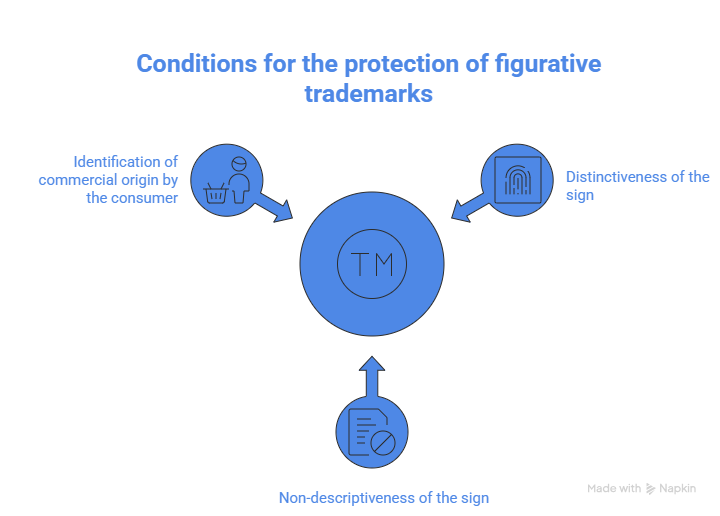
A figurative trademark encompasses any non-verbal sign composed of graphic elements: logos, icons, stylized drawings, shapes, lines, or visual combinations. Under both French law and European Union law, such signs must be distinctive, non-descriptive, and capable of identifying the commercial origin of the goods or services.
Legislation requires that the sign be perceived immediately by the consumer as an indication of origin, and not as a simple decorative motif or ordinary shape. This requirement is set out in Article L.711-2 of the French Intellectual Property Code and Article 7(1)(b) EUTMR.
Industrial property offices consistently refuse signs considered banal, even when applicants rely on actual commercial use or marketing strategy. The logic remains constant: a trademark does not protect a graphic idea but a form that is immediately perceived as distinctive.
Distinctiveness criteria applicable to shapes and graphic elements
The central question is whether the figurative sign contains sufficiently marked characteristics to allow the consumer to memorise it without particular effort. This does not require a high level of artistic creativity, but the sign must be capable of standing apart from the common stock of shapes.
Where the graphic element approaches a simple geometric shape (circle, square, rectangle, line, pentagon), there is a high risk of refusal. Case law adds that minor variations (slight waviness, tilt, rounding) are not sufficient to compensate for a lack of distinctiveness.
For example, in a decision dated November 13, 2024 (TUE, November 13, 2024, case 426/23 Chiquita Brands v. EUIPO), the General Court of the European Union ruled that a simple yellow and blue oval was comparable to a basic geometric shape and therefore not eligible for trademark protection. This approach is particularly strict, as the offices and courts consider that these signs do not convey any identifiable commercial message.
This requirement applies irrespective of the relevant public. Even if that public has a higher level of attention, as in technological or professional sectors, case law reiterates that the degree of attention has no impact on the threshold of distinctiveness.
Key lessons from recent case law: the Rigo Trading decision
The judgment delivered by the General Court of the European Union on 16 July 2025 (Case T-215/24, Rigo Trading SA v. EUIPO) constitutes a major development.
Facts and procedure
The Luxembourg company Rigo Trading SA designated the European Union for the international registration of a purely figurative sign representing a slightly wavy rectangle, intended to distinguish a wide range of goods.
The EUIPO examiner refused registration on the ground that the sign had no distinctive character within the meaning of Article 7(1)(b) EUTMR, considering that it amounted to a minor variation of a basic geometric shape. The Fifth Board of Appeal upheld that decision, prompting the company to bring the matter before the General Court.
Before the Court, Rigo Trading argued, in particular, that the EUIPO had incorrectly defined the relevant public and that the sign could not, in reality, be assimilated to a simple geometric figure.
Findings of the General Court
The General Court dismissed the action, confirming that the sign did not allow consumers to identify the commercial origin of the goods. It emphasised that the level of attention of the consumer, whether average or specialised, has no impact on the assessment of distinctiveness.
The Court found that:
- The contested sign is very close to a simple geometric figure
- The slight waviness is not sufficient to constitute a substantial variation
- The absence of additional graphic elements (combination, complexity, stylisation) prevents the sign from meeting the minimum threshold required
- The simplicity of the sign prevents immediate memorisation by the public
The ruling reinforces a long-established trend: overly simple or minimalist signs (rectangles, lines, stylised circles, regular hexagons) fail to be registered unless distinctiveness acquired through use is proven.
An interesting point: the same sign had been accepted by the Benelux Office, highlighting divergences between European offices. However, the Court confirmed that EU law prevails for any registration targeting the European Union.
Best practices for securing a figurative trademark
To maximise the chances of registration, it is advisable to:
- Integrate distinctive graphic elements: visual rhythm, asymmetry, original contours
- Avoid simple or geometric shapes, especially when the aim is to protect packaging or motifs
- Reinforce the stylisation of the logo to increase memorability
- Demonstrate intensive use of the sign through structured marketing evidence when necessary
- Systematically analyse recent EUIPO refusals to adjust the graphic strategy
Conclusion
The protection of figurative trademarks requires both a strategic and technical approach. Ensuring strong figurative trademark protection involves more than aesthetic analysis: it relies on a precise understanding of distinctiveness as assessed by trademark offices. Companies must therefore anticipate obstacles linked to graphic simplicity, strengthen stylisation, and closely monitor recent case law.
Dreyfus & Associés assists its clients in managing complex intellectual property cases, offering personalized advice and comprehensive operational support for the complete protection of intellectual property.
Nathalie Dreyfus with the support of the entire Dreyfus team
Q&A
1. How can distinctiveness acquired through use be proven?
By providing evidence demonstrating that the public associates the sign with your company: sales data, advertising campaigns, surveys, press coverage, market share, or any proof of effective recognition.
2. Can a figurative trademark protect packaging?
Yes, provided the packaging has sufficiently original visual features to be perceived as an indicator of origin rather than a decorative or functional element.
3. Do European offices assess distinctiveness in the same way?
No. Although EU law sets a common framework, assessments differ between national offices. The EUIPO generally applies a stricter approach, particularly regarding simple shapes.
4. How can a logo that is too simple be strengthened before filing?
By adding distinctive graphic elements: asymmetry, combinations of shapes, original lines, stylistic effects, or integrating a verbal element to distance the sign from basic geometry.
5. How can a refusal before the EUIPO be avoided?
By anticipating the distinctiveness assessment, avoiding minimalist signs, preparing an evidence-of-use strategy if needed, and conducting a legal evaluation of the sign prior to filing. Reinforcing stylisation greatly increases the chances of registration.
This publication is intended for general public guidance and to highlight issues. It is not intended to apply to specific circumstances or to constitute legal advice.