

Sommaire
- 1 Introduction
- 2 What is the legal framework governing labelling, packaging and sorting?
- 3 When do the main measures enter into force?
- 4 What obligations apply to food and non-food packaging?
- 5 Why are sorting and recycling at the heart of the new rules?
- 6 What impact do these rules have on trademarks and environmental claims?
- 7 Conclusion
- 8 FAQ
Introduction
French and European regulations on labelling, packaging and sorting are undergoing a major transformation with the entry into force of Regulation (EU) 2025/40, also known as the PPWR (Packaging and Packaging Waste Regulation). Published on January 22, 2025, this regulation replaces Directive 94/62/EC and establishes a harmonised and binding framework for all packaging placed on the European market, with clear objectives aimed at reducing waste and promoting the circular economy.
This represents a structural legal turning point, engaging not only environmental law, but also consumer law and trademark law, for both food and non-food packaging. Companies must now integrate these obligations into their compliance strategies and legal governance frameworks.
What is the legal framework governing labelling, packaging and sorting?
A directly applicable and strengthened European framework
Regulation (EU) 2025/40, adopted on December 19, 2024 and published on January 22, 2025, now constitutes the core European legal instrument governing packaging and packaging waste. It replaces Directive 94/62/EC and introduces binding rules on the design, durability, recyclability, labelling and management of packaging waste across all Member States.
This harmonisation aims to:
- Reduce packaging waste,
- Promote reuse and recycling,
- Foster the circular economy throughout the internal market.
At national level, these provisions interact with the existing French regulatory framework, in particular the AGEC Law, which already imposes obligations relating to the reduction and recycling of packaging.
When do the main measures enter into force?
A progressive yet legally binding timetable
The PPWR entered into force on January 22, 2025. Its main milestones are structured as follows:
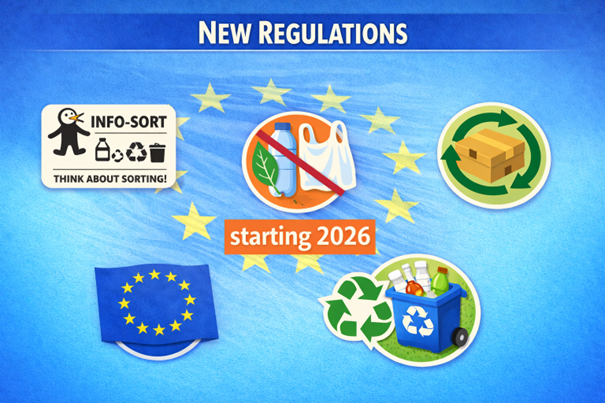
- August 12, 2026: mandatory application of the new rules on packaging design, harmonised labelling and consumer information for companies and Member States.
- 2028: introduction of a minimum recycled content requirement for certain categories of plastic packaging, for example at least 30% recycled plastic in PET packaging.
- 2030: more ambitious reuse and recycling targets must be met.
- 2035: extension of recycling obligations to additional types of packaging, with a goal of large-scale recyclability.

What obligations apply to food and non-food packaging?
Challenges specific to food packaging
Food packaging combines environmental constraints with strict health and safety requirements.
Packaging must ensure product safety while avoiding any misleading information regarding the nature, composition or preservation of the product.
From 2026, new rules will apply, reinforcing in particular:
- the clarity and legibility of sorting instructions,
- consistency between the packaging and the environmental message conveyed,
- traceability of the materials used.
Constraints for non-food packaging
For non-food products (cosmetics, household products, electronics, textiles, etc.), obligations will also apply from 2026, covering new standards of design and labelling. Companies will need to anticipate reuse requirements and the reduction of unnecessary packaging in product design, relying on technical data and documented evidence of compliance.
Why are sorting and recycling at the heart of the new rules?
Persistent complexity for consumers
Despite the widespread use of the Triman logo  in France, studies show that consumers still have difficulty understanding sorting instructions.
The European regulation now requires a clear hierarchy of information, combined with standardised pictograms.
Companies must explain:
- what can be recycled,
- how to dismantle the packaging where applicable,
- what must not be disposed of in recycling bins.
The central role of environmental instructions for use
Instructions for use will no longer concern solely the use of the product, but also its end of life.
This obligation directly extends the consumer law duty to provide clear and accurate information.
What impact do these rules have on trademarks and environmental claims?
The PPWR has a direct impact on the use of environmental claims on packaging. From 2026, statements such as “recyclable”, “eco-friendly” or “biodegradable” may only be used if they are based on objective and verifiable criteria. The new regulatory framework requires absolute consistency between the trademark message and the technical reality of the packaging.
The absence of technical substantiation for such claims may be considered a misleading commercial practice, engaging the company’s liability regardless of its status as a trademark owner. From 2028, enforcement is expected to intensify, particularly in the context of market surveillance and product compliance checks.
To learn more about green brands and greenwashing, we invite you to read our previously published article.
Conclusion
French and European regulations on labelling, packaging and sorting now form a structuring legal framework, with obligations progressively applicable between 2026 and 2035, aimed at strengthening recyclability, reducing waste and harmonising practices across the internal market.
Integrating these constraints into companies’ legal and operational strategies is essential to ensure compliance and to mitigate significant legal risks.
Dreyfus & Associés assists its clients in managing complex intellectual property cases, offering personalized advice and comprehensive operational support for the complete protection of intellectual property.
Nathalie Dreyfus with the support of the entire Dreyfus team
FAQ
1. How can regulatory developments be anticipated?
To anticipate these developments and minimise legal risks, it is recommended to:
- conduct packaging audits incorporating the new European obligations;
- document evidence of recyclability and recycled content;
- align environmental claims with certified technical data;
- involve legal, CSR and marketing teams from the product design stage.
2. What sanctions apply in the event of non-compliance?
Administrative penalties, unfair competition actions, consumer litigation and reputational damage.
3. Does the Triman logo remain mandatory?
Yes, the Triman logo remains mandatory in France, but it will gradually have to be coordinated with the harmonised European pictograms provided for under the PPWR. In the medium term, companies will have to manage the coexistence of different systems, requiring particular vigilance in terms of clarity and hierarchy of information.
4. Does the regulation require a complete redesign of existing packaging?
Not systematically, but in many cases adaptation will be unavoidable, particularly for:
- packaging that is not recyclable by design,
- packaging using complex composite materials,
- packaging containing non-compliant environmental claims.
5. Why anticipate obligations that only apply in 2028 or 2030?
Because current decisions relating to design, supplier contracts and trademark strategy commit the company for several years. Anticipation helps secure investments legally, avoid rushed redesign costs and transform regulatory compliance into a controlled competitive advantage.
This publication is intended to provide general guidance to the public and to highlight certain issues. It is not intended to apply to specific circumstances or to constitute legal advice.