

Sommaire
Introduction
In a world where artificial intelligence is reshaping the digital commercial landscape, ChatGPT is opening up new opportunities by becoming a genuine player in e-commerce, no longer limited to the role of a conversational assistant. The issue of trademark protection within ChatGPT therefore becomes a central concern for companies seeking to safeguard their intangible assets.
Contrary to a sometimes-widespread belief, the digital environment does not constitute a lawless space. A structured legal framework has gradually emerged, particularly at the European level, foremost among which is Directive 2000/31/EC of the European Parliament and of the Council of 8 June 2000, known as the “e-Commerce Directive”.
Trademark law in the face of AI technologies
Trademark law is based on the right of the trademark owner to prohibit the use, in the course of trade, of a sign that is identical or similar to its trademark for identical or similar goods or services, where such use is likely to create a likelihood of confusion in the mind of the public, including the likelihood of association.
Applied to ChatGPT, this principle requires a contextual analysis. AI, as a technology, does not itself hold rights or obligations. However, the uses made of the content it generates, particularly in a commercial context, may fall squarely within the scope of trademark law.
Instant Checkout and conversational commerce: a new area of vulnerability for trademarks
The Instant Checkout service, launched in 2025 by OpenAI, allows users to purchase products directly from ChatGPT. This technology, currently available in the United States, could be rapidly deployed in Europe.
The immediate visibility offered by this platform represents a powerful commercial lever, as it enables trademarks to reach a wide audience through purchase offers. At the same time, it also facilitates infringements of intellectual property rights, particularly trademarks.
The AI system aggregates product feeds from various platforms, enabling counterfeiters to offer infringing products using images and registered trademarks without authorization. This process is particularly risky, as ChatGPT does not automatically certify that the seller is official, preventing consumers from knowing whether they are purchasing from an authorized reseller.
It is therefore imperative for trademark owners to take measures to secure their products and prevent the abusive use of their distinctive signs.
Best practices for protecting trademarks on commerce platforms
Trademark protection on commerce platforms incorporating generative AI engines now relies on the proactive structuring of information, aimed at guiding algorithmic interpretation toward authentic products and legitimate sources.
Generative Engine Optimization (GEO) is a key lever in this respect. GEO follows in the footsteps of SEO and encompasses all techniques designed to improve the visibility of certain information in outputs generated by generative AI systems such as ChatGPT. When applied to trademark protection, GEO enables rights holders to enhance the clarity, credibility, and visibility of legitimate product listings for AI systems.
Clear identification of authorized sellers, product origin, and rights holders, combined with technical measures such as the integration of metadata and distinctive elements in visuals, helps limit fraudulent uses.
Finally, securing trademarks within the ChatGPT ecosystem requires an active and ongoing approach. This includes continuous monitoring of generated results to quickly identify suspicious offers, systematic enrichment of product catalogs, and the use of verification badges designed to reassure consumers.
Trademark enforcement and legal actions
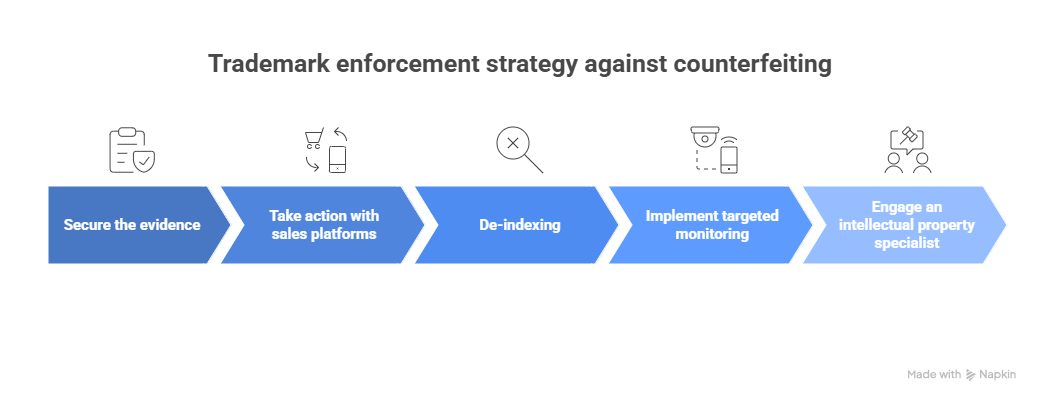
Where counterfeit products are identified, trademark owners must follow a rigorous enforcement process to protect their rights:
- Securing evidence: retaining screenshots and metadata in order to build a robust evidentiary file.
- Taking action with sales platforms: directly contacting platforms to obtain the removal of counterfeit product listings and the deactivation of the sellers’ accounts involved.
- De-indexing : obtaining the removal of counterfeit product listings from ChatGPT’s results.
- Implementing targeted monitoring: in order to rapidly identify new high-risk occurrences and intervene at an early stage.
In this complex technological environment, recourse to an intellectual property specialist remains decisive to define an appropriate and legally secure enforcement strategy.
Conclusion
In this new era of digital commerce, the integration of tools such as ChatGPT and Instant Checkout creates significant opportunities for trademarks, while also introducing risks of counterfeiting and identity misappropriation. By adopting protection strategies such as GEO, the use of metadata, and authenticity labels, trademarks can secure their position in this dynamic environment and effectively protect their intellectual property rights.
Dreyfus & Associés law firm assists its clients in managing complex intellectual property matters, providing tailored advice and comprehensive operational support for the full protection of intellectual property.
Nathalie Dreyfus, with the support of the entire Dreyfus team.
FAQ
1. What are the main threats to trademarks in the ChatGPT ecosystem?
The risk of association with inaccurate content, unauthorized sellers, or counterfeit products, as well as the dilution of the official source in favor of third-party content.
2. Why is GEO (Generative Engine Optimization) important for trademarks?
It aims to optimize the understanding and accurate citation of a trademark by generative AI systems, in order to prevent confusion and uncontrolled uses. Conversational engines no longer merely reference existing content; they synthesize, rephrase, and prioritize information, becoming powerful intermediaries between trademarks and the public. In this context, a lack of GEO control exposes trademarks to heightened risks of confusion, approximation, and potential infringement of their rights.
3. What legal and operational levers can trademarks activate to regain control over their image in responses generated by ChatGPT?
Trademarks can combine several complementary levers, including monitoring the use of their trademarks in conversational environments, as well as notification, takedown, or legal actions in the event of misleading or unlawful associations. This hybrid approach, both preventive and reactive, helps reduce the risk of confusion, protect trademark reputation, and strengthen the consistency of information relayed by generative AI systems.
4. Is ChatGPT liable for the counterfeit products it displays?
Legal liability depends on the contractual arrangements between ChatGPT and the sales platforms and remains unclear at this stage.
5. How can metadata be used to protect a trademark in ChatGPT?
By integrating explicit, standardized, and consistent metadata enabling the identification of the trademark, its legitimate rights holder, and its official channels. Such metadata may include the exact trademark name as registered, registration references (INPI, EUIPO, WIPO), protected territories, and links to official websites and verified social media accounts.
This publication is intended for general public guidance and to highlight issues. It is not intended to apply to specific circumstances or to constitute legal advice.