

Sommaire
Introduction
Trademarks and patents are intangible assets of value for a company. Thus, both their maximization and their protection are essential to preserve innovation, differentiation, and competitiveness in the market. However, effectively managing these rights requires much more than their simple registration: a thorough audit allows to analyze and evaluate all the industrial property rights held by a company to ensure that they are well protected, operated and in accordance with legal and contractual requirements. An audit of trademarks and patents is therefore a crucial lever to avoid risks and optimize innovation and growth strategies.
The need for an audit of trademarks and patents
There are multiple situations in which a trademark or patent audit is required. Among these, three major reasons justify, in themselves, making this approach an essential strategic reflex for the company..
The protection of intellectual property assets
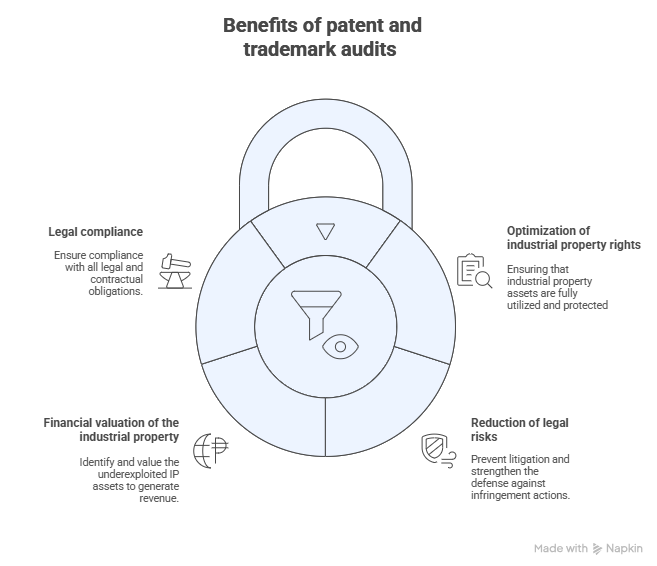
Trademarks and patents are essential tools for securing a company’s activity. Indeed, the audit allows verifying that all intellectual property rights are properly registered and protected. Many intellectual property assets can be neglected, such as unpaid annuities or a title not renewed on time or not used. The audit also makes it possible to verify that the rights are properly used and that the company does not face risks of infringement, revocation or nullity. By identifying rights at risk or geographical areas that are insufficiently covered, the audit makes it possible to adopt a proactive strategy to strengthen legal protection.
The optimization of business strategies and transactions
An audit of trademarks and patents is particularly important in the context of commercial transactions such as mergers, acquisitions or fundraising. During these events, an investor or a purchaser will conduct a due diligence review, including the audit of intellectual property rights. This ensures the legal soundness of the company and avoids setbacks during the transaction. In addition, the audit allows to identify patents or trademarks that can be , transferred or assigned, which optimizes the commercial potential of the company.
The reduction of legal risks
An audit helps limit the legal risks and helps to identify industrial property rights that could be contentious or invalid and to anticipate possible conflicts. By verifying the compliance of contracts, licenses and transfers of rights, the audit helps to avoid potential violations of third-party rights. In addition, it allows for the assessment of the scope of existing patents and trademarks, as well as their potential to be exploited in new markets or areas.
The essential steps of trademark and patent audit
An audit of trademarks and patents is not limited to a simple inventory of rights. It includes several fundamental steps to assess the situation of intellectual property assets and propose appropriate recommendations.
The inventory of intellectual property assets
The first step of the audit is to draw up a complete inventory of the company’s intangible assets. This includes intellectual property titles stricto sensu, such as trademarks, patentsdesigns, as well as copyright-protected works, but the trade secret.
Each asset must be listed with its essential information:
- Registration dates
- Renewal dates
- Geographical scope
- Etc…
This step also allows identifying unused or abandoned rights that can be removed from the portfolio.
Assessment of the validity and strength of rights
The next step is to assess the validity and scope of the rights held. This includes verification of their legal status (for example patents reaching an expiry date or trademarks that will need to be renewed). The audit also assesses the strength of rights in the face of potential challenges. We also study the strength of the right in case of infringements by third parties such as counterfeiting.
Management of contracts and licenses
The audit also includes the analysis of contracts related to intellectual property rights: license, assignment, co-ownership agreements, as well as agreements with employees and business partners. These contracts must be reviewed to ensure that they are up-to-date and comply with current legislation. The audit verifies that the company meets all its contractual obligations and identifies areas for improvement for better management of intellectual property.
Anticipating an action against a trademark or a patent: auditing as a tool for litigation preparation
In the context of an opposition, a cancellation action, revocation for non-use or infringement, the ability to quickly produce legally relevant proof of use is decisive. In practice, many cases fail not on the substance of the law, but due to insufficient, inadequate or non-aligned evidentiary elements with procedural requirements.
A trademark audit allows for the upstream identification of the portfolio’s evidentiary strengths and weaknesses, by verifying the existence of usable proof of use in relation to the labels, territories and periods concerned. It also highlights securities exposed to a risk of lapse or challenge, thus avoiding the company from placing itself in a situation of procedural vulnerability vis-à-vis a prepared opponent.
In patent matters, auditing is an essential tool for litigation preparation. It enables the legal and technical soundness of the titles invoked, the consistency between the claims and the invention actually exploited, as well as their ability to withstand a nullity action, to be assessed.
This anticipation reduces reaction times, secures the contentious strategy and refocuses the debate on the substance of the law, rather than on avoidable evidentiary weaknesses, while offering a realistic vision of the chances of success and the associated financial stakes.
Conclusion
The audit of trades and patents is an essential step for a proactive management of intellectual property tools. It allows a company to maximize the value of its assets while protecting against legal risks. To ensure the sustainability of rights and effectively exploit assets, a regular audit is essential.
Dreyfus & Associates helps its clients identify, secure, and monetize their rights, both in France and internationally.
Dreyfus & Associates is partnered with a global network of intellectual property law firms.
Nathalie Dreyfus with the help of the entire team at Dreyfus & Associates
FAQ
1. Does the industrial property rights audit include the analysis of third party?
Yes, the audit of patents includes the analysis of freedom to operate, that is to say the study of third-party patents likely to prevent the exploitation of the invention. This allows the company to identify potential patent conflicts before launching a product on the market.
2. How often should a trademark and patent audit be conducted?
It is advisable to carry out an annual or biannual audit, or on the occasion of strategic events such as an acquisition or a change in strategy.
3. What is the difference between an internal industrial property audit and an audit carried out by an external firm?
An internal audit can be conducted by the company’s legal team, but it often lacks the necessary hindsight and objectivity to identify all gaps. An external audit, conducted by lawyers specialized in intellectual property, provides a more complete, impartial and expert view of industrial property rights and the strategies to adopt.
4. What are the advantages of an industrial property audit as part of fundraising?
An industrial property audit can reassure investors that the company has properly protected its industrial property assets and is in compliance with regulations. This increases the company’s perceived value and improves its position in negotiations, proving that its assets are well managed.
5. What are the costs associated with a trademark and patent audit?
Costs vary depending on the size and complexity of a company’s industrial property portfolio. A comprehensive audit may include additional research, legal advice, and analysis of contracts and documents related to the industrial property. It is important to consider these costs as an investment in the security and valuation of company assets.
6. Is the audit of trademarks and patents mandatory?
Auditing trademarks and patents is not a legal requirement, but it is highly recommended to optimize industrial property asset management, avoid legal risks, and maximize business value. Some companies choose to carry out one in strategic periods (before a transaction, a change of strategy, etc.).
The purpose of this publication is to provide general guidance to the public and to highlight certain issues. It is not intended to apply to particular situations or to constitute legal advice.