

Sommaire
Introduction
The sharp increase in demand for out-of-court dispute resolution services in the field of domain names constitutes one of the most significant indicators of recent developments in digital law. According to official data published by WIPO, more than 6,200 UDRP complaints were filed in 2025, representing the highest volume ever recorded, and a slight increase compared to 2024 (6,168 cases).
This growth is not a short-term or cyclical phenomenon. It reflects a structural transformation in the way intellectual property disputes are resolved, driven directly by the digitalization of intangible assets.
An analysis of the 2025 statistics provides key legal, economic, and strategic insights for businesses, particularly regarding the now central role of WIPO procedures in the protection of intangible assets.
Statistical analysis of domain name disputes
UDRP: a new all-time record
In 2025, more than 6,200 UDRP complaints were filed, a level never reached since the creation of the UDRP mechanism.
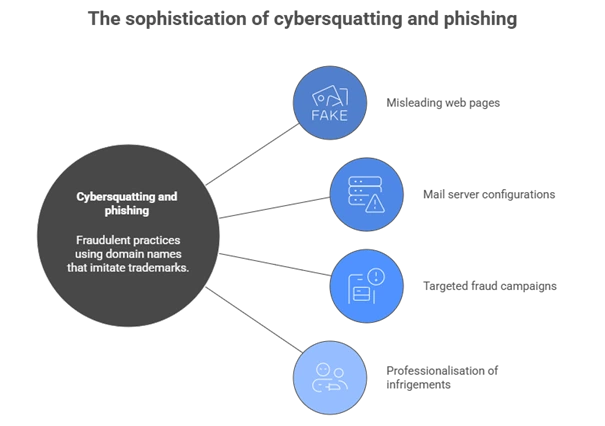
These figures confirm a continued intensification of cybersquatting, phishing, and identity theft practices, involving domain names that imitate well-known trademarks or distinctive corporate signs. Such practices are frequently accompanied by:
- deceptive websites,
- mail server (MX) configurations,
- targeted fraud campaigns aimed at employees, partners, or customers.
At the same time, these infringements have become increasingly professionalized, involving mass registrations, multiple extensions, and fraudulent uses combining websites and email services.
An industrialized form of litigation
Cumulative data show that WIPO has now administered more than 80,000 domain name disputes since the inception of its dispute resolution mechanisms.
From a statistical perspective, this critical mass produces two major effects:
- a highly structured and predictable case-law,
- a growing deterrent effect on the most visible fraudulent operators.
Geographical distribution and sectors of activity
Complaints originate from rights holders established in numerous countries, with a strong concentration of filings from the United States, France, and the United Kingdom.
The disputes span a wide range of economic sectors, including retail and distribution, digital technologies, healthcare, finance, and consumer goods.
WIPO mechanisms: scope and operational effectiveness
UDRP and related procedures: an international standard
The procedures administered by WIPO, foremost among them the UDRP, make it possible to obtain the transfer or cancellation of a domain name when three cumulative conditions are met:
- identity or confusing similarity with a prior right,
- absence of rights or legitimate interests on the part of the respondent,
- registration and use in bad faith.
A pragmatic and predictable procedural framework
The average duration of a procedure remains limited, generally a matter of weeks, with reasoned decisions that are widely published, thereby contributing to legal certainty and jurisprudential consistency.
Strategic impacts for companies and legal departments
Integrating WIPO procedures into a global protection strategy
The statistics invite companies to rethink their internal organization, including:
- anticipation of infringements,
- structured international monitoring,
- the ability to initiate WIPO proceedings rapidly.
A complementary lever to judicial litigation
Recourse to WIPO does not systematically replace court actions, but rather forms part of a complementary approach.
It allows companies to reserve judicial proceedings for matters with high strategic value, while effectively addressing large-scale or repetitive infringements. In practice, WIPO procedures often make it possible to:
- Act quickly,
- Reduce costs,
- Secure digital assets upstream of more complex litigation.
Conclusion
WIPO’s record 2025 statistics reflect a clear reality: out-of-court resolution of intellectual property disputes has become a central pillar of digital law.
For businesses, these mechanisms now constitute an essential strategic tool, provided they are integrated into a comprehensive and forward-looking approach to the protection of intangible assets.
Dreyfus & Associés assists its clients in managing complex intellectual property cases, offering personalized advice and comprehensive operational support for the complete protection of intellectual property.
Nathalie Dreyfus with the support of the entire Dreyfus team
FAQ
1. How can a WIPO procedure be prepared effectively?
By gathering solid technical evidence, conducting a precise legal analysis, and clearly demonstrating bad faith.
2. Are WIPO decisions binding?
They are enforceable at the registrar level, subject to the absence of judicial proceedings initiated within the prescribed deadlines.
3. Are WIPO procedures truly effective?
The growing volume of cases and their recurrence demonstrate an effectiveness recognized by companies of all sizes.
4. Does a WIPO procedure prevent subsequent judicial action?
No. It does not preclude complementary actions before the competent courts.
5. Why is there such a sharp increase in WIPO procedures?
The statistics reflect the multiplication of digital infringements and the search for rapid, international, and specialized solutions.
6. Will domain name disputes continue to increase?
Current statistical trends indicate a likely continuation of growth, driven by fraudulent practices and the expansion of domain name extensions.
This publication is intended to provide general guidance to the public and to highlight certain issues. It is not intended to apply to specific circumstances or to constitute legal advice.