

Sommaire
Introduction
ICANN (Internet Corporation for Assigned Names and Numbers) established the system of national top-level domains, known as ccTLDs (country code Top-Level Domains), the management of which is entrusted to each country. Specific rules govern the registration and use of these extensions, depending on local legal and regulatory requirements.
Choosing an appropriate ccTLD makes it possible to clearly indicate to search engines and users the intended target audience, thereby strengthening the relevance of content at a national or regional level. As such, the ccTLD constitutes an essential legal, technical, and strategic lever for any company developing an online activity, whether domestic or international.
Definition: what is a ccTLD?
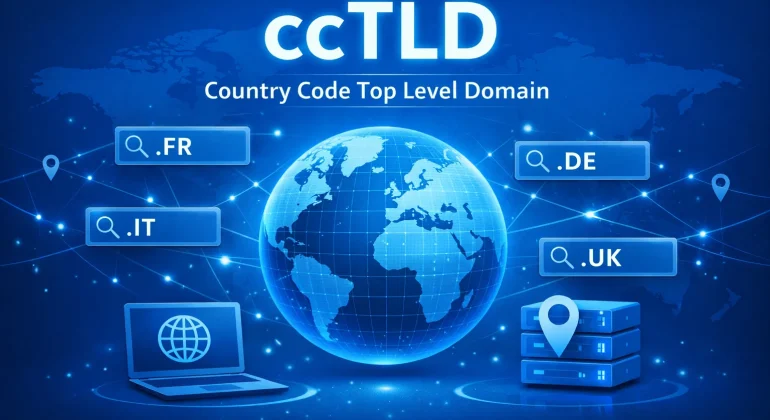
A ccTLD (Country Code Top-Level Domain) is a domain name extension composed of two letters, assigned to a State or territory on the basis of the international ISO 3166-1 standard.
Each ccTLD corresponds to a clearly identified geographical area, for example .fr for France, .de for Germany, .it for Italy, .es for Spain, or .cn for China.
In addition, certain territories have been assigned specific codes under the ISO standard, in particular overseas territories, in order to reflect their particular geographical situation. Accordingly, alongside the French .fr extension, there are also .gf (French Guiana), .mq (Martinique), .re (Réunion), .nc (New Caledonia), .yt (Mayotte), and .gp (Guadeloupe).
Certain exceptions also exist. The United Kingdom, for instance, does not use the standard ISO code .gb, but rather the ccTLD .uk. Likewise, although the European Union is not a State, the ccTLD .eu is widely used by institutions and organisations in order to strengthen their visibility and identification at the European level.
From an institutional perspective, the allocation of all ccTLDs is coordinated by ICANN. However, the management and registration of national domain names are carried out by the respective national registries, commonly referred to as NICs (Network Information Centers).
In France, for example, the .fr extension is administered by AFNIC (Association française pour le nommage Internet en coopération), which sets specific rules relating to eligibility, dispute resolution mechanisms, and the protection of prior rights.
Accordingly, a ccTLD is not merely a technical extension. It is the expression of national digital sovereignty, governed by specific rules that are often firmly rooted in local law.
What are the conditions for registering a ccTLD?
Each ccTLD is subject to its own registration rules, which are often stricter than those applicable to generic top-level domains (gTLDs) such as .com, .net, or .org. Certain extensions require a local presence, a national registration, or the appointment of a legal representative within the relevant territory.
By way of example, the registration of a .fr domain name is limited to holders established within the European Union, as well as in Iceland, Liechtenstein, Norway, or Switzerland.
Registration conditions vary depending on the policy adopted by the relevant registry. For more information about the eligibility rules for the .fr extension, please refer to our previously published article.
Similarly, the Canadian ccTLD .ca is strictly reserved for companies and individuals having their registered office or residence in Canada.
As a result, ccTLDs are not subject to a uniform regime.
What are the advantages of ccTLDs for businesses?
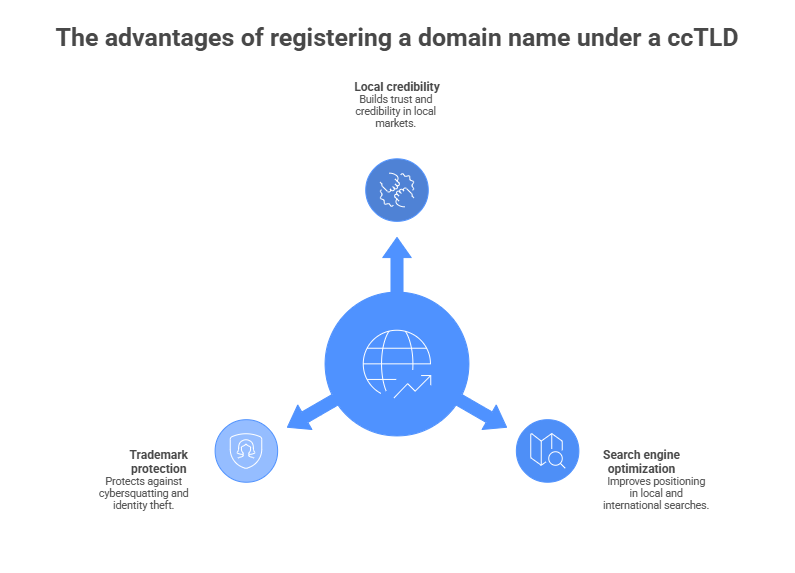
A lever of credibility and local trust
A ccTLD sends a strong signal of geographical proximity to users. It enhances trust, improves the clarity of the offer, and reinforces commercial credibility, particularly in markets where local presence is decisive. For many consumers, a national extension is naturally associated with a company established locally and subject to the applicable national law.
A strategic advantage for search engine optimisation
From an SEO perspective, a ccTLD clearly indicates the geographical target to search engines. It improves rankings for local searches and enables the implementation of a more precise international SEO strategy than reliance on a generic domain name alone.
A tool for protecting trademarks and digital assets
ccTLDs play a key role in the fight against cybersquatting, phishing, and other fraudulent uses. The defensive registration of strategic country-code extensions helps reduce the risk of trademark infringement, traffic diversion, and online impersonation, while facilitating recovery actions based on local law.
Conclusion
The ccTLD (Country Code Top-Level Domain) has become a structuring tool at the heart of corporate digital strategies. Far beyond a simple geographical extension, it serves as a vector of credibility, a lever for local visibility, and an essential legal instrument for protecting trademarks and online intangible assets.
The firm Dreyfus & Associés works in partnership with a global network of intellectual property lawyers.
Nathalie Dreyfus with the support of the entire Dreyfus firm team
Q&A
Does registering a domain name under a ccTLD automatically protect a trademark?
No, but it is an effective tool for preventing and combating online infringements.
Are all ccTLD extensions subject to the same registration requirements?
No. There is no uniform regime applicable to ccTLDs. Registration requirements vary depending on the policy of the relevant registry. Some extensions are open without specific conditions, while others require a local presence, national incorporation, or the appointment of a local representative.
Can a ccTLD be used as an indicator of territorial targeting in a dispute?
Yes. Courts and IP offices frequently take the national extension into account when assessing the intended audience, particularly in cases involving trademark infringement or unfair competition.
Can a ccTLD domain name be deleted if the eligibility requirements are no longer met?
Yes. Many registries provide for the suspension or deletion of a domain name if the holder no longer satisfies the required criteria, in particular where local presence is lost.
Are dispute resolution procedures identical for all ccTLDs?
No. Each ccTLD applies its own mechanisms, which may be based on the UDRP, local alternative dispute resolution procedures, or national courts.