


Sommaire
Introduction
Adopted in 2004, the French “Loi pour la confiance dans l’économie numérique” (LCEN) laid the foundations for the regulation of the Internet in France. Nearly seven years later, the implementing decree of Article 6 II, published in 2011 (Decree No. 2011-219 of February 25, 2011), clarified the obligations relating to the retention of identification data imposed on technical intermediaries.
More than fifteen years after the entry into force of this decree, and in a profoundly transformed digital environment, the practical effects of this framework now call for renewed assessment.
The issue is no longer the long-awaited adoption of an implementing text, but rather its current relevance. In an era characterized by the massification of data, the consolidation of major digital platforms, and the expansion of European regulation, does the LCEN framework still provide an effective response to contemporary digital challenges, or does it expose the limits of a system conceived for an Internet that no longer exists?
The evolution of article 6 II of the LCEN in a transformed digital environment
The legal framework of Article 6 II of the LCEN establishes one of the pillars of French Internet law. Asserted as early as 2004, in a technological context predating the development of large platforms, this obligation was designed for an Internet with largely linear and centralized uses. However, it has been implemented in a constantly evolving digital environment, characterized by the diversification of services, the emergence of global intermediaries, and the exponential growth of data volumes processed.
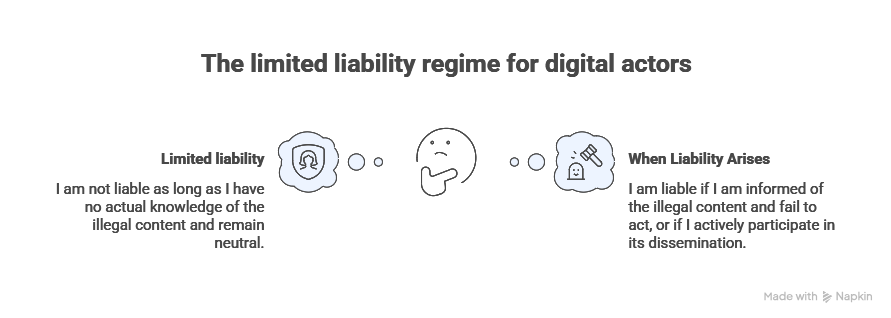
By requiring access providers and hosting service providers to retain data enabling the identification of content authors, the legislator established a key counterpart to the limited liability regime applicable to technical intermediaries. This regime is based on a conditional exemption from liability, grounded in the absence of prior knowledge of the content and the obligation to act promptly upon notification, excluding any general obligation to monitor. The retention of data thus serves as the procedural counterpart to this neutrality, allowing for the subsequent identification of those responsible for infringements without transforming intermediaries into oversight actors.
This obligation is a prerequisite for the ex post identification of authors of unlawful content, without imposing any form of generalized monitoring.
However, from the outset, this framework was structurally incomplete. The legislator expressly deferred to an implementing decree the task of defining the categories of data to be retained and the applicable modalities, in order to ensure proportionality and legal certainty. The prolonged absence of this decree generated lasting legal uncertainty.
In practice, operators relied on fragmented case law and heterogeneous recommendations, resulting in uneven retention practices, sometimes excessive, sometimes insufficient. The decree was therefore expected to serve as an instrument of normative clarification and alignment with European requirements, particularly in the field of personal data protection.
An assessment of the implementing decree in light of changes in the digital ecosystem
The implementing decree of Article 6 II of the LCEN was adopted in a context radically different from that prevailing in 2004. At the time, the legislator primarily sought to regulate the first generation of hosting and access providers, within a relatively stable technical environment dominated by identifiable operators.
Twenty years later, the digital ecosystem has undergone profound transformation. Platforms have proliferated, uses have become more complex, and data volumes have reached unprecedented levels.
Against this backdrop, the detailed list of identification data categories imposed by the decree appears, with hindsight, both necessary and structurally outdated. While it initially provided much-needed formal clarification, it soon encountered the limits of a retention model designed for the early 2000s Internet.
Transposed to a 2026 environment marked by service fragmentation, automated exchanges, and the widespread use of distributed architectures, this approach has proven only partially suitable. Retention periods and modalities have been repeatedly challenged, particularly in light of contemporary principles of proportionality and data minimization.
Far from settling the debate, the decree has thus contributed over time to the emergence of structural litigation concerning the compatibility between identification requirements, personal data protection, and technical realities.
Operational impacts on digital stakeholders
Following its entry into force, the decree resulted in significant operational requirements for hosting providers, publishers and platforms including a legal obligation to retain and secure identification data. This obligation, which conditions the limited liability regime provided by the LCEN, has required operators to implement substantial technical and organizational measures. These measures particularly focus on the traceability of connections, the integrity of retained data, and its security, in accordance with Article 32 of the GDPR.
With hindsight, these obligations have formed part of a broader movement toward the standardization of compliance functions within digital actors. They have progressively been integrated into comprehensive frameworks combining requirements arising from the LCEN, the GDPR, and, more recently, European regulations governing digital services.
By 2026, this accumulation of regulatory obligations represents one of the sector’s principal operational challenges, in terms of both costs and internal legal governance particularly regarding the allocation of responsibilities, management of litigation risk, and traceability of compliance decisions.
From the perspective of intellectual property rights holders, the decree has strengthened the procedural tools allowing, under judicial oversight, the identification of perpetrators of online infringements.. The clarification regarding the categories of data retained, such as IP addresses, connection timestamps, and subscription data held by the host or registrar has improved, in several disputes, the effectiveness of actions for infringement and unfair competition.
Nevertheless, litigation experience since 2011 demonstrates that this mechanism remains largely dependent on the effective cooperation of intermediaries and judicial interpretation of their obligations. The decree has therefore not created an automatic right to identification, but rather a procedural framework whose scope varies according to circumstances.
Anticipated legal and litigation risks
The main legal risks associated with the decree implementing the LCEN relate to the delicate balance between the legitimate objective of identifying the authors of illegal content and the protection of fundamental freedoms, foremost among which are the right to privacy and the protection of personal data. In practice, these tensions have crystallized around the requirements of proportionality, which stipulate that data retention and disclosure obligations must be strictly necessary, limited in scope, and subject to effective procedural safeguards. Over time, they have given rise to extensive litigation before national and European courts, concerning both retention periods and conditions of access to data.
This is the case, for example, in this ruling dated March 25, 2021 (Cass. civ. 2e, March 25, 2021, No. 18-18.824), in which the French Cour de Cassation clarified the conditions for accessing identification data. In this case, the High Court was asked to rule on a request for disclosure of data made by a private party in a civil dispute, based on the obligations arising from Article 6 II of the LCEN. The Court ruled that the retention obligation established by the LCEN does not confer on individuals an automatic right of access to data, but is subject to a strict procedural framework, subject to judicial review. It thus reiterates that the disclosure of identification data must comply with the principles of proportionality, purpose and necessity, in accordance with the requirements of both domestic and European law. This decision illustrates the Cour de Cassation’s desire to maintain a balance between the effectiveness of the fight against illegal content and the protection of personal data. In practice, it limits the possibilities for direct identification by rights holders and strengthens the role of the judge as the guarantor of this balance.
Conclusion
Long awaited, the implementing decree of Article 6 II of the LCEN has undeniably contributed to structuring obligations relating to the retention of identification data in France. With more than fifteen years of application, however, it appears that it has constituted neither a definitive solution nor an instrument fully adapted to digital transformations.
While it has strengthened the traceability of online activities, it has also intensified tensions with data protection law and multiplied areas of litigation, particularly in relation to proportionality, liability, and data governance.
In an environment increasingly shaped by European regulation and global platform dynamics, this framework reveals the limits of an essentially national approach. It calls upon digital stakeholders to adopt an integrated legal strategy combining compliance, risk management, and anticipation of regulatory developments.
Dreyfus & Associés assists its clients in managing complex intellectual property cases, offering personalized advice and comprehensive operational support for the complete protection of intellectual property.
Nathalie Dreyfus with the support of the entire Dreyfus team
Q&A
1. Are all platforms subject to the obligations of Article 6 II of the LCEN?
No. The applicable regime depends on the qualification of the actor: hosting provider, publisher, access provider, or hybrid operator. In practice, many services combine multiple functions, making classification more complex. Each service must be assessed individually, taking into account its actual role in content publication and control.
2. Are LCEN retention obligations compatible with the GDPR?
In principle, yes, subject to strict conditions. Retention must be based on a legal ground, be necessary and proportionate, and comply with the principles of minimization and storage limitation. The main risk lies in excessive precautionary retention, which may expose operators to GDPR litigation and proportionality challenges.
3. Under what conditions may a judge order the disclosure of identification data?
In practice, courts require targeted requests justified by a legitimate purpose (e.g., identifying the author of unlawful conduct) and subject them to strict necessity and proportionality review.
4. Do LCEN obligations apply to actors established outside France?
Potentially, depending on connecting factors such as targeting of the French public, activities directed toward France, or the presence of infrastructure or establishments. Enforcement may be more complex, reinforcing the relevance of European mechanisms such as the DSA and cross-border cooperation tools.
5. Do artificial intelligence and automation affect identification obligations?
They primarily affect scale and speed, through automated moderation, abnormal behavior detection, and event correlation. However, they do not reduce legal obligations. On the contrary, they require enhanced governance, including minimum explainability, human oversight, and decision traceability.
This publication is intended to provide general guidance and highlight certain issues. It is not intended to address specific situations and does not constitute legal advice.