


Sommaire
Introduction
Genuine use of a trademark constitutes a fundamental condition for maintaining balance within trademark law. In response to the proliferation of filings, defensive registration strategies, and overly broad specifications covering entire classes of goods and services, the legislature has enshrined the requirement of actual commercial exploitation of the sign. Protection is legitimate only insofar as the trademark effectively fulfills its essential function of indicating origin on the market.
This requirement of genuine use is not merely theoretical. In contentious proceedings, it operates as a substantive filter of the validity and enforceability of the monopoly right. A registered trademark that is insufficiently exploited becomes vulnerable to revocation.
The legal framework governing genuine use: requirements and assessment
The concept of genuine use is clarified under French law by in Article L. 714-5 of the French Intellectual Property Code, as amended pursuant to Directive (EU) 2015/2436, and forms part of the harmonized framework established by Regulation (EU) 2017/1001 on the European Union trademark .
Under this regime, a trademark owner incurs total or partial revocation where, without proper reasons, the trademark has not been genuinely used for a continuous period of five years in respect of the goods or services for which it has been registered. Revocation may be sought by any third party upon proof of absence of genuine use.
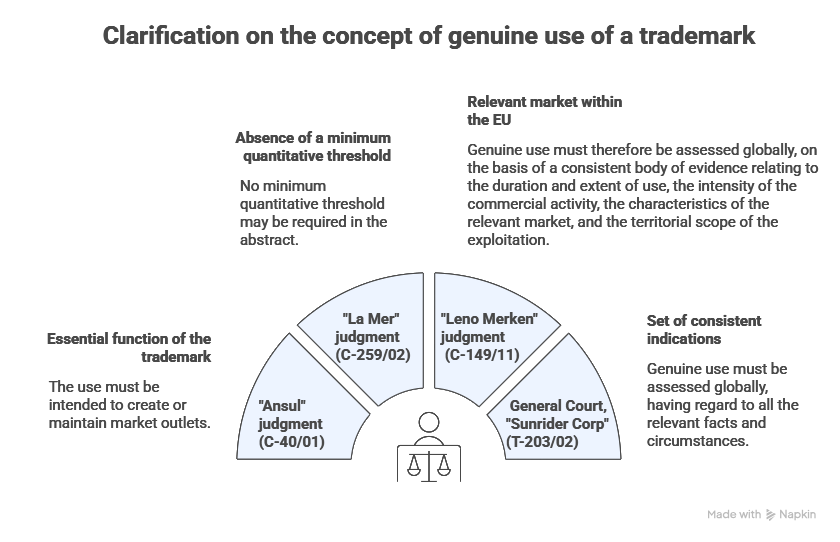
The concept of genuine use must not be equated with token or purely formal use intended solely to preserve the rights conferred by the trademark. According to settled case law of the Court of Justice of the European Union, genuine use consists in use that is consistent with the essential function of the trademark namely, to guarantee the identity of origin of the goods or services and that seeks to create or maintain market share for those goods or services (CJEU, Ansul, C-40/01). Such use must be public and external to the undertaking; purely internal or symbolic use is insufficient. However, genuine use may be effected by a third party with the consent of the proprietor.
Furthermore, the assessment of genuine use must be carried out globally, taking into account the nature of the goods or services concerned, the characteristics of the relevant market, the territorial scope, and the frequency and intensity of the use (General Court, Sunrider Corp., T-203/02). In this respect, no minimum quantitative threshold of use may be required in the abstract (CJEU, La Mer Technology, C-259/02).
Moreover, genuine use must occur within the relevant territory covered by the protection conferred by the trademark. In the case of a French trademark, use must take place in France, it being accepted that use confined to a particular geographical area may suffice where it is economically justified. As regards an EU trademark, use must extend to a substantial part of the territory of the European Union; this requirement is assessed qualitatively rather than purely geographically, having regard in particular to the characteristics of the relevant market (CJEU, Leno Merken, C-149/11).
The burden of proof of genuine use
The assessment of genuine use of a trademark is subject to a concrete and contextual review carried out by the INPI or the EUIPO or the competent court, which determines, on the basis of a consistent body of converging evidence, whether the alleged use fulfills the essential function of the trademark, namely to guarantee the identity of origin of the goods or services on the market.
Use must be established for the relevant reference period and within the legally pertinent territory that is, France in the case of a French national trademark and, in the case of a European Union trademark, within the European Union, pursuant to a concrete appraisal taking into account the market concerned, without any automatic requirement of proof in several Member States.
Genuine use must also be demonstrated in respect of the specific goods or services relied upon and in a form of the sign that corresponds to the registration or does not alter its distinctive character. The assessment is both qualitative and quantitative in nature: the economic consistency of the evidence, its expression, and its capacity to demonstrate an actual presence on the market prevail over its mere isolated volume.
The nature of admissible evidence
Proof of genuine use rests primarily on objective, external and economically verifiable evidence demonstrating that the trademark has been effectively exploited on the market in relation to the goods or services concerned. The courts and the INPI as well as the EUIPO expect documentary evidence such as invoices, contracts, purchase orders or accounting records referring to the sign at issue, enabling the identification of the nature of the goods or services marketed, their volume, their frequency and their geographical destination. Catalogues, brochures, price lists, packaging, advertising materials or product photographs likewise carry probative value, provided that they are precisely dated and establish actual commercial circulation rather than merely preparatory acts.
Digital and marketing evidence now plays a decisive role, subject to proper contextualization: dated and archived screenshots of websites, sales data drawn from e-commerce platforms, media coverage or market studies, for example. Such evidence derives its probative force not from its abstract existence, but from its capacity to demonstrate an effective interface between the trademark and the relevant public, thereby evidencing concrete commercial activity on the relevant goods and services.
The scope of proof: preservative effect and delimitation of enforceable rights
In litigation, these principles assume a decisive procedural dimension. In revocation proceedings, the burden of proof lies with the trademark owner, who must demonstrate genuine use during the relevant period; failing such proof, revocation is ordered in respect of those goods or services not substantiated by the evidence produced by the adverse party. In opposition or invalidity proceedings, where the earlier trademark has been registered for more than five years, proof of use is required upon request by the contested applicant/trademark holder and constitutes a condition for both the admissibility and the effectiveness of the pleas relied upon by the adverse party. The adjudicating authority does not confine itself to noting the formal existence of documents, but assesses their economic consistency, their concordance and their precise correspondence to the goods claimed.
The issue of autonomous sub-categories reinforces this requirement: where the specification is broad and divisible, proof must relate to each distinct segment, as sporadic use in respect of a single good or service is insufficient to maintain protection for the entirety of the abstractly claimed category. An overextended portfolio, not aligned with actual exploitation, mechanically increases the risk of partial revocation.
From this perspective, proof of use does not merely establish that exploitation has occurred; it determines the exact scope of the right maintained and legally enforceable. Its effect is strictly proportionate to the evidence adduced: protection subsists only for those goods or services for which genuine use is demonstrated, within the relevant period and territory, and in the registered form or an equivalent form. Proof of use thus produces a limited preservative effect, reducing the title to its economically justified perimeter and transforming the abstract wording of the registration into an effective monopoly. In practice, it redefines the scope of actions and pleas available in contentious proceedings.
Conclusion
Proof of genuine use constitutes a central issue in trademark litigation. The burden rests on the proprietor and must relate to a relevant period, territory and scope, supported by dated and verifiable documentation.
In a context where courts undertake a nuanced assessment particularly where autonomous sub-categories are at issue evidentiary management becomes a major strategic concern. Assembling a robust and structured evidentiary record is no longer optional, but a condition for the survival of trademark rights when faced with revocation actions or challenges in opposition proceedings.
While genuine use is not a condition for the initial validity of a trademark, it is a condition for the continued maintenance of the monopoly over time.
Dreyfus & Associés assists its clients in managing complex intellectual property cases, offering personalized advice and comprehensive operational support for the complete protection of intellectual property.
Nathalie Dreyfus with the support of the entire Dreyfus team.
FAQ
1. Can late resumption of use prevent revocation?
Yes, but only if it occurs prior to the filing of the revocation action and is not artificially organized for the sole purpose of avoiding the proceedings.
2. Is use by a licensee valid?
Yes. Use by a licensee, with the consent of the proprietor, is legally deemed equivalent to use by the proprietor.
3. Is internal use (internal documents, prototypes) sufficient?
No. Use must be public and market-oriented. Purely internal or preparatory use is insufficient.
4. Can limited commercial activity amount to genuine use?
Yes, provided it is consistent with the size and structure of the relevant market. Assessment is always contextual.
5. Is proof of use examined ex officio?
No. It is examined only when expressly raised in the context of contentious proceedings.
6. Why must evidentiary management be anticipated?
Assembling an evidentiary record retrospectively is often complicated. Regular archiving of evidence of use is an essential measure to secure and preserve a trademark portfolio.
The purpose of this publication is to provide general guidance to the public and to highlight certain issues. It is not intended to apply to particular situations or to constitute legal advice.