


Sommaire
- 1 Introduction
- 2 The legal function of the plant variety denomination
- 3 Validity criteria : lawfulness, distinctiveness and neutrality
- 4 Frequent grounds for refusal by the CPVO
- 5 The strategic articulation between plant variety denominations and trademarks
- 6 Illustration : the “WILD PINK” / “PINK LADY” dispute
- 7 Conclusion
- 8 Q&A
Introduction
Choosing a plant variety denomination constitutes a strategic legal step in the procedure for obtaining plant variety rights. It has lasting implications for the identification, commercialization and valorization of a plant variety on the market.
Too often treated as a mere administrative formality, the denomination actually lies at the intersection of plant variety rights law, trademark law, and competition law.
The issue is therefore not purely regulatory. It also involves economic, reputational and international considerations. This article provides a structured analysis of the applicable rules, the risks of refusal and potential conflicts with trademarks, incorporating the key lessons from the “WILD PINK” / “PINK LADY” case.
The legal function of the plant variety denomination
A plant variety denomination is the official identifier of a plant variety protected under a plant variety right certificate. It must be used by any operator marketing the plant variety within the European Union.
Unlike a trademark, a plant variety denomination does not confer any exclusive right of use. It constitutes the generic designation of the plant variety and cannot be monopolized by an operator or appropriated as a proprietary distinctive sign. Its primary purpose is to ensure market transparency and the clear identification of plant material.
This public interest function explains the neutrality requirements surrounding its selection, as well as the prohibition of adopting a denomination that may create confusion with another plant variety or trademark, or mislead the public.
Validity criteria : lawfulness, distinctiveness and neutrality
The denomination must clearly distinguish itself from any other plant variety of the same species or closely related species. A simple spelling variation or minor modification is not sufficient to eliminate the risk of confusion.
It must not suggest an inaccurate geographical origin nor attribute particular qualities to the plant variety that have not been demonstrated. Laudatory or promotional references are generally rejected, as they undermine the neutrality expected from a regulatory identifier.
Frequent grounds for refusal by the CPVO
The examination of a plant variety denomination aims to ensure that it properly fulfills its function of identifying the plant variety. Competent authorities may refuse a denomination that does not meet the criteria established by the UPOV Convention.
The most common ground for refusal concerns similarity with an existing plant variety denomination. The proposed denomination must be clearly distinguishable from any denomination already used for a plant variety of the same species or a closely related species. Even a minimal spelling difference may be considered insufficient if the phonetic similarity could create confusion between varieties.
A denomination may also be refused if it is misleading or descriptive. The denomination must not mislead users as to the characteristics, value or identity of the plant variety. For example, a denomination suggesting a characteristic that the plant variety does not possess, or presenting the plant variety as superior to others, may be considered inappropriate.
Denominations that falsely suggest a connection with another plant variety may also be rejected. A denomination may be considered misleading if it suggests that the plant variety is derived from a well-known plant variety when that plant variety was not actually used in the breeding process.
Finally, a denomination may be refused where it infringes prior rights held by third parties, such as trademarks, trade names, geographical indications or other protected signs. In such cases, the breeder may be required to propose a new denomination in order to avoid legal conflicts when the plant variety is commercialized.
These different grounds for refusal illustrate that the choice of a plant variety denomination cannot be considered in isolation. It operates within a broader legal environment in which plant variety denominations often coexist with distinctive signs used for marketing purposes. This interaction raises the broader question of the relationship between plant variety denominations and trademark strategies.
The strategic articulation between plant variety denominations and trademarks
The rules governing plant variety denominations pursue a public interest objective: ensuring the clear and reliable identification of plant varieties on the market. In this context, the plant variety denomination must constitute the generic designation of the plant variety and remain freely usable by all operators marketing it. It cannot therefore fulfill a distinctive function comparable to that of a trademark.
This explains why authorities examining plant variety denominations pay particular attention to risks of confusion and potential infringements of prior rights. A denomination may therefore be refused if it is too similar to an existing plant variety denomination, if it is misleading regarding the characteristics of the plant variety, or if it conflicts with a prior right such as a trademark or trade name.
In practice within the horticultural and agricultural sectors, this requirement leads to a clear distinction between two levels of designation: the plant variety denomination, which enables the botanical and regulatory identification of the plant variety, and the trademark, which serves as the main tool for commercial differentiation.
The example of the Cripps Pink apple plant variety, marketed under the trademark Pink Lady, illustrates this model. The plant variety denomination fulfills a technical identification function and must be used in the marketing of plant material, while the trademark supports the marketing strategy and creates a distinct commercial identity.
This dual structure requires breeders to adopt a strategic approach from the moment the denomination is chosen. A denomination that is too close to an existing trademark may lead to refusal based on prior rights or later create difficulties when the plant variety is commercialized.
In this context, securing a plant variety denomination requires not only verifying its availability in international plant variety databases but also anticipating possible interactions with existing distinctive signs in the relevant sector. Early coordination between the plant variety denomination strategy and the trademark strategy helps limit legal risks and ensures a more secure market launch for the plant variety.
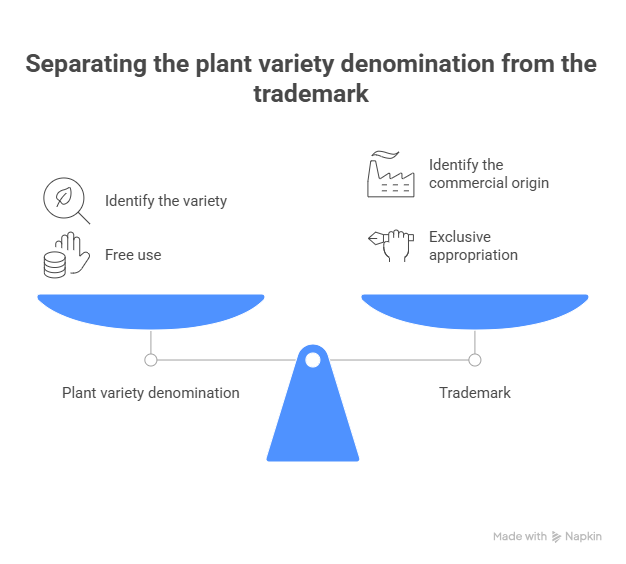
Illustration : the “WILD PINK” / “PINK LADY” dispute
The interaction between naming strategies and trademark rights can be illustrated by the dispute involving the sign WILD PINK and the Pink Lady trademarks, which are widely known in the apple sector.
In this case, the competent authorities were required to assess the likelihood of confusion between the signs, particularly due to the shared element “pink” and the overall impression produced by the trademarks on the relevant public. The analysis relied on the traditional criteria of trademark law, including visual and phonetic similarity, consumer perception and the distinctiveness of the elements composing the trademarks.
Although this dispute falls primarily within the scope of trademark law, it highlights a strategic issue that is directly relevant for breeders. In the horticultural sector, certain terms may become strongly associated with well-established trademarks. Using a similar term when marketing a new plant variety may therefore give rise to legal challenges capable of affecting the commercialization strategy.
This situation demonstrates that securing a plant variety denomination should not be considered independently from the trademark strategy that will accompany the marketing of the plant variety. Conducting a prior analysis of the trademark landscape within the relevant sector is therefore essential to avoid conflicts with already established distinctive signs.
Conclusion
The choice of a plant variety denomination is not merely an administrative formality but a strategic decision that must be assessed in light of the applicable legal rules and the broader landscape of prior rights, particularly trademarks.
Dreyfus & Associés assists its clients in managing complex intellectual property matters by providing tailored advice and comprehensive operational support for the full protection of intellectual property rights.
Nathalie Dreyfus with the support of the entire Dreyfus team.
Q&A
1. What is a plant variety denomination ?
A plant variety denomination is the official name assigned to a plant variety that is protected or subject to an application for a plant breeder’s right. It serves to identify the plant variety and must be used when marketing its reproductive or propagating material.
2. What are the main criteria for choosing a plant variety denomination ?
The denomination must clearly identify the plant variety, be distinct from existing denominations for varieties of the same or related species, and must not be misleading regarding the characteristics, origin or value of the plant variety.
3. Can a plant variety denomination be refused ?
Yes. Competent authorities, such as the Community Plant Variety Office (CPVO), may refuse a denomination if it is too similar to an existing plant variety denomination, if it is misleading, or if it infringes a prior right such as a trademark or protected geographical indication.
4. What is the difference between a plant variety denomination and a trademark ?
A plant variety denomination constitutes the generic designation of the plant variety and does not confer any exclusive right. By contrast, a trademark is a distinctive sign used to differentiate products commercially on the market. In the horticultural sector, a plant variety may therefore have a plant variety denomination while being marketed under a trademark.
5. How can the choice of a plant variety denomination be secured ?
Before proposing a denomination, it is advisable to conduct searches in databases of existing varieties, including those derived from the UPOV system, as well as in trademark databases in order to identify potential prior rights. Coordinating the plant variety denomination strategy with the trademark strategy can also help reduce the risk of refusal or conflict during commercialization.
This publication is intended to provide general guidance to the public and to highlight certain issues. It is not intended to apply to specific situations or to constitute legal advice.