


Sommaire
Introduction
The priority rule in trademark law is a fundamental mechanism within the international trademark protection system. It allows an applicant who has filed a first trademark application in one country to claim that filing date for a subsequent application in another territory, particularly for a European Union trademark (EUTM).
This mechanism enables applicants to obtain retroactive protection, preventing third parties from acquiring rights between two successive filings. However, recent case law from the General Court of the European Union reminds us that this rule must be applied strictly.
The Coloratura ruling (Capella v EUIPO, General Court of the European Union, 8 October 2025, T-562/24) is a particularly significant decision in this regard. It clarifies the limits of the concept of the “first application” and reiterates that the priority system cannot be used to artificially extend trademark protection.
The priority rule in trademark law: definition and legal framework
The right of priority originates from the Paris Convention for the Protection of Industrial Property, which enables applicants to organize the international expansion of their trademarks.
Under this principle, anyone who has filed a trademark application in a Convention member state benefits from a six-month period to file the same trademark in other countries while retaining the date of the first filing. This mechanism facilitates the international protection of trademarks while giving trademark owners time to evaluate their expansion strategy.
Within the European Union, this right is governed by Article 34 of Regulation (EU) 2017/1001 on the European Union trademark. This provision allows applicants to claim the priority of an earlier application when filing a European Union trademark application before the EUIPO.
Where priority is validly claimed, the EU trademark is deemed to have been filed on the date of the first national filing. Consequently, any application filed by a competitor during that period becomes legally ineffective against the earlier rights.
Legal conditions for claiming priority in trademark law
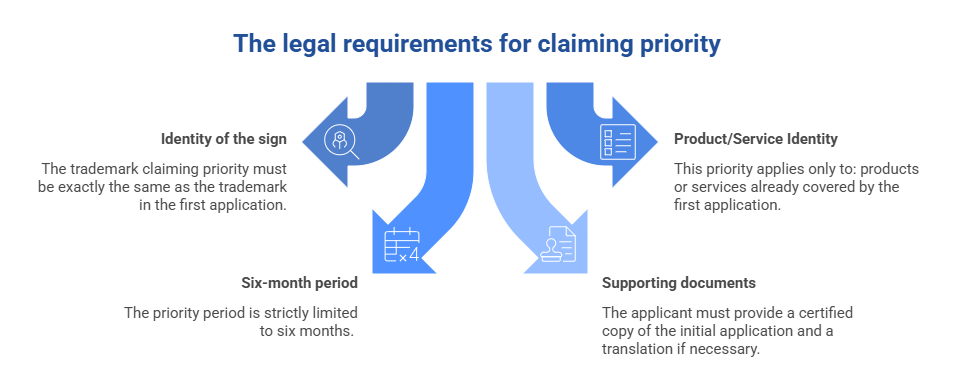
Claiming priority is subject to several cumulative conditions :
- First, the trademark claiming priority must be strictly identical to the trademark filed in the initial application. Any substantial modification may result in the loss of priority.
- Second, priority applies only to the goods or services covered by the first application. If the subsequent application includes additional goods or services, those additional elements will not benefit from priority.
- Third, the deadline to file a trademark under priority is strictly limited to six months. In principle, this period cannot be extended, which requires careful strategic planning when organizing international trademark filings.
- Finally, the applicant must provide supporting documentation, including a certified copy of the first application and, where necessary, a translation. These documents enable the EUIPO to verify the validity of the priority claim.
The Coloratura ruling: a major clarification of the concept of “first application”
Background of the case
The Coloratura case has become an important reference for interpreting the priority rule in EU trademark law.
In this case, the company Capella filed several German national trademark applications for the trademark “Coloratura” between February and September 2017. It subsequently filed an EU trademark application on March 30, 2018, claiming priority from a German application filed in September 2017.
However, in the meantime, Richemont had filed a similar trademark in Germany on March 9, 2018 and filed an opposition against Capella’s EU trademark application.
This issue was decisive in the pending opposition proceedings, since recognition of that priority claim would have enabled Capella to rely on a filing date earlier than that of the trademark relied upon by Richemont and, accordingly, to defeat the earlier right asserted in opposition. Capella therefore maintained that priority could validly be claimed on the basis of that September 2017 application, whereas Richemont argued that the true first application was in fact the one filed in February 2017.The decision of the General Court of the European Union
The General Court confirmed the analysis of the EUIPO. According to the Court, the application filed in February 2017 had to be regarded as the true first application to be taken into account for the purpose of claiming priority, as it had been published and had produced legal effects.
The Court emphasized that accepting Capella’s argument would allow applicants to extend the priority period indefinitely by repeatedly filing new applications, with each new filing triggering a fresh six-month priority period. Such a practice would undermine the purpose of the priority system, which seeks to balance the protection of applicants with legal certainty and fair competition.
Nevertheless, the Court recalled that in very limited circumstances a later application may exceptionally be considered the “first application”, as provided for in Article 34(4) of the EU Trademark Regulation, which establishes a narrow exception to the general rule.
For this exception to apply, several strict cumulative conditions must be satisfied:
- the earlier application must have been withdrawn, abandoned, or refused;
- it must not have been made available for public inspection;
- it must not have given rise to any surviving rights;
- and it must not have served as the basis for a priority claim.
In the Coloratura case, these conditions were not met. Because the February 2017 application had been published, it necessarily constituted the first application. As a result, the priority period had already expired when the EU trademark application was filed, depriving Capella of any right to claim priority.
Conclusion
The priority rule in trademark law remains an essential tool for companies seeking to develop their trademarks internationally. It allows businesses to balance strategic flexibility with legal certainty by providing a six-month period to organize the territorial extension of a trademark filing.
However, the Coloratura judgment clearly demonstrates that this mechanism must be used strictly within its intended purpose: enabling the international expansion of a trademark rather than creating artificial strategies to extend legal protection.
A rigorous trademark filing strategy combined with careful anticipation of target markets therefore remains essential for securing an effective trademark portfolio.
Dreyfus & Associés assists its clients in managing complex intellectual property cases, offering personalized advice and comprehensive operational support for the complete protection of intellectual property.
Nathalie Dreyfus with the support of the entire Dreyfus team.
Q&A
1. Does the priority rule also apply to designs or patents?
Yes, the priority rule is not limited to trademarks. It also applies to patents, industrial designsunder similar rules provided by the Paris Convention.
2. Does claiming priority affect the duration of trademark protection?
No, the duration of protection for an EU trademark remains ten years from the filing date of the EU application, even if priority has been claimed. Priority affects only the legal seniority of the trademark, not its duration.
3. Can priority be claimed from an application filed in any country?
Priority can be claimed from an application filed in a country that is a member of the Paris Convention or the World Trade Organization (WTO). This means the first filing may originate from a wide range of jurisdictions worldwide.
4. Can multiple filings be used to extend the priority period?
No, European case law, including the Coloratura ruling, clearly confirms that the priority mechanism cannot be misused to artificially extend priority periods through successive filings.
5. Does priority apply to all goods and services in a later application?
No, priority applies only to the goods and services covered by the original application.
This publication is intended to provide general information to the public and to highlight certain legal issues. It is not intended to apply to specific situations or to constitute legal advice.