

Sommaire
Introduction
The “.fr” domain name is experiencing a significant resurgence, driven by growing concerns around digital sovereignty, trust, and the control of intangible assets. Long overshadowed by generic extensions, it is now emerging as a strategic choice for French companies seeking to secure their online presence.
Supported by a structured legal framework, national governance, and effective enforcement mechanisms, the “.fr” provides a reliable and protective environment.
“.fr” as a symbol of renewed digital sovereignty
A national extension with strategic importance
The “.fr”, France’s historical extension, is now part of a broader movement toward reclaiming control over digital infrastructure. This shift is driven by:
- Increasing dependence on international platforms
- Risks of unilateral changes in access or visibility rules
- Exposure to foreign jurisdictions
The domain name thus becomes a strategic and autonomous asset, largely independent from the constraints imposed by global tech players.
A stronger perception of reliability and proximity
The “.fr” benefits from a decisive advantage in that it is immediately identifiable as a local, reliable, and secure extension.
This perception is based, on the one hand, on its strong territorial anchoring, which allows users to naturally associate the website with an entity established in France, and, on the other hand, on its compliance with French and European regulatory frameworks, particularly regarding data protection and transparency.
In addition, it offers greater clarity for consumers, who can more easily identify the origin of the service, thereby reinforcing trust and user engagement.
Widespread adoption by French businesses
Recent figures reflect a clear shift: nearly two-thirds of SMEs now prioritize the “.fr”, compared to about one-third for “.com”. This trend highlights :
- A growing strategic awareness
- A desire to reduce dependence on foreign actors
- An increased need for credibility with customers
The “.fr” is therefore becoming a national standard of trust, moving beyond its former role as a secondary extension.
A protective legal framework strengthened by effective mechanisms
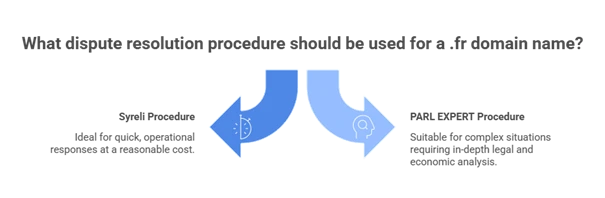
Syreli: a fast and efficient procedure
The Syreli procedure, implemented by AFNIC, enables efficient challenges against “.fr” domain names. It is characterized by:
- A short timeframe (around two months)
- A fully online process
- Controlled costs
It is particularly effective in addressing clear cases of rights infringement.
PARL EXPERT: a more in-depth expert approach
The Alternative Dispute Resolution procedure (PARL EXPERT) relies on independent experts and is suited to more complex disputes involving:
- Detailed legal analysis
- Consideration of economic stakes
- Greater procedural flexibility
To learn more about domain name disputes, we invite you to consult our previously published guide.
Case law offering stronger protection for rights holders
The trends observed in Syreli and PARL EXPERT proceedings, as highlighted in AFNIC’s annual reports, reflect stronger protection for rights holders. A review of the decisions issued shows a growing consistency in the application of these principles, pointing to the gradual consolidation of the legal framework governing “.fr” domain names.
First, acts of cybersquatting are being sanctioned more and more systematically where there is a likelihood of confusion, unfair exploitation of reputation, or evidence of bad faith. Bad faith is assessed on the basis of specific indicators, such as the registrant’s passivity or the redirection of the domain name to competing content.
Second, protection is no longer limited to the mere reproduction of a registered trademark. Decisions now reflect a broader approach to prior rights, extending in particular to company names, provided that a likelihood of confusion is established.
Lastly, AFNIC’s figures confirm the operational effectiveness of these dispute-resolution mechanisms. Since its creation in 2011, more than 3,000 Syreli decisions have been issued, with an increase of over 75% between 2012 and 2024. In 2024, nearly 87% of decisions resulted in the transfer of the domain name to the claimant, illustrating the concrete effectiveness of the system for the benefit of rights holders.
In this context, the “.fr” stands out as a structured, responsive, and protective legal framework, meeting companies’ needs in securing their digital identity.
“.fr” as a response to changes in the web and the rise of AI
Digital visibility reshaped by new online uses
Changes in online practices, particularly with the development of generative AI, are altering the way internet users access information by reducing the direct visibility of domain names within browsing paths.
Without eliminating their role, this development creates a risk of reduced visibility for traditional websites, to the benefit of intermediary interfaces such as search engines, assistants, and platforms.
Even so, domain names remain essential: they constitute the primary source of the content used by artificial intelligence systems.
In this context, domain names continue to serve an important function as a point of identification, credibility, and long-term anchoring for businesses.
“.fr” as a guarantee of digital resilience
In response to these changes, the “.fr” offers:
- Legal stability
- Strategic independence
- Greater resilience in the face of technological developments
It is becoming an essential tool for businesses seeking to secure their visibility and digital identity.
Domain name monitoring: an essential reflex
In this context, merely owning a domain name is no longer enough. Proactive domain name monitoring has become a natural extension of digital sovereignty.
The renewal of the agreement between AFNIC and INPI, aimed at raising entrepreneurs’ awareness of the importance of protecting their intangible assets from the outset through the combined registration of a trademark and a domain name, confirms this direction. It encourages rights holders to implement proactive monitoring in order to detect fraudulent registrations quickly and to activate the appropriate procedures without delay.
Such vigilance makes it possible to:
- Promptly identify infringements affecting trademarks and domain names
- Anticipate cybersquatting practices
- Secure digital identity over the long term
Monitoring therefore forms part of a broader strategy for protecting intangible assets, which is essential to preserving a company’s value and credibility in an ever-evolving digital environment.
Conclusion
The “.fr” has evolved beyond its purely technical function to become a genuine instrument of digital sovereignty, combining trust, legal certainty, and strategic autonomy. Its increasing adoption by French companies reflects a deeper transformation in digital practices, with a growing emphasis on control, security, and the protection of intangible assets.
In a landscape shaped by technological developments and the rise of artificial intelligence, the “.fr” remains a structuring asset, ensuring credibility, visibility, and long-term stability, while fully integrating into a comprehensive intellectual property strategy.
Dreyfus & Associés assists its clients in managing complex intellectual property cases, offering personalized advice and comprehensive operational support for the complete protection of intellectual property.
Nathalie Dreyfus with the support of the entire Dreyfus team
FAQ
1. Who can register a “.fr” domain name?
Any individual or legal entity may register a “.fr” domain name, provided they reside or are established within the European Union.
2. Is “.fr” suitable for international strategies?
Yes, it can complement other extensions while strengthening local presence and brand security.
3. How can a “.fr” domain name be effectively protected?
By registering strategic variants, securing trademark rights, monitoring registrations, and acting quickly via Syreli or PARL when needed.
4. How can domain names be monitored?
Through specialized monitoring services that detect potentially infringing registrations.
5. What is the difference between UDRP and Syreli?
UDRP applies mainly to generic domains (.com), while Syreli is specific to “.fr” and generally faster.
This publication is intended to provide general guidance and highlight certain issues. It is not intended to apply to specific situations or to constitute legal advice.