Nathalie Dreyfus

How to win a cancellation action against a French trademark or invalidity proceedings before the INPI?

Effective trademark management in France requires a thorough mastery of the administrative procedures needed to challenge a trademark’s validity or obtain its revocation. The French National Institute of Industrial Property (INPI) provides simplified mechanisms for invalidation (nullity) and revocation (déchéance), enabling stakeholders to maintain fair practices in the field of trademarks.

In 2023, trademark-related cases account for 91% of all procedures before the INPI. Invalidation actions have risen to 22% (compared to 19% in 2022), while revocation procedures have decreased from 17% to 9%.

Introduction to Invalidation and Revocation Procedures before the INPI

The procedures for invalidation and revocation, introduced by the EU Trademark Package in 2020, allow you to challenge improper registrations or revoke a trademark. They offer a faster and more cost-effective alternative compared to court proceedings.

  • Invalidation (Nullity): The trademark was invalid from the moment it was registered. It is therefore removed from the register with retroactive effect.
  • Revocation (Déchéance): The trademark has lost its validity due to events occurring after its registration. Its effects end only for the future.

Key statistics:

  • In 2023, 60% of successful invalidation actions were based on absolute grounds.
  • Favorable revocation decisions for non-use represent 75% of cases initiated since 2021.

These tools protect market integrity and ensure fair competitive practices.

The Invalidation Procedure

Invalidation aims to eliminate trademarks that should never have been registered.

Absolute Grounds for Invalidation

A trademark may be invalidated if it:

  • Lacks distinctiveness: e.g., generic or descriptive terms.
  • Is contrary to public policy or accepted principles of morality.
  • Misleads the public: e.g., about the geographical origin or quality of the products.

Relative Grounds for Invalidation

A trademark may be invalidated for infringing prior rights:

  • Identical or similar trademark already registered.
  • Pre-existing copyright, trade names, or domain names.

Dive Deeper: When a trademark is challenged on relative grounds, it is crucial to present a clear comparative analysis of the distinctive elements, including phonetics, appearance, and meaning. Citing relevant case law bolsters your arguments.

Case Law Example: In 2022, a French trademark was invalidated for causing confusion with an EU trademark registered 5 years earlier (Source: INPI).

Extended Practical Example: A competitor registered a trademark using the dominant color of a pre-existing company, combined with similar wording. An expert analysis of consumer perception was crucial in convincing the INPI to invalidate the trademark on relative grounds.

The Revocation Procedure

Revocation addresses abuses or omissions that occur after registration.

Non-Use of a Trademark

If a trademark is not used within 5 years of its registration, it can be revoked. For instance, a trademark registered in 2017 with no proven use by 2023 could be subject to revocation.

Focus: Evidence of use may include invoices, advertising materials, or packaging samples. The absence of such documents weakens the owner’s position.

Becoming a Generic Term

Abusive use can cause a trademark to lose its distinctiveness. Examples include Aspirin or Kleenex, which have become generic terms in some countries.

Misleading Use

Use that misleads consumers about the nature or origin of products may lead to revocation.

Recent Example: In 2021, a trademark was revoked for misleading use after being applied to products radically different from those stated in the registration.

Administrative Process before the INPI

Filing the Application

  • Identify the targeted trademark.
  • State the grounds (invalidation or revocation).
  • Include the supporting evidence (non-use reports, market research, etc.).

Practical Tip: For complex applications, engaging an attorney can be pivotal to avoid rejection for incomplete filings.

Adversarial Phase

Each party presents its arguments and evidence through structured exchanges. Counter-evidence may include customer testimonials or financial data.

Final Decision and Appeals

  • Effects of Decisions:
    • Invalidation: Retroactive effect.
    • Revocation: Future effect only.
  • Appeals may be filed with the Paris Court of Appeal.

Practical Cases and Case Law Examples

  1. Example of an Invalidation Action: A French trademark was invalidated for failing to meet distinctiveness requirements (Source: INPI, case 2022-03).
  2. Example of a Revocation Action: A trademark not used within 5 years of registration was revoked in 2023 for non-use (Source: INPI case law).

Advanced Strategies to Maximize Your Chances of Success

  1. Comprehensive Evidence Analysis: Gather persuasive documents such as expert reports, market studies, or consumer surveys to substantiate your claims.
  2. Leverage Case Law: Reference similar cases to strengthen your position.
  3. Prepare a Strategic File: Ensure each piece of evidence is presented coherently and in an organized manner.
  4. Professional Support: Consult with intellectual property experts to maximize your odds of success.

Analysis of Recent Trends in Invalidation Actions

Increase in International Actions

With the rise of cross-border trade, trademark disputes involving international parties have risen significantly. Many companies seek to extend trademark protection beyond national borders, leading to conflicts with similar or identical trademarks registered in other jurisdictions. This trend is pushing owners to step up monitoring of their intellectual property assets.

Key Statistics:

  • In 2023, 35% of invalidation actions involved international parties (source: INPI).
  • A 15% increase in oppositions to European trademarks was observed during the same period.

The Rise of Digital Tools

The INPI and other organizations have implemented digital platforms to streamline the filing and tracking of procedures. These tools offer greater transparency and faster management of disputes. However, they also demand quick adaptation by companies to ensure accuracy and completeness in their filings.

Focus on Distinctiveness

Invalidation actions based on a lack of distinctiveness have been particularly numerous in 2023. Companies are now using more rigorous methods to demonstrate that contested trademarks are not sufficiently distinct from generic products or services.

Resources and Practical Tools

Useful Links for Professionals:

  1. INPI Platform: Link to the filing portal
    • Enables online submission of invalidation and revocation requests.
    • Provides educational resources on procedures.
  2. INPI Trademark Database: Trademark search
    • Tool for searching registered trademarks and identifying potential conflicts.
  3. WIPO (World Intellectual Property Organization):
    • Platform for monitoring trademarks internationally (WIPO link).
  4. Practical Guides:
    • Download the guide on trademark disputes (INPI).

Analysis and Monitoring Tools:

  • Semrush / Ahrefs / Ubersuggest: Keyword analysis associated with trademarks to anticipate disputes.
  • TrademarkVision: AI-based tool for detecting visual similarities between trademarks.
  • Google Alerts: Track public mentions of your trademark or potential conflicts.

Our Expertise

At Dreyfus & Associés, we understand the importance of protecting your intellectual property assets while maintaining your competitiveness in the marketplace. Our services include:

  1. Audit and Strategy:
    • Evaluation of trademarks and identification of potential risks.
    • In-depth analysis of grounds for invalidation or revocation.
  2. Representation before the INPI and the Courts:
    • Meticulous preparation of case files with convincing evidence.
    • Robust defense in adversarial proceedings.
  3. Strategic Monitoring:
    • Monitoring competing trademarks.
    • Early detection of possible conflicts.
  4. International Management:
    • Coordinating litigation across multiple jurisdictions.
    • Aligning strategies on a global scale.

Contact us for a personalized consultation and learn how we can support you in all your initiatives.

FAQ

  1. What is the difference between invalidation and revocation?
  • Invalidation addresses issues at the time of registration (e.g., lack of distinctiveness).
  • Revocation addresses abuses or omissions that occur after registration (e.g., non-use, misleading use).
  1. What are the deadlines for filing an action?
  • There is no time limit for filing an invalidation action.
  • A revocation action may be initiated as soon as non-use is established (after 5 years).
  1. How much does a procedure before the INPI cost?
  • Filing fees are generally moderate, with a base cost of €600 for an invalidation or revocation procedure. Attorney fees are additional.
  1. Can I appeal an INPI decision?
    Yes, a decision can be appealed before the Paris Court of Appeal within one month of the notification.
  2. Why should I consult an intellectual property expert?
    An expert ensures strategic analysis and thorough case management, significantly increasing your chances of success.
Read More

Understanding the French Trademark Office INPI Decision of October 7, 2024: Implications for Trademark Opposition Procedures

On October 7, 2024, the French National Institute of Industrial Property (INPI) delivered its much-anticipated ruling in case NL 23-0255. The decision, which examined the interplay of trademarks, trade names, and domain names under intellectual property law, rejected LPB SAS’s nullity claims against the contested mark “Les P’tites Bombes LPB.” This ruling highlights critical principles in trademark opposition proceedings, offering key insights into risk of confusion, proof of usage, and procedural nuances.

Understanding the Background of the Dispute

Parties and Context

The case involved LPB SAS, the claimant, challenging the trademark “Les P’tites Bombes LPB,” registered in May 2019. The opposition was based on earlier rights, including:

  • The corporate name “LPB”;
  • The trade name “Les P’tites Bombes”;
  • The domain name lespetitesbombes.com.

LPB SAS argued the contested trademark created a risk of confusion due to the similarity of signs and overlapping goods and services.

LPB SAS argued a risk of confusion, asserting similarity in signs and overlapping goods and services.

Legal Analysis

Applicable Law

The contested trademark was evaluated under provisions in place at the time of its registration. Articles L.711-2, L.711-3, and L.714-3 of the French Intellectual Property Code set forth conditions for nullity, requiring proof of:

  • Earlier rights such as trade names or domain names;
  • A likelihood of confusion between the contested mark and these earlier rights.

Earlier Rights

Under French intellectual property law, trademarks can be opposed based on earlier rights, including:

  • Corporate names: Identifiers of legal entities conducting business. The INPI confirmed LPB SAS’s prior use of its corporate name for wholesale fashion activities. However, the institute found no evidence linking LPB SAS’s corporate name to goods or services overlapping with the contested mark, and insufficient demonstration of confusion due to differences in the signs’ overall impressions.
  • Trade names: Commercial identifiers associated with a specific business reputation. While LPB SAS substantiated limited usage of its trade name, the INPI held that the claimant failed to demonstrate nationwide recognition.
  • Domain names: Online identifiers with established goodwill or recognition. LPB SAS asserted long-standing exploitation of this domain for e-commerce. However, most evidence provided, including web analytics and sales data, was dated after the trademark’s registration. As a result, the INPI ruled out effective use predating May 2019.

Likelihood of Confusion: A Holistic Perspective:

The INPI evaluated confusion using the following factors:

  • Visual and phonetic differences: The contested mark and earlier rights shared limited similarity.
  • Distinctiveness: The claimant failed to show that the earlier rights were distinctive enough to create confusion.
  • Consumer perception: An average consumer with moderate attention would not likely confuse the contested mark with the earlier rights.

The cumulative analysis negated the existence of a risk of confusion.

Practical Implications for Businesses

Clarifying the Burden of Proof

The decision highlights the necessity for claimants to present robust, contemporaneous evidence of their earlier rights’ usage and recognition. Post-registration documentation cannot substantiate claims of prior use. Claimants must demonstrate:

  • Effective prior use of earlier rights;
  • Nationwide recognition where applicable.

Scope of Trademark Nullity

This decision underscores the need to narrowly tailor nullity claims, ensuring:

  • Clear alignment between earlier rights and the contested mark’s goods and services.
  • Direct evidence of overlap and potential consumer confusion.

Broader Legal and Strategic Takeaways

From a strategic perspective, this case exemplifies the challenges businesses face in protecting legacy rights against newer trademarks. Businesses must maintain comprehensive, dated records of usage, reputation, and consumer recognition to safeguard their intellectual property and support future litigation or opposition.

Procedural Changes in Trademark Opposition

The case reflects procedural shifts in French trademark law, notably:

  • Stricter evidentiary requirements.
  • A more streamlined opposition process.

To succeed in nullity claims, opponents must present:

  • Detailed documentation of prior use.
  • Proof of consumer recognition.
  • Clear articulation of harm resulting from potential confusion.

Conclusion

The INPI’s decision in NL 23-0255 sets a high bar for nullity claims and reinforces the importance of proactive intellectual property management. For trademark holders, the ruling serves as a critical reminder to document and safeguard rights effectively.

About Dreyfus Law Firm

Dreyfus Law Firm specializes in intellectual property law, providing expert guidance on trademark protection and opposition procedures. Our global network of attorneys ensures comprehensive solutions tailored to your business needs. Subscribe to our newsletter or follow us on social media for the latest insights in IP law.

FAQ 

What is a trademark opposition in France?

A trademark opposition in France is a legal procedure allowing the holder of earlier rights (such as a prior trademark, trade name, or business name) to oppose the registration of a later mark that may infringe upon their rights. The opposition must be filed with the French National Institute of Industrial Property (INPI) within two months from the publication of the trademark application in the Official Bulletin of Industrial Property (BOPI). The opponent must provide evidence of a likelihood of confusion between their earlier trademark and the contested application.

What is the opposition procedure for WIPO?

For International Trademarks filed under the Madrid System, opposition procedures vary depending on the designated country. The World Intellectual Property Organization (WIPO) itself does not handle oppositions; instead, once an international application is published in the WIPO Gazette of International Marks, each designated country examines the mark according to its national law. Any third party wishing to oppose the registration must do so directly with the national or regional IP office (e.g., INPI for France, EUIPO for the European Union) within the applicable opposition period.

How is EU trademark opposition processed?

In the European Union, trademark oppositions are handled by the European Union Intellectual Property Office (EUIPO).

  • The opposition must be filed within three months of the publication of the EU trademark application in the EU Trademark Bulletin.
  • The opponent must be the owner of an earlier registered trademark or other prior rights.
  • The opposition process consists of a cooling-off period (for possible settlement), followed by an adversarial phase where both parties submit arguments and evidence.
  • The EUIPO then issues a decision, which can be appealed before the Board of Appeal and subsequently before the General Court of the European Union.

What invalidates a trademark?

A trademark can be invalidated if it does not comply with legal requirements. Common grounds for invalidation include:

  • Lack of distinctiveness: The mark is purely descriptive or generic.
  • Earlier conflicting rights: A third party holds prior rights to a similar or identical trademark.
  • Bad faith registration: The mark was filed dishonestly, such as to block competitors.
  • Deceptive nature: The mark misleads consumers about the nature, quality, or origin of the goods/services.
  • Non-use: If a registered trademark is not used for five consecutive years, it may be subject to cancellation for non-use.

How to deal with trademark infringement?

If you believe your trademark is being infringed, you should take immediate action to protect your rights. Possible steps include:

  • Sending a cease-and-desist letter to the infringer, requesting them to stop using the mark.
  • Negotiating an amicable settlement to avoid litigation.
  • Initiating administrative procedures such as opposition or cancellation actions before the relevant IP office.
  • Filing a legal action for trademark infringement before national courts.
  • Monitoring and enforcing your rights by conducting regular brand surveillance to detect unauthorized use.

What is the action for trademark infringement?

Trademark infringement actions typically involve:

  1. Filing a lawsuit before a competent court: The trademark owner must provide evidence of infringement.
  2. Provisional measures: The court may grant injunctions to stop unauthorized use before a final decision is reached.
  3. Damages and penalties: Courts may award financial compensation for losses suffered due to the infringement.
  4. Seizure of infringing goods: Counterfeit or infringing products may be confiscated.
  5. Criminal proceedings (in serious cases): Infringement may be subject to fines or imprisonment, depending on national laws.

    Dreyfus Law Firm is partnered with a global network of lawyers specializing in Intellectual Property.

    Join us on social media!

    LinkedIn  

    Instagram

Read More

The Challenges of the UDRP Procedure in the Face of the Rise of New gTLDs

The digital landscape has undergone significant transformations with the introduction of new generic Top-Level Domains (gTLDs). This expansion presents both opportunities and challenges, particularly concerning the Uniform Domain-Name Dispute-Resolution Policy (UDRP). As experts in intellectual property law, we aim to elucidate the complexities that brand owners face in navigating the UDRP amidst the proliferation of new gTLDs. This article will provide an overview of the UDRP procedure, discuss the implications of new gTLDs, and explore how brand owners can adapt their strategies to address these challenges.

Understanding the UDRP: A Framework for Resolving Domain Disputes

Definition and Purpose

Established in 1999 by the Internet Corporation for Assigned Names and Numbers (ICANN), the UDRP provides a streamlined mechanism for resolving disputes related to domain names. Its primary objective is to address cases where domain names are registered and used in bad faith, infringing upon trademark rights.

Key Criteria for Filing a Complaint

To initiate a UDRP proceeding, a complainant must demonstrate that:

  • The disputed domain name is identical or confusingly similar to a trademark in which the complainant has rights.
  • The respondent has no rights or legitimate interests in respect of the domain name.
  • The domain name has been registered and is being used in bad faith.

These criteria ensure that the UDRP targets clear cases of abusive domain name registrations.

The Impact of New gTLDs on the Domain Landscape

Expansion of the Domain Name System

In 2012, ICANN launched the New gTLD Program, significantly expanding the number of available gTLDs beyond the traditional ones like <.com>, <.org>, and <.net>. This initiative introduced a plethora of new extensions, such as <.shop>, <.tech>, and <.paris>, aiming to enhance consumer choice and foster competition. For instance, <.shop> has been widely adopted by e-commerce businesses, while <.tech> has gained traction among technology companies.

Opportunities and Risks for Brand Owners

While new gTLDs offer brand owners the chance to secure domain names that align closely with their trademarks and industries, they also pose increased risks of cybersquatting. The vast array of new extensions provides malicious actors with more avenues to register domain names that infringe upon established trademarks.

Challenges Posed by New gTLDs to the UDRP

Increased Potential for Cybersquatting

The surge in gTLDs has led to a corresponding rise in cybersquatting incidents. According to the World Intellectual Property Organization (WIPO), there has been a notable increase in UDRP cases, with a record number of complaints filed in recent years. WIPO reported a 20% increase in UDRP cases filed between 2015 and 2020, demonstrating the growing impact of cybersquatting in the era of new gTLDs.

Complexity in Brand Protection Strategies

Brand owners now face the daunting task of monitoring and protecting their trademarks across a vastly expanded domain landscape. This complexity necessitates more comprehensive surveillance and enforcement strategies to safeguard intellectual property effectively.

Jurisdictional and Procedural Issues

The introduction of numerous gTLDs has also led to jurisdictional challenges, as different registries may have varying policies and procedures. This fragmentation can complicate the enforcement of UDRP decisions and the overall dispute resolution process. For example, the variation in registry policies across jurisdictions, such as Europe and Asia, often creates hurdles for uniform enforcement of UDRP decisions.

Adaptations and Responses

Evolution of the UDRP Framework

In response to the evolving domain landscape, there have been discussions about reforming the UDRP to address new challenges effectively. Proposals include introducing financial penalties for cybersquatters and extending response times for respondents. However, such changes must be balanced against the need to maintain the UDRP’s efficiency and effectiveness.

Introduction of the URS Procedure

To complement the UDRP, ICANN introduced the Uniform Rapid Suspension (URS) system, designed for clear-cut cases of infringement. The URS offers a faster and more cost-effective means of suspending infringing domain names but does not provide for their transfer to the complainant.

Recommendations for Brand Owners

Given the complexities introduced by new gTLDs, brand owners should:

  • Develop a robust domain name strategy that includes registering key trademarks across relevant gTLDs.
  • Implement continuous monitoring to detect and address potential infringements promptly.
  • Utilize mechanisms like the Trademark Clearinghouse to safeguard their rights during the launch of new gTLDs.

Brand owners should also consider employing AI-powered tools to automate the monitoring of domain name registrations across multiple gTLDs.

Conclusion

The proliferation of new gTLDs has undeniably transformed the domain name ecosystem, presenting both opportunities and challenges for brand owners. While the UDRP remains a vital tool for combating cybersquatting, it must evolve to address the nuances introduced by the expanded gTLD space. As the domain name landscape continues to evolve, staying ahead requires not only vigilance but also an adaptable strategy that leverages legal and technological advancements.

At Dreyfus Law Firm, we offer comprehensive services to protect and enforce your domain name rights, including proactive domain name monitoring, strategic enforcement actions, UDRP complaints, and tailored solutions for brand protection in the digital space. Our expertise spans domain name recovery, litigation, and cybersecurity strategies to mitigate the risks posed by online infringement and cybersquatting.


For tailored advice on navigating the complexities of domain name protection, subscribe to our newsletter or contact Dreyfus Law Firm for expert guidance.


FAQ

How does UDRP work?

The Uniform Domain-Name Dispute-Resolution Policy (UDRP) is an administrative process designed to resolve disputes over domain names that have been registered in bad faith. Complainants must demonstrate that:

  • The disputed domain name is identical or confusingly similar to their trademark.
  • The domain holder has no legitimate rights or interests in the name.
  • The domain name was registered and is being used in bad faith. Decisions under the UDRP are made by dispute resolution providers, such as WIPO, and can result in the transfer or cancellation of the domain.

What are the grounds for a domain name dispute?

A domain name dispute arises when a domain name is alleged to have been registered in bad faith, infringing upon trademark rights. Under the UDRP, the cumulative  grounds for a complaint are:

  • The domain name is identical or confusingly similar to a trademark owned by the complainant.
  • The domain registrant has no legitimate rights or interests in the domain name.
  • The domain name was registered and is being used in bad faith, such as for cybersquatting or phishing.

What is UDRP top-level domains?

UDRP applies to generic Top-Level Domains (gTLDs) such as <.com>, <.org>, <.net>, and to new gTLDs like .shop and .tech, as well as country-code Top-Level Domains (ccTLDs) that have voluntarily adopted the UDRP framework.

What are examples of gTLDs?

Examples of traditional gTLDs include:

  • .com
  • .org
  • .net
  • .info
  • .biz

New gTLDs introduced under the ICANN expansion program include:

  • .shop
  • .tech
  • .law
  • .paris
  • .bank

Dreyfus Law Firm is partnered with a global network of attorneys specializing in Intellectual Property.

LinkedIn  

Instagram

Read More

AI and Copyright: Understanding the U.S. Copyright Office’s Second Report on Copyrightability

The evolution of AI and Copyright

The United States Copyright Office has released the second part of its comprehensive study on artificial intelligence and copyrightability. This latest report, dated January 29th 2025, titled “Copyright and Artificial Intelligence, Part 2: Copyrightability“, delves into one of the most contentious legal questions of the modern digital era: Can AI-generated content receive copyright protection?

As AI tools like ChatGPT, MidJourney, and DALL·E continue to evolve, artists, musicians, and content creators are leveraging these technologies to assist in their creative processes. However, where does the boundary between human creativity and AI automation lie? This report provides critical insights into how the U.S. Copyright Office currently addresses AI-generated works and their copyrightability.

Background: A recap of Part 1 – Digital Replicas

Before discussing AI-generated works, it is essential to recall the findings from the first part of the U.S. Copyright Office’s AI report, which focused on digital replicas (e.g., deepfakes and AI-generated voices). Key takeaways from Part 1:

  • Digital replicas (AI-generated likenesses of individuals) raise significant legal and ethical concerns.
  • The report emphasized the lack of clear legal frameworks to address the unauthorized replication of an individual’s image or voice.
  • The Copyright Office recommended further legislative action to protect against AI-generated deepfakes and potential misuse of identity rights.

With Part 2, the focus has now shifted to an equally pressing issue: the copyrightability of AI-generated content.

AI-Generated works and copyrightability

The fundamental question addressed in Part 2 of the report is: To what extent can AI-generated content be considered copyrightable under U.S. law?

1 – Human authorship requirement

According to the U.S. Copyright Act, only works created by a human author qualify for copyright protection. The Copyright Office reaffirms this principle, stating that:

  • Copyright protection does not extend to material generated wholly by AI.
  • AI-assisted works may qualify for copyright protection if there is sufficient human involvement in the creative process.
  • The determination of copyrightability will be handled on a case-by-case basis.

There is a key precedent: Thaler v. Perlmutter (2023) – The U.S. courts upheld that AI-generated works cannot be copyrighted, reinforcing the human authorship requirement.

2 – The role of AI in creativity

The Copyright Office differentiates between AI as a tool and AI as an autonomous creator.

  • AI as an assistive tool meaning that if AI is used to enhance human creativity, the final work may be eligible for copyright protection.
  • AI as an autonomous creator meaning that if AI produces a work without human creative input, it cannot be copyrighted.

For example: a human artist using Photoshop, AI-based filters, or generative AI as part of their creative workflow can still claim copyright. However, a fully AI-generated artwork created without human selection, arrangement, or modification is not copyrightable.

3 – The significance of prompts

One of the most controversial topics covered in the Copyrightability Report is whether AI-generated content based on human prompts qualifies for copyright protection.

The Copyright Office’s stance:

  • Writing a prompt alone is not sufficient for copyright protection.
  • Prompts must involve “sufficient creative expression” and “substantive human input” to be considered authorship.
  • A person modifying, arranging, or selecting elements of AI-generated content may qualify for partial copyright protection.

Therefore, an AI-generated images or texts created using a prompt may not belong to the user unless they demonstrate clear human creativity in the final output.

4 – Legal analysis and international approaches

Different countries are addressing AI and copyright in varying ways:

  • United States: AI-generated content is not eligible for copyright protection unless there is substantial human involvement.
  • United Kingdom: AI-generated works may receive limited protection under existing copyright laws.
  • European Union: The EU AI Act mentions the obligation for AI systems to comply with intellectual property rights.
  • China: AI-generated works can be copyrighted, but liability and authorship rules remain ambiguous.

The lack of global harmonization in AI and copyright laws could create significant legal uncertainties for creators using AI worldwide.

Implications and potential legal changes

The Copyright Office recognizes the complexity of AI copyrightability and explores potential legal reforms, including:

  • Clarification of “substantial human involvement” in AI-assisted works.
  • New guidelines for AI-generated content registration.
  • Possible introduction of a sui generis (unique) legal framework for AI-generated creative works.

However, the report does not recommend legislative changes at this time, instead emphasizing case-by-case assessments.

Conclusion: The Future of AI and Copyright

The U.S. Copyright Office’s second report on AI and copyrightability establishes that:

  • AI-generated works are not independently copyrightable unless there is clear human authorship.
  • Prompts alone do not establish copyright ownership.
  • The legal framework remains flexible but requires further clarification.

As AI technology continues to evolve, creators, businesses, and policymakers must navigate an uncertain legal landscape.

Need expert guidance on AI and intellectual property? Dreyfus Law Firm specializes in intellectual property law, including trademark, copyright, and AI-related legal matters. Our experts stay ahead of AI and copyright developments!

Dreyfus Law Firm collaborates with a global network of IP attorneys to provide tailored legal solutions in the evolving field of AI and copyright.

Join us on social media !

LinkedIn  

Instagram

Can a work generated by artificial intelligence be protected by copyright?

Currently, no, if it is entirely generated without meaningful human input. As clarified by the US Copyright Office report, copyright protection requires human authorship.

What responsibilities does the user of a generative AI have in creating a work?

The user may be seen as a co-author if their contribution is creative and substantial. The USCO notes that a simple text prompt may not be enough to claim copyright ownership.

Does the Copyright Office’s report have immediate legal effect?

No, it is a consultative report that guides future reforms and court decisions. However, it plays a key role in shaping current understanding of copyright limitations in the AI context.

Read More

French Trademark Office INPI Decision of September 13, 2024: Bad Faith Trademark Filing and Its Implications

The INPI’s decision of September 13, 2024, in case NL 23-0183, addresses the critical issue of bad faith in trademark law. The cancellation of the “POMPON” trademark, which was registered to monopolize a name linked to the renowned sculptor François Pompon, underscores the misuse of intellectual property rights for undue commercial advantage. This article dissects the legal reasoning, evidence, and implications of this decision for businesses operating in intellectual property and cultural heritage sectors.

Case Summary

Background

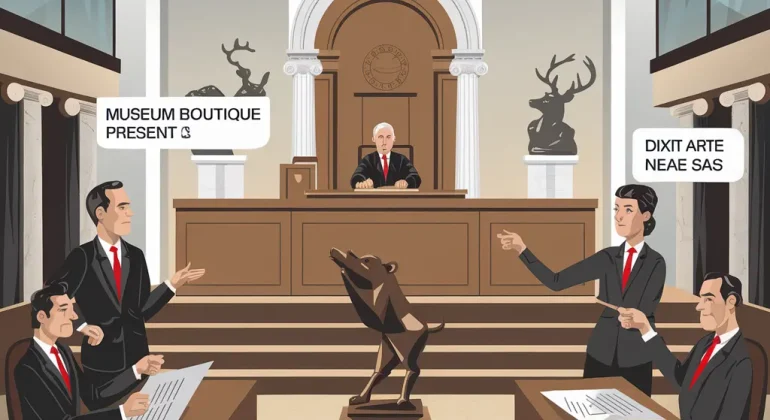
The trademark “POMPON,” registered by a museum boutique operator, faced cancellation proceedings initiated by Dixit Arte SAS. The latter argued that the registration aimed to monopolize the name “Pompon,” associated with the renowned sculptor François Pompon, whose works are part of the public domain.

Key Arguments

At the heart of the case were allegations of bad faith. The plaintiff contended that the trademark holder sought to exploit the public domain status of François Pompon’s name by imposing licensing fees on other legitimate users. This was seen as an attempt to gain undue control over a name that should remain accessible to all stakeholders within the art and heritage sector. The registrant countered that the trademark was filed to protect the integrity of Pompon’s legacy and ensure high-quality reproductions.

Legal Framework

Establishing Bad Faith

The INPI based its decision on Article L.714-3 of the French Intellectual Property Code, which allows for the cancellation of trademarks filed in bad faith. It requires a comprehensive assessment of the registrant’s intent at the time of filing, as established by European case law. Factors such as knowledge of prior use by third parties and the broader context of the registration play a decisive role in determining bad faith.

The Role of Evidence in Establishing Intent

Key factors included the registrant’s activity as the manager of museum boutiques in Dijon, which gave him direct exposure to Dixit Arte’s products. Additionally, email correspondence proposing royalty-bearing licenses substantiated the claim that the registration was a deliberate attempt to monetize a name integral to the public domain. The registrant’s argument of safeguarding the artist’s legacy was found to lack credibility given the financial motivations reflected in the evidence.

Decision and Implications

Cancellation of the Trademark

The INPI concluded that the “POMPON” trademark was filed with the intent of creating an undue monopoly on a public domain name. By restricting access to a term essential for the reproduction and sale of François Pompon’s works, the registrant sought to exploit the trademark system in a manner inconsistent with its intended purpose.

Implications for Future Trademark Applications

This decision underscores the necessity of ensuring good faith in trademark applications, particularly in cases involving public domain elements. Businesses must exercise due diligence to confirm that their filings align with the principles of fairness and do not obstruct legitimate commercial practices. This ruling also highlights the importance of preserving access to cultural heritage symbols for all stakeholders.

Broader Lessons from the Decision

Safeguarding Public Domain Names

The decision underscores that names linked to public domain works, such as those of François Pompon, should remain freely available to stakeholders. Attempts to impose exclusivity through trademark registration risk contravening the principles of intellectual property law.

Ethical Licensing Practices

The case serves as a reminder of the importance of transparency and fairness in licensing agreements. Leveraging trademarks to extract royalties on public domain names undermines the spirit of free competition and innovation.

Conclusion

The cancellation of the “POMPON” trademark by the INPI sets a precedent against bad faith filings, emphasizing the need for ethical practices in intellectual property management. Businesses must align trademark strategies with the principles of fairness and competition.

For expert guidance on trademark filing and enforcement strategies, subscribe to our newsletter and follow us on LinkedIn and Twitter. Stay informed about critical updates in intellectual property law and leverage our expertise to safeguard your brand’s integrity.

Our firm specializes in trademark protection, ensuring compliance with legal frameworks while maximizing commercial value. Contact us to discuss tailored strategies for your business needs.

For more insights into navigating trademark filings and intellectual property strategies, subscribe to our newsletter and follow us on social media. Our team specializes in providing comprehensive, client-focused advice to help you protect your brand and ensure compliance with evolving legal standards.

The Dreyfus firm collaborates with a global network of intellectual property specialists.

Follow us on social media!

LinkedIn  

Instagram


FAQ

What is bad faith in trademark?

Bad faith in trademark law refers to a situation where an applicant files for a trademark with dishonest intentions. This may include registering a mark solely to block competitors, exploit the reputation of an existing brand, or prevent others from using a term that should remain available in the public domain.

What is bad faith EU trademark?

In the EU, bad faith is defined under Article 59(1)(b) of the EU Trademark Regulation. It applies when a trademark application is filed with the intention of misleading, obstructing competitors, or unfairly benefiting from another party’s reputation. The European courts assess factors such as prior knowledge of third-party use, the applicant’s commercial strategy, and any attempt to abuse trademark law.

How do you cancel a trademark?

A trademark can be canceled through invalidity or revocation proceedings:

  • Invalidity: If the mark was registered in bad faith, lacks distinctiveness, or infringes prior rights.
  • Revocation: If the trademark has not been used for a continuous period of five years or has become misleading to consumers.
    Proceedings can be initiated before the relevant intellectual property office (e.g., EUIPO, INPI) or in court, depending on the jurisdiction.

How to withdraw a trademark?

A trademark can be withdrawn voluntarily by submitting a request to the relevant trademark office. The applicant or owner may request total or partial withdrawal, meaning it may apply to all goods/services or just specific ones.

How do you protect your domain name?

To protect a domain name:

  1. Register it promptly to prevent third-party claims.
  2. Monitor for potential cybersquatting using watch services.
  3. Secure trademarks corresponding to the domain name, strengthening enforcement rights.
  4. Enforce rights through legal actions, such as Uniform Domain-Name Dispute-Resolution Policy (UDRP) or national court procedures.

What are the conflicts of trademarks with domain names?

Conflicts arise when a domain name incorporates a registered trademark without authorization. Key issues include:

  • Cybersquatting: A third party registers a domain with the intent to profit from the trademark owner.
  • Trademark infringement: If a domain creates confusion among consumers, misleading them into thinking it is affiliated with the trademark owner.
  • Reverse domain name hijacking: When a company tries to obtain a domain name illegitimately by claiming false trademark rights.

Resolving such conflicts may involve legal action under UDRP, court proceedings, or negotiations with the domain holder.

Read More

Understanding UDRP Jurisprudence: Key Decisions and Practical Insights

The Uniform Domain-Name Dispute-Resolution Policy (UDRP) was established by the Internet Corporation for Assigned Names and Numbers (ICANN) in 1999 to provide a streamlined and cost-effective for resolving disputes related to domain name registrations. This policy effectively addresses challenges such as cybersquatting and trademark infringement in the constant evolving digital landscape. Over the past two decades, UDRP precedent has evolved significantly, setting critical benchmarks that guide current and future domain name dispute resolutions.

Key Cases Shaping UDRP Jurisprudence

Madonna.com: Protecting Celebrity Names

In Ciccone p/k/a Madonna v. Parisi (2000), Madonna filed a complaint against Dan Parisi and challenged the registration of <madonna.com>, which was used to redirect users to inappropriate content. The WIPO panel ruled in favor of Madonna, emphasizing her rights as a globally recognized artist and the protection afforded by her established trademarks. This case underscored UDRP’s role in safeguarding celebrity identities against misuse.

Takeaway: In these types of cases, demonstrating fame and trademark rights, even for personal names, is crucial to success under UDRP.

Panavision.com: Battling Cybersquatting

Panavision Int’l, L.P. v. Toeppen (1999) sets the stage for addressing cybersquatting. The respondent, Dennis Toeppen, registered <panavision.com> to demand payment from the trademark holder. The panel ruled this conduct constituted bad faith, highlighting the UDRP’s utility in combating such exploitative practices.

Takeaway: Registering domains primarily for financial extortion constitutes clear evidence of bad faith.

Sting.com: Navigating Generic Terms

In Sumner p/k/a Sting v. Urvan (2000), the musician Sting failed to secure the domain <sting.com>, as the respondent demonstrated its generic nature and lack of exclusive association with the complainant. The panel noted that UDRP protects trademarks, not dictionary words, unless secondary meaning is proven.

Takeaway: The generic nature of a domain name complicates claims under the UDRP unless clear trademark rights are demonstrated.

Wal-MartSucks.com: Protecting Trademarks from Misuse

This case involved the domain <wal-martsucks.com>, registered by Richard MacLeod. The panel concluded that MacLeod had registered the domain in bad faith, aiming to attract users by creating confusion with the Wal-Mart trademark. The decision emphasized the UDRP’s stance against domains that incorporate trademarks to mislead or criticize without legitimate non-commercial use.

Takeaway: The UDRP consistently upholds the principle that domain names incorporating trademarks cannot be used to mislead, tarnish, or exploit the brand’s reputation under the guise of criticism unless supported by legitimate non-commercial use. This case reinforces the need for complainants to demonstrate how such domains create confusion or harm their brand’s integrity.

Trends and Practical Recommendations for UDRP Practitioners

Rising Caseloads:

WIPO reported over 6,000 cases in 2023, marking a 7% increase from the previous year. This surge reflects the growing challenges faced by brand owners in protecting their trademarks online. Notably, 82% of these cases resulted in the transfer of the disputed domain names to the complainants, demonstrating the effectiveness of the UDRP process in addressing cybersquatting. With the introduction of new gTLDs, vigilance and proactive measures are essential for brand protection.

Critical Elements for Success:

Complainants must establish:

  • The domain name is identical or confusingly similar to their trademark.
  • The respondent has no legitimate interest in the domain.
  • The domain was registered and is being used in bad faith.

Strategic Considerations:

  • Preemptive Registrations: Secure key domains proactively.
  • Evidence Collection: Document respondent behavior indicating bad faith.
  • Supplementary Responses: Address gaps or rebuttals proactively where panels permit.

Practical Examples:

  • com: This case demonstrated the value of early action when the complainant reclaimed her name from misuse in an auction setting.
  • com: Highlighted the necessity of proving bad faith beyond legitimate business use to succeed under the UDRP.

Conclusion: The Role of Expertise in Domain Disputes

The evolution of UDRP jurisprudence over the past two decades has provided a robust, internationally recognized framework for resolving domain name disputes efficiently. Landmark decisions have clarified the policy’s application, balancing the rights of trademark holders with legitimate domain name registrants. As the digital landscape continues to evolve, staying informed about UDRP developments and best practice is crucial for brand owners and legal practitioners alike.

FAQ on UDRP and Domain Name Disputes

  1. What are the three elements of UDRP?
    The UDRP requires the complainant to prove: (1) the domain name is identical or confusingly similar to a trademark in which they have rights, (2) the domain holder has no legitimate interests in the domain, and (3) the domain was registered and is being used in bad faith.
  2. What are the grounds for a domain name dispute?
    A domain name dispute arises when a registered domain is alleged to infringe on another party’s trademark rights. Common grounds include cybersquatting, bad faith registration, and unauthorized commercial use of a trademarked term.
  3. What is the UDRP dispute-resolution policy?
    The UDRP (Uniform Domain-Name Dispute-Resolution Policy) is a procedure established by ICANN for resolving domain name disputes related to trademark infringement. It provides an alternative to litigation, allowing trademark owners to recover domains through arbitration.
  4. What are the three key domains?
    In domain name disputes, the three key domains often refer to: (1) Generic Top-Level Domains (gTLDs) such as .com, .net, and .org, (2) Country Code Top-Level Domains (ccTLDs) like .fr or .uk, and (3) New gTLDs introduced to expand the domain space (e.g., .store, .tech).


For comprehensive assistance in navigating domain name disputes and protecting your intellectual property rights, our firm offers expert legal services tailored to your needs. Dreyfus Law Firm is in partnership with a global network of attorneys specializing in Intellectual Property.

The Dreyfus firm collaborates with a global network of intellectual property specialists.

Follow us on social media!

LinkedIn  

Instagram

Read More

Sony Computer Entertainment Europe Ltd v. Datel Design and Development Ltd (Case C-159/23)

On October 17, 2024, the Court of Justice of the European Union (CJEU) delivered a pivotal judgment in the case of Sony Computer Entertainment Europe Ltd v. Datel Design and Development Ltd (Case C-159/23). This decision addresses the extent of copyright protection for computer programs under Directive 2009/24/EC, particularly concerning software that modifies variable data during program execution without altering the program’s source or object code.

Background of the case

Sony, a leading developer and distributor of PlayStation consoles and associated video games, initiated legal proceedings against Datel, a company specializing in software and devices that interact with gaming consoles. It identified that Datel was marketing products such as the “Action Replay PSP” software and the “TiltFX” device. These products allowed users to alter gameplay by unlocking features or modifying controls, achieved by running concurrently with Sony’s games and altering variable data in the console’s random access memory (RAM) during execution. Sony contended that such modifications infringed upon its exclusive rights to authorize alterations of its computer programs, as protected under Directive 2009/24/EC on the legal protection of computer programs.

Legal questions referred to the CJEU: Analysis and judgment

The Bundesgerichtshof (Federal Court of Justice, Germany) referred two primary questions to the CJEU:

  1. Scope of Protection: Does the modification of variables transferred to a computer’s RAM by a protected program, without altering its source or object code, fall within the protection afforded under Article 1(1) to (3) of Directive 2009/24/EC?
  2. Definition of Alteration: Does such modification constitute an “alteration” under Article 4(1)(b) of the Directive, which grants the copyright holder exclusive rights to authorize or prohibit any alteration of their computer program?

In its deliberation, the CJEU focused on the interpretation of “forms of expression” of a computer program as protected under Article 1 of Directive 2009/24/EC. The Court emphasized that protection extends to the program’s source code and object code, as these are the expressions that enable the reproduction or subsequent creation of the program. Conversely, elements such as functionalities, programming languages, and data file formats do not constitute protected forms of expression.

The Court concluded that the content of variable data inserted by a program into a computer’s RAM during execution does not fall within the protection conferred by the Directive, provided that such content does not enable the reproduction or subsequent creation of the program. Consequently, modifying these variables without altering the source or object code does not constitute an infringement of the copyright holder’s exclusive rights under Article 4(1)(b).

Implications of the decision

This judgment delineates the boundaries of copyright protection for computer programs within the EU, clarifying that:

  • Variable Data vs. Source Code: Alterations to variable data during program execution, which do not impact the source or object code, are outside the scope of protection under Directive 2009/24/EC.
  • Functional Modifications: Software that interacts with existing programs by modifying runtime variables, without altering the program’s code, does not infringe upon the exclusive rights of the original program’s copyright holder.

This decision has significant ramifications for developers of ancillary software, such as game enhancement tools or customization applications, affirming that certain modifications at the execution level are permissible under EU copyright law.

Conclusion

The CJEU’s ruling in Case C-159/23 provides critical guidance on the interpretation of copyright protection for computer programs, particularly concerning the distinction between protected forms of expression and permissible modifications during program execution. This clarification is essential for both software developers and rights holders in understanding the legal parameters of program modification and the scope of intellectual property rights within the European Union.

At the Dreyfus firm, we bring expertise across all areas of intellectual property, including copyright law, to provide you with the highest level of guidance and protection for your rights and innovations.

The Dreyfus firm collaborates with a global network of intellectual property specialists.

Follow us on social media!

Read More

US trademark protection: which filing basis and use evidence should a foreign business prepare?

Commercial label, application file and US outline representing a trademark strategy.
A US application should connect the legal basis, claimed goods and actual commercial exploitation.

A French or EU trademark does not cover the United States. Strong protection there requires a US registration, obtained by filing directly with the USPTO or by extending an international registration. There are several legal grounds for such a filing, and they do not carry the same obligations. A foreign business must also plan for qualified representation and preserve the required evidence, including after registration. Choosing the route should reflect the actual project rather than only the filing cost.

Preparation should begin before sales, a distribution agreement or packaging production. A sign available in Europe may encounter earlier rights in the United States, while a European specification may need adaptation to US requirements. An international trademark strategy connects those checks with launch objectives. It avoids assuming that a six-month priority claim guarantees registration or permanently removes the need to use the mark. For international legal teams, a consistent file supports correspondence with US counsel and monitoring of office notices throughout the process. It also identifies which commercial documents the business must supply before statements are made.

Key points in 41 seconds

Watch on YouTube

Expertise and the scope of the assessment

An intellectual property assessment helps evaluate, before any filing, the availability of the sign and the filing basis. Nathalie Dreyfus’s qualifications can be checked through the official directories: the Paris Court of Appeal 2026 directory (PDF), under trademarks and designs, the Court of Cassation directory, 2025 edition (PDF), and the CNCEJ directory. Listings relate to defined specialisms. A private opinion is distinct from a court-ordered investigation. The engagement is defined according to the matter and the skills required.

Search earlier rights before selecting the route

A prior-rights search should not be limited to whether an identical sign appears on a register. Similar signs, goods and services and relevant uses must also be considered. In the United States, a mark that is simply used, even if unregistered, can also block an application. A trademark law assessment should therefore include the commercial context instead of promising availability from an identical-name search alone.

The owner, sign to be filed and activities genuinely planned should be determined. Filing the name alone (word mark) or the logo does not protect the same thing. Two points often cause difficulties. First, the application must be filed in the name of the actual owner of the mark: in the United States, an application filed by someone who is not the owner (for example the director instead of the company, or a distributor) is void and cannot be corrected. Second, the mark filed must match the mark shown on the products: if the logo changes between filing and launch, the use evidence may be refused. The launch timetable should allow these matters to be examined before making commitments that are difficult to change, especially where distributors are already preparing their own communications.

Distinguish the filing bases

Section 1(a): established use

This basis requires the mark to be already used to sell the goods or services in the United States (“use in commerce”). Statements must be supportable and an appropriate specimen supplied for the goods or services concerned, meaning evidence of that actual use (a label, packaging or an online sales page, for example) for each good or service. The existence of a business or a website accessible from the United States is not sufficient by itself. USPTO guidance on filing bases provides the starting framework.

Section 1(b): a genuine intention to use the mark

Where use has not begun, a bona fide intention to exploit the mark may provide a basis. That intention should be taken seriously and documented. The mark is registered only once actual use has been proven. That evidence must be filed within six months of the USPTO’s Notice of Allowance, a deadline that can be extended in six-month periods up to three years in total. Launch plans, agreements and relevant preparation should be retained without manufacturing supposed use to complete the file.

Sections 44(d) and 44(e): priority and foreign registration

Section 44(d) allows the applicant to rely on the date of its first foreign application, provided the US application is filed within six months. It is not, by itself, a basis for final registration. It must be combined with another basis: use, intent to use or foreign registration. Section 44(e) relies on a registration in the applicant’s country of origin. This route avoids proving use before registration, but the applicant must have a genuine intention to use the mark in the United States and will need to prove use to maintain it.

Section 66(a): a US designation under Madrid

The owner of a trademark can extend it to the United States through the Madrid international trademark system. The designation remains subject to US examination and does not guarantee acceptance of the specification or sign. The basic file, international registration and responses to any refusals must be coordinated. Madrid should not be treated as an automatically accepted right in every designated territory.

Plan for a qualified US attorney

The USPTO requires foreign-domiciled applicants to have a US-licensed attorney. For Madrid applications under section 66(a), representation is required when a refusal or other office action needs a response. Contact details and authority should be arranged according to the procedure concerned rather than assumed from the international filing.

French counsel can coordinate strategy and documents with US counsel. That coordination does not replace the qualification needed to practise before the USPTO.

Prepare genuine, appropriate use evidence

The USPTO distinguishes the representation of the mark (the “drawing”) identifying the requested sign from a specimen showing actual use. Its official specimen guidance explains that mock-ups, proposed packaging and digitally altered images are not acceptable evidence of use. Advertising may be suitable for services without being sufficient for goods. The purpose of the document should be checked before it is submitted.

Collection should relate to the goods and services actually claimed. Labels, packaging and commercial webpages must demonstrate relevant use. An isolated invoice should not be presumed sufficient. Preserving dates, versions and trading conditions allows counsel to review the evidence before a declaration is made. Commercial teams should understand why projected visuals and real transactions cannot be treated as equivalent.

Budget for costs and maintenance

The USPTO’s official information states a base electronic fee of USD 350 per class for the relevant section 1 and 44 applications. Surcharges and later filings may add costs. This excludes professional fees and should not be presented as a single price for a Madrid designation, for which a US individual fee is paid to WIPO.

The budget should include searching, drafting, counsel, possible responses, use evidence and monitoring. Official fees should be checked at the transaction date. Maintaining a direct registration includes a use declaration between the fifth and sixth anniversaries and formalities around the ninth and tenth anniversaries, then periodically, as explained in the official maintenance timetable.

A Madrid extension also requires US formalities, including a declaration of use under section 71 between the fifth and sixth anniversaries of the US registration of the extension, alongside the ten-year renewal of the international registration. The calendars can have different starting points. A record should therefore distinguish the US registration, international registration and contractual obligations. Paying WIPO does not automatically satisfy every US requirement. Responsible team members and advisers should be assigned to each relevant deadline.

Collaboration between French and US counsel

French IP counsel connects the project, existing registrations and commercial documents. US counsel checks the eligible basis, local requirements and office responses. Lawyers working on distribution contracts ensure commitments are consistent with the rights strategy. This allocation avoids treating a use declaration as a routine formality and clarifies each adviser’s responsibility. It also helps operational teams provide the evidence needed at the right time.

Illustrative case study

A fictional business owns a French trademark and plans US cosmetics sales. A distributor requests evidence of protection before signing. The team wants to claim priority from its French application and submit a packaging mock-up as evidence of use, although sales have not begun and the specification has not been reviewed against the US project.

Counsel would examine the foreign filing date to check whether a French priority claim is still open, the possible registration basis and launch preparations. The mock-up would not be used as evidence of use. The sign and goods would be checked before selecting the relevant route, with a timetable for evidence. The agreement would define the distributor’s uses and collection of the necessary documents, including records of the version actually used.

The intended result would be a procedure consistent with the project’s true stage rather than a premature declaration. Monitoring would connect office notices, the launch and maintenance deadlines. This illustrative scenario does not describe a client matter or guarantee acceptance or a registration timeframe. The office’s examination remains a separate step in the process.

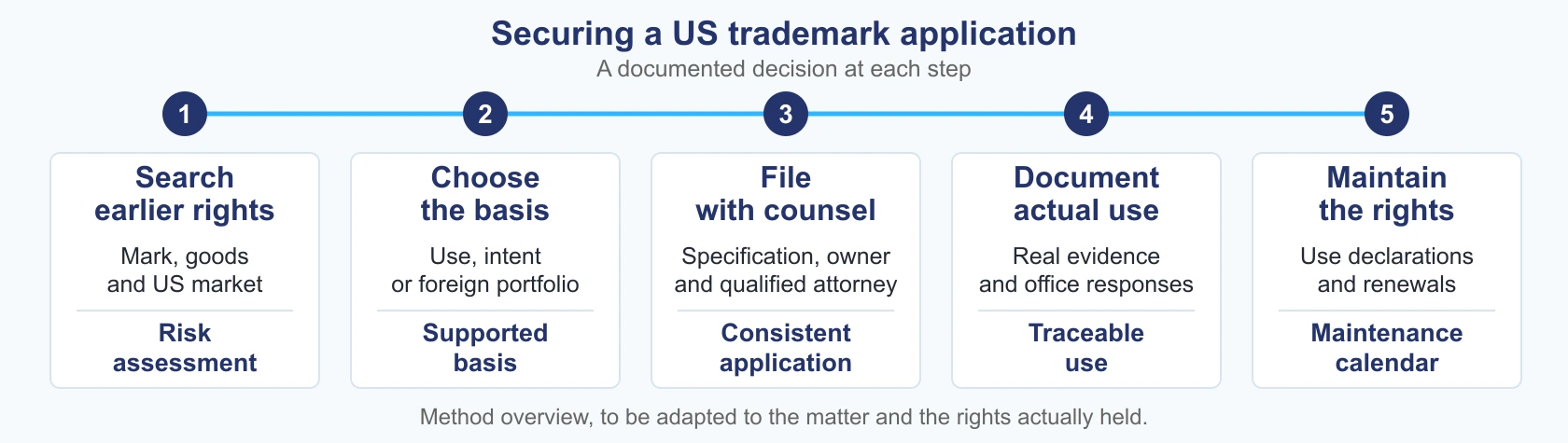
A five-step filing process

Search earlier rights, choose the basis, file with counsel, document use and maintain the rights.
Maintenance planning should start when the filing basis is selected.
  1. Search earlier rights. Assess signs, goods and US uses.
  2. Choose the legal basis. Check use, intent and foreign rights.
  3. File with counsel. Confirm owner, specification and representation.
  4. Document use. Connect evidence and distribution agreements.
  5. Maintain and monitor. Plan declarations and trademark monitoring.

FAQ on US trademarks

Is French priority enough to secure registration?

No. Priority must be distinguished from the basis permitting registration. The applicable sections’ conditions must be met. Filing in France does not resolve the US examination or remove earlier-rights issues.

Does a foreign basis permanently remove use requirements?

No. Certain routes permit registration without a prior specimen, but US maintenance obligations remain. The intention to exploit and future declarations should be considered in the initial strategy, not only when an anniversary approaches.

Can a mock-up or edited visual be submitted as a specimen?

No. An image illustrating future use does not demonstrate actual use. Mock-ups and digitally altered materials should not be presented as commercial evidence. The file must be reviewed with local counsel before submission.

Does Madrid remove the need for US counsel?

No. As soon as the USPTO issues an office action requiring a response (a provisional refusal, for example), a US attorney must act. Representation and deadlines must be organised even where the international application was submitted through another route.

Why work with Dreyfus

Dreyfus advises businesses and their counsel on trademark strategy and international coordination. The objective is to connect assets, the commercial launch and qualified advisers with an evidence and maintenance timetable operational teams can understand. Each local requirement is addressed within the appropriate professional scope.

Conclusion

A US application should reflect actual use and the existing portfolio. To define the search, the legal basis of the filing and coordination with local counsel, contact Dreyfus for an initial confidential discussion.

Dreyfus & Associés law firm partners with a global network of lawyers specializing in intellectual property.

Read More

Understanding the European Union trademark (EUTM)

Navigating the world of trademarks can be complex, especially when it comes to the European Union Trade Mark (EUTM).
This system offers a unique opportunity: it allows businesses to protect their brand across all EU member states with a single application.

But what does the process involve? How does it differ from national trademarks?
This article provides a comprehensive guide to the EUTM, covering the application process, benefits, and legal considerations.

Whether you’re a business owner, a legal professional, or just curious, keep reading. Let’s explore the world of the European Union Trade Mark.

What is the European Union Trade Mark (EUTM)?

The European Union Trade Mark (EUTM) is a crucial asset for businesses. It is a unified trademark system that grants protection across all EU member states with just one application.

Managed by the European Union Intellectual Property Office (EUIPO), the EUTM offers a cost-effective and streamlined registration process. This is particularly beneficial for businesses looking to expand their market reach across Europe.

A key feature of the EUTM is its uniformity:

  • One trademark = protection in all EU countries
  • The same rights and legal standing apply in every member state

Who can register an EUTM?

To qualify, a trademark must be distinctive—it must clearly distinguish goods or services from those of competitors.

  • Generic or purely descriptive names cannot be registered
  • The trademark can be a word, logo, shape, color, sound, or even a combination of these elements

In short, the EUTM is a powerful tool for businesses seeking to protect their brand across the European Union.

Benefits of Registering a European Union Trade Mark (EUTM)

Registering an EUTM comes with significant advantages, especially for businesses operating across multiple EU countries.

Key benefits:

  • Single registration = protection in all EU member states
  • Cost-effective: One application is cheaper than multiple national filings
  • Simplified administration: Manage your trademark centrally via EUIPO
  • Stronger brand protection: Enforce rights across all EU countries
  • 10-year protection, renewable indefinitely

Industry-specific advantages:

  • Fashion & luxury goods: Protects against counterfeit sales across the EU
  • Tech & software: Secures brand identity in a rapidly evolving market
  • Agriculture & regional products: Helps protect geographical indications (GI) and designations of origin

By securing an EUTM, businesses strengthen their brand presence in one of the world’s largest markets.

How to Apply for an EUTM

The European Union Intellectual Property Office (EUIPO) handles all EUTM applications.

Step-by-step application process:

  1. Conduct a trademark search
    • Use TMview to check for existing trademarks and avoid conflicts
  2. Prepare your application
    • Choose your trademark type (word, logo, etc.)
    • List goods & services using the Nice Classification system
  3. File your application online via EUIPO
    • The basic fee is €850 for one class of goods/services
    • Additional fees apply for extra classes (€50 for the second, €150 for each extra class)
  4. EUIPO examination
    • EUIPO checks if your trademark meets legal requirements (e.g., distinctiveness)
  5. Publication & opposition period
    • Your trademark is published in the EU Trade Marks Bulletin
    • Third parties have three months to file oppositions
  6. Final registration
    • If no opposition is filed, or if opposition is rejected, your trademark is officially registered
    • You receive a registration certificate valid for 10 years

A well-prepared application reduces delays and increases approval chances.

EUTM vs. National Trademarks vs. Madrid System

Feature EUTM National Trademark Madrid System
Coverage All EU countries (27) One country only Multiple countries (incl. non-EU)
Cost-effectiveness One fee for the entire EU Separate fees per country Covers global markets
Enforcement Unified rights across EU Must enforce in each country separately Protection varies by country
Best for… Businesses targeting the entire EU Local businesses Companies expanding worldwide

Which one to choose?

  • If your focus is the EU market, an EUTM is the best option
  • If you only operate in one or two countries, a national trademark might be more practical
  • For international protection, consider using the Madrid System to cover multiple regions

After Registration: Rights & Responsibilities

Once your EUTM is registered, you gain exclusive rights across all EU member states.

Your rights:

  • Use the ® symbol to signal trademark protection
  • Take legal action against infringers anywhere in the EU
  • License or sell your trademark

Your responsibilities:

  • Use it or lose it: If your trademark isn’t used for five consecutive years, it can be revoked
  • Monitor for infringements: Regularly check online & offline markets for unauthorized use
  • Renew every 10 years to maintain protection

Consider using trademark monitoring services to detect infringement early.

The Impact of Brexit on EUTM

Since Brexit (January 1, 2021), EUTMs no longer cover the UK.

Key Brexit changes:

  • EUTMs remain valid in the EU (27 countries)
  • Existing EUTMs were automatically converted into UK trademarks
  • New UK trademarks must now be filed separately

If you operate in both the EU and UK, you must manage your trademarks separately.

Common Mistakes & How to Avoid Them

  1. Mistake: Not conducting a trademark search
    Solution: Use TMview to check for conflicts before applying
  2. Mistake: Choosing a generic name
    Solution: Pick a distinctive and non-descriptive brand name
  3. Mistake: Submitting an incomplete application
    Solution: Double-check that all details and classifications are correct
  4. Mistake: Not renewing on time
    Solution: Set reminders for the 10-year renewal deadline

Conclusion: Why a Strategic Approach Matters

Registering an EUTM is a valuable investment for businesses expanding across Europe.

  • It provides strong legal protection
  • It helps build a unified brand identity
  • It simplifies trademark management across 27 countries

By carefully planning your application, avoiding common pitfalls, and actively protecting your trademark, you can ensure long-term brand success in the European market.

Ready to register your EUTM? Start your application today at EUIPO.

Would you like any additional refinements or industry-specific details?

FAQ: European Union Trade Mark (EUTM)

  1. What is the EUTM, and how does it differ from national trademarks?
    The EUTM is a single trademark registration valid across all EU member states. Unlike national trademarks, it offers uniform protection in 27 countries through one application.
  1. How much does it cost to register an EUTM?
    The basic fee is €850 for one class of goods or services. Additional classes cost €50 for the second class and €150 for each subsequent class.
  1. Can I modify my EUTM after registration?
    Yes, but modifications are limited to minor changes that do not alter the trademark’s identity. Adding new goods or services requires a new application.
  1. What happens during the opposition period?
    The opposition period lasts three months after publication. Third parties can challenge the trademark based on prior rights, requiring the applicant to provide evidence to defend their case.
  1. How long does the EUTM registration process take?
    Typically, it takes 4–6 months, provided there are no oppositions or complications.
  1. What rights does the ® symbol grant?
    The ® symbol indicates that your trademark is officially registered. It serves as a deterrent to infringers and enhances your brand’s credibility.
  1. Can an EUTM be revoked?
    Yes, an EUTM can be revoked for non-use over five consecutive years or if it becomes generic or misleading.
  1. How does Brexit affect my EUTM?
    Since Brexit (January 1, 2021), EUTMs no longer cover the UK. Existing EUTMs were automatically converted into comparable UK trademarks.
  1. What should I do if my trademark application is rejected?
    You can file an appeal or amend your application to address the reasons for rejection. Consider legal counsel for complex cases.
  1. How do I enforce my EUTM rights?
    You can take legal action against infringers in any EU member state. Monitoring tools and legal support help detect and address violations effectively.

Protect your trademarks and business reputation with expert legal guidance. Contact Dreyfus Law Firm today for strategic advice on EUTM registration, enforcement, and cancellation actions before the EUIPO. Secure your brand’s future now!

Read More

How to win a cancellation action against a European trademark ?

How to win a cancellation action before the EUIPO?

Protecting trademarks effectively within the European Union requires a deep understanding of the legal mechanisms available to challenge the validity or use of a registered trademark. The invalidity and revocation procedures, collectively referred to as “cancellation proceedings,” before the European Union Intellectual Property Office (EUIPO) provide rights holders and third parties with tools to maintain the integrity of the trademark register.

In 2024, approximately 2,000 cases have been consistently initiated each year since 2021, showing a stable trend with a slight decrease. Meanwhile, revocation proceedings have remained stable at approximately 500 per year since 2021, with a slight upward trend observed.

Introduction to Invalidity and Revocation Procedures

The invalidity and revocation procedures aim to challenge the validity or continued use of a registered European Union trademark (EUTM). Invalidity disputes the trademark’s validity at the time of registration, while revocation addresses the loss of the trademark owner’s rights due to post-registration circumstances.

Invalidity Procedure

A trademark can be declared invalid based on absolute or relative grounds.

Absolute Grounds for Invalidity

A trademark may be invalidated if, at the time of registration, it:

  • Lacked distinctiveness.
  • Was descriptive of the goods or services in question.
  • Contravened public order or morality.
  • Was liable to mislead the public regarding the nature, quality, or geographical origin of the goods or services.

Relative Grounds for Invalidity

A trademark may also be invalidated if it infringes upon prior rights, such as:

  • An earlier identical or similar trademark for identical or similar goods or services, creating a likelihood of confusion.
  • Copyright, design, trade name, or company name rights.

Revocation Procedure

Revocation addresses the improper use or non-use of a trademark following its registration.

Non-use of the Trademark

The owner may lose their rights if the trademark has not been put to genuine use in the European Union for an uninterrupted period of five years without valid reasons.

Becoming a Generic Term

If, due to the owner’s actions or inaction, the trademark has become a generic term in the trade for the goods or services it covers, it may be revoked.

Misleading Character of the Trademark

A trademark may also be revoked if its use by the owner or with their consent has become misleading regarding the nature, quality, or geographical origin of the goods or services.

Procedure Before the EUIPO

Application Filing by Your Representative

To ensure a smooth and effective application process before the EUIPO, it is essential to engage a qualified counsel who can provide strategic advice and represent your interests effectively. While it is not mandatory to appoint a representative to file a cancellation action, parties without a domicile, principal place of business, or an effective and genuine industrial or commercial establishment within the European Economic Area (EEA) must be represented by an authorized representative in EUIPO proceedings. Even for those with a presence in the EEA, appointing a representative ensures the process is handled with the expertise required to maximize efficiency and effectiveness.

Adversarial Phase

Once the application is received, the EUIPO verifies its admissibility. If deemed admissible, an adversarial phase begins, allowing the parties to present arguments and evidence. The EUIPO may also request additional information or clarification from the parties.

Decision and Effects

Following the review of arguments and evidence, the EUIPO issues a decision. If the application is successful, the trademark is either invalidated retroactively or revoked from the date of the decision. These decisions can significantly impact the trademark landscape within the EU.

Appeal Process

Decisions by the EUIPO can be challenged through a well-defined appeal process:

  1. Appeal to an EUIPO Board of Appeal: This must be filed within two months from the date of notification of the decision. A written statement detailing the grounds of appeal is required.
  2. Appeal to the General Court of the European Union: If dissatisfied with the Board of Appeal’s decision, an appeal can be lodged within two months from the notification of that decision. This process examines the legality of the decision but does not re-assess the facts.
  3. Referral to the Court of Justice of the European Union (CJEU): A further appeal on points of law can be made within two months of the General Court’s decision. The CJEU reviews legal errors but does not revisit the case’s substance.

Recent Trends and Emerging Practices

Use of Artificial Intelligence in Trademark Searches

With the increasing reliance on AI tools, many businesses now utilize AI-driven platforms for pre-registration trademark searches. These tools enhance precision and speed in identifying potential conflicts, reducing the likelihood of disputes.

Impact of Blockchain on Trademark Authenticity

Blockchain technology offers a secure and transparent method for proving trademark use. By maintaining immutable records, it ensures authenticity and provides robust evidence in revocation proceedings.

Practical Tips for Success in Cancellation Actions

  1. Conduct Comprehensive Pre-Filing Research: Ensure thorough investigation of potential conflicts or grounds for cancellation using tools like TMview.
  2. Maintain Robust Documentation: Keep detailed records of trademark usage to counter non-use allegations.
  3. Engage Expert Counsel Early: Involve experienced legal professionals to navigate the complexities of EUIPO procedures.
  4. Leverage Evidence Effectively: Present compelling evidence, such as market surveys or sales data, to support your claims or defense.

Strategic Approaches to Cancellation Actions

Proactive Risk Assessment

Before initiating a cancellation action, it is critical to conduct a comprehensive risk assessment. This involves analyzing the targeted trademark’s weaknesses, such as lack of distinctiveness or non-use, and identifying supporting evidence to strengthen your case. Using tools like TMclass and DesignView can streamline this process and ensure a strategic approach.

Collaborating with Regional Experts

Trademark laws and practices can vary subtly between EU member states. Collaborating with local IP experts who understand jurisdictional nuances ensures your cancellation strategy aligns with both EUIPO standards and local regulations.

Tailoring Arguments for Absolute and Relative Grounds

When challenging a trademark based on absolute grounds, highlight legal principles such as descriptiveness or violation of public order. For relative grounds, focus on substantiating prior rights through market research, survey evidence, and sales data.

Case Studies: Lessons from Recent Decisions

Case Study 1: Revocation for Non-Use

In 2023, a tech company successfully revoked a competitor’s trademark on the grounds of non-use. The claimant demonstrated that the trademark owner had not used the mark in commerce for over five years. This case underscores the importance of maintaining detailed records of trademark use.

Case Study 2: Genericization of a Trademark

A recent case involved a prominent food brand losing its trademark due to genericization. The opposing party presented consumer surveys and industry reports showing that the mark had become synonymous with the product category, no longer serving as a source identifier.

Emerging Trends in Trademark Cancellation

AI-Driven Case Analysis

Artificial intelligence tools are being adopted by law firms and businesses to analyze previous EUIPO decisions. These tools can predict potential outcomes and identify the most persuasive arguments, streamlining the preparation process for cancellation proceedings.

Globalization of Trademark Disputes

With the rise of global commerce, trademark disputes increasingly involve cross-border issues. EUIPO decisions are often referenced in cases involving parallel trademarks filed in other jurisdictions, emphasizing the need for a unified global strategy.

Sustainability as a Grounds for Contestation

As sustainability becomes a consumer priority, trademarks misleadingly suggesting eco-friendliness are increasingly being challenged. Leveraging environmental claims can form a compelling basis for cancellation under absolute grounds.

Practical Insights: Preparing Evidence for Success

  1. Collect Robust Documentation

Evidence is crucial in trademark cancellation cases. Compile a comprehensive portfolio that includes:

  • Historical usage records (e.g., invoices, advertising campaigns).
  • Market surveys demonstrating consumer confusion or genericization.
  • Third-party testimonials or affidavits supporting your claims.
  1. Engage Technical Experts

For cases involving complex goods or services, expert opinions can provide critical insights. For example, a technical expert can validate claims about the functionality of a product, supporting arguments for invalidity based on lack of distinctiveness.

  1. Monitor Competitors Proactively

Use trademark monitoring tools to track potential infringements or misuse by competitors. This allows you to initiate cancellation proceedings promptly, protecting your brand equity.

Strengthening the Legal Framework: Recommendations for Businesses

Policy Alignment with Sustainability Goals

Aligning trademark strategies with broader corporate sustainability goals can strengthen the defensibility of trademarks. For example, ensuring that trademarks promoting eco-friendly products are substantiated with solid evidence mitigates the risk of misleading claims.

Adapting to Regulatory Changes

With the EU’s continuous evolution of IP laws, businesses must stay updated on new directives and regulations. Engaging with IP attorneys who monitor these changes can ensure that strategies remain compliant and forward-looking.

Strengthening Evidence Practices

Regularly collect and update documentation related to the use of trademarks, including marketing materials, sales records, and consumer studies. Proactively preparing this data not only strengthens your defense against cancellation actions but also positions you better for asserting your rights in cross-border disputes.

Our Expertise

Handling invalidity and revocation proceedings before the EUIPO demands expertise, precision, and a results-oriented approach. At Dreyfus Law Firm, we specialize in intellectual property law, offering extensive experience in managing cancellation actions and defending trademarks.

Why Choose Dreyfus Law Firm?

  1. Proven Expertise: Our attorneys possess deep knowledge of EUIPO procedures and case law, ensuring robust representation for clients.
  2. Tailored Strategies: We analyze each case individually, crafting solutions that align with our clients’ business objectives and maximize their chances of success.
  3. Cross-Border Capabilities: Our team seamlessly manages cases that span multiple jurisdictions, ensuring a cohesive strategy for global trademark protection.

Comprehensive Services

  • Pre-Filing Analysis: Conducting in-depth assessments of trademarks for invalidity or revocation risks.
  • Preparation and Filing: Drafting detailed and persuasive cancellation applications supported by strong evidence.
  • Effective Advocacy: Representing clients during adversarial proceedings and appeals before the EUIPO and EU courts.

Client Success Stories

  • Revocation for Non-Use: Successfully revoked a dormant competitor’s trademark, allowing our client to expand its brand presence in the EU market.
  • Invalidity on Absolute Grounds: Achieved invalidity of a trademark for being descriptive, ensuring our client’s unique branding was safeguarded against dilution.
  • Defending Against Cancellation: Protected a client’s established trademark by demonstrating genuine use through robust documentation and market evidence.

Commitment to Results

At Dreyfus Law Firm, we are dedicated to providing practical solutions and achieving results that protect our clients’ business interests. Whether filing a cancellation action or defending against one, we deliver unparalleled legal expertise and strategic insight.

Frequently Asked Questions (FAQ)

  1. What is the difference between cancellation and opposition actions?
    Opposition actions occur before a trademark is registered and aim to block the application. Cancellation actions, on the other hand, target trademarks that are already registered.
  2. How long does the cancellation process take at the INPI?
    The average timeline for cancellation actions at the INPI is 6 to 12 months, depending on the complexity of the case and the volume of evidence submitted.
  3. Can I initiate a cancellation action if I am outside France?
    Yes. Non-French entities can initiate cancellation actions, but they must appoint a local representative or authorized attorney to act before the INPI.
  4. What are the costs associated with a cancellation action?
    The INPI charges a fixed administrative fee of €600 for filing a cancellation action. Additional legal fees depend on the complexity of the case and the attorney’s expertise.
  5. Can a cancellation action be appealed?
    Yes. Decisions made by the INPI can be appealed to the Court of Appeal of Paris within one month of notification. Further appeals can be made to the Court of Cassation.
  6. What evidence is required for revocation due to non-use?
    To support a revocation action based on non-use, you must demonstrate:
  • The absence of sales or marketing activities related to the trademark.
  • Lack of trademark visibility in commercial contexts.
  1. How do cancellation actions impact brand reputation?
    While cancellation actions can protect your business, they may also generate publicity. Managing public relations alongside legal strategy is essential.
  1. How do I prove non-use of a trademark?
    To prove non-use, collect evidence such as market analyses, online presence checks, and absence of sales records during the relevant period.
  1. Can I initiate cancellation proceedings outside the EU?
    Yes, parallel actions can be initiated in jurisdictions where the trademark is also registered, provided local laws allow for cancellation based on similar grounds.
  1. What is the success rate for cancellation proceedings at the EUIPO?
    Recent EUIPO data suggests that approximately 40% of invalidity and revocation applications are successful, emphasizing the importance of presenting strong evidence.

Protect your trademarks and business reputation with expert legal guidance. Contact Dreyfus Law Firm today for tailored advice on cancellation actions before the EUIPO. Let us help safeguard your intellectual property rights!

Read More