ICANN data published on October 7, 2026 | Subject to change
Introduction
On October 7, 2026, ICANN, a California-based non-profit organization responsible for coordinating the Internet's system of unique identifiers, including IP addresses and domain names, published 1,615 applications for new Internet extensions (gTLDs), submitted by 481 applicants. This publication, known as Reveal Day, does not mean that the extensions can already be registered. Rather, it marks a decisive stage at which businesses must assess potential risks, ahead of the public comment and objection period from November 17, 2026 to March 16, 2027. These figures remain provisional until String Confirmation Day.
For businesses, the objective is not to register their trademark in every new Internet extension, but to identify those that could infringe their rights or present a risk of fraudulent use. In particular, companies should check whether any proposed extensions reproduce their trademarks and determine whether those extensions will be reserved for a single company or open to the public. Depending on the risks identified, various measures may be considered: challenging an application, monitoring new domain names, recording a trademark with the Trademark Clearinghouse to benefit from protection mechanisms, or making preventive registrations in the most relevant extensions.
Reveal Day 2026: 1,615 applications, .brand extensions and intense competition
The data published by ICANN on October 7, 2026 identify 333 .brand applications, 16 community-based applications, 15 geographical applications, 21 applications in internationalized scripts and nine variant applications. The Applicant Support Program accounts for 51 applications. Most applications come from North America (864) and Europe (506), followed by Asia-Pacific (218), Africa (16), and Latin America and the Caribbean (11).
ICANN’s preliminary list identifies 263 contention sets, i.e. groups of applications competing for the same string. The .agent extension is the most contested, with 13 applications, while .bit, .api, .brand and .hub each attract around ten. These figures may still change as replacement strings are activated and similarities between extensions are examined.
What is a .brand (dotBrand) extension used for?
A .brand extension allows a company to operate its own Internet extension and control the domain names registered under it. Applications for .openai, .adidas and .michelin illustrate this approach, which is intended in particular to make official websites more secure. However, this protection cannot prevent fraudulent websites from being created under other extensions.
Artificial intelligence, trademarks and Europe: the main trends
Companies specializing in artificial intelligence have applied for new extensions corresponding to their products, such as .chatgpt (OpenAI), .gemini (Google) and .claude (Anthropic), as well as technical terms such as .agent and .api. OpenAI alone filed 15 applications. However, some terms may be used by several companies or refer to different activities. Each application must therefore be examined to determine whether it genuinely infringes another company's rights, particularly by creating a likelihood of confusion.
By way of comparison, Reveal Day in 2012 attracted 1,930 applications, compared with 1,615 this year. The 2026 round includes fewer geographical applications and far fewer internationalized ones (21, compared with 116 in 2012), while new applications are more heavily concentrated among registry operators and digital platforms. This comparison should nevertheless be qualified: companies already holding an extension obtained in 2012 did not have to apply again.
In France, applications by companies such as Michelin, Air Liquide, BPCE, Atos and Sodexo highlight the industrial value of .brand extensions. The limited representation of French applicants does not mean that French businesses face little exposure: a generic registry operated abroad may directly affect their market.
ICANN objections: what remedies are available before March 16, 2027?
A Legal Rights Objection is not a UDRP proceeding
A Legal Rights Objection (LRO) is a procedure administered by WIPO that allows an application for a new Internet extension to be challenged where it may infringe earlier rights, particularly a trademark. It differs from the UDRP procedure, which concerns disputes over domain names that have already been registered. Module 4 of the 2026 Applicant Guidebook identifies four grounds for objection:
string confusion;
infringement of existing legal rights (Legal Rights Objection, LRO);
limited public interest;
community-based objections.
An LRO requires the objector to demonstrate standing and a risk of infringement of the rights invoked, in accordance with the criteria specific to the procedure. An existing trademark therefore does not give its holder a veto over every identical string.
It is also important to distinguish the levels of the domain name system: an LRO targets an application for an extension before delegation, whereas the UDRP deals with disputed second-level domain names after registration, for example "trademark.extension". A substantiated public comment may be submitted during the same period to draw the evaluators’ attention to an issue, but it does not replace a formal objection.
What happens when several applicants request the same extension?
Where several companies apply for the same Internet extension, only one can obtain it. Several mechanisms may determine the outcome: granting priority to an application representing a community, allowing an applicant to withdraw its application or choose a replacement extension, or holding an auction if the conflict remains unresolved. Unlike the 2012 round, the 2026 program prohibits private auctions, joint ventures and any other arrangement between applicants intended to resolve such conflicts privately, on pain of disqualification in particular. As explained in ICANN's 2026 Applicant Guidebook (Module 5, Section 5.2.3), these conflicts must be resolved through ICANN's procedures, including Community Priority Evaluation or, as a last resort, an ICANN-run auction.
Timeline and action plan for trademark owners
October 7, 2026: publication of the requested strings, applicants and preliminary contention sets.
October 8-21, 2026: period during which a replacement string may be activated, where applicable.
November 17, 2026: String Confirmation Day and opening of the public comment and objection period.
March 16, 2027: announced deadline for public comments and objections, subject to the requirements applicable to each procedure.
From 2027 onward: evaluation, resolution of competing applications, contracting and gradual delegation of approved extensions.
What measures should be taken once the applications have been published?
Review the strings: cross-check the official list of applications against the trademarks, products, trade names and language variants in the portfolio; also examine the applicant's identity and business model.
Prioritize conflicts: collect trademark registration certificates, evidence of use, evidence of reputation and indications of confusion; assess the legal basis and costs of a potential LRO before March 16.
Prepare for public launches: consider recording the mark with the Trademark Clearinghouse in order to benefit, where eligibility requirements are met, from Sunrise periods and the Trademark Claims mechanism. These services do not automatically prevent third parties from registering domain names.
Adopt a targeted defensive strategy: prioritize the registration of names relevant to customers and exposed to fraud; monitor other extensions and, where appropriate, prepare UDRP actions against abusive registrations.
Reveal Day for the 2026 new gTLDs confirms the rise of .brand extensions and strings associated with artificial intelligence. Above all, it opens a period for legal decisions that runs until March 16, 2027. Companies should identify their priority risks now, without confusing an objection to a proposed extension, the registration of domain names, and subsequent action against cybersquatting.
Dreyfus Law Firm assists its clients in managing complex intellectual property cases, offering personalized advice and comprehensive operational support for the full protection of intellectual property.
How much does it cost to apply for a new Internet extension in 2026?
The application fee set by ICANN is USD 227,000 per extension. Additional evaluation fees, technical costs and expenses associated with operating the registry may apply. An applicant support program also provides discounts for certain applicants who meet its eligibility conditions.
Does owning a .com domain name give priority rights in new extensions?
Owning a .com domain name does not automatically confer rights over its equivalent in a new extension. For example, a company that owns "company.com" does not necessarily acquire "company.shop". Registration depends on the rules of the relevant registry and any earlier rights that may be invoked.
Do new Internet extensions improve Google search rankings?
New extensions do not receive any automatic search-engine optimization advantage. Google treats new gTLDs in the same way as traditional extensions such as .com or .org. Choosing a relevant extension may nevertheless make a website address easier for users to identify.
Are new Internet extensions using non-Latin characters compatible with all online services?
Extensions using scripts such as Arabic, Chinese or Cyrillic may encounter compatibility problems with certain software, online forms and email services. ICANN promotes their universal acceptance, but technical checks remain necessary before professional use, particularly for email addresses.
Is there a procedure faster than the UDRP for taking action against a fraudulent domain name?
The Uniform Rapid Suspension (URS) procedure may provide a rapid means of suspending a domain name, for extensions to which it applies, where there is a clear-cut infringement of trademark rights. Unlike the UDRP, it does not allow the domain name to be transferred.
This publication is intended for general public guidance and to highlight issues. It is not intended to apply to specific circumstances or to constitute legal advice.
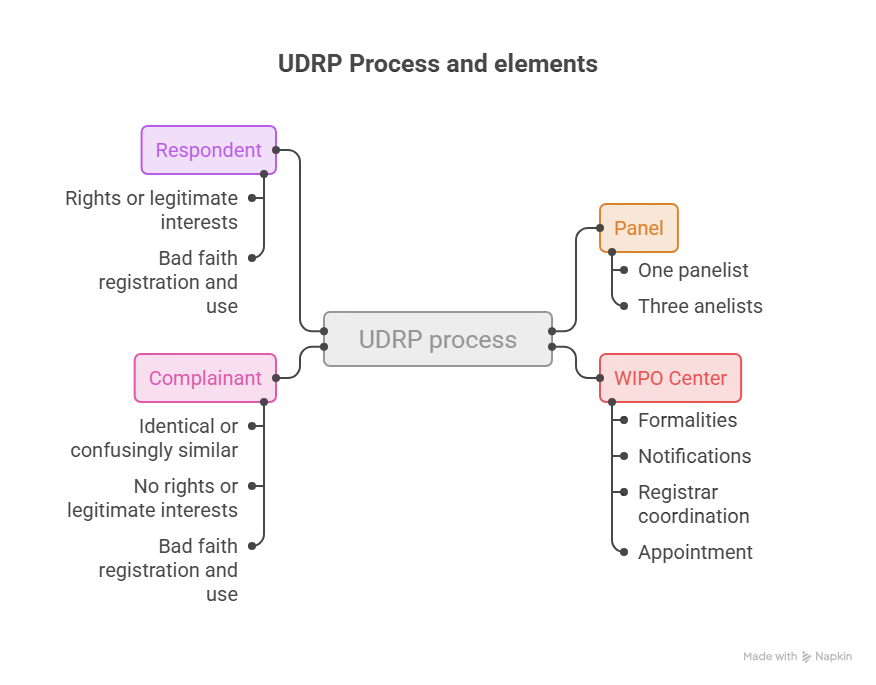
A UDRP panelist, a member of the administrative panel appointed to decide a domain name dispute, is neither the case administrator nor a simple trademark checker. The panelist independently assesses the record, determines the weight of the evidence, and gives reasons within the UDRP’s deliberately narrow framework. The work therefore has three core components: procedural fairness, reconstruction of the relevant facts, and application of the UDRP’s three cumulative requirements.
Generative AI makes that role newly important. The Third Annual Levine Lecture in July 2026, featuring Nick Gardner, was framed around the question: “26 Years of Deciding UDRP Cases: What Does a Panelist Actually Do, and Why? How Will AI Change This?” The real issue is not reading speed, but the boundary between technological assistance and the decision-maker’s personal responsibility. Nathalie Dreyfus, who serves as a panelist for the WIPO Arbitration and Mediation Center, shares a practitioner’s perspective on these questions.
What is the role of a UDRP panelist?
According to the WIPO Guide to the UDRP, a panel consists of one or three impartial and independent individuals. The WIPO Center administers the proceeding (formalities, notifications, registrar coordination, and panel appointment), but does not decide the merits. The panelist decides the case without representing either side and may order transfer or cancellation, deny the complaint, or, where appropriate, find reverse domain name hijacking (RDNH). The UDRP Rules define it as using the Policy in bad faith to attempt to deprive a registered domain-name holder of a domain name. Where the complaint was brought in bad faith, the panel must declare in its decision that it constitutes an abuse of the administrative proceeding (paragraph 15(e) of the Rules); no financial penalty follows, but the finding is published and has a lasting impact on the complainant’s credibility.
The complainant must prove three cumulative elements under paragraph 4(a) of the UDRP Policy:
the domain name is identical or confusingly similar to a trademark or service mark in which the complainant has rights;
the respondent has no rights or legitimate interests in the domain name;
the domain name was registered and is being used in bad faith.
What does a panelist actually do before issuing a decision?
1. Frame the proceeding and rank the evidence
Paragraph 10 of the ICANN UDRP Rules requires equality between the parties and a fair opportunity for each to present its case. The panel also determines the admissibility, relevance, materiality, and weight of the evidence. A screenshot, an undocumented assertion, or a precedent cited without context therefore carries no automatic weight merely because it appears in the record.
2. Reconstruct chronology instead of reading exhibits in isolation
The panelist connects the date trademark rights arose, the domain registration date, registrar-disclosed data, successive website uses, offers for sale, and party communications. Chronology often separates opportunistic targeting from legitimate registration.
3. Check limited public facts without rebuilding a party’s case
The WIPO Overview 3.1accepts limited factual research into public material useful to the merits, such as the disputed website, the Internet Archive, dictionaries, or trademark databases. The purpose is to confirm or corroborate a point, not to find missing evidence for a party. Where outside material may influence the result, procedural fairness may require an opportunity for comment.
Why does human judgment remain central?
The UDRP criteria are clearly defined, but their application always depends on the facts of the case. Legitimate interests, targeting, and bad faith are inferred from circumstances whose significance depends on context. WIPO Overview 3.1 promotes consistency, but neither the Overview nor earlier decisions are strictly binding. A panelist must still explain why the specific record supports the result reached.
How will artificial intelligence change a panelist’s work?
AI can assist document analysis, but it should not become the decision-maker
AI can extract dates, group arguments, compare document versions, translate material, or suggest authorities for verification. Those functions may reduce time spent on preparatory work. They do not replace judgment: factual characterization, credibility assessment, and the weighing of competing inferences remain human decisions.
In its April 30, 2026 Note on the Use of AI in WIPO ADR Proceedings, WIPO emphasizes human decision-making, non-delegation of responsibility, and verification of outputs. The Note has its own scope, distinct from the UDRP, but its governance principles are directly relevant to the risks of uncontrolled automation in dispute resolution.
AI also changes evidence: traceability becomes a credibility issue
The 2026 update to the WIPO Overview 3.1 specifically addresses UDRP arguments or evidence created with AI assistance: credibility may be affected by whether specific prompts, dates, and outputs are provided. AI-generated or AI-transformed material should therefore remain traceable to a verifiable source. Confidentiality matters too: the French Data Protection Authority (CNIL) advises users to submit only information they are authorized to share with generative AI services, particularly where personal or confidential data are involved.
What are the practical consequences for the parties?
AI does not lower the evidential burden; it makes verification more important. In practice, parties should:
preserve source evidence and dates rather than relying only on automated summaries;
verify every decision, quotation, and factual assertion suggested by AI before using it;
present a concise chronology linking each material fact to the relevant UDRP element;
record the provenance of AI-generated material when it plays a material role in the case.
A UDRP panelist remains, above all, a decision-maker: maintaining a fair framework, assessing imperfect evidence, reconstructing chronology, and giving reasons for applying defined criteria. AI may accelerate supporting tasks, but its deeper effect is to increase the importance of verification, provenance, and human accountability. The more capable the tools become, the more important it is to distinguish reliable information from information that is merely plausible.
Dreyfus Law Firm assists its clients in managing complex intellectual property cases, offering personalized advice and comprehensive operational support for the complete protection of intellectual property.
Dreyfus Law Firm works in partnership with a global network of attorneys specializing in Intellectual Property.
Can a party file an unsolicited supplemental submission after the complaint or response?
The UDRP Rules do not create a general right to a second round of pleadings. Unsolicited filings are generally discouraged and their admission is discretionary. The party should explain why the new material matters and why it could not reasonably have been submitted earlier. The panel may itself request further statements or documents when needed.
Can an oral hearing take place in UDRP proceedings?
The procedure is designed to be predominantly written. Paragraph 13 of the UDRP Rules ordinarily excludes hearings, including by teleconference, videoconference, or web conference. A hearing may take place only where the panel determines, in its sole discretion and as an exceptional matter, that it is necessary to decide the complaint.
Who pays when the respondent requests a three-member panel?
If the complainant chose a single-member panel but the respondent requests three members, the three-member panel fees are shared equally. The respondent must pay its half with the response; otherwise, the dispute will be decided by a single-member panel.
How long does a UDRP panel normally have to issue its decision?
Absent exceptional circumstances, paragraph 15(b) of the UDRP Rules provides that the panel should forward its decision to the provider within fourteen days of its appointment. This is the decision period after the panel has been constituted, not the total duration of the proceeding.
What happens if the registrant goes to court after a UDRP transfer decision?
The UDRP does not prevent court proceedings. A registrar ordinarily waits ten business days after receiving notice of a transfer decision before implementing it. If, within that period, it receives the documentation required under paragraph 4(k) showing that qualifying court proceedings have been commenced, implementation is stayed in accordance with the Policy.
This publication is intended for general public guidance and to highlight issues. It is not intended to apply to specific circumstances or to constitute legal advice.
Artificial intelligence can be legally protected, but not through one single right. An AI solution combines code, mathematical models, parameters, data, architecture and know-how. Each component should therefore be matched with the appropriate regime: copyright, patent law, trade secrets, database rights or contracts.
This approach must be coordinated with Regulation (EU) 2024/1689, the AI Act, generally applicable since August 2, 2026, and with the GDPR where personal data is involved. These rules do not create ownership rights in AI itself, but they directly affect design, documentation and asset value.
In an AI project, economic value does not lie solely in the code: it may also arise from data selection, training parameters, fine-tuning methods, the integration architecture or internal procedures used to improve system performance. An effective protection strategy should therefore cover the entire value chain.
Copyright: protecting code without monopolising the algorithm
The judgment delivered by the Full Court of the French Court of Cassation on March 7, 1986 (French Court of Cassation, Full Court, March 7, 1986, No. 83-10.477 – Pachot) recognised that software may be protected where its author demonstrates an individual creative effort going beyond the mere implementation of automatic and compulsory logic, while the Court of Justice of the European Union, in its judgment of July 16, 2009 (CJEU, July 16, 2009, Infopaq International, C-5/08), more broadly established the requirement that a work constitute the author’s own intellectual creation in order to satisfy the originality criterion. Source code, object code, certain modules and technical documentation may therefore be protected automatically where originality can be shown.
Where AI generates or completes code, evidence of human contribution becomes important. Version histories, repositories and an INPI e-Soleau filing may help document creation. For employees, Article L.113-9 of the French Intellectual Property Code provides, subject to its conditions, for the transfer to the employer of economic rights in software; contractor agreements should contain the necessary assignments.
This is particularly important where several individuals or tools contribute successively to the same development. Businesses should distinguish elements actually created by developers, components taken from third-party libraries, portions generated with AI assistance and pre-existing modules integrated into the product. Copyright protection therefore does not remove the need for a code-provenance and licence audit. Model weights, parameters or training methods that do not themselves constitute original expression of a computer program will often depend more heavily on trade-secret protection, contracts and technical confidentiality measures.
The application should identify a concrete technical effect. Merely automating a commercial rule will generally be insufficient. The decision issued by the Enlarged Board of Appeal of the European Patent Office on March 10, 2021 (EPO, Enlarged Board of Appeal, March 10, 2021, G 1/19) confirms that the technical character of a computer-implemented invention cannot arise solely from the fact that it involves calculations or a simulation, but requires those elements to contribute to a technical effect within the claimed invention.
Technical character is nevertheless only one part of the analysis. As with any invention, an AI-related solution must also satisfy the requirements of novelty, inventive step and sufficiency of disclosure. Drafting is therefore critical: the application should explain with sufficient precision how the AI contributes to the claimed technical result and, where that effect depends on particular characteristics of the training data or learning process, disclose the information needed for the skilled person to reproduce the invention. A claim that merely refers to the use of an “AI model” without defining its technical contribution may therefore be inadequate.
For further information on the circumstances in which an artificial intelligence model may benefit from patent protection, we invite you to read our article: “How to protect an AI-trained model?”
Trade secrets, data and contracts: protecting ancillary assets
Beyond intellectual property rights, several mechanisms may protect assets associated with an AI system.
Trade secret protection, governed in particular by Law No. 2018-670 of July 30, 2018 and Article L.151-1 of the French Commercial Code, may apply to confidential information such as model weights, hyperparameters, certain training methods or proprietary datasets. Such protection nevertheless requires concrete confidentiality measures, including restricted access, encryption, traceability and appropriate contractual provisions.
Training databases may also, subject to the applicable conditions, benefit from the sui generis right provided for under Article L.341-1 of the French Intellectual Property Code, where substantial investment has been made in their creation. This protection must be distinguished from rights in the individual materials contained in the database and from the licences authorising their use.
Finally, agreements with employees, contractors or partners should define the conditions governing access to data, fine-tuning, confidentiality and exploitation of the resulting model.
AI Act and GDPR: aligning protection and compliance
The AI Act does not grant IP rights to an AI system, but it affects documentation. For general-purpose AI models, Article 53 notably requires a copyright-compliance policy and a sufficiently detailed summary of training content.
Where personal data is used, the CNIL recommendations on AI development stress purpose, lawful basis, minimisation and security. Third-party models, open-source libraries and code-generation tools also require licence review: provider terms do not remove the need to assess third-party rights.
Compliance and asset protection should therefore be addressed together. Structured records of data sources, model versions, design choices, licences and security measures can both support regulatory compliance and establish the traceability of the know-how developed by the business.
For further information on the processing of personal data in the development and use of artificial intelligence systems, we invite you to read our article: “AI and Data privacy”
Protection strategy
Businesses should :
Map their code, models, data and know-how,
Identify contributors,
Select the appropriate protection for each asset, and
Preserve evidence of ownership, data provenance and licences.
Effective protection of AI therefore results from a combination of rights and organisational measures, rather than from a single registration.
An operational audit can usefully take the form of a matrix recording, for each component, its origin, owner, intended form of protection, licence restrictions, available evidence and authorised users. This approach quickly reveals weaknesses in the chain of rights and facilitates licensing, partnerships, investment and due-diligence exercises.
Conclusion
Can artificial intelligence be legally protected as software? Yes, if protection is structured component by component. Copyright may protect original software expression; patents may cover technical inventions; trade-secret and database law may secure non-public assets; and contracts organise ownership and use rights. AI Act, GDPR and licence compliance should be considered from the design stage.
The strategy should therefore be defined before the product is disclosed and reassessed whenever the system changes materially.
Dreyfus & Associés assists its clients in managing complex intellectual property cases, offering personalized advice and comprehensive operational support for the complete protection of intellectual property.
Can artificial intelligence be protected by copyright?
Original code and documentation may be protected; ideas, functionality and abstract algorithms are not.
Protection focuses on elements reflecting creative choices attributable to a natural person. The more a development relies on automated generation without identifiable creative input, the more important it becomes to document the human choices, corrections and decisions that led to the final version.
How can an AI system incorporating open-source components be protected?
The use of open-source components does not prevent certain proprietary elements of an AI system from being protected, but it requires careful identification of the applicable licences and their obligations. Depending on the licence, specific requirements may apply to redistribution, access to source code or the reuse of modifications.
Maintaining a clear inventory of the components used and their licences helps determine which elements may remain proprietary and which are subject to specific obligations before commercial exploitation.
Who owns code generated with AI?
It depends on human contribution, the developer’s status, contracts, tool terms and possible third-party rights. The use of AI does not, by itself, determine ownership.
The rules applying to employees and contractors, as well as the chain of rights in third-party components, must also be reviewed. An AI tool’s terms may govern the relationship with its provider, but they do not by themselves guarantee that no third-party rights subsist in code used or generated.
How can training data and model weights be protected?
Through trade secrets, database rights and contracts, depending on their nature and confidentiality.
For trade secrets, confidentiality must be supported by effective and proportionate measures. For databases, any protection of the database itself does not automatically mean that the business owns all rights in each individual item contained in it.
Must a business choose between patents and trade secrets?
Not necessarily. A single solution may combine a patent for a technical invention with secrecy for parameters, data or training methods.
The choice will depend in particular on whether infringement can be detected, the risk of reverse engineering and the ability to keep information confidential over time. A patent requires disclosure in exchange for a time-limited exclusive right, whereas secrecy can continue for as long as the legal conditions remain satisfied.
This publication is intended for general public guidance and to highlight issues. It is not intended to apply to specific circumstances or to constitute legal advice.
Practical guide for international legal teams and business leaders
A trademark registered in your home country does not automatically create enforceable rights in France. Before launching a product, service or platform in the French market, an international business must choose the appropriate filing route, confirm ownership, clear the sign, define the goods and services, anticipate oppositions and prepare evidence of use. This guide explains the full French trademark lifecycle from a foreign company’s perspective.
Updated on 29 September 2026. Estimated reading time: 25 minutes.
An operational framework for registering, using, monitoring and enforcing a trademark in France.
French trademark law in 2026, video overview
This video from Dreyfus gives international businesses a concise overview of French trademark law in 2026. It introduces the main filing routes, use requirements and enforcement options before the guide examines each step in detail.
France is an active filing market. The INPI received 103,645 trademark applications in 2025, an increase of 14.1% in one year. Foreign legal entities accounted for 10% of filings. For overseas businesses, this density makes early clearance and a disciplined filing plan commercially important.
This guide complements Dreyfus’s overview of trademark law services in France. Its purpose is to help an international legal or management team connect its home portfolio with French, EU and international rules.
1. What a French trademark does, and does not, protect
A trademark distinguishes the goods or services of one undertaking from those of others. French law can protect word marks, logos, combinations of colours, shapes, sounds, motion, patterns, holograms and multimedia marks, provided that the representation allows the authorities and the public to determine the subject matter of protection clearly and precisely.
The exclusive right is defined by three elements: the sign as filed, the listed goods and services, and the territory covered. Registration does not give a general monopoly over a word in every context. Infringement analysis may involve the signs, the relevant goods or services, the public, the conditions of use and the likelihood of confusion. Marks with a reputation may receive broader protection, but reputation must be supported by evidence.
Your home registration does not automatically extend to France
A US, UK, Chinese, Canadian or other national registration has no automatic territorial effect in France. To obtain a registered right covering France, the business needs a French national right, an EU trademark, or an international registration that is protected in France or the European Union. Well-known marks and certain unregistered rights can be relevant in specific circumstances, but relying on those exceptions is rarely a sound launch strategy.
France does not require a specimen of use when filing
A French application does not require the applicant to submit a specimen or prove current use. This is a material difference for businesses used to US practice. It allows filing before launch, but it does not remove the later obligation to use the mark genuinely. After five years of uninterrupted non-use, the registration can become vulnerable to revocation for some or all of the protected goods and services.
Trademark clearance extends beyond registered marks
Company names, trade names, signs, domain names with more than local reach, geographical indications, copyright, personal names and the names of public entities may also create risk. A useful French clearance exercise therefore combines register searches with market and corporate intelligence.
2. Choose the right route: France, the European Union or Madrid
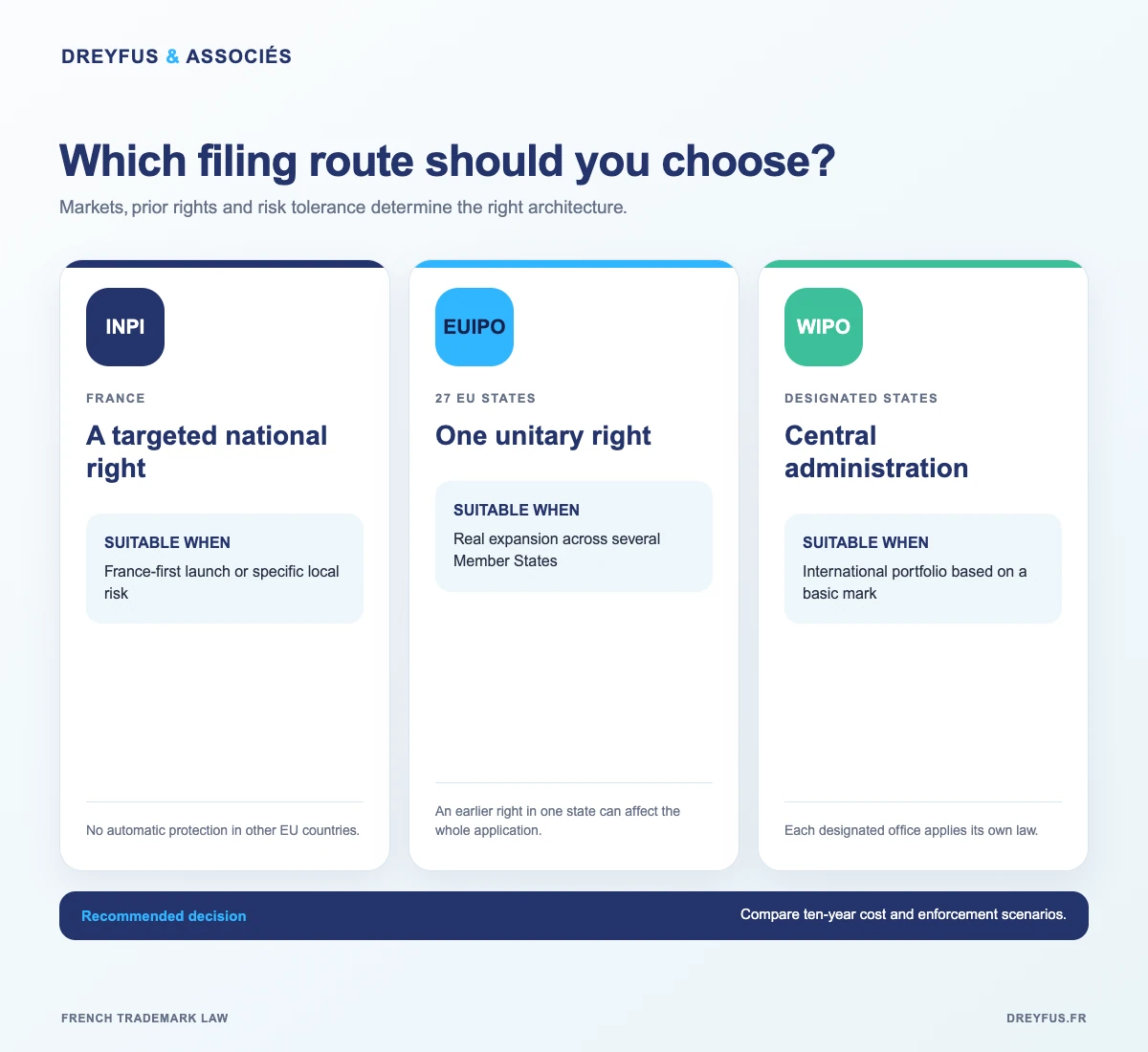
The filing route is the first strategic decision. A business may combine routes, but each filing should have a clear role. An oversized portfolio creates renewal costs and exposes unused goods and services to later challenges.
The appropriate route depends on actual markets, clearance results, the existing portfolio and accepted risk.
Route
Coverage
Main benefit
Main point to test
French trademark, INPI
France
Targeted national right for a France-first launch
No automatic protection in other EU countries
EU trademark, EUIPO
All 27 EU Member States
One unitary right and one filing procedure
A relevant earlier right in one Member State can jeopardise the application across the EU
International registration, WIPO
Selected Madrid System members
Central administration based on a basic mark
Each designated office applies its own law and may issue a provisional refusal
Coordinated national filings
Selected countries
Territory-specific risk management
More local procedures, representatives and deadlines
When a French national filing is often suitable
An INPI filing may be appropriate when France is the first or only EU market, when a known issue in another Member State could threaten a unitary EU trademark, or when the budget calls for a focused national right. A French application may also serve as the basic application for a Madrid filing if the legal and commercial conditions align.
When an EU trademark may be more efficient
An EU trademark can be efficient when the business genuinely plans to operate in several Member States and an EU-wide clearance search does not reveal a critical obstacle. The unitary character simplifies ownership and renewal, but broadens the range of earlier rights that may be asserted. A fallback conversion into national applications can sometimes preserve priority, subject to cost and procedural requirements.
When the Madrid System fits the portfolio
The Madrid System allows a business with the required connection to a member and a basic mark to request protection in multiple territories through a central filing. WIPO performs a formal examination, then each designated office conducts its own substantive review. A WIPO certificate therefore does not mean that protection has been finally accepted in every designated market.
3. Secure ownership before a French launch
The applicant should match the group’s legal and commercial reality. Filing in the name of a French distributor, an individual founder or an operating subsidiary that does not control the brand may create difficulties for licensing, due diligence, fundraising, restructuring and enforcement. Review intra-group arrangements, distribution agreements and royalty flows before filing.
For joint ventures and distributor relationships, the agreement should state who owns new marks, local language versions, domains and social media handles. It should also define who files, pays, monitors, enforces and transfers the assets when the relationship ends. A power of attorney is not a substitute for ownership terms.
If an external agency, consultant or employee created the name, logo, packaging or campaign in another country, review copyright ownership and assignments as well. Paying an invoice does not necessarily transfer all rights required for exploitation in France. Trademark and copyright protection may overlap while belonging to different parties.
4. Clear the sign for the French market
Screen absolute grounds in French
The sign must be distinctive for the goods and services claimed. Descriptive, customary, deceptive or unlawful signs, and certain shapes or characteristics dictated by the goods, may be refused or invalidated. A name that appears suggestive in English can be directly descriptive or misleading to French consumers. Clearance should test French meaning, pronunciation, transliteration, cultural associations and likely consumer understanding.
Search for identical and similar rights
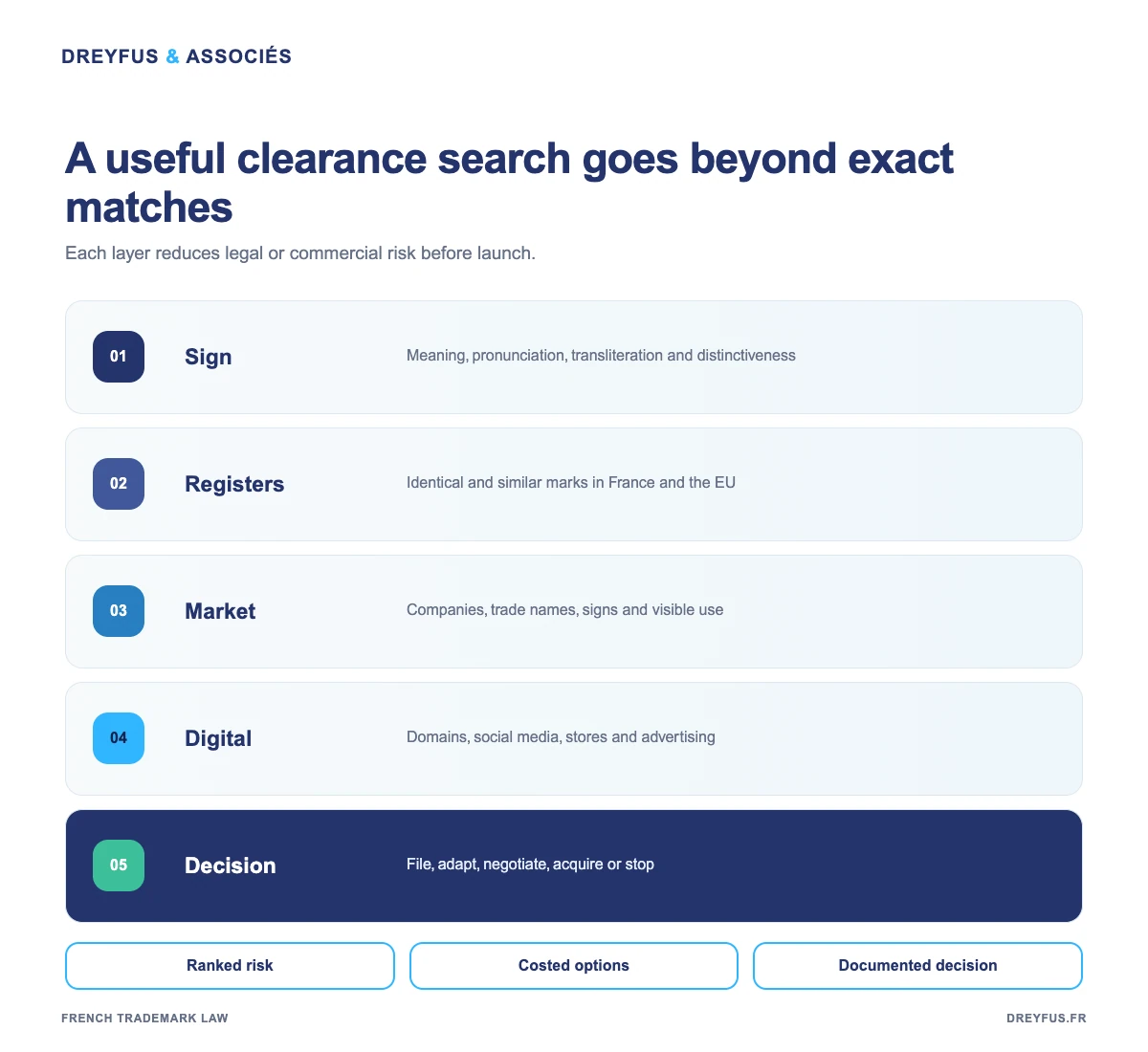
A reliable search connects trademark registers with company names, domains, market use and other relevant rights.
An identical search is only the first filter. A proper review should cover visual, phonetic and conceptual similarity, related goods and services, relevant company names, domains and market use. Dreyfus also provides AI-powered trademark similarity analysis, combined with legal assessment of the results and commercial context.
The outcome should be a decision document, not a raw result list. It should rank risk, identify active owners, examine available use evidence and recommend a course of action: file, modify the sign, narrow the specification, negotiate, acquire a right or stop the project.
Use the Paris Convention priority period deliberately
A company that has filed the same mark in a Paris Convention or World Trade Organization country may claim priority in France within six months, subject to the applicable requirements. The six-month period is useful for coordinating markets, but it is not a reason to postpone French clearance. A priority claim preserves a date, not freedom to operate.
5. Draft goods and services around the business model
The specification defines the legal perimeter of the application. Nice classes organise goods and services, but a class number is not a legal entitlement in itself. Items in different classes can be considered similar, while items in one class can have little commercial connection.
The wording should cover the planned offer and realistic extensions while remaining defensible. A broad specification increases costs and can later be revoked in part where genuine use is not proved. An overly narrow specification may fail to cover foreseeable software, platform, subscription, maintenance, training or marketplace functions.
The specification cannot be broadened after filing. A material expansion generally requires a new application. A short workshop with product, marketing, legal and sales teams before filing can prevent expensive gaps.
6. File and prosecute a French trademark application
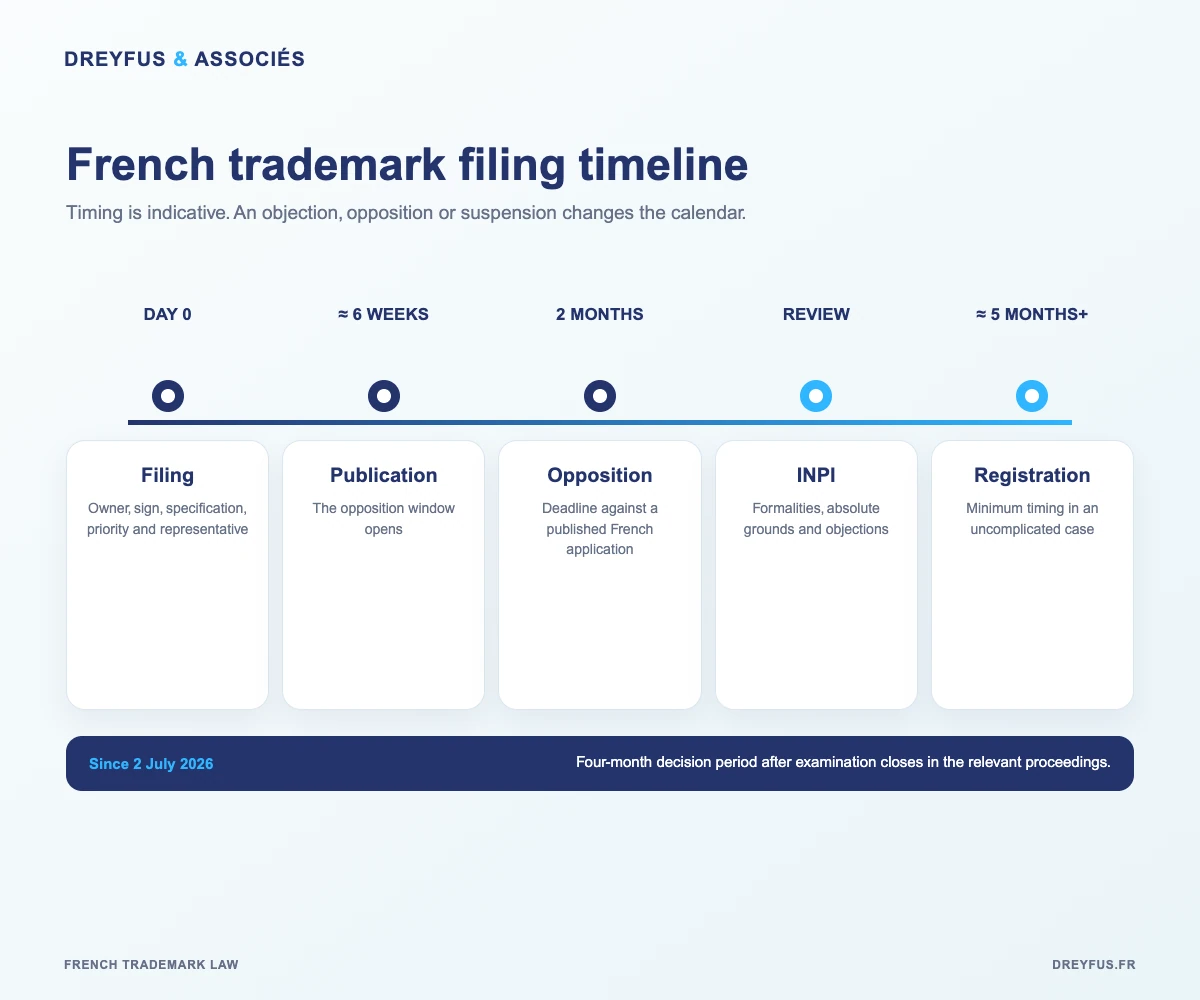
An unopposed application may proceed in a minimum of approximately five months. Objections or oppositions change the timetable.
Information to prepare
The application identifies the owner, the sign, the type of mark, the goods and services, the representative where applicable, and any claimed priority. The owner’s legal name and address should match reliable corporate records. Internal brand names, abbreviated group names and outdated addresses create avoidable recordal work.
Representation for applicants outside the EEA
Under Article R. 712-2 of the French Intellectual Property Code, persons without a domicile or registered office in the European Union or European Economic Area must appoint a representative who meets the statutory conditions. A correspondence address is not equivalent to a genuine establishment. Representation requirements should also be checked for opposition, invalidity, revocation, renewal and recordal procedures.
Publication, examination and the opposition window
The INPI normally publishes the application in the official bulletin around six weeks after filing. Publication opens a two-month opposition period. The INPI examines formal requirements and absolute grounds, but it does not conduct a complete clearance search for the applicant. In an uncomplicated matter, registration may be completed after a minimum period of approximately five months.
Since 2 July 2026, the decision period in French trademark opposition and administrative invalidity or revocation proceedings has been aligned at four months after the end of the examination phase. This is a decision deadline within the proceeding, not the total duration from filing to decision.
Responding to an objection or opposition
An examination objection calls for a focused response and may justify limiting the specification. An opposition requires analysis of the earlier rights, their use, the signs, the goods or services and settlement options. Where the conditions are met, the applicant may request proof of genuine use of an earlier mark registered for at least five years. Dreyfus’s page on French trademark opposition proceedings explains the procedural role of this remedy.
7. Build evidence of genuine use from day one
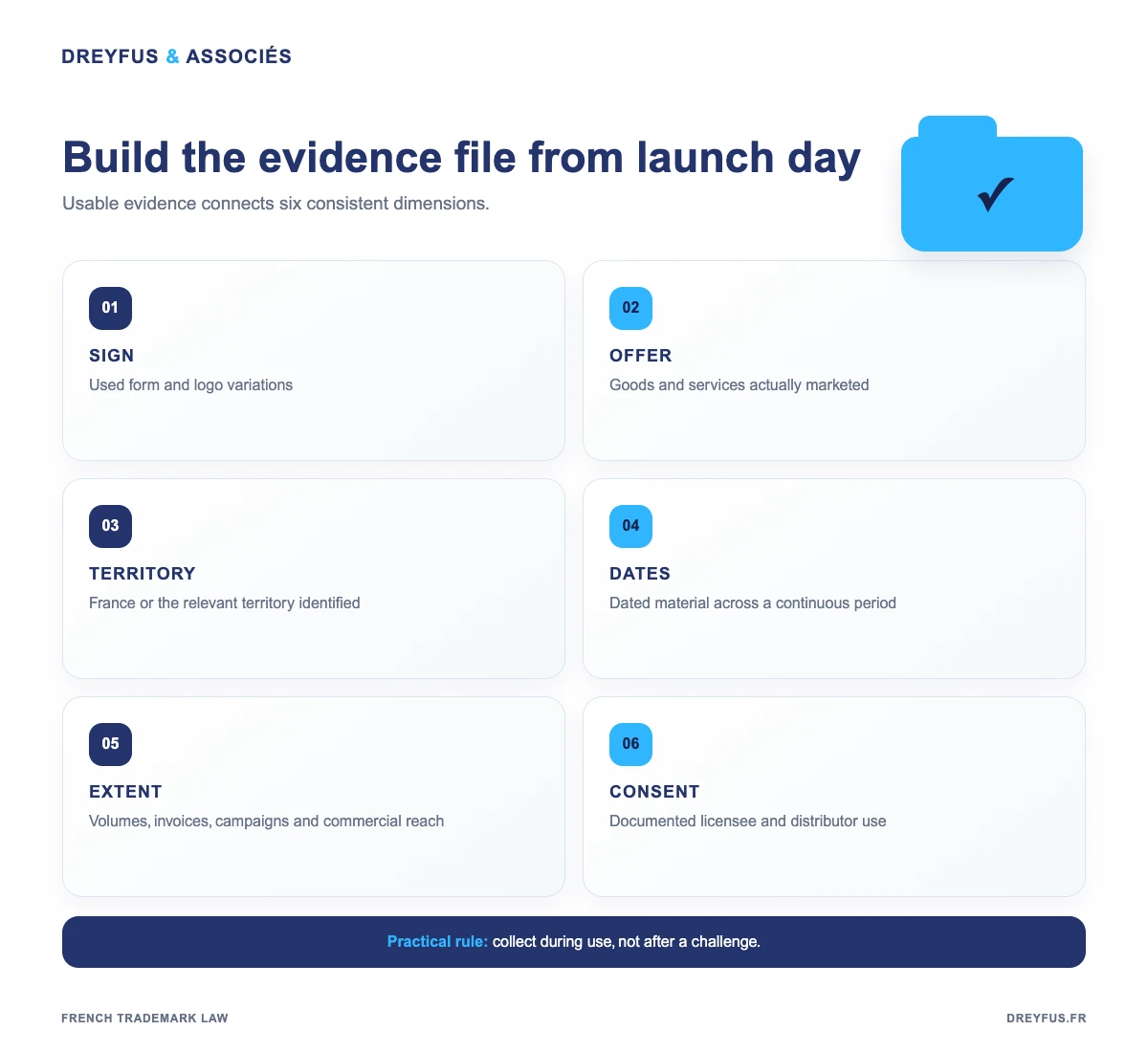
Evidence should be collected during normal business activity, not reconstructed after a challenge. It must connect the mark, goods or services, relevant territory, dates and commercial scale. Useful material can include invoices, catalogues, dated web pages, advertising, sales data, distribution agreements, packaging, delivery records and trade fair participation.
Strong evidence connects the sign, goods or services, territory, dates and commercial extent.
Use must be public and external, consistent with the trademark’s function, and more than token use intended only to preserve the registration. A sign can sometimes be used in a form that differs from the registration if the differences do not alter its distinctive character. During a rebrand, compare the old and new forms, decide whether a fresh filing is advisable and retain a dated transition record.
Use by licensees and distributors
Use by a licensee or distributor can benefit the owner where it is made with consent. Contracts should address quality control, territories, channels, evidence retention and incident reporting. They should also state who may negotiate, report infringements or participate in proceedings. A poorly documented licence can weaken the evidence chain.
8. Keep the register and the portfolio accurate
A French trademark is protected for ten years from filing and can be renewed indefinitely. Renewal is available during the year before expiry. A further six-month grace period starts after expiry and carries an additional fee. Calendar responsibility therefore remains essential.
Changes of name, address or legal form, mergers, assignments, licences and security interests may require recordal. Before enforcement, financing or sale, reconcile the register with the group’s legal structure and transaction documents.
Event
Risk if records are not updated
Recommended action
Merger or company name change
Mismatch between the actual owner and register
Prepare evidence and record the event
Intra-group assignment
Broken or unclear chain of title
Document the transfer and maintain record continuity
Licence
Unclear consent, standing or use evidence
Define quality control, evidence and enforceability
New logo
Gap between the registered and used forms
Assess distinctive character and consider refiling
New offer
Goods or services fall outside the specification
Map the current wording against the new activity
9. Monitor and challenge conflicting marks
Trademark offices do not provide a complete monitoring service for every owner. A watching programme should cover the relevant registers and qualify results according to commercial risk. The objective is to identify applications that may weaken distinctiveness, divert customers or obstruct expansion.
Opposition
An opposition to a French trademark application must be filed within two months of publication in the French official bulletin. An EU trademark has a three-month opposition period after publication. These deadlines are strict and should be built into the global watch workflow.
Invalidity and revocation
An invalidity action challenges whether the mark should have been registered, for example because of absolute grounds, bad faith or an earlier right. Revocation addresses events such as five years of non-use, the mark becoming generic, or the mark becoming misleading through the owner’s conduct. Administrative proceedings before the INPI are available for claims within its competence, subject to the relationship with court proceedings.
10. Enforce a trademark in France
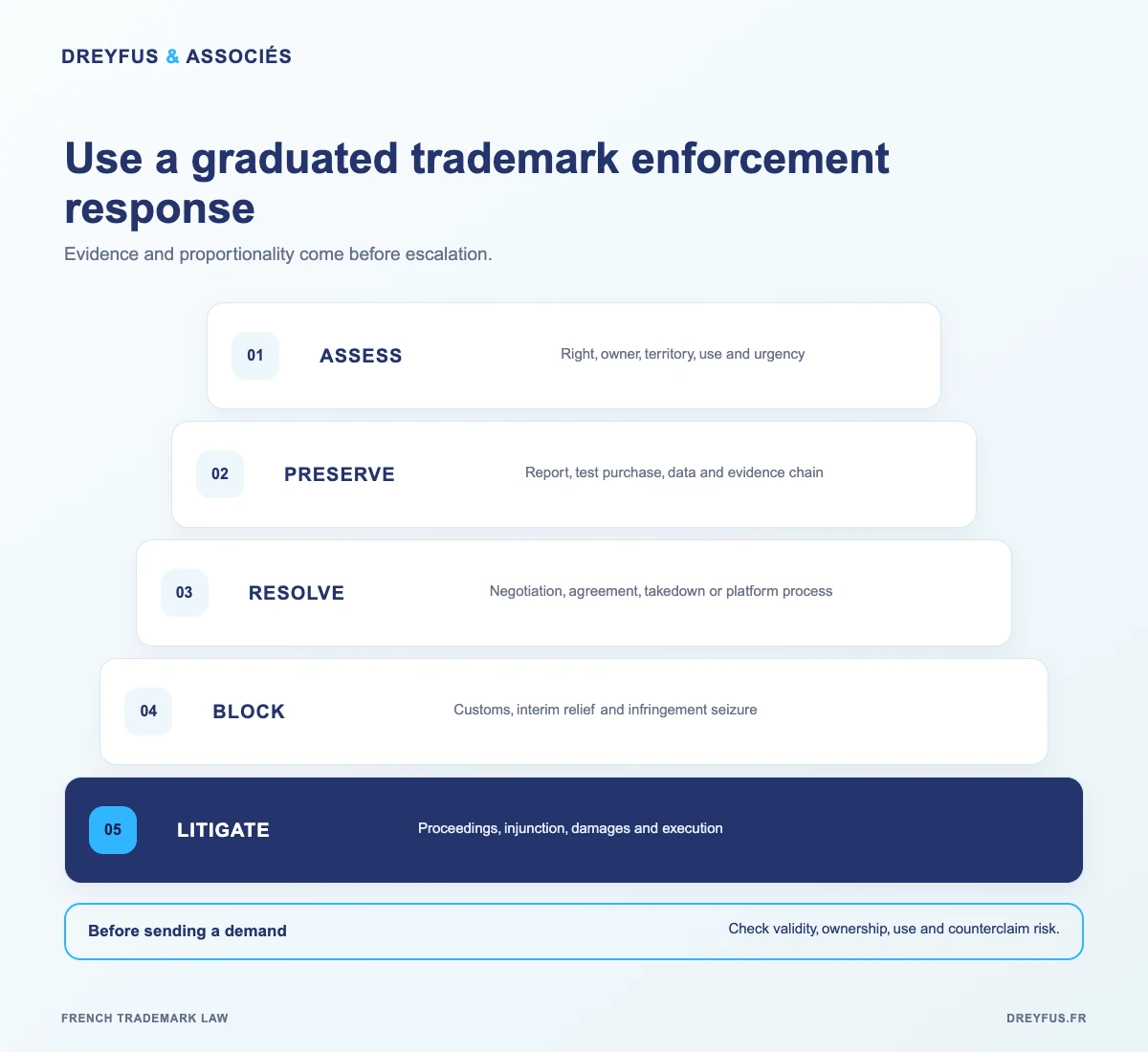
Enforcement begins with a verified factual and legal position. Confirm the right, owner, territory, specification, use and alleged act. The chosen response should preserve evidence, reflect commercial urgency and remain proportionate.
A coordinated response can combine evidence, negotiation, platforms, customs, interim relief and proceedings on the merits.
Preserve evidence before sending a letter
A single screenshot may be insufficient. Depending on the matter, record the URL, date, purchase path, seller identity, advertising, payment, delivery and operating company. A report by a French court-appointed officer, a test purchase, an expert review or a court-authorised infringement seizure may be appropriate. Once the alleged infringer is alerted, evidence can disappear.
Choose the right escalation route
The response may include a cease-and-desist letter, settlement, coexistence agreement, opposition, platform notice, domain name procedure, customs action, interim measure or action on the merits. A letter should not be automatic. It can trigger a non-use challenge, invalidity action or negative declaration. Assess validity and evidence before escalating.
Use French customs where imports are at risk
A customs application for action can help identify and detain suspected counterfeit goods at the border. The French procedure is free to file and is generally valid for one year. When goods are detained, short response periods apply, generally ten working days and three working days for perishable goods. Customs preparation should include product recognition material, authorised distribution information, contacts and a rapid decision process.
Prepare for French court proceedings
Trademark infringement actions are subject to specialised court jurisdiction and French procedural rules. Claims may include injunctions, recall or destruction, disclosure and damages. The civil limitation period is generally five years from the day the rights holder knew or should have known the last relevant fact. An infringement seizure must be followed by an action within the statutory period, generally twenty working days or thirty-one calendar days, whichever is longer.
11. Connect trademarks with domains, marketplaces and advertising
Online brand protection should connect trademark rights with domain names, marketplace listings, social accounts, paid search, impersonation and unauthorised distribution. Registration alone does not remove online abuse. Conversely, takedown requests made without checking ownership, use, jurisdiction and platform rules can fail or create risk.
A useful dashboard distinguishes high-impact cases, repeat sellers, active domains, advertising accounts, recurrence and final outcomes. Dreyfus coordinates trademark enforcement with its international practice in domain name law and online brand protection.
12. A 90-day plan for entering the French market
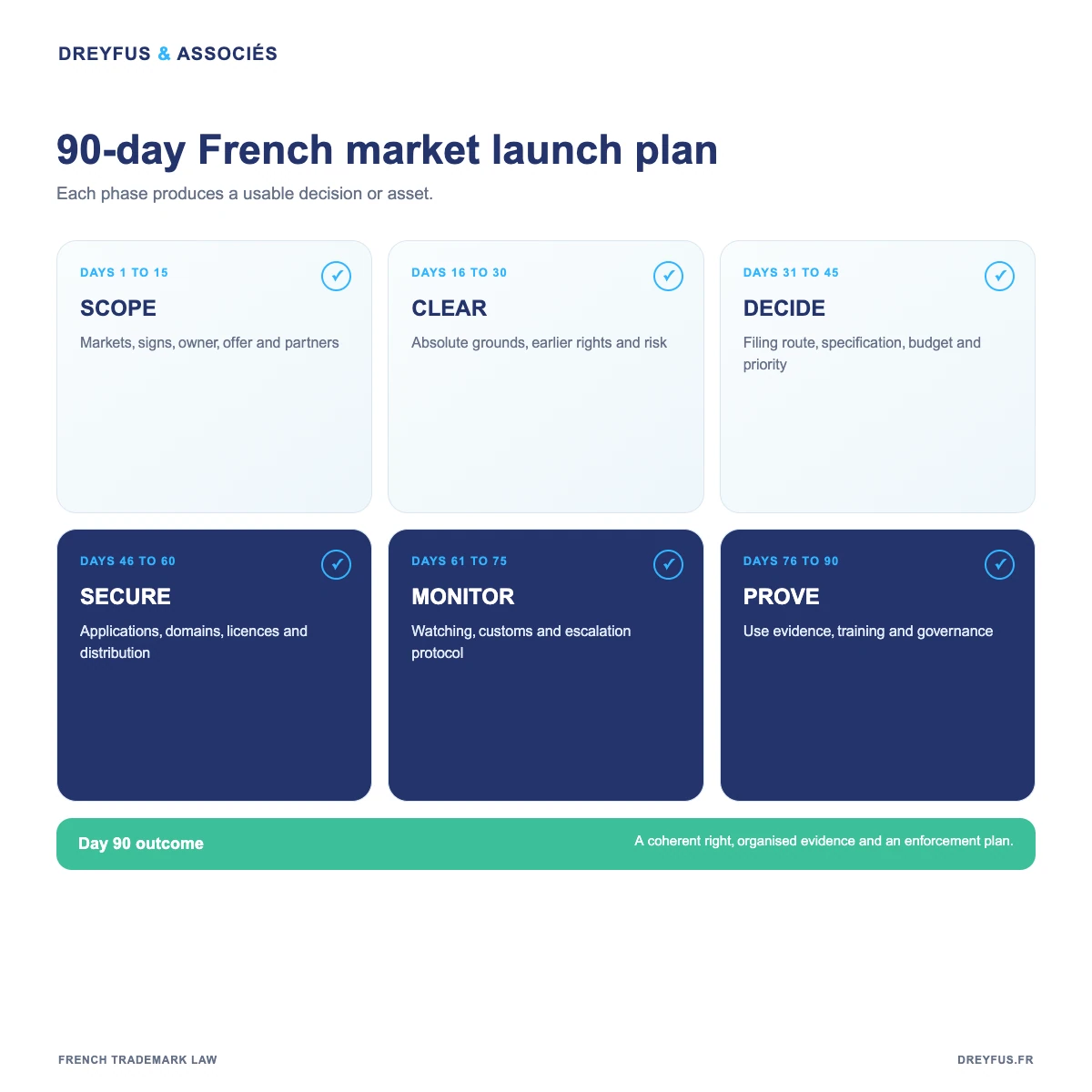
The plan links ownership, clearance, filing, contracts, monitoring and evidence to the commercial launch date.
Period
Legal and operational work
Decision output
Days 1 to 15
Map markets, signs, owners, products, distributors, domains and launch dates
Validated perimeter and owner
Days 16 to 30
Screen absolute grounds and conduct French or EU clearance
Risk-ranked clearance opinion
Days 31 to 45
Select INPI, EUIPO or Madrid route and finalise goods and services
Filing strategy and budget
Days 46 to 60
File, secure domains and update distribution and licence terms
Applications and signed controls
Days 61 to 75
Configure watching, customs preparation and incident escalation
Monitoring and response protocol
Days 76 to 90
Create the use-evidence file and train local marketing and sales teams
Launch-ready evidence and governance
13. Ten mistakes that create avoidable cost
Assuming that the home registration covers France.
Allowing a distributor or individual to own the French filing.
Filing before checking French meaning, pronunciation and similar rights.
Choosing an EU trademark without testing risk across the EU.
Copying a home-country specification without mapping the French business model.
Missing the six-month priority period or treating priority as clearance.
Using a materially redesigned logo without reviewing the registered form.
Keeping no organised evidence of genuine use.
Sending a demand before checking validity, ownership and non-use exposure.
Treating domains, marketplaces, advertising and customs as separate from trademark strategy.
14. Worked example: a foreign technology brand launching in France
A non-European software company plans a French launch in four months. It owns a home-country word mark for downloadable software but will offer a hosted platform, implementation, training and a marketplace in France. A French distributor has already reserved a local domain.
The review identifies four issues: the home mark has no effect in France, the specification does not cover the full service model, a similar French mark exists for related business software, and the distribution agreement is silent on domains and local brand assets. The company pauses campaign production, negotiates a narrower coexistence perimeter, files a French word mark with a revised specification, transfers the domain to the parent, updates the distributor agreement and starts a dated evidence repository.
This fictional example shows why the filing form is only one step. Ownership, clearance, contracts, operational use and enforcement readiness determine whether the French right will support the business.
15. Why international businesses instruct Dreyfus in France
Dreyfus is a Paris-based intellectual property firm founded in 2004. It advises on French, EU and international trademarks, opposition, invalidity and revocation, domains, online brand protection, customs and litigation. Its international network of specialised intellectual property lawyers supports coordinated matters beyond France and the European Union.
One French strategy, connected to EU procedures, international counsel and operational enforcement.
The model gives a foreign legal team a clear French lead while preserving coordination with home counsel and local specialists. The scope can cover filing, clearance, watches, disputes, domains, customs, investigations and portfolio governance, with defined responsibilities and reporting.
Frequently asked questions
Can a foreign company own a French trademark?
Yes. A foreign legal entity can own a French trademark. Applicants without a domicile or registered office in the EU or EEA must appoint a representative who meets French statutory requirements.
Must the mark be used in France before filing?
No. A specimen or proof of use is not required when filing a French application. Five years of uninterrupted non-use after registration can, however, expose the right to revocation.
Does an EU trademark cover France?
Yes. An EU trademark is a unitary right covering all EU Member States, including France. Its wider reach also means that relevant earlier rights elsewhere in the EU may affect the application.
How long does a French trademark registration take?
The INPI indicates a minimum period of approximately five months in a straightforward application. An objection, opposition, suspension or irregularity will extend the timetable.
How long is the French opposition period?
Two months from publication of the French application in the official bulletin. The EUIPO opposition period is three months for an EU trademark application.
Can goods or services be added after filing?
No. The specification can be limited, but it cannot be broadened. New goods or services generally require a new application.
Should a French distributor file the mark for the foreign company?
The group should normally retain control of core brand assets. If a distributor performs filing tasks, ownership, authority, costs, record access and mandatory transfer terms should be documented before any application.
Can French customs stop counterfeit imports?
Yes. A customs application for action can support detention of suspected counterfeit goods. It must be backed by accurate product information and a rapid response process when a detention notice arrives.
Can a French trademark be renewed indefinitely?
Yes. Each term lasts ten years from filing and can be renewed indefinitely, provided that deadlines and fees are met.
When should foreign counsel involve French trademark counsel?
Ideally before the French name, specification, distributor agreement or campaign is fixed. Early involvement is particularly useful for clearance, filing-route decisions, urgent oppositions, evidence preservation and court or customs planning.
Dreyfus & Associés works alongside international businesses to secure, develop and defend their intellectual property assets in France, across the European Union and worldwide.
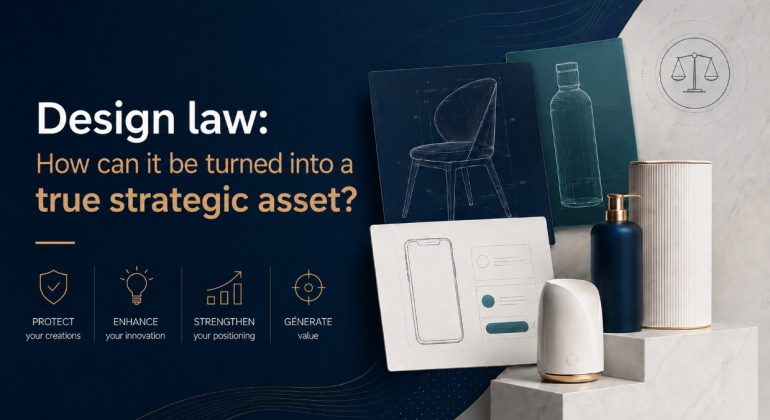
In an economic environment where the appearance of products is a decisive factor in competitive differentiation, design law stands out as a protection tool that is still too often underestimated. Yet this intellectual property right gives its owners exclusive control over the visual appearance of their creations, whether it concerns the shape of an object, its lines, colours, ornaments or texture, thereby providing a genuine commercial advantage in markets where aesthetics have become a value proposition in their own right.
A design should therefore not be treated as a mere administrative formality completed after a product launch. When considered upstream, it becomes a genuine lever for differentiation, valuation and competitive defence.
1. Design: much more than an aesthetic choice
For a long time, design was perceived as a secondary attribute of a commercial offering, a form of packaging refined once the product had been technically finalised. That view is now outdated. Consumers no longer buy only products: they buy experiences. The visual appearance of a product shapes users’ perception of it, builds trust and creates the emotional connection that fosters long-term loyalty.
The more successful a design is, the more it attracts imitators. Its strength is also its greatest vulnerability. The case of Loro Piana v. Eleante Fashion No. 1570/2025, decided by the Turin court in 2025, provides a recent illustration of this: it was precisely because Loro Piana, an Italian luxury brand specializing in high-end textiles, ready-to-wear clothing, and accessories, had registered its designs that it was able to take effective action against counterfeiters and preserve the value of its creations.
2. What qualifies as a protectable design?
Definition
Within the meaning of Regulation (EC) No. 6/2002 on Community designs,, as amended by Regulation (EU) 2024/2822 of 23 October 2024 a design remains defined as the appearance of a product or part of a product resulting from its lines, contours, colours, shape, texture, materials and/or ornamentation. However, since the 2024 reform, this definition now also includes “movement, transition or any other sort of animation”, considerably broadening the scope of protection.
To benefit from this protection, the design must meet two essential criteria:
Novelty: the design must not have been disclosed to the public before filing, subject to certain exceptions;
Individual character: the design must produce an overall visual impression that differs from existing designs.
The following may therefore be protected:
lines, contours, shapes, textures and materials;
colours and ornamentation;
movements, transitions and animations, particularly for digital interfaces;
packaging, interior and exterior configurations;
graphic elements: logos, icons and typefaces.
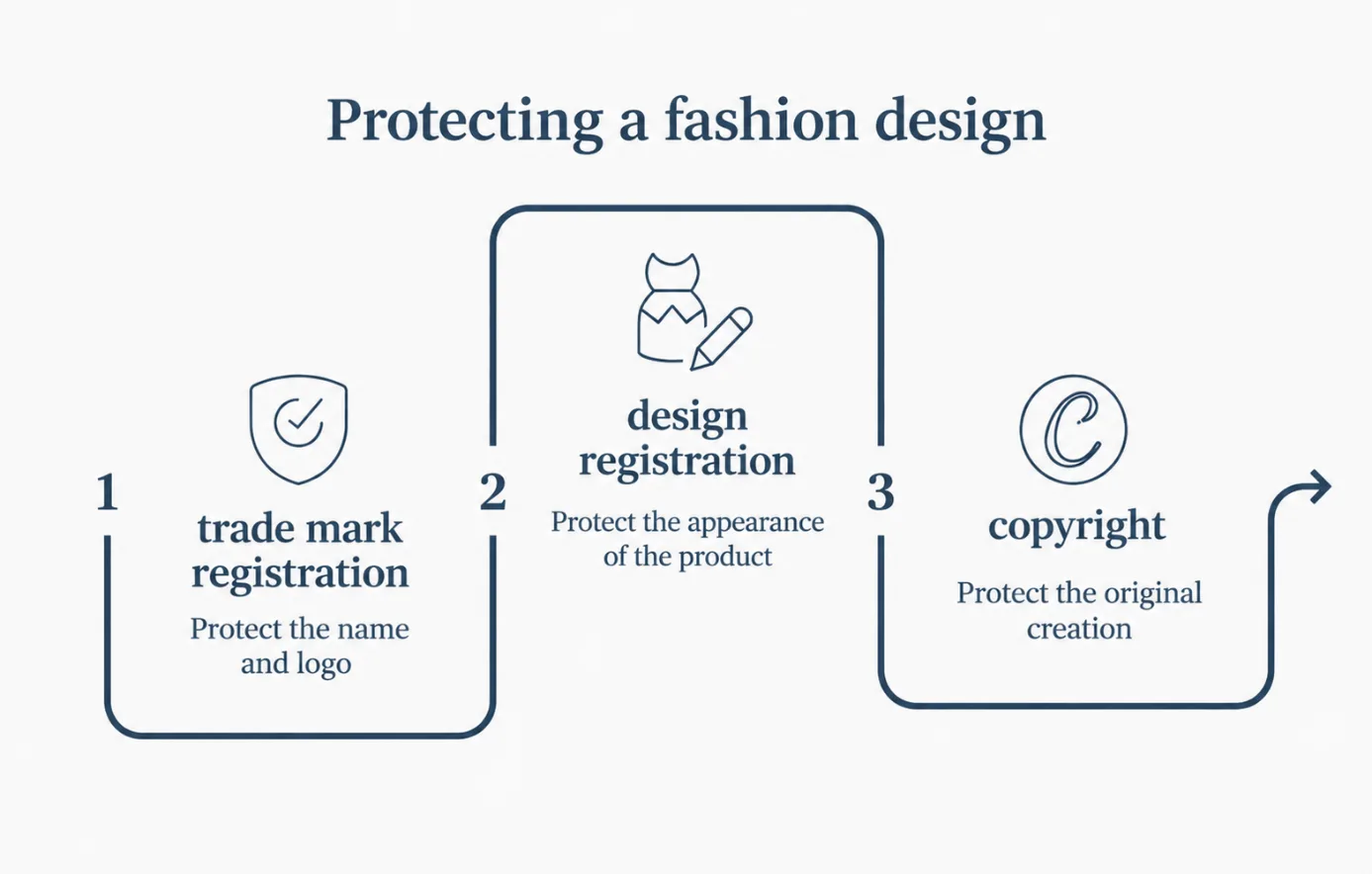
However, certain subject matter remains excluded from the scope of protection: computer programs, abstract ideas or methods, purely functional shapes, simple words, isolated colours which fall more within the scope of trademark law and olfactory or sound creations. This distinction is essential in order not to confuse design law with other branches of intellectual property, particularly copyright or trademark law, with which it has areas of overlap but is not identical.
Design law protects the appearance of a product; copyright protects an original intellectual creation, such as a drawing, text or musical work. These two regimes may overlap, but their conditions of access, duration and enforceability differ significantly. Registering a design provides greater legal certainty: it creates a presumption of ownership and facilitates infringement proceedings.
3. The protection mechanisms available in Europe
Several protection routes coexist, and the choice between them must be made according to the company’s commercial strategy and target markets.
Registered vs. unregistered design
A registered European Union design provides an initial protection period of five years, renewable up to a maximum of twenty-five years, and applies throughout the European Union through a single application filed with the EUIPO.
An unregistered European Union design arises automatically from the first disclosure within the EU and provides protection for three years. While it has the advantage of requiring no formalities, it is much harder to enforce: the rights holder must prove not only ownership but also the act of copying, and cannot rely merely on a close resemblance.
Thus, filing and registering a design gives its owner an exclusive right valid for up to 25 years, allowing the owner, among other things, to prohibit any unauthorized reproductions or imitations that are too similar to the registered design.
What geographical scope?
There are four main options:
an EU filing with the EUIPO, covering all Member States;
national registrations, providing country-by-country protection;
regional systems, such as Benelux, offering intermediate coverage;
international protection through WIPO, under the Hague Agreement, allowing coordinated extension in several designated states.
European registration remains the most efficient solution for companies operating in the internal market: a single application, in a single language, covering all 27 Member States. Provided the application meets the applicable requirements, a European Union design is generally registered within approximately ten business days. This timeframe can be reduced to two business days under the Fast Track procedure.
4. When should a design be filed to protect a competitive advantage?
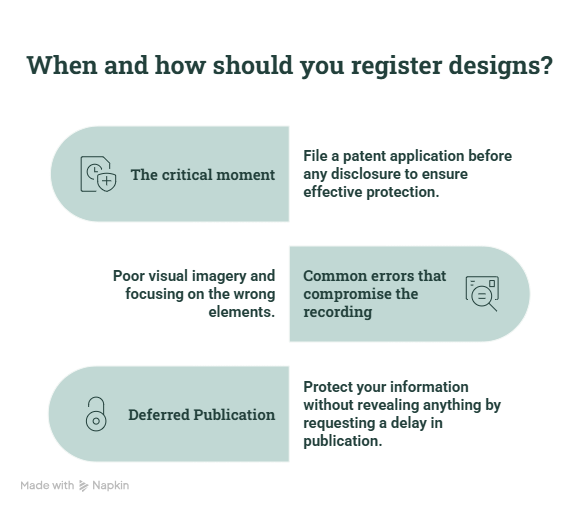
The critical moment: before any disclosure
The timing of the filing determines the effectiveness of the entire protection strategy. The rule is simple: file before involving anyone outside the development team.
Protection should be considered:
before any trade fair or professional exhibition;
before publication on a website or any communication medium;
before any official launch.
French law provides for a twelve-month grace period following the first disclosure, during which an application may be filed without loss of novelty. However, this mechanism is far from offering complete security: it is not harmonised worldwide and does not neutralise competitors’ reactions, since once your design is visible, they may legitimately draw inspiration from it in unprotected territories.
The most common filing mistakes
The European filing procedure is inherently simple. The real difficulty lies less in the formality itself than in the quality of the visual representations submitted.
Two recurring mistakes compromise the value of a registration:
Insufficient visual representations. The image must isolate and highlight the distinctive aesthetic elements of the design. An unedited photograph or a poorly framed 3D rendering may result in incomplete protection, or even protection that is unusable in litigation. The value of a filing largely depends on the quality of the visual representations submitted.
Focusing on the wrong elements. Purely technical or functional elements cannot be protected under design law. Similarly, trademark elements such as logos or trade names fall within trademark strategy and must be protected through a separate route. Only the aesthetic features that contribute to the individuality of the product should be highlighted.
It should also be noted that the EUIPO does not examine at the time of filing: novelty, individual character, conflicts with earlier rights. This review is the responsibility of the rights holder: a registered design filed without a prior search for earlier rights is a fragile legal protection, liable to be invalidated in the event of a dispute. In the context of an EUIPO filing, the applicant’s vigilance remains essential.
Deferred publication: Protecting without disclosing
A little-known but valuable feature: it is possible to request deferment of publication for up to thirty months after filing. The company can thus secure its rights while maintaining the confidentiality of its design: a significant competitive advantage in highly innovative sectors, particularly ahead of major commercial launches.
5. Design as a strategic asset
Beyond its defensive function, design law fulfils four fundamental strategic roles:
Obtaining exclusive rights over the appearance of its products, a company creates a lasting barrier to entry against competitors.
Managing risk IP as insurance: a properly structured design portfolio enables a company to act quickly and effectively against copying.
Creating value: intellectual property rights are assets recorded on the balance sheet and may be valued, assigned, contributed or licensed. They increase the company’s attractiveness in the eyes of investors.
Conclusion:
Design rights become a business advantage when they are used prior to disclosure, aligned with target markets, and integrated into the commercial strategy. They help protect the appearance that drives customer preference, deter imitators, support brand value, and strengthen negotiations with partners.
The right approach is not to file late to mitigate a risk, but to build a coherent portfolio that secures the value created by design.
Dreyfus & Associés assists its clients in managing complex intellectual property cases, offering personalized advice and comprehensive operational support for the complete protection of intellectual property.
What is the difference between a design and a trademark?
A design protects the appearance of a product its shape, lines and ornamentation for a limited period of up to 25 years. A trademark protects a distinctive sign, such as a name, logo or colour, that identifies the commercial origin of a product or service, without any time limit provided it is renewed and used. The two rights are complementary and may coexist on the same product.
Can the interface of a mobile application be protected by a design?
Yes. Since the reform of the Community design regulation, user interfaces, icons, animations and digital transitions are explicitly eligible for design protection. This is an increasingly important issue for companies in the digital sector.
How much does it cost to file a design with the EUIPO?
The official fee for a simple EUIPO filing is €350 (as of the date of publication of this article). In addition to these official fees, you will also need to pay the fees of the attorney assisting you with this application.
What is deferred publication and what is it used for?
Deferred publication makes it possible to delay the publication of a registered design for up to 30 months after the filing date. This tool is particularly useful for companies wishing to legally secure their design before commercial launch, without revealing their creative direction to competitors.
Is design law compatible with copyright protection?
Yes, the two forms of protection may be combined. In France, the theory of unity of art has long recognised that aesthetic creations, whether applied to industry or to the fine arts, may benefit simultaneously from both regimes.
What happens if I file too late, after having already disclosed my design?
In the EU, a 12-month grace period from the first disclosure allows a filing to be made without loss of novelty
This publication is intended to provide general guidance to the public and to highlight certain issues. It is not intended to apply to specific situations or to constitute legal advice.
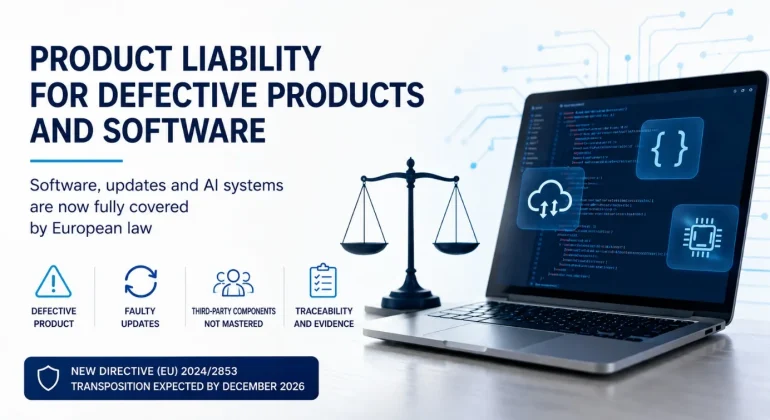
Product liability for defective software is entering a new phase in the European Union. Directive (EU) 2024/2853 removes a major source of uncertainty by expressly treating software as a “product”, whether embedded in a connected device, supplied separately, accessed through the cloud or provided under a SaaS model. Artificial intelligence systems also fall within this framework.
Member States must transpose the Directive by 9 December 2026. Following the corrigendum published on 7 May 2026, the new regime applies to products placed on the market or put into service from 9 December 2026.
Why is software now a product for EU product liability purposes?
Directive (EU) 2024/2853 updates this framework. Article 4 expressly includes software in the definition of a product. Recital 13 confirms that this encompasses operating systems, firmware, applications and AI systems, irrespective of the method by which the software is supplied. Software developers or producers, including providers of AI systems where relevant, may therefore qualify as manufacturers.
A strict liability regime originally designed around tangible industrial goods now accommodates products that may continue to evolve long after the first commercial release.
Does every software bug make a product defective?
The Directive does not turn every programming error, performance issue or functional anomaly into a product defect triggering manufacturer liability. Defectiveness continues to depend on whether the product provides the safety that the public is entitled to expect.
For software, the analysis may take into account its intended function, reasonably foreseeable use, interactions with other products, its ability to continue learning and relevant cybersecurity requirements. Article 7 of the Directive lists those circumstances and expressly refers to the effect on the product of any ability to continue to learn after it is placed on the market. A cosmetic display bug is therefore fundamentally different from an erroneous calculation in medical-device software, a vulnerability that allows remote control of a connected product, or a malfunction causing an automated system to behave dangerously.
Software updates and AI: liability may continue after market release
A major feature of the new Directive is the concept of manufacturer control after a product has been placed on the market.
Digital products are rarely frozen on their release date. They receive patches, new functions and security upgrades, while certain AI systems may continue to change through learning mechanisms.
Article 11 of the Directive therefore removes the defence that the defect appeared after the product was first marketed where the defect results from an element remaining within the manufacturer’s control. This can include:
a defective software update or upgrade;
failure to provide an update necessary to maintain safety;
a related digital service under the manufacturer’s control;
a substantial modification of the product; or
the evolution of a machine-learning algorithm where the manufacturer retains control.
The Directive does not, by itself, create a general obligation to provide every possible update. It also recognises situations that are genuinely beyond the manufacturer’s control, such as where a user fails to install a safety update that has been properly made available.
Third-party software components: outsourcing development does not mean outsourcing risk
Modern software is rarely written entirely in-house. Open-source libraries, APIs, SDKs, proprietary modules, pretrained models and outsourced development form a complex software supply chain.
The fact that a component originates from a third party does not, in itself, insulate the manufacturer of the final product.
Where a component has been integrated or interconnected under the manufacturer’s control, the manufacturer of the final product and, depending on the circumstances, the manufacturer of the defective component may both face liability. The Directive also provides that an economic operator’s liability is not reduced or excluded simply because the act or omission of a third party contributed to the damage.
It would nevertheless be inaccurate to conclude that every component genuinely outside a manufacturer’s control automatically creates liability for that manufacturer. Control will itself become a central litigation issue: who selected the component? Who authorised its integration? Who could update or disable it? Who approved its use in production?
Why is code traceability becoming legal evidence?
This may be one of the Directive’s most consequential developments for legal and engineering teams.
Article 9, headed “Disclosure of evidence”, allows relevant evidence held by the opposing party to be disclosed, subject to defined conditions. Article 10, on the burden of proof, introduces evidentiary presumptions going both to defectiveness and to causation. Defectiveness may, for example, be presumed where a defendant fails to disclose relevant evidence when required to do so. Further presumptions can apply where technical or scientific complexity makes proving defectiveness or causation excessively difficult. Recital 48 specifically discusses the difficulty a claimant may encounter in explaining the internal operation of an AI system.
Poor development records can therefore become a litigation weakness.
Conversely, a manufacturer that can reconstruct software versions, testing, security decisions, human approvals and component provenance will be better positioned to identify the source of an incident and rebut allegations or presumptions.
AI-generated code: generation, review and approval should be distinguishable
The issue becomes especially important with coding assistants such as ChatGPT, GitHub Copilot and other generative models.
The Directive does not require businesses to identify the legal “author” of each line of code for copyright purposes. Indeed, recital 13 distinguishes the mere source code, as information, from the software product itself. Nevertheless, the history of that source code can be highly relevant when determining who controlled the design, integration, testing and release of the product.
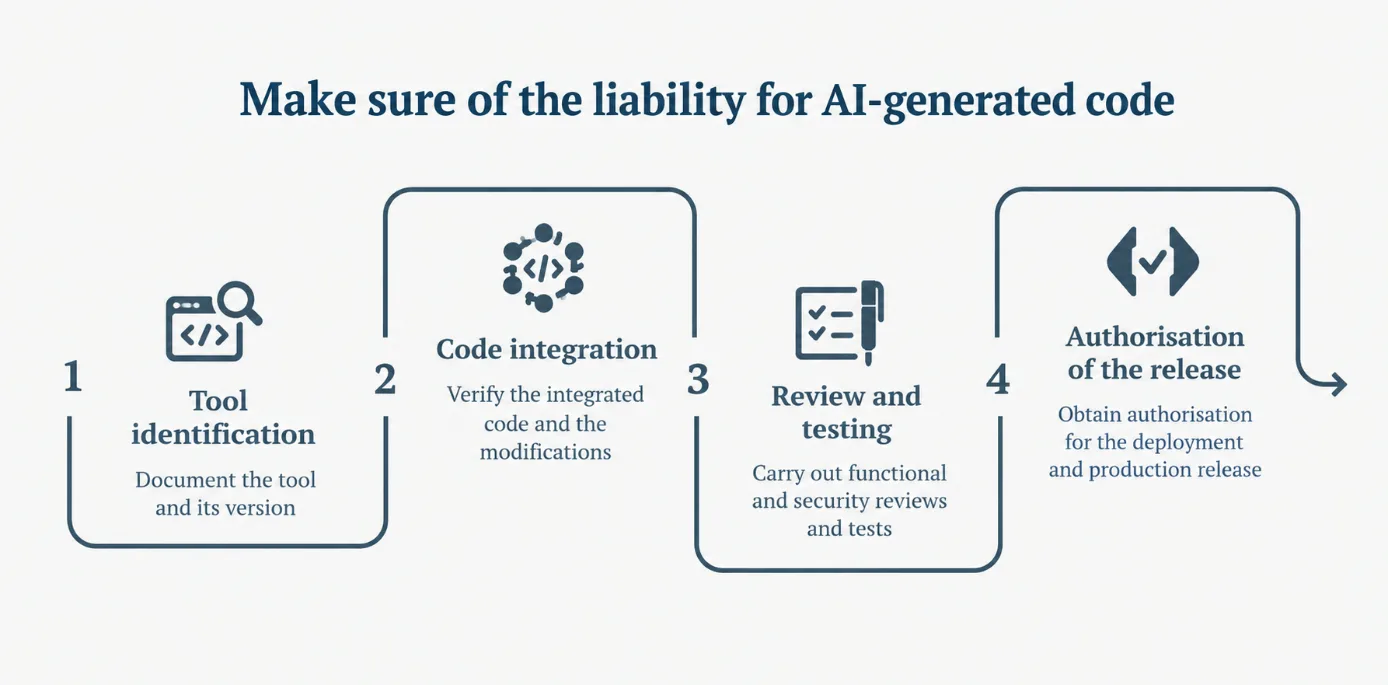
Consider a fictitious example. An engineer uses a generative AI system to propose a modification to software controlling a connected device. Six months later, that function causes dangerous behaviour. Saying that “the AI wrote the code” is not a defence. The company should instead be able to establish:
which tool and, where relevant, which version was used;
what generated code was actually incorporated;
who reviewed that code;
which functional and security tests were performed;
who approved the merge and production release; and
Product liability for defective software can no longer be addressed only after an incident occurs. Directive (EU) 2024/2853 brings product liability into closer contact with cybersecurity, AI governance, vendor management and intellectual property.
Businesses should therefore build an evidentiary chain alongside their development chain. Code provenance, human decisions, reviews, testing, third-party components and updates should be reconstructable. Such records cannot guarantee that liability will be avoided, but they can establish the factual conditions in which the product was designed, controlled and maintained when litigation occurs.
Does the Directive compensate a business for pure economic loss caused by software downtime?
Not generally. Article 5 of the Directive confers the right to compensation on natural persons only, and the Directive defines specific categories of compensable damage; it is not a general mechanism for recovering every form of B2B economic loss. Depending on the circumstances, business interruption and other purely financial losses may instead be addressed through contractual liability or other national causes of action.
Can a court require disclosure of a software application’s source code?
Potentially, where source code constitutes relevant evidence. Article 9 allows courts to order disclosure of relevant evidence subject to necessity and proportionality. The Directive also requires courts to consider confidential information and trade secrets, meaning that disclosure does not equate to unrestricted public access to proprietary source code.
Can a manufacturer contractually exclude its liability towards an injured person?
The liability provided for by the Directive cannot simply be excluded or limited against the injured person by contractual terms where the statutory conditions for liability are met. Contracts between manufacturers, suppliers and integrators nevertheless remain essential for allocating warranties, obligations and rights of recourse between businesses.
What happens to software placed on the market before 9 December 2026?
Products placed on the market or put into service before that date remain, in principle, subject to the rules deriving from Directive 85/374/EEC. A later substantial modification, however, may create a new product-liability analysis and may result in the person carrying out that modification being treated as a manufacturer under the conditions laid down by the new Directive.
Does the new Directive cover the destruction of professional data?
The Directive covers destruction or corruption of data that is not used for professional purposes. Loss involving business data must therefore be considered under any other applicable legal basis, including contractual remedies where appropriate.
Does using open-source software automatically protect the final manufacturer from product liability?
No. The Directive excludes certain free and open-source software developed or supplied outside the course of a commercial activity. That exclusion does not automatically shield a commercial manufacturer that integrates such software into its own defective product.
This publication is intended for general public guidance and to highlight issues. It is not intended to apply to specific circumstances or to constitute legal advice.
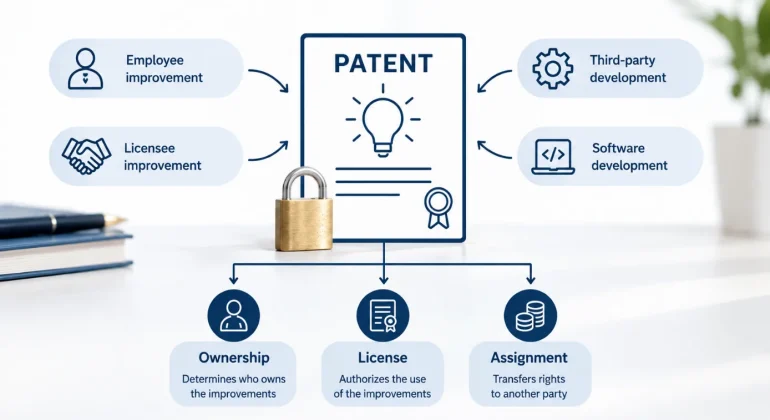
Ownership of the original patent does not automatically confer ownership of improvements developed later. A patent owner may contractually the treatment of future improvements, but it cannot simply appropriate innovations created by another party. Ownership depends on
Who legally owns an improvement to a patented invention?
Ownership of the original patent does not extend automatically to subsequent innovation
Under Article L. 611-6 of the French Intellectual Property Code, entitlement to a patent belongs to the inventor or the inventor’s successor in title. Consequently, ownership of an earlier patent does not in itself confer ownership of a subsequent invention merely because that invention improves the patented technology.
An “improvement” may moreover take several legal forms: a separate patentable invention, technical know-how, a new application, software, documentation or a combination of different intellectual property assets.
The decisive question is therefore not merely who owns the original patent, but who created the new development and on what legal basis ownership has been transferred, if at all.
Where several parties jointly contribute to the inventive concept, joint ownership may arise. French patent law provides default rules for co-owned patents, although the parties may organise their relationship contractually.
Ownership and freedom to exploit are separate issues
An entity may own an improvement without being free to commercialise it.
For example, a licensee may develop and patent an improvement that nevertheless falls within the scope of an earlier patent belonging to the licensor. French law expressly addresses dependent patents: the holder of the later patent cannot exploit it in infringement of the earlier patent without authorisation, while the holder of the earlier patent cannot exploit the later patented improvement without the latter patent owner’s consent.
This creates a potentially powerful negotiating dynamic. Each party may own its technology while neither can fully exploit the combined solution independently.
Who owns improvements developed by employees, contractors or developers?
Employee inventions are governed by mandatory statutory rules
Where an improvement is created by an employee, the parties cannot determine ownership solely by reference to the original patent or licence agreement.
Article L611-7 of the French IPC distinguishes three categories.
A mission invention, created in the performance of inventive duties or specifically entrusted research, belongs to the employer. The employee inventor is nevertheless entitled to additional remuneration.
An attributable non-mission invention initially belongs to the employee. Where the statutory conditions are satisfied, the employer may obtain ownership or enjoyment of the patent rights but must pay the employee a fair price.
A non-attributable non-mission invention remains the employee’s property.
This distinction means that financial consideration is sometimes a statutory entitlement, rather than merely a matter of commercial negotiation.
Software improvements require an additional ownership analysis
Software law provides a particularly useful example because different rights may overlap.
Under Article L. 113-9 of the French Intellectual Property Code, the economic rights in software and related documentation created by employees in the performance of their duties or following their employer’s instructions are, unless otherwise provided, vested in the employer.
The position of an independent contractor is different. Entering into a services agreement does not by itself transfer the author’s rights, and a properly drafted written assignment will generally be required.
If the same software development also contains a patentable technical invention, copyright ownership and patent entitlement must be analysed separately. The same technological product may therefore involve several layers of rights owned by different persons.
Can a licence agreement allocate all improvements to the original patent owner?
Contractual allocation is possible, but precision is essential
Patent rights may be assigned in whole or in part and may be licensed on an exclusive or non-exclusive basis. French law requires assignments and patent licences to be recorded in writing.
A sophisticated improvements clause should therefore determine:
what constitutes an improvement, derivative version, new application or replacement technology;
whether each party retains ownership of developments it creates;
which developments are subject to assignment and which merely trigger licence rights;
who controls filing, prosecution, maintenance and enforcement of subsequent patents;
how jointly developed inventions will be handled;
whether sublicensing is permitted and how sublicensing income is shared;
what happens following termination, a change of control or cessation of activity.
Particular attention should be paid to technologies that evolve through successive versions. The contractual definition must prevent commercially valuable developments from being shifted outside the agreed perimeter simply because they are characterised as a new version or replacement product.
For additional background, see the Dreyfus resources on patent assignments and patent licence agreements.
How should consideration for improvements be structured?
A transfer or licence of improvements may be remunerated through an upfront payment, milestone payments, royalties on products incorporating the improvement, a share of sublicensing income or a valuation mechanism triggered by a subsequent sale.
However, payment does not automatically remove competition-law concerns. This is particularly important under the European technology-transfer regime applicable since 2026.
How does EU competition law restrict clauses relating to improvements?
The new Commission Regulation (EU) 2026/877, applicable since 1 May 2026, significantly affects the drafting of technology-transfer agreements.
Conclusion
The owner of the original patent has substantial contractual freedom, but no general proprietary right over future innovations.
A robust technology-transfer strategy should determine from the outset who is expected to create improvements, who will own them, who may patent them, who may exploit them, what consideration is payable and which rights survive termination of the relationship.
Employee inventions, contractor-created developments, software rights, dependent patents and the 2026 EU rules on grant-backs must all be integrated into that analysis.
For a broader approach to portfolio management, see our article on patent auditing and patent portfolio value.
The Dreyfus Law Firm assists its clients in managing complex intellectual property cases, offering personalized advice and comprehensive operational support for the complete protection of intellectual property.
Nathalie Dreyfus with the support of the entire Dreyfus team
Q&A
What happens if the agreement does not address future improvements?
The absence of a specific clause may create a significant area of legal uncertainty. Each improvement will then have to be assessed according to the rules applicable to its creator and to the nature of the intellectual property right concerned. The owner of the original patent cannot assume that improvements developed by its contractual partner automatically belong to it.
How should an “improvement” be precisely defined in a patent licence agreement?
A definition that is too narrow may allow one party to argue that a new version or replacement technology falls outside the scope of the agreement. Conversely, an excessively broad definition may create disproportionate obligations or raise competition law concerns.
Who owns an improvement jointly developed by the licensor and the licensee?
Where an improvement results from inventive contributions made by both parties, a situation of joint ownership may arise. In collaborative R&D projects, a contractual joint ownership arrangement generally helps avoid the difficulties associated with relying solely on statutory default rules.
What happens to rights in improvements when the licence agreement terminates?
Termination of the agreement does not automatically determine the fate of improvements developed during the contractual relationship. The agreement should specify whether licences relating to such improvements terminate immediately or continue to apply to products already placed on the market.
How can it subsequently be proven who created an improvement?
Evidence becomes crucial where an improvement results from a project involving several employees, contractors or partners. It is advisable to retain documentation that makes it possible to trace the dates and stages of development, the individuals involved in the work, and other relevant elements.
This publication is intended for general public guidance and to highlight issues. It is not intended to apply to specific circumstances or to constitute legal advice.
A breeder uses CRISPR (a technical tool enabling genome editing) to introduce a disease-resistance gene into a wheat variety. Three months later, a third party writes to inform the breeder that the modification is covered by its patent. Who owns what? This is the question that the European Regulation on New Genomic Techniques (NGTs) was intended to clarify.
These techniques, first and foremost genome editing, make it possible to modify a plant in a targeted manner without inserting a gene from a species with which it cannot be crossed. Long treated as GMOs, these plants now have their own European regulatory framework: Regulation (EU) 2026/1388. Part of the seed sector had expected the Regulation to introduce an outright ban on patents covering such plants. The European Parliament had voted in favour of such a prohibition on 7 February 2024. This prohibition was ultimately not retained.
The Regulation therefore does not choose between patents and Plant Variety Rights (PVRs): it keeps both titles and makes a different bet, that of transparency, by requiring anyone seeking recognition of an NGT plant to disclose the patents it is aware of, and by setting up a code of conduct on licensing. Hence the counter-intuitive but decisive point: a plant recognised as equivalent to a conventionally bred plant as a matter of regulation is not thereby free of intellectual property rights. Clearing the regulatory hurdle says nothing about freedom to operate.
This article examines what the Regulation actually changes: how patents and plant variety rights interact for one and the same plant, what the new transparency obligations legally amount to, and what strategy to adopt before the text becomes applicable.
Key references: Regulation (EU) 2026/1388 of June 17, 2026, published in the Official Journal of the European Union on June 26, 2026, in force since July 16, 2026 and applicable from July 17, 2028. Its Articles 29 to 31, on EFSA guidance, the patent code of conduct and the expert group on the effects of NGT patenting, have applied since July 16, 2026 (Article 38).
What the NGT Regulation Changes
Before this Regulation, a plant whose genome had been modified in a laboratory fell under the GMO regime, regardless of the nature of the modification: prior authorisation, risk assessment, traceability and labelling. In practice, almost no crops of this type were authorised in the Union.
The European Regulation now distinguishes between two categories of NGT plants. Category 1 plants, which meet the equivalence criteria defined by the text, benefit from a substantially lighter regime than under traditional GMO law. In practical terms, these are plants whose modification could have been obtained through conventional breeding.
Category 2 plants remain subject to a more restrictive regulatory framework, inspired by the rules applicable to GMOs. This regulatory simplification must not, however, be confused with freedom to operate from an intellectual property perspective. The right to place the plant on the market and the right to exploit it without infringing a third party’s patent are two separate questions.
The general ban on patents advocated in 2024 was not retained
In February 2024, the European Parliament adopted a particularly ambitious position: it sought to exclude NGT plants, plant material, genetic information and certain associated traits from patentability.
That prohibition does not appear in the Regulation ultimately adopted in 2026.
Patentability therefore remains governed by the existing legal framework, in particular Directive 98/44/EC on the legal protection of biotechnological inventions, the European Patent Convention and national legislation. In France, Article L. 611-19 of the French Intellectual Property Code excludes plant varieties and products exclusively obtained through essentially biological processes from patentability, while allowing patent protection for inventions concerning plants where their technical feasibility is not confined to a particular plant variety.
A genomic modification obtained by means of a technical intervention such as targeted genome editing may therefore, if the usual patentability requirements are met, remain covered by a patent.
Classification as NGT 1 is therefore neither a certificate of non-patentability nor a guarantee of freedom to operate.
NGT Status, PVR and Patent: Three Questions That Should Not Be Confused
The same plant may fall under all three regimes at the same time, and this is the primary source of confusion. These three regimes do not address the same question, are not administered by the same authorities and do not produce the same legal effects.
NGT Status
PVR
Patent
Question addressed
Am I allowed to place this plant on the market?
Who holds the rights to the variety?
Who holds the rights to the trait or process?
Subject matter
The plant and the products derived from it
The variety as a whole
A technical invention
Who decides?
Competent national authority or EFSA, followed by the Commission
INOV in France, CPVO at EU level
INPI, EPO
Effect
An authorization to place the plant on the market
An exclusive right over the variety
An exclusive right over the invention
None of these three layers determines the others. Classification as Category 1 does not make the plant free of third-party rights, nor does it determine whether the relevant trait is patentable. Conversely, holding a PVR does not remove the need to obtain a licence from the patent holder.
The only bridge established by the Regulation between these two areas is declaratory: an applicant seeking recognition of Category 1 NGT status must disclose the patents of which it is aware, and this information is entered into a public database (Article 6(5), Article 7(4) and Article 9 of the Regulation). This is information, not a right: it does not validate anything, invalidate any patent or replace a freedom-to-operate analysis.
Example : A wheat variety may be recognised as a Category 1 NGT plant, be protected by the PVR held by the breeder who developed it, and contain a gene covered by a third party’s patent. Three legal regimes, potentially three different right holders, and three separate checks before any commercialisation.
How will patents and Plant Variety Rights interact for NGT plants?
The Regulation does not replace PVRs with patents. The two forms of protection continue to coexist, and the same NGT plant may be covered by both at the same time.
A PVR protects an identified variety, provided that it is distinct, uniform and stable. A patent protects a technical invention: a process, a technical application, biological material or a trait, provided that the requirements of patent law are met (Art. L. 611-10 of the French Intellectual Property Code). It cannot, however, monopolise a plant variety as such.
In practical terms, on the same bag of seed, the PVR protects “this wheat variety” while the patent protects “the resistance gene it contains”. Two possible right holders, two authorisations to obtain.
These rules are not new: they existed before the Regulation. What the new genomic techniques change is how often they arise in practice. There are three reasons for this.
A trait obtained by conventional crossing is not patentable in Europe. A trait obtained through genome editing may be, because it involves a technical intervention. There will therefore be more patents capable of covering what a variety contains.
Next, the Regulation removes most of the administrative constraints for Category 1 plants. Once that door is open, the only hurdle remaining before the plant is placed on the market is the patent.
Finally, genome editing changes only a few letters of the DNA and leaves the rest intact. The new variety therefore closely resembles the variety from which it derives, making it more likely to remain dependent on it.
Hence the two questions examined below. Before breeding: do I have the right to use someone else’s variety? After breeding: is the variety I have obtained really mine?
Before breeding: the breeder’s exemption does not have the same scope under patent law and PVR law
Consider the following case. Wheat variety A is protected by a PVR. It contains a disease-resistance gene which is itself covered by a patent held by a third-party company. A breeder wants to create its own variety from A.
Under PVR law, the path is open from start to finish. The plant variety rights system was designed to allow genetics to circulate between breeders: a protected variety may, under certain conditions, be used to create new varieties. If the resulting variety is genuinely new and distinct, it may be commercialised.
Under patent law, that freedom stops sooner. In France, Article L. 613-5-3 of the French Intellectual Property Code provides that a patent relating to biological material does not prevent acts carried out for the purpose of creating, discovering and developing other varieties. Cross-breeding, sowing, selecting and evaluating are therefore permitted.
But that freedom stops at the trial field. If the resulting variety still contains the patented gene, selling it amounts to exploiting the third party’s invention and therefore requires a licence. This is where the two rights diverge: the PVR permits both research and sale; the patent permits only research.
What happens if the patent holder refuses? There is a safety valve, the compulsory licence for dependency, but it is narrow. Article 12 of Directive 98/44/EC requires proof that an attempt to obtain a contractual licence has failed and that there is significant technical progress of considerable economic interest. It is a remedy against blocking situations, not a right of access to another party’s inventions. In practice, the parties negotiate.
What changes with NGTs is therefore not the rule, but the context in which it applies. When the trait to be modified is precisely the one that has been patented, as will increasingly be the case, the breeder is free to work but blocked at the point of sale.
After breeding: genome editing brings the issue of essentially derived varieties back to the forefront
NGTs also make the concept of the essentially derived variety (EDV) particularly important. Regulation (EC) No 2100/94 allows the rights in an initial protected variety to extend, under specified conditions, to essentially derived varieties, that is, varieties predominantly derived from it while retaining the expression of the essential characteristics of the initial variety (Article 13(5) of the Regulation).
A company using CRISPR to introduce a targeted modification into a protected variety must therefore not think only in terms of patents. Depending on its characteristics and degree of derivation, the new variety could remain legally dependent on the initial variety. In other words, a variety obtained by making only marginal changes to a protected variety may remain legally tied to it, and its exploitation may be subject to the consent of the holder of the initial variety.
UPOV also notes, in its revised Explanatory Notes on Essentially Derived Varieties (UPOV/EXN/EDV/3, adopted on 27 October 2023), that varieties derived from a single parent resulting, for example, from mutations, genetic modification or genome editing are by their nature predominantly derived from their initial variety, the list of methods in Article 14(5)(c) of the Convention being non-exhaustive. Classification as an essentially derived variety nevertheless remains a case-by-case assessment.
NGT patent transparency: meaningful progress, but not freedom to operate
It is on this issue that Regulation 2026/1388 introduces its most direct innovation. In practical terms, the public online database provided for in Article 9 of the Regulation, which will list decisions recognising Category 1 NGT status, will show who declares what; it will not show who has the right to do what.
For applications seeking recognition of NGT 1 status, the applicant will have to disclose, to the best of its knowledge, patents and published patent applications containing claims covering the biological material of the relevant plant, or declare that there are no such patents or published applications (Articles 6(5) and 7(4) of the Regulation). This information will be included in that public database. Where the applicant is itself the holder of the relevant patent, it will also have to indicate, in particular, whether it is willing to grant licences on fair and reasonable terms.
The legal effect of this mechanism should not, however, be overstated. Patent information and licensing declarations are not subject to verification and have declaratory value only (Articles 6(7) and 7(6) of the Regulation).
This database will therefore not replace a freedom-to-operate analysis. On its own, it will not determine:
whether the claims of a patent actually cover the contemplated variety;
whether the patent is valid and in force in each of the territories concerned;
whether other patents belonging to third parties must be taken into account;
whether an application that has not yet been published could subsequently create an obstacle;
or whether the economic terms of a licence actually make exploitation of the product possible.
An omission from the declaration likewise does not make the omitted patent unenforceable: the Regulation does not provide for the extinction of the patent or any immunity from infringement proceedings merely because the relevant right was not included in the database. The omission is not, however, without procedural consequences: where the required patent information is missing, or where the applicant is itself the holder of an identified patent and does not provide the corresponding licensing declaration, the verification request is declared inadmissible within thirty working days (Articles 6(9) and 7(8) of the Regulation).
The patent code of conduct remains a soft-law mechanism
The European Commission confirms that, pursuant to Article 30 of Regulation (EU) 2026/1388, a Union-level code of conduct is to be developed to improve the transparency of patent information, facilitate breeders’ access to patented plant biological material and strengthen legal certainty, notably by encouraging the granting of licences on fair and reasonable terms and the amicable settlement of certain patent disputes involving SME breeders and farmers.
Participation in drawing up the code is voluntary, however, and the mechanism does not currently create a general compulsory licensing system. In other words, it is a voluntary commitment with no sanction for non-compliance. The Commission will monitor participation and effectiveness and may ultimately propose legislation where the system fails to secure appropriate access to patented NGT biological material. The Regulation sets a firm timetable: the code of conduct must be ready by January 17, 2028, and the Commission is to publish an evaluation report on its operation by July 17, 2033 and every five years thereafter, accompanied where appropriate by legislative proposals to safeguard access by primary users, including farmers, to patented biological material (Article 30(6) to (8) of the Regulation).
Article 31 of the Regulation confirms this progressive approach: an expert group comprising up to two experts per Member State, together with one expert designated, where appropriate, by the EPO and the CPVO, assists the Commission, which regularly assesses the effects of patenting NGT plants on innovation, breeders’ access to biological material, seed prices and access, litigation risks and market concentration.
What IP strategy should NGT businesses adopt before 2028?
For seed companies, breeders and biotechnology companies, the future framework requires regulatory and intellectual property issues no longer to be treated separately.
Consider a breeder using CRISPR to introduce a resistance trait into a variety already protected by a PVR. The plant may meet the regulatory criteria for NGT 1 status; the trait or technique may be covered by a patent; the resulting variety may itself be eligible for protection by a new PVR; and its exploitation may remain dependent on the right attached to the initial variety if it constitutes an EDV.
One innovation may therefore require four separate assessments: NGT regulatory status, patentability, freedom to operate and varietal dependency.
The challenge posed by Regulation 2026/1388 is therefore not the disappearance of patents but the emergence of a system in which stakeholders will have to identify the rights at stake earlier, document their portfolios and contractually organise the necessary access.
Conclusion
The EU Regulation on NGTs does not establish a ban on patents and does not make PVRs the exclusive form of protection for plant innovation. The compromise adopted preserves the existing system of coexistence between patents and plant variety rights while adding mechanisms for transparency, sector dialogue and assessment.
The real change therefore lies less in an immediate redefinition of patentability than in a redefinition of the practical balance between exclusivity, access to genetic material and legal certainty. From 2028, increased transparency will make it easier to map the relevant rights, but it will eliminate neither dependencies between rights nor the need for freedom-to-operate analyses and licensing strategies.
Dreyfus Law Firm assists its clients in managing complex intellectual property cases, offering personalized advice and comprehensive operational support for the complete protection of intellectual property.
Nathalie Dreyfus, with the assistance of the entire Dreyfus team.
FAQ
Can a Category 1 NGT plant reproducing a naturally occurring trait still be covered by a patent?
NGT 1 classification and patentability are governed by different criteria. A plant may be regarded as equivalent to a conventionally bred plant for regulatory purposes without every technical invention used to obtain it necessarily being excluded from patent protection. A distinction must, however, be drawn between protection for a patentable technical intervention and an attempt to extend claims to a natural trait or to material exclusively obtained through an essentially biological process. The exact scope of the claims and the applicable exclusions therefore remain decisive.
What happens if a relevant patent does not appear in the future Category 1 NGT database?
The absence of a patent from the database should not be interpreted as a guarantee that no third-party rights exist. The information is provided to the best of the applicant’s knowledge and is not verified by the Commission. The Regulation does not provide that omission of a patent results in its invalidity or unenforceability. However, failure to provide the patent information required by the Regulation renders the verification request inadmissible. An independent freedom-to-operate search will therefore remain necessary before any placing on the market.
Does the breeder’s exemption allow a breeder to sell an NGT variety developed from patented material?
Not necessarily. Under patent law, the exemption allows, in particular, biological material to be used to create, discover and develop a new variety. It does not automatically constitute authorisation to commercialise that variety where it still incorporates the patented invention. The research phase and the commercial exploitation phase must therefore be distinguished legally.
Can a CRISPR-edited variety based on a protected variety qualify as an essentially derived variety?
Yes, potentially, but the classification is not automatic. In particular, it is necessary to examine derivation from the initial variety, the distinctness of the new variety and the retention of the expression of its essential characteristics. A highly targeted genomic modification may make this analysis particularly important, because a limited genetic difference can coexist with a high degree of overall similarity to the initial variety.
May farmers freely save and replant NGT seeds protected by both a PVR and a patent?
There is no general right to save and replant every NGT seed. The exceptions for farm-saved seed depend, in particular, on the species, the intellectual property right concerned, the conditions laid down by the plant variety rights regime and the scope of the applicable patent. Where several rights coexist, each must be examined: the existence of an exception under PVR law does not automatically neutralise all the effects of the patent.
This publication is intended for general public guidance and to highlight issues. It is not intended to apply to specific circumstances or to constitute legal advice.
Plant variety protection in France operates through a two-tier system: a French national plant variety right, or certificat d’obtention végétale, commonly referred to in English as a plant variety right (PVR), and the unitary Community Plant Variety Right (CPVR) covering the European Union.
In 2024 the CPVO received 3,268 applications for Community protection, around 11% of worldwide filings, making it the second largest office in the world, and 31,317 titles were in force as at 31 December 2024 (WIPO, World Intellectual Property Indicators 2025).
1. French PVR or EU plant variety right: which protection should be selected?
1.1 The French plant variety certificate (certificat d’obtention végétale)
A French PVR is a specific industrial property right designed for new plant varieties. National applications are handled through the Instance nationale des obtentions végétales (INOV), with technical expertise provided within the French plant variety testing framework, notably through GEVES.
The holder can control activities including production or reproduction, conditioning for propagation, offering for sale, marketing, importing, exporting and stocking protected material. Subject to statutory conditions, protection can also reach harvested material and essentially derived varieties.
Protection normally lasts 25 years from grant. French law provides a 30-year term for specified categories, including forest, fruit and ornamental trees, vines, certain perennial forage plants, potatoes and certain inbred lines used to produce hybrids.
A French filing may therefore be appropriate where the commercial market is genuinely concentrated in France. Where expansion into several EU countries is foreseeable, however, the European route should be evaluated before the initial filing strategy is fixed.
1.2 The Community Plant Variety Right: one title across the EU
The relationship between national and EU rights is particularly important. Article 92 of Regulation No 2100/94 permits Member States to maintain national systems but prohibits cumulative protection: a national plant variety right, or a patent, covering a variety protected by a Community right is ineffective and, where it predates the Community right, is suspended for the latter’s duration. Portfolio planning should consequently be approached as a territorial and chronological strategy, rather than the automatic stacking of equivalent rights.
The EU term is calculated differently from the French one: a Community right runs until the end of the twenty-fifth calendar year following the year of grant, rather than for twenty-five years from grant. That term is extended to thirty years for vines and trees (Article 19 of the Regulation), for potatoes (Regulation (EC) No 2470/96) and, since 15 November 2021, for asparagus, certain flower bulbs, woody small fruits and woody ornamentals (Regulation (EU) 2021/1873).
Criterion
French PVR (COV)
Community plant variety right (CPVO)
Authority
INOV, hosted by GEVES, which carries out the DUS technical examination
Community Plant Variety Office (CPVO), Angers
Applicable law
Articles L. 623-1 et seq. of the French Intellectual Property Code
Regulation (EC) No 2100/94
Territory
France
27 Member States, unitary effect
Term
25 years from grant; 30 years for forest, fruit and ornamental trees, vines, perennial forage grasses and legumes, potatoes and inbred lines
Until the end of the 25th calendar year following the year of grant; 30 years for vines and trees, potatoes and, since 2021, asparagus, certain flower bulbs, woody small fruits and woody ornamentals
Application fee
EUR 140
EUR 450 online, EUR 800 on paper
Grant fee
EUR 60
Not applicable
Annual fee
EUR 70 in year 1, EUR 100 in year 2, EUR 135 in year 3, EUR 180 in year 4 and EUR 225 in year 5.5e
EUR 380
Technical examination
Fee equal to the amount charged by the examination office, plus EUR 37 in handling costs
EUR 1,980 to EUR 4,130 per growing period depending on the fee group; one to six years depending on the species
Cumulation
Suspended for the duration of the Community right
Cumulative protection prohibited (Article 92)
2. What are the legal requirements for plant variety protection?
2.1 Novelty, distinctness, uniformity and stability
The French system requires a distinct, uniform, and stable variety. In addition to these technical criteria, there is the requirement of commercial novelty: novelty is destroyed only by the sale or other disposal of the variety to others for purposes of exploitation, by the breeder or with the breeder’s consent, once the applicable grace periods have expired: one year within the territory concerned, four years abroad and six years for trees and vines. A scientific publication or a presentation does not, in principle, destroy novelty.
Requirement
Content
Legal basis
Distinctness
The variety is clearly distinguishable from any other variety of common knowledge
Article 7 of the Regulation; Article 7 UPOV 1991
Uniformity
The variety is sufficiently uniform in its relevant characteristics
Article 8 of the Regulation; Article 8 UPOV 1991
Stability
The characteristics remain unchanged after repeated propagation
Article 9 of the Regulation; Article 9 UPOV 1991
Novelty
No sale or transfer to third parties, by the breeder or with the breeder’s consent, for the purpose of exploitation beyond the grace periods: 1 year in the EU, 4 years outside the EU, 6 years for trees and grapevines
Article 10 of the Regulation; Article 6 UPOV 1991; Article L. 623-5 of the French Intellectual Property Code
Variety denomination
A compliant denomination must be proposed and approved
Articles 6 and 63 of Regulation (EC) No. 2100/94; Article 20 of the 1991 UPOV Convention; Article L. 623-3 of the CPI
This requirement necessitates strict contractual discipline prior to filing. Agronomic trials, demonstrations, sample distributions, and trials conducted by distributors or foreign partners must be documented and properly supervised. A distribution classified as commercial exploitation can become a decisive factor in nullity proceedings.
2.2 Variety denominations and trademarks must remain separate
Every protected variety requires an approved variety denomination identifying the variety. This designation performs a different legal function from the trademark under which plants, seeds or harvested products may be marketed.
That distinction should be incorporated into the branding strategy at an early stage. French trademark law excludes, in relevant circumstances, marks consisting of an earlier registered plant variety denomination for the same or a closely related species. Under the EU plant variety system, a trademark may be used alongside the approved denomination, but the denomination must remain readily recognizable.
2.3 Priority must be secured before any commercialization
International filing sequences also require careful control of priority. Under the applicable French and UPOV framework, a breeder may claim a twelve-month priority period following the first qualifying application (Article L. 623-6 of the French Intellectual Property Code, Article 11 of the 1991 UPOV Convention and Article 52 of Regulation (EC) No 2100/94). That period is the one applicable to plant varieties and patents, not the six-month period applicable to trademarks and designs.
3. How broad are breeders’ rights and what exceptions apply?
3.1 Protection can extend beyond literal reproduction
Plant variety protection is not limited to the reproduction of material strictly identical to the protected variety. French law and the UPOV framework also address essentially derived varieties, varieties not clearly distinguishable from the protected variety and varieties whose production requires repeated use of the protected variety.
This is strategically important in modern breeding programmes: a limited modification of a commercially successful variety does not necessarily place the resulting material outside the scope of the initial breeder’s rights.
3.2 Breeder’s exemption and farm-saved seed
Plant variety rights deliberately differ from patents in certain respects. Article L. 623-4-1, I, of the French Intellectual Property Code excludes from the exclusive right private non-commercial acts, experimental acts and, in principle, the use of a protected variety for the purpose of breeding other varieties. The breeder’s exemption preserves access to genetic material for further innovation, subject in particular to the rules governing essentially derived varieties.
Farm-saved seed is governed by a separate statutory mechanism. For eligible species and subject to the applicable conditions, farmers may use on their own holdings harvested material obtained from protected varieties for further propagation. This is a limited exception, not a general right to reproduce and resell protected seed.
3.3 Combining plant variety rights, patents and trademarks
Plant-related innovation may involve several intellectual property rights, provided that their respective subject matter and scope of protection are clearly distinguished:
A plant variety right (PVR) protects the plant variety itself, provided that it satisfies the applicable legal requirements, in particular novelty, distinctness, uniformity and stability.
A patent cannot protect a plant variety as such. That exclusion is not specific to French law: it appears in identical terms in Article L. 611-19 of the French Intellectual Property Code and Article 53(b) of the European Patent Convention, and extends to essentially biological processes for the production of plants based exclusively on natural phenomena such as crossing or selection, as well as to products obtained exclusively by such processes.
A technical invention applied to plants may nevertheless be patentable where its technical feasibility is not limited to a particular plant variety. Microbiological processes and, more broadly, certain biotechnological innovations may therefore fall within the scope of patent protection provided that they satisfy the general requirements for patentability.
Trademarks operate in a different sphere: commercial identification. A trademark may protect the name, logo or other distinctive sign used to market products derived from the variety, without replacing the official variety denomination.
These forms of protection are therefore complementary rather than interchangeable. A coherent IP strategy may combine a PVR for the variety, a patent for a separate technical invention and a trademark for its commercial positioning.
Effective IP structuring therefore requires a distinction between the plant variety, potentially patentable technical inventions, trademarks, know-how and contractual rights. These mechanisms can be complementary, but they protect different legal objects. To explore this connection further, see: Simultaneous filing of a plant variety right and a patent: which strategy should be adopted?
Conclusion
Plant variety protection in France should not be limited to filing a plant variety application. For an international operator, it requires a coordinated strategy across France, the European Union, and foreign territories; ensuring novelty prior to commercialization; rigorous management of trials and material transfers; and proactive coordination among plant variety applications, patents, trademarks, license agreements, and variety denominations.
Dreyfus Law Firm assists its clients in managing complex intellectual property cases, offering personalized advice and comprehensive operational support for the complete protection of intellectual property.
Yes, plant material may be requested to enable the technical examination of the variety. Its absence or non-compliance may jeopardize the procedure.
Can a PVR be assigned or licensed?
Yes. The rights attached to a plant variety right may, in particular, be assigned or licensed for exploitation, subject to the applicable formalities.
Are fees required to maintain a plant variety right in force?
Yes. Maintaining protection requires, in particular, the payment of the required annual fees. Failure to pay these fees may result in the forfeiture of the right.
Can the validity of a plant variety right be challenged?
Yes. A plant variety right or a Community plant variety right may, under the circumstances provided for by law, be subject to nullity proceedings (Article 20 of Regulation No 2100/94) or cancellation proceedings (Article 21). “Cancellation”, not “revocation”, is the term used by the Regulation.
Can a third party oppose an application for European protection?
Yes. The CPVO system allows third parties to file an objection to an application for a Community plant variety right when they have a basis provided for by the regulations.
Is an application for a French plant variety right made public?
Yes. Applications and the main stages related to plant variety rights are subject to official publication, which allows third parties, in particular, to become aware of them.
This publication is intended for general public guidance and to highlight issues. It is not intended to apply to specific circumstances or to constitute legal advice.
[Note de relecture] Asymétries FR/EN restantes, à arbitrer éditorialement : la version anglaise comporte, après la sous-partie sur la dénomination variétale, un paragraphe sur les recherches d’antériorité (« Availability searches… ») sans équivalent français ; elle ajoute également, en conclusion de la partie 3.3, la phrase « These mechanisms can be complementary, but they protect different legal objects. ».
Fashion law in France is built on a combination of legal rules governing a product from its creation through to its commercialisation. For fashion and luxury businesses, protection therefore extends far beyond trademark or design registration: relationships with designers and manufacturers must be secured, distribution networks controlled, and effective anti-counterfeiting measures implemented.
This approach is particularly important in a fashion industry characterised byby rapidly renewed creations, substantial brand value and international distribution. French intellectual property code expressly refers to creations produced by seasonal clothing and fashion industries among works capable of benefiting from copyright protection.
How can fashion manufacturing and supply chains be legally secured?
Contracts throughout the creative process
Fashion manufacturing is primarily governed by general contract law (articles 1101 et seq. of the civil code). Agreements between fashion houses, designers, manufacturers, subcontractors and suppliers should clearly define production requirements, quality standards, deadlines, liability and confidentiality obligations.
Intellectual property ownership should also be addressed from the outset. Where drawings, patterns, prototypes or visual material are created by an external designer or agency, the agreement should clearly determine who owns the relevant rights and how they may be exploited.
The main agreements to consider are:
Manufacturing or assembly agreements: define production arrangements, quality standards, deadlines and responsibilities.
Subcontracting agreements: set out the subcontractor’s obligations, particularly regarding confidentiality and respect for intellectual property rights.
Purchase or supply agreements: provide for commitments relating to volume, quality and compliance.
Confidentiality is particularly important before the launch of a collection, when premature disclosure may significantly affect its commercial value.
“Made in France” and Haute Couture
The “Made in France” indication does not necessarily mean that every production step occurred in France. A product must in principle have been wholly made in France or undergone its last substantial transformation there, subject to the applicable rules of origin and customs classification. The DGCCRF and French customs authorities monitor the use of these origin indications.
Haute Couture is subject to a separate framework. The designation is legally controlled and may only be used by fashion houses..
How can fashion and luxury distribution networks be structured?
Fashion companies may operate selective, exclusive or non-exclusive distribution systems. Selective distribution is particularly important in the luxury industry because it enables suppliers to choose authorised distributors according to quality criteria, in order to ensure that products are marketed in a manner consistent with the brand’s positioning.
Exclusive distribution, meanwhile, allows a distributor to be selected for a specific geographical area and granted exclusive sales rights within that territory.
These arrangements must nevertheless comply with competition law. Regulation (EU) 2022/720 regulates selective and exclusive distribution systems and sets limits on certain restrictions affecting active and passive sales.
E-commerce has added another layer of complexity. Distribution agreements increasingly need to regulate sales through marketplaces, online stores and social media, together with the use of trademarks, photographs, promotional campaigns and other brand assets.
Fashion brands operating their own e-commerce websites must also comply with general data protection regulation governing customer and prospect information, online marketing, cookies and tracking technologies.
How can fashion designs be protected through intellectual property rights?
Trade marks, designs and copyright
Effective protection generally requires several complementary intellectual property rights.
Trademarks protect names, logos and other distinctive signs identifying the commercial origin of fashion products. A prior rights search is essential.
Design rights protect the appearance of a product or part of a product, including features such as lines, contours, colours, shape, texture or materials.
These rights may overlap when their respective requirements are satisfied. A fashion house may, for example, protect the name of a collection through trade mark law while relying on design rights and potentially copyright to protect the appearance of a handbag or shoe.
EU design law has also recently undergone significant modernisation, with another phase of the new implementing framework applying since July 1st 2026.
How can fashion brands fight counterfeiting and online infringements?
Legal protection must be supported by active monitoring. Counterfeiting now occurs across physical distribution networks, marketplaces, social media platforms, fraudulent e-commerce websites and domain names.
Depending on the nature of the infringement and the urgency of the situation, the owner of rights may involve cease-and-desist letters, platform takedown requests, action against online intermediaries, infringement seizures or evidentiary measures. Customs protection can provide an additional preventive tool: rights holders may file an application for action to help customs authorities identify and intercept suspected counterfeit goods.
Conclusion
Fashion law in France should therefore be approached as a comprehensive business strategy combining contractual protection, distribution control, intellectual property rights, regulatory compliance and enforcement against both physical and digital infringements.
Dreyfus Law Firm assists its clients in managing complex intellectual property cases, offering personalized advice and comprehensive operational support for the complete protection of intellectual property.
1. Does a fashion house automatically own designs created by a freelance designer?
No. Paying for a designer’s services does not, by itself, transfer copyright in the resulting creations. Where an assignment is required, it should be expressly documented and define the rights transferred as well as their scope, purpose, territory and duration.
2. Can a competitor copy a fashion design that is no longer protected by an intellectual property right?
In principle, a product that is not protected by an exclusive intellectual property right may be reproduced. However, the circumstances surrounding the imitation may amount to unfair competition or parasitic conduct, particularly where they create a likelihood of confusion or involve the unjustified appropriation of another business’s investments or economic value.
3. Can a luxury brand oppose the upcycling or resale of modified genuine products?
The resale of genuine products first placed on the market in the EU or EEA by the trade mark owner, or with its consent, is generally covered by the exhaustion of trade mark rights. However, the owner may oppose further commercialisation where legitimate reasons exist, in particular where the condition of the goods has subsequently been changed or impaired. Upcycled luxury goods therefore require a case-by-case assessment, especially where the original trade mark remains visible on the transformed product.
4. Can a fashion house continue using a model’s photographs after the original campaign has ended?
Not without checking the scope of the rights originally obtained. The exploitation of a model’s image should be contractually defined, including the relevant media, geographical territories and duration of use. A photograph authorised for a specific campaign should therefore not automatically be treated as available for unlimited reuse in subsequent campaigns or on additional media.
5. Can a fashion design created with generative AI be protected by copyright?
It depends on the extent of the human creator’s contribution. A July 2026 CSPLA report rejected the creation of a specific copyright or sui generis right for purely synthetic AI-generated outputs. Where AI is instead used as a creative tool and a human creator makes sufficiently identifiable free and creative choices, copyright protection must be assessed under the traditional requirements, including originality.
This publication is intended for general public guidance and to highlight issues. It is not intended to apply to specific circumstances or to constitute legal advice.
Our site uses cookies to offer you the best service and to produce statistics, and measure the website's audience. You can change your preferences at any time by clicking on the "Customise my choices" section.
When browsing the Website, Internet users leave digital traces. This information is collected by a connection indicator called "cookie".
Dreyfus uses cookies for statistical analysis purposes to offer you the best experience on its Website.
In compliance with the applicable regulations and with your prior consent, Dreyfus may collect information relating to your terminal or the networks from which you access the Website.
The cookies associated with our Website are intended to store only information relating to your navigation on the Website. This information can be directly read or modified during your subsequent visits and searches on the Website.
Necessary cookies are absolutely essential for the website to function properly. These cookies ensure basic functionalities and security features of the website, anonymously.
Dreyfus is concerned about protecting your privacy and the Personal Data ("Data"; "Personal Data") it collects and processes for you.
Hence, Dreyfus complies every day with the European Union legislation regarding Data protection and particularly the European General Data Protection Regulation Number 2016/679 of 27 April 2016 (GDPR).
This Privacy Policy is aimed at informing you clearly and comprehensively about how Dreyfus, as Data Controller, collects and uses your Personal Data. In addition, the purpose of this Policy is to inform you about the means at your disposal to control this use and exercise your rights related to the said processing, collection and use of your Personal Data.
This Privacy Policy describes how Dreyfus collects and processes your Personal Data. The collection happens when you visit our Website, when you exchange with Dreyfus by e-mail or post, when exercising our Intellectual Property Attorney and representative roles, when we interact with our clients and fellow practitioners, or on any other occasion when you provide your Personal Data to Dreyfus, in particular when you register for our professional events.


 Written by Nathalie Dreyfus08/10/2026