
Nathalie Dreyfus

France : The use of third-party trademarks as keywords on the Internet and the limited liability regime of hosting providers

Introduction

The rise of digital marketing and paid search advertising has profoundly transformed the use of trademarks on the Internet. In particular, the purchase of keywords corresponding to third-party trademarks raises significant legal issues at the intersection of trademark law, intermediary liability, and digital law.

This article provides a structured and rigorous analysis of the conditions under which the use of trademarks as keywords is lawful, as well as the limits of the limited liability regime applicable to hosting providers in France.

Use of third-party trademarks as keywords : a regulated principle

The purchase of keywords corresponding to a third-party registered trademark, particularly in the context of paid search campaigns, is not unlawful per se. Both European and French case law have acknowledged the permissibility of such practices, provided that they respect the essential function of a trademark, namely to guarantee the origin of goods or services.

Accordingly, the use of a keyword identical to a trademark is considered lawful where it does not adversely affect that function, does not create a likelihood of confusion in the mind of the average consumer, and does not take unfair advantage of the reputation of the protected sign.

Conversely, such use becomes unlawful where the advertisement displayed creates ambiguity as to the origin of the goods or services or suggests the existence of an economic link with the trademark owner. This is particularly the case where the advertisement reproduces the third party’s trademark or exploits its reputation to divert customers. In such circumstances, courts will find an infringement of the essential function of the trademark, thereby constituting trademark infringement.

Advertiser liability : a principle of general law

An advertiser who selects a keyword corresponding to a trademark incurs direct liability, as it is deemed to be making use of the sign in the course of trade.

Such liability may arise on the basis of trademark infringement within the meaning of Articles L.713-2 et seq. of the French Intellectual Property Code, as well as on grounds of unfair competition or parasitic conduct.

Courts adopt a concrete and contextual analysis, taking into account the content of the advertisement, the perception of the average consumer, and the clarity of the commercial origin of the goods or services. The degree of reputation of the trademark is also a relevant factor, as well-known trademarks benefit from enhanced protection against undue exploitation.

The limited liability regime of hosting providers in France

The legal framework governing hosting providers derives from the French Law of June 21, 2004 on Confidence in the Digital Economy (LCEN), which transposes the EU E-Commerce Directive. This framework establishes a regime of limited liability for technical service providers.

Hosting providers are not subject to a general obligation to monitor the content they store. This principle constitutes a cornerstone of digital law, aimed at preserving innovation and the development of online services.

In practice, a search engine or advertising platform is not required to proactively verify the legality of keywords selected by advertisers. The liability of a hosting provider may only be incurred where it has actual knowledge of manifestly unlawful content and fails to act expeditiously to remove or disable access to such content. Such knowledge presupposes a sufficiently precise and legally substantiated notice, followed by a diligent response from the provider.

Conversely, it is deemed to be a publisher where it plays an active role in the selection, presentation, or promotion of content.

Accordingly, a platform involved in optimizing advertisements or actively suggesting keywords may face increased liability exposure.
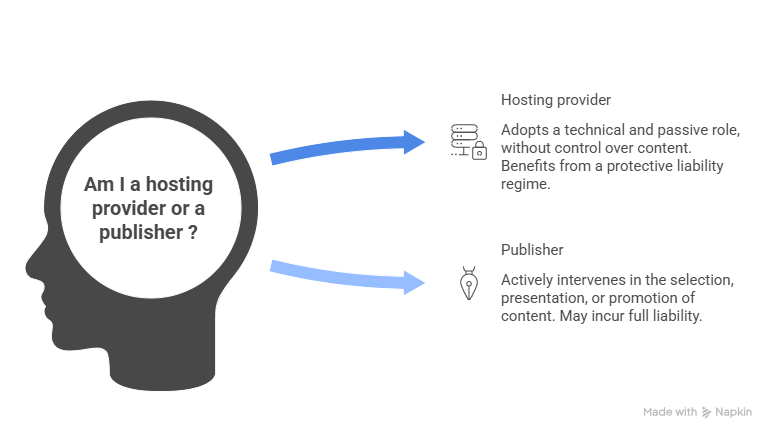
hosting provider publisher

French and European case law : guiding principles

The general principle was first established by the Court of Justice of the European Union, in its ruling of March 23, 2010, Google France SARL and Google Inc. v Louis Vuitton Malletier (C-236/08).

The Court held that a referencing service provider such as Google does not make “use” of a trademark within the meaning of trademark law where it merely plays a neutral, technical, and passive role. In such circumstances, it may benefit from the limited liability regime provided for under Directive 2000/31/EC.

Under French law, this analysis has been confirmed and further clarified in a decision of the French Supreme Court dated January 20, 2015 (No. 11-28.567). The Commercial Chamber reiterated, on the one hand, the applicability of the limited liability regime to technical service providers acting as hosts, and, on the other hand, the absence of trademark infringement solely on the basis of the use of a sign as a keyword on the Internet.

In that case, SNCF alleged that several competing companies had used its trademarks, including well-known marks, as keywords in order to redirect internet users to their own websites. It also argued that the technical service provider involved could not benefit from hosting provider status due to its allegedly active role, and further claimed the existence of misleading commercial practices suggesting a commercial link.

However, the Cour rejected all of these arguments, holding that the conditions for engaging the liability of the service provider were not met and that the use of trademarks as keywords did not, in itself, constitute an infringement of trademark rights.

French courts thus follow the line of European case law by adopting a concrete approach, based on the actual role played by the service provider and on the perception of the average internet user regarding the origin of the goods or services.

SEO and legal best practices for businesses

An effective strategy requires constant vigilance in the drafting of advertisements and in the use of third-party distinctive signs. Businesses must avoid any ambiguity, refrain from reproducing competitors’ trademarks in advertising content, and implement monitoring and rapid response mechanisms in the event of infringement. A structured approach enables the reconciliation of marketing performance with legal certainty.

Conclusion

The use of third-party trademarks as keywords constitutes a powerful strategic tool, yet one that is strictly regulated. French and European law strike a balance between freedom of online commerce and the protection of intellectual property rights, clearly distinguishing between advertiser liability and that of technical intermediaries.

Dreyfus & Associés assists its clients in managing complex intellectual property matters by providing tailored advice and comprehensive operational support for the full protection of intellectual property rights.

Dreyfus & Associés works in partnership with a global network of specialized intellectual property lawyers.

Nathalie Dreyfus with the support of the entire Dreyfus team.

Q&A

1. Can a company bring legal action even if its trademark does not appear in the advertisement?
Yes. Courts recognize that infringement may be established even without visible reproduction of the sign, where the keyword triggers advertising that exploits the economic value of the trademark.

2. Is achieving a higher ranking than a competitor in sponsored results on the Internet unlawful?
No. Ranking itself is not unlawful; what matters is how the advertisement is perceived by the internet user.

3. Can a platform refuse to remove a contested advertisement?
Yes, where the notice is insufficiently substantiated or does not establish the manifestly unlawful nature of the content. Hosting providers retain a degree of discretion when processing notices.

4. Is the use of similar (but not identical) keywords risky?
Yes. The use of similar signs may incur liability where it creates a likelihood of confusion or exploits the proximity to a protected trademark.

5. Is an action based on unfair competition more effective than trademark infringement?
In certain cases, yes. It allows courts to address conduct that does not strictly meet the criteria for infringement but nonetheless constitutes unfair appropriation of another’s business or parasitic behavior.

This publication is intended for general public guidance and to highlight issues. It is not intended to apply to specific circumstances or to constitute legal advice.

Read More

Cour de cassation: in France, authorship rights belong to individuals


©A corporation cannot have authorship of software, according to the judgment of the Cour de Cassation rendered on January 15, 2015 (Cass. Civ. 1, January 15, 2015, No. 13-23566). In this case, a computer engineer and a professor of medicine together founded a company editing cephalometric analysis software. Differences emerged regarding the ownership of the rights arising from the creation of the software and from its later developments.

The Professor of Medicine became the majority manager of the aforesaid company which filed suit against two companies managed by the engineer, petitioning the Court to declare that the two software programs were collective works. The Professor also wished it to be recognized that the authorship rights belonged solely to the company.

 The Cour d’Appel of Rennes held that the company which was originally incorporated by the two protagonists is the sole author, since the development of the software was the result of the work of its partners (CA Rennes, May 28, 2013, No. 11/05770).

Yet, the Cour de Cassation opined that a corporation cannot hold authorship rights. Indeed, Article L113-1 of the French Intellectual Property Code provides that “authorship belongs, unless proven otherwise, to the person or persons under whose name the work has been disclosed.” Accordingly, the Cour de Cassation held that it can only cover one or several individual(s) and quashed the decision of the Cour d’Appel of Rennes. The reasoning behind this judgment is crucial from a legal point of view: the corporation cannot be the author of the software, but it is vested with [its] copyright rights.

Read More

New French law to promote Intellectual Property rights and cultural heritage


AnticiperThe French Parliament passed a Law on February 20, 2015 (n°2015-195) transposing three different European directives in the fields of copyright and related rights and the return of cultural goods.

These transpositions reflect a significant improvement in respect of protection of certain related rights and of orphan works and a strengthening of the European cooperation for the restitution of national treasures.

Three European directives have been transposed by the Law n°2015-195:

  • Directive 2006/116/CE of September 27, 2011 extending the term of protection for phonogram performers and producers
  • Directive 2012/28/UE of October 25, 2012 on the new regime of orphan works
  • Directive 2014/60/UE of May 14, 2014 on the interstate cooperation for the restitution of cultural goods.
  1. Directive 2006/116/CE: increased protection of phonogram performers and producers.

The Law of February 20, 2015 amended Article L.211-4 of the French Intellectual Property Code (FIPC), extending, for the performers and producers of phonograms, the term of protection of 50 years to 70 years after the 1st of January of the calendar year following the moment when the work was made available or communicated to the public.  However, the protection for performers and producers of videos would remain at 50 years.

The Law also inserts new articles in the FIPC (L.212-3-1 to L.212-3-4) which grants performers the right to terminate the agreement whereby the performer assigned his/her rights to a phonogram producer, if the latter does not sufficiently exploit the work.  Hence, the revised law brings a more favorable environment for performers of phonograms. The 20-year extension term   is accompanied with the introduction of an additional yearly compensation for those performers remunerated on a lump-sum basis by producers of phonograms in exchange for the assignment of their rights. .The second amendment will enable them to find a way out in case of a detrimental contractual relationship with a producer.

These new guarantees will probably lead to an increase of the number of new performers and producers in France.

  1. Directive 2012/28/UE: new regime of orphan works.

The Law introduces a new Chapter in the FIPC, enabling the public libraries, museums, archives, depositary institutions of cinematographic and audio heritage and educational institutions to make works considered as orphan available to the public, i.e where their owner cannot be reasonably identified and located after extended researches.

This amendment represents a major legislative progress considering the difficulties that legislation about orphan works had caused in the past.

  1. Directive 2014/60/UE: restitution of cultural goods.

Finally, the revised Law embeds new provisions in the French Heritage Code to guarantee the return of cultural goods which are considered national treasures and which present a major interest for the national heritage in matter of History, Art and Archeology, and that have been unlawfully removed from their national territory after December 31, 1992. This new process facilitates the restitution of the goods and contributes to the enhanced cultural cooperation at the European level.

Read More

International trademark: Gambia joins the Madrid Protocol effective December 18, 2015


s-business-dreyfus-7On September 18, 2015, the Republic of Gambia joined the Protocol relating to the Madrid Agreement concerning the international registration of trademarks (known as the Madrid Protocol). The country thus has become the 96th member to join the Madrid system.

It is to be noted that the Madrid system makes it possible for applicants to simultaneously protect their trademarks in the 112 territories, which represents more than 80% of the world’s trade.

This system thus simplifies the protection of trademarks by streamlining the registration process on an international level as it makes it possible for holders of a trademark to submit an application for registration in a large number of countries, by filing a single document, in only one language (French, English or Spanish) and by paying only one set of fees.

The relevant treaty will enter into force on December 18, 2015. Trademark owners will then be able to include the Republic of Gambia when registering an international trademark and will be able to therefore extend their existing international registrations to Gambia.

On October 6, 2015, the government of the Republic of Gambia notified the Director of the World Intellectual Property Organization of specific measures to be put into place in virtue of article 5(2)(b) and 8(7)(a) of the Protocol.

Thus it was stated that the deadline of one year for raising a provisional refusal of protection is to be replaced by a delay of 18 months. A provisional refusal based on an objection can be raised however even after the 18 month period.

The government also requested to be able to receive an individual fee, in the event that the Republic of Gambia is designated under an international filing application and where the designation is related to a prior international registration or international renewal.

These measures will come into force in the Republic of Gambia on the January 6, 2016.

The Madrid system has many advantages to offer trademark owners and the number of members increases every year. However, certain countries, including Canada, have still not joined the system.

Dreyfus can assist in all procedures relating to the registration of your trademark by devising the best strategy to enhance and protect your rights.

Read More

France: “Je suis Paris” and “Pray for Paris”: INPI refuses to register slogans as trademarks

Like the phenomenon “Je suis Charlie” during the tragic events of last January, the recent attacks in Paris dated November 13, 2015 were also an opportunity for spreading messages of support such as “Je suis Paris” or “Pray for Paris”.

Since the attacks, the INPI (France’s trademark office) counted more than ten attempts to file these slogans. In fact, as the slogans have since been shared worldwide and across numerous social networks, some people sought to seize the opportunity and take advantage of this phenomenon. In the aftermath of the attacks on the offices of the magazine, Charlie Hebdo, some fifty trademark applications “Je suis Charlie” were received.

However, like trademark applications relating to the attacks of Charlie Hebdo, INPI stated on Friday November 20, 2015, that it would not register as trademarks, signs such as “Je suis Charlie” or “Pray for Paris”.

In fact, according to INPI, such signs or variants thereof, appear to be contrary to public policy. Pursuant to Article L 711-3 of the French Code de la Propriété Intellectuelle, a request for registration indeed should be rejected if it appears that “its publication is likely to cause prejudice to public policy or morality”. The components of the signs in question cannot be taken up by an economic actor, due to the global perception of the terms, in light of the events that took place on Friday, November 13, 2015.

The basis for INPI’s decision to reject as trademarks, the slogans “Je suis Paris” and “Pray for Paris” is different however from its decision regarding the slogan “Je suis Charlie”. In fact, on January 13th 2015, INPI refused to register this slogan as a trademark on the grounds of the descriptive character of the terms used, as per Article L 711-1 of the French Code de la Propriété Intellectuelle.

Furthermore, INPI’s decision regarding the refusal to register the slogans, “Je suis Paris” and “Pray for Paris” as trademarks, is founded on a different legal basis: the prejudice to public policy or morality.

The concept of public policy is traditionally used to justify the registration of trademarks referring to drugs or profanities, but it can also be invoked in respect of the refusal to register slogans as trademarks.

For example, in 2003, the Director of the INPI decided to reject as a trademark, the slogan “Non à la Turquie en Europe” as it was contrary to public policy.

Thereafter, the Cour d’Appel de Paris confirmed the decision of the Director of the INPI by concluding that the sign was “a slogan which, contrary to the objective of trademark law, does not aim at distinguishing the goods and services of a company from those of another in order to guarantee the source or origin to a customer, but rather to establish to the advantage of the association […] operating a purely political privilege of the use of this sign”. (CA Paris, 4e ch., sect. A – June 9, 2004). According to the Court, the association tried “to obtain, through a misuse of trademark law, an exclusive right on one of the terms of this debate”.

In the same way and following the previous refusal to register as a trademark the slogan “Je suis Charlie” by the INPI, the Office For Harmonization In The Internal Market (OHIM), reported in a statement dated January 16, 2015 that the same sign will most likely be rejected as a trademark on the basis of Article 7(1) (f) of the Council Regulation on the Community trademark. Indeed, this article provides that trademarks which are contrary to public policy or morality shall not be registered.

The slogans “Je suis Paris” or even “Pray for Paris” are compositions which have been appropriated by both French citizens and the rest of the world. Used in multiple forms on social networks and through various expressions, the combination of these terms cannot be perceived by potential customers as a sign fulfilling the function of a trademark.

Thus, INPI’s refusal to register these signs is entirely in accordance with the stance that applicants for the trademarks, “JE SUIS PARIS” and “PRAY FOR PARIS” have tried to appropriate slogans benefiting from a strong popularity and which were not originally created for commercial purposes.

The slogan widely used both in and outside France since the attacks, conveys a message of support and therefore cannot be perceived by the public as a trademark guaranteeing the origin of the applicant’s goods and services.

Other than the legal basis, the stance taken by the INPI is most welcomed. Indeed, no one can be authorised to gain commercial advantage from such tragic events.


Read More

Personal Injury Case Settled

Shortly after Detroit filed for bankruptcy in July 2013, Judge Rhodes made it clear that its lawyers shouldn’t be charging the struggling city for first-class flights, alcoholic beverages or movies in hotel rooms. His instructions are the most detailed legal-fee instructions given to a city or county in a modern municipal bankruptcy case.

In Detroit’s case, some firms said they refrained from making unnecessary or overly aggressive moves that would have run up the bill for the 680,000-resident city. Lawyers at Dentons U.S. LLP who spoke for the city’s 23,500 retirees said that they also cut their bill by $3.4 million. The firm charged $14.6 million for helping explain the claims and voting process to retirees who were unfamiliar and “largely hostile” to the bankruptcy, firm officials said in court papers.

The 204 ABA-approved law schools reported total J.D. enrollment (full-time and part-time students) of 119,775. This is a decrease of 8,935 students (6.9 percent) from 2013 and a 17.5 percent decrease from the historic high total J.D. enrollment in 2010. The 2014 total enrollment is the lowest since 1982, when there were 169 ABA-approved law schools.

Read More

Dreyfus : Legal 2015 Awards Corporate LiveWire

prix
Dreyfus has been awarded the Most Innovative Intellectual Property Law Firm in the Legal 2015 Awards LiveWire

The Corporate LiveWire Global Awards highlight those businesses that display exemplary standards and an incredible performance in their chosen fields right across the globe. They are awarded by the Corporate LiveWire team for showing an unending commitment to excellence in their field.

Winners are chosen based on referrals from readers and clients, representation on high profile cases, significant deals closed, peer reviews, speaking engagements and articles produced.

The Corporate LiveWire Legal Awards considers that its acknowledgment stems from the fact that Dreyfus is an innovative Intellectual property firm with expertise in the digital economy and internationally recognized.

This prize rewards the seriousness, rigor and dynamism of the Dreyfus Team and its innovative technology platform known as “Dreyfus IPWeb®” for the management of trademark and domain name portfolios.

Here at Dreyfus we endeavor to strive and exceed our innovative ambition.

We are truly honoured to have received the award for the Most Innovative Intellectual Property Law Firm. We are especially grateful to our clients; we could not have achieved such an award without their faith and trust in our firm.

Read More

France: Jane Birkin defends her trademark against Hermès

Recently alerted by the cruel practices endured by crocodiles during their slaughter for the production of the famous Birkin bags from the Hermès fashion house, the singer Jane Birkin informed Hermès about her intention to rename the crocodile-skin handbag bearing her name. The singer no longer wishes her name to be associated with such practices.

The Birkin bag, created in the early 1980s following a meeting between the singer and Jean-Louis Dumas, the chief executive of Hermès at that time is, however, one of the leading bags from the Hermès fashion house since its inception date.

Alongside arousing the curiosity of fans of the luxury brand Hermès, this news has also piqued the interest of lawyers. Indeed, in the face of such news, the question that arises is whether Jane Birkin can legally rename the crocodile-skin bag.

The fact of renaming a designer bag bearing the name of a star is not an isolated practice since there is a myriad of bags bearing the name of their muse. To cite only the most famous, it is noteworthy to mention the following designer handbags namely: So Kelly from Hermès as a tribute to Grace Kelly, Jackie from Gucci, Lady Dior, or B. Bardot from Lancel.

Since these names are associated with handbags, i.e. with goods, they were obviously registered as trademarks. This is the case, for example, for the name Birkin, filed and registered both as a French and international trademark by HERMES INTERNATIONAL since 1997 and the “So Kelly”, filed in 2009. The same holds true for the “Jackie” handbag, which refers to Jackie Kennedy and was filed by the Italian company GUCCIO GUCCI in 2008.

The practice of registering a surname as a trademark has been upheld by legislation and the French courts for a long time.

The surname is a personality right which is inalienable and indefeasible. Yet Article L.711-1, paragraph 2 a) of the French Intellectual Property Code provides that surnames can be registered as a trademark. Moreover, since the 1985 case of Bordas (Cass. Com. March 12, 1985, No. 84-17163), it is settled law that there can be an agreement to the effect of the commercial use of a surname.

Subsequently, the cour de cassation specified the conditions under which a surname could be registered as a trademark. In a judgment datedMay 6, 2003 (Cass. Com. No. 00-18192) the cour de cassation held that a founding partner who has agreed to the inclusion of his name in the company name must also expressly waive his ownership rights and allow the company to register the said surname as a trademark. In other words, the use of the surname of a third party is limited to what has been expressly authorized by the name holder.

Thereafter, the cour de cassation intervened in the Inès de la Fressange case regarding the use of her surname as a trademark by the fashion company bearing her name. After being dismissed from the company, the fashion designer had sought to recover the rights affiliated with her name by invoking the potentially misleading nature of the trademark on the basis of Article L. 714-6 b) of the Intellectual Property Code. She claimed that consumers would be misled into believing that they were buying clothes designed by her. But this was not the stance taken by the cour de cassation which, on the basis of Article 1628 of the Civil Code and the implied warranty against eviction principle, dismissed the designer’s claim (Cass. Com. January 31, 2006, N ° 05-10116).

A few months later, the Court of Justice of the European Union also faced a similar question in the Elizabeth Emanuel case (ECJ March 30, 2006. Aff . C-259 /04. Elizabeth Florence Emanuel v Continental Shelf). The issue in that case concerned the sale by the designer Elizabeth Emanuelof her fashion company bearing her name and the assets attached thereto, including the ELIZABETH EMANUEL trademark. However, following the sale, the fashion designer filed a claim for the revocation of rights against the trademark which was transferred accordingly, deeming that, just as was the case with Madame de la Fressange, the public was confused since she was no longer the designer of the clothes marketed under the trademark.

The Court held that the ELIZABETH EMANUEL trademark was not, in itself, likely to mislead the public as to the origin of the clothes. But the Court opined that it is for the national court to verify whether there is, on behalf of the company holding the trademark, an intention to make the consumer believe that the designer is still involved in the design of clothes. This would thus be tantamount to fraudulent tactics likely to make the company liable.

In the present case, since Jane Birkin is not associated with the design of the handbag, she cannot rely on this approach for the crocodile-skin handbag to be renamed.

It therefore remains to be seen whether the intention to rename the Birkin crocodile-skin handbag can materialize to the extent that the surname of the singer, registered as a trademark, could be considered as part of the assets of the Hermès company. The outcome of this case shall enlighten us.

Furthermore, on 11 September last, the saddler welcomed in a press release that Jane Birkin seemed to be satisfied by the measures adopted by the Hermès house following the controversy appeared this summer.

Can Jane Birkin legally prohibit Hermès from using her name?

Yes. Jane Birkin can oppose the use of her name if it harms her image or was used without her express consent. Under French law, a family name is protected by privacy rights and potentially by trademark law, if registered.

What are the criteria to protect your name as a trademark?

To defend your name, you must demonstrate its notoriety, commercial use, and the risk of confusion or harm to your reputation. This is especially relevant for public figures and celebrities.

Does Hermès have to rename the Birkin bag?

Not necessarily. If Hermès originally obtained consent or the name has become a standalone brand, the use may be legally justified. However, legal opposition from Jane Birkin could force the company to reconsider its use.

Read More

France: a Digital Law scheduled for autumn 2015

Dreyfus, expert des nouvelles technologies

In today’s enhanced digital age, the establishment of a Digital Law was only a matter of time. Indeed, although France already possesses a Digital Law, this law dates back to 2004 and does not therefore take into account several innovative technologies such as social media, big data or smartphones.

It is against this background that the government announced, in early 2013, at a seminar on digital technology, its decision to submit a bill on digital technology during its parliamentary term.

To this end, the involvement of several special advisors as well as the French National Commission for Information Technology and Civil Liberties (Commission Nationale de l’Informatique et des Libertés – CNIL) was sought; they gave their views on the subject and also made proposals with regards to areas for improvement. The government even went further by setting up an online consultation platform, inviting everyone to give their opinion on the bill on digital technology.

The first contribution was made by the National Digital Council (Conseil National du Numérique – CNN), which presented, on June 18, 2014, its report entitled “Digitial Ambition” (“Ambition numérique”) to the Prime Minister, Manuel Valls.

The report outlines 70 proposals and the bill on digital technology is expected to incorporate many of them. Amongst these proposals, the creation of a net neutrality principle for ensuring equal access to all networks regardless of the operator is to be particularly noted. Net neutrality ensures equal treatment of all data flows on the Internet and thus serves to deter any kind of discrimination against the source, destination and content of the information transmitted.

It is worth noting here that the principle of “net neutrality” is not an innovation of the CNN. Quite the contrary, it is a principle which has been the subject of intense debate and lobbying in the United States before being adopted by the Federation Communications Commission (FCC) on February 26, 2015. This principle has also been a topic of discussion within the European Commission since 2011.

Another major point addressed by the CNN is the need for platform loyalty which would take the form of new obligations imposed on the major digital players like Google and Facebook.

In addition and as it is difficult to contemplate a revision of the digital law without taking into account the protection of personal data, the CNN also proposed to strengthen the data personal protection policy, particularly in order to establish a right to be digitally forgotten.

The CNIL consequently took over the reins by making public its reform proposals regarding the protection of personal data on January 13, 2015. The primary focus of these proposals is on reinforcing the effectiveness of people’s rights, aiming particularly to strengthen the right of access or the “right to know of one’s data”, which, although essential, has hardly been used so far. However, the CNIL also wishes to establish special provisions for minors who are often the targets of data theft due to their increased use of the Internet in general and of social networks in particular.

The CNIL also proposes to simplify the formalities and rules relating to companies, especially as regards the formalities relating to international data transfers, which are currently particularly bulky.

In light of all these proposals, the Prime Minister, Manuel Valls announced on June 18, 2015, during a presentation of the government’s “digital strategy’’ before an assembly of experts, his aim to make public the new bill in July 2015. During this presentation, the Prime Minister and Secretary of State for the Digital Economy, Axelle Lemaire, notably announced that the long-awaited principle of net neutrality would be included in the law and also that the Personal Data Act would be amended.

Other measures were revealed, particularly the will of the government to set up a grande école for digital technology, to control, through inspections by competition services, the terms of use of major sites operating in France as well as to create data of public interest. Furthermore, the Secretary of State for the Digital Economy revealed the future collaboration between the French government and the Council of Europe in order to draft a citizens’ rights and digital charter.

To conclude, the government’s digital strategy highlights awill to integrate digital technology in all aspects of French people’s life, including economic, tourism, educational and health sectors. The government thus wishes to “boost France five years ahead in time to make our country a digital republic” and at the same time to provide a model to the Council of Europe for the drafting of the European regulation for 2018 on the use of personal data.

Read More

France : news about

dreyfus-ipwebThe new gTLD <.paris> has been available to everyone since 2 December 2014, making it the first gTLD in France to be specifically dedicated to a city.

While it has become difficult to stand out on the web with now classic domain names such as <.fr> or <.com>, <.paris> represents a great opportunity for those who wish to gain more visibility.

The new gTLD <.paris> attaches to the domain name all that the city of Paris is known for: quality, elegance and innovation throughout the world.

Its many attractions have not gone unnoticed, as, by the end of 2014, more than 2,000 companies had already purchased a domain name ending with <.paris>, especially those in the luxury, gastronomy and innovation sectors. These figures rapidly increased and according to statistics from May 2015, there are now more than 18,000 domain names ending with <.paris>.

I. The distinctive features of <.paris>

The distinctive feature of <.paris> is that one has to belong to the community of Paris to qualify for registration. Indeed, under Article 2.1.1 of the registration policy of .paris, in order to register for or to renew a domain name ending with <.paris>, one should be a natural or legal person, established, in what could be considered as good faith, in the Paris region, at the time of, as well as after, registration. The applicant must be able to prove that it resides in the Paris region, or that it carries out professional, personal, commercial or cultural activities there, or it must be able to prove a direct or indirect link to the Paris region.

This requirement should not be taken lightly, because Article 9 of this registration policy specifies that “the registry operator has the right to reject, revoke or annul, at any time, any application for domain name, or any related registration, if it is found that the applicant has not satisfied the eligibility requirements in whole or in part”.

Interestingly, this requirement is exclusive to <.paris>. Indeed, applicants for the <.london> or <.tokyo> gTLDs, for example, do not have to prove belonging to the region.

II. Disputes surrounding .paris

Since <.paris> is still very new, there has been little in the way of case law, although there have been out-of-court decisions, and various disputes, including the cases of <match.paris>, <briochedoree.paris>, <laposte.paris> and <eleven.paris>.

Danone was able to obtain the suspension of the domain name <groupedanone.paris> on 5 June 2015, in a Uniform Rapid Suspension (URS) proceeding at the National Arbitration Forum (No 1618861). In this case, the fact that the domain name included the entire name of the company and the Danone trademark and associated it to the city of Paris, which is precisely where the company was founded, served to show that the applicant knew of the company and that it was acting in bad faith.

In another case, held this time before the World Intellectual Property Organization (WIPO) Arbitration and Mediation Center, Société du Figaro obtained the transfer of the domain names <le-figaro.paris> and <lefigaro.paris> (D2015-0094). In this case, the applicant had tried to prove that the term ‘Figaro’ was a common word used to designate an opera character. But when linked to Paris, which is where the Figaro Company is headquartered, it became clear that the applicant had registered and used this domain name in bad faith. The fact that the ‘Figaro’ trademark was linked to Paris demonstrated the identity of the domain name with the trademark and therefore, the likelihood of confusion.

The same argument relating to the head office of the holder of the trademark was raised in URS proceedings on 31 March 2015 (FA1503001608773) concerning <lasamaritaine.paris>.

The <.paris> gTLD may, where there is a dispute, constitute an additional argument to demonstrate a domain name applicant’s bad faith where the holder of the trademark whose rights have been infringed is situated in Paris.

However, this is not always the case and experts do not yet agree on whether new gTLDs should be considered during the comparative examination of a domain name and a trademark in Uniform Domain Name Dispute Resolution Policy (UDRP) proceedings.

When UDRP proceedings were instituted in 1999, TLDs were extremely limited and were restricted to the original five and 247 country-code TLDs. Experts have therefore rapidly established a principle according to which TLDs must not be taken into consideration while assessing the identity or the similarity between the domain name and the trademark in question. It was generally accepted that the TLD should not be taken into consideration when comparing the signs due to its exclusively technical nature and it being an inherent part of the domain name system.

However, this principle is now being questioned in the wake of the new gTLD programme. In the first UDRP proceeding following the introduction of the new gTLDs, experts had to determine whether the domain name <canyon.bike> was identical or similar to the ‘Canyon’ trademark, registered for bicycles (D2014-0206). On this occasion, the experts pondered whether, in the context of new gTLDs, it is correct to take into consideration the TLD when assessing the identity or the similarity of the name with the trademark, although, in this case, they did not directly address this question, given that the domain name consisted of the ‘Canyon’ trademark in full in such a way that the identity was clear.

In another case, this time a dispute concerning the domain names <statoil.holdings> and <statoil.venture> (D2014-0369), the experts examined both cases: namely, the comparison of the signs without considering the gTLDs, and the comparisons with the gTLDs. However, the experts again declined to comment on whether it was relevant to consider them since in both cases, the signs were similar in such a way that the requirement in Paragraph 4 (a)(i) of the UDRP principles was fulfilled.

In a case concerning the domain name <zionsbank.holdings> (D2014-0269), the experts examined at length the relevance of taking new gTLDs into account. In that case, however, it was considered that the term “holdings” at the end of the domain name at dispute made it impossible to establish that the domain name was identical or similar to the ‘Zions Bank’ trademark. Nevertheless, they specified that, depending on the case at hand, the examination of the gTLD could impact on the analysis of the requirement set out in 4(a)(i).

Several URS proceedings relating to new gTLDs have revealed the experts’ willingness to take into account the new gTLD in examining the likelihood of confusion between the domain name in dispute and the trademark.

In this light, a 1 April 2014 case of 1 April 2014 regarding the registration of the domain name dior.clothing (FA140201546033) is noteworthy. In this case, the experts took into consideration the fact that the disputed domain name was registered in a gTLD (.clothing) which explicitly refers to the business that the complainant is active in.

Similarly, an 11 June 2014 case, where the issue was the registration of the domain name parissaint-germain.club (FA1406001563159), the experts said: “The generic word ‘club’ which serves as a gTLD does not distinguish the domain name. Furthermore, it rather increases risk of confusion since the complainant’s main activity is maintaining a football club.”

To conclude, it is impossible for the time being to state that new gTLDs should be taken into consideration during the examination of the identical or similar nature of domain names in relation to trademarks during UDRP or URS proceedings. Indeed, the experts seem reluctant to enunciate such a principle and have until now, especially in UDRP proceedings, not been clear on the issue of whether and to what extent these gTLDs should be taken into consideration. This is not surprising since the new gTLDs, publicly accessible since 2012, represent a significant evolution from the classic TLDs around which case law has been constructed. The situation is now expected to evolve.

Read More