

Introduction
AI-assisted coding is emerging as one of the most profound technological disruptions of this decade. Platforms such as GitHub Copilot, Cursor and Claude Code now allow an AI agent to design, structure and deliver a complete software package based solely on high-level instructions. This technical acceleration raises a strategic legal question: can a company truly protect, under copyright law, software created with the assistance, or even under the impetus, of AI agents?
In a context where AI programming tools are becoming genuine production partners, legal departments and technical teams must anticipate a major risk: losing, in whole or in part, the protection attached to the software assets they believed they controlled.
The legal framework for copyright protection of software
The European foundation: the software directive
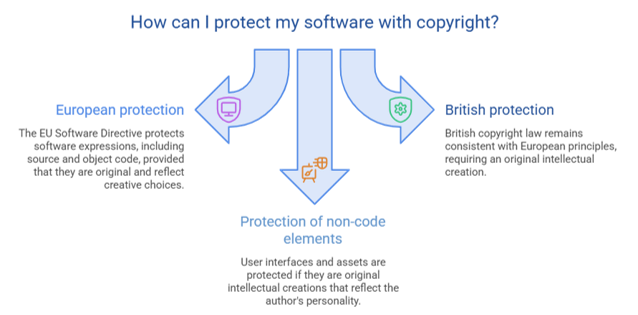
Under European Union law, copyright protection for software is based on Directive 2009/24/EC on the legal protection of computer programs, commonly referred to as the “Software Directive”. This text requires Member States to grant protection to “the expression in any form of a computer program”. The wording is deliberately broad: it covers both source code and object code, as well as preparatory design material, functional specifications, architectures and technical documentation provided that these elements reflect genuine creative work.
The central criterion remains originality, as interpreted by the Court of Justice of the European Union (CJEU).
According to settled European case law since the judgment in Bezpečnostní softwarová asociace (C-393/09, BSA, 22 December 2010), and as confirmed in the Painer cases, of December 1, 2011 (C-145/10) “a computer program is protectable only if its author has exercised “free and creative choices” in the way the software’s functionalities are expressed.”
Elements whose form is entirely dictated by technical constraints, a sorting equation or a standardized compression protocol cannot, in themselves, claim protection.
Post-Brexit continuity in the United Kingdom
Since the United Kingdom’s withdrawal from the European Union, UK copyright law has remained aligned with these principles. The Court of Appeal of England and Wales confirmed in THJ v Sheridan that originality, within the meaning of the Copyright, Designs and Patents Act 1988 (CDPA), still requires the work to be the “author’s own intellectual creation”, in line with European standards. At this stage, no substantial divergence appears to be emerging between continental and UK law on this issue.
Protection of non-code elements: interface and assets
Beyond the code itself, the visual, textual and sound elements that make up the user interface benefit from their own protection regime. In Infopaq (C-5/08, 16 July 2009), the CJEU held that a work is protected where it is the “author’s own intellectual creation”, reflecting the author’s personality and expressed through free and creative choices.
This approach was recently reaffirmed by the CJUE in the Mio judgment of December 4, 2025 (C-580/23, 2024), which clarified the contours of originality for graphic and sound elements.
AI at the heart of the development process: a threat to protection?
Three levels of AI involvement in the software development cycle should be distinguished, as each carry distinct legal consequences:
- The code copilot such as GitHub Copilot or Tabnine: AI suggests code snippets that the developer accepts, modifies or rejects. The creative initiative remains human.
- The conversational development assistant such as ChatGPT or Claude: the developer describes a feature in natural language and receives a complete code block, which is then integrated into an architecture that the developer controls.
- The autonomous coding agent such as Claude Code, Devin or OpenHands: based on a high-level specification, the agent plans, codes, tests and delivers the entire project with minimal human supervision.
It is this third category that concentrates most of the legal risk. Where the agent autonomously determines the software architecture, chooses programming paradigms and writes the thousands of lines of code forming the final product, the human contribution may be reduced to the formulation of an intention which is difficult to characterize as a “free and creative choice” within the meaning of CJEU case law.
The core issue is that the technical performance of code and its originality under copyright law are radically different qualities. Software generated by an AI agent may be syntactically flawless, functionally complete and algorithmically sophisticated, while still lacking any human creative imprint. What it reflects is the statistical combination of the model’s training corpus, not the personality of an author.
Yet it is precisely this imprint the trace of choices that the author could have made differently that forms the basis of protection under Directive 2009/24/EC and settled CJEU case law. AI-optimized code is not necessarily original code in the legal sense: this is the first pitfall that legal teams must learn to identify.
European and U.S. case law on AI-assisted coding
There is not yet any case law directly addressing software entirely coded by AI. The available decisions concern other types of AI-generated works, such as images, logos and lyrics, but they converge around a common criterion that can be directly transposed to software: protection depends on measurable and documented human creative control over the final result.
The U.S. position
In the United States, the applicable framework is set out in the Copyright Act of 1976, whose constitutional basis has been interpreted by the Supreme Court as requiring a human author. The U.S. Copyright Office formalized this position in its revised 2023 guidance, stating that material generated by AI without sufficient human creative control cannot be registered.
The Case of Thaler v. Perlmutterdecided on March 18, 2025, by the District of Columbia Court of Appeals, illustrates this requirement. Although the case did not concern software, but rather a visual work generated by AI, the court’s reasoning is directly relevant to AI-generated code. By recalling that the Copyright Act requires the existence of a human author, the court confirmed that the protection of an AI-assisted creation depends on human intervention in the final result. Transposed to software, this requirement means assessing whether the developer actually designed, selected, structured or modified the generated code, beyond merely submitting a request to the tool.
We invite you to read the dedicated article on this case on our blog.
The European position
The first European decision: Prague Municipal Court, October 11, 2023
In the first European decision on this issue, case no. 10 C 13/2023-16, the Prague Municipal Court refused to grant copyright protection to an image generated using DALL-E by OpenAI. The claimant had written a prompt describing the desired scene in detail; the court held that this was not sufficient to demonstrate that the image was “the unique result of the creative activity of a natural person”. Now final, this decision establishes a principle applicable to any type of AI-generated content: a high-level instruction given to a generative system does not, ipso facto, confer copyright ownership over the resulting output.
The Munich court’s reference decision: no protection for AI-generated logos
In its decision of February 13, 2026 (AG München, 142 C 9786/25, GRUR-RS 2026, 1513), the Munich court refused copyright protection for three AI-generated logos, holding that neither the prompts nor the successive human interventions demonstrated sufficient creative control over the final form of the works. The court nevertheless left open the possibility that protection could arise where human creative elements “dominate” the result to such an extent that it can be regarded as the author’s own original creation. This leaves a narrow path that legal and technical practice must now seek to build upon.
The Frankfurt case: the burden of proving authorship
The decision of the “Landgericht Frankfurt am Main” (Frankfurt am Main Regional Court GRUR-RS 2025, 41927), sheds light on a decisive procedural issue. A lyricist sought an injunction for infringement of her lyrics; the defense submitted expert evidence claiming that the lyrics had been generated by AI. The claimant responded with a simple sworn statement establishing her initial authorship, AI having been used only for subsequent musical adaptation.
The court held that this statement was sufficient at the interim relief stage. This case reveals a major risk for companies: the “AI defense” is becoming a means of challenging copyright, placing an increasing evidential burden on creators, one that only rigorous preventive documentation can anticipate.
Conclusion
The rise of agentic coding forces companies to rethink their approach to software intellectual property, no longer as an automatic protection acquired by the mere fact of development, but as the result of a conscious strategy of human involvement and creative documentation. The transatlantic convergence of European and U.S. case law points to a coherent legal horizon: only measurable and documented human creative control can form the basis of copyright protection for software developed with the assistance of AI.
Dreyfus & Associés assists its clients in managing complex intellectual property matters by providing tailored advice and comprehensive operational support for the full protection of intellectual property rights.
Nathalie Dreyfus with the support of the entire Dreyfus team.
FAQ
1. Can software generated entirely by AI be protected by copyright in France?
No, under current positive law. Copyright protection requires the work to be the author’s own intellectual creation, reflecting free and creative choices (Article L. 112-1 of the French Intellectual Property Code; Directive 2009/24/EC). Software whose architecture, structure and code have been determined autonomously by an AI agent does not satisfy this criterion. Only the parts of the code that are subject to identifiable and documented human creative interventions may qualify for protection.
2. What is the difference between an AI coding assistant and an autonomous coding agent from a legal standpoint?
The distinction is crucial. A coding assistant, or copilot, suggests code fragments that the human developer selects, adapts and integrates: the chain of creative decisions remains human. By contrast, an autonomous agent performs the entire design and production process based on high-level instructions, reducing the human contribution to the formulation of an intention. The more control AI exercises over the final result, the weaker copyright protection becomes.
3. How can companies preserve copyright when using AI tools?
The key lies in documenting and structuring human interventions. Developers should retain architecture notes, creative decision logs, version histories and prior specifications evidencing their expressive and structural choices. Companies should also define mandatory creative control checkpoints within development processes, where a human developer deliberately and traceably validates or transforms AI outputs.
4. Is U.S. law aligned with European law on the protection of AI-generated software?
Yes. The convergence between U.S. and European law provides a coherent analytical framework for companies operating internationally.
5. Can trade secret protection replace copyright for AI-generated software?
It may constitute a partial and effective substitute for internal-use software. Directive 2016/943/EU on the protection of trade secrets, transposed into French law by Law No. 2018-670 of July 30, 2018, protects any commercial information that has economic value, is not publicly disclosed and is subject to reasonable protective measures. Strictly internal software, whose code is not exposed to third parties, may therefore be protected independently of copyright considerations, provided that appropriate confidentiality measures are implemented, such as restricted access, contractual clauses and a BYOD policy.
This publication is intended to provide general guidance to the public and to highlight certain issues. It is not intended to apply to specific circumstances or to constitute legal advice.