


Introduction
The fashion industry relies almost entirely on intangible assets: a print, a silhouette, a clasp, a collection name. Unlike raw materials or manufacturing workshops, these creations cannot be locked away with a key: they must be protected legally to preserve their economic value. Fashion houses, from major luxury groups to emerging young brands, are today facing a triple pressure: the proliferation of online counterfeiting, the rise of marketplaces that multiply illicit points of sale, and new risks linked to artificial intelligence, capable of generating or reproducing designs within seconds.
Faced with this reality, no single intellectual property right is sufficient to cover every possible infringement. It is the combination of design rights, copyright and trademark law, supplemented by a monitoring and anti-counterfeiting strategy, that allows designers and fashion houses to durably secure their collections, their commercial identity and their competitive edge.
I- Which intellectual property rights protect a fashion creation?
A fashion creation can be protected by combining three complementary rights: design rights, which protect the appearance of the product; copyright, which protects original creations with no formality; and trademark law, which protects a house’s distinctive signs (name, logo, shape).
 These are backed by evidence of the creation date, such as the INPI’s Soleau envelope, a notarial deposit or blockchain timestamping, which are valuable in the event of a dispute. These different layers of protection, detailed below, are cumulative and mutually reinforcing.
a) Design protection: the fashion designer’s tool of choice
A design protects the appearance of a product (its lines, contours, colours and texture) provided it meets two cumulative conditions: novelty (the design must not have been previously disclosed) and individual character (it must produce, on the informed user, a different overall impression from that produced by earlier designs).
In practice, filing is carried out with the INPI for national protection or the EUIPO for a European Union design, with protection lasting up to 25 years (5-year terms renewable four times). There is also a regime of unregistered EU designs, automatically protecting any creation disclosed within the EU for 3 years, with no formalities, a particularly useful safety net for collections with a short life cycle.
The European framework has just been thoroughly modernised by Regulation (EU) 2024/2822 and Directive (EU) 2024/2823, which entered into application on 1 May 2025: the definition of “product” now extends to digital creations, movement and animation are taken into account, a new symbol has been introduced, and rights now extend to goods in transit within EU territory. The Dreyfus firm details all of these developments and their strategic implications for rights holders in its full guide to the 2025 EU design reform as well as in its article on the . For the official text, see Regulation (EU) 2024/2822 on EUR-Lex.
b) Copyright: automatic protection that is difficult to prove
Copyright protects fashion creations from the moment they are created, with no filing or formalities required, provided they are original, meaning they bear the imprint of their author’s personality (Cofemel case law, CJEU, 12 September 2019). This absence of formalism is both a strength and a weakness: in the event of a dispute, it is up to the creator to prove the date and authorship of their creation.
Several tools help establish this proof: the INPI’s Soleau envelope, deposit with a notary or bailiff, or, increasingly, blockchain timestamping. On this last point, French case law is beginning to accept this form of digital evidence, as explained by the Dreyfus firm in its analysis of the Marseille Judicial Court’s ruling of 20 March 2025: «Is blockchain evidence recognised in copyright matters?»
Copyright protection lasts for the life of the author plus 70 years post mortem.
c) Trademarks: protecting a fashion house’s commercial identity
Trademark law protects a house’s distinctive signs, in several cumulative forms:
- a word mark (the house’s name or a collection’s name);
- a logo (semi-figurative mark);
- a figurative mark (a pattern, a symbol);
- a three-dimensional mark, which protects the very shape of a product or one of its distinctive elements.
This last category is subject to strict examination by trademark offices, to avoid granting a monopoly over a purely functional shape to the detriment of competition. Yet it enabled Hermès to secure a resounding victory: in its ruling of 7 February 2025 (No. RG 22/09210), the Paris Judicial Court held that the Kelly and Birkin bags were protected both by copyright (on account of their originality) and by the three-dimensional trademark covering their clasp and padlock, ruling against a company marketing bags and an NFT reproducing these features. The Dreyfus firm provides a detailed analysis in «Decision of the Paris Judicial Court on the Protection of the Iconic Kelly and Birkin Bags »; an official summary of the decision is also available on the EUIPO case-law database.
II- What are the main legal risks facing fashion brands?
a) Online counterfeiting and marketplaces
Marketplaces have multiplied sales channels, but also the areas of vulnerability for rights holders: counterfeit bags, cosmetics, watches and clothing are offered there at slashed prices, sometimes via “ready-to-use kits” including graphic branding, fake customer reviews and copied product photos. Social media amplifies this phenomenon by serving as both a showcase and a direct sales channel. The Dreyfus firm details the reporting mechanisms, the obligations imposed on platforms under the DSA and the DMA, and the available monitoring strategies in «Strengthening Intellectual Property rights protection against counterfeiting on marketplaces» and in «Trademark protection in the digital age: key issues and best practices».
The role of platform operators nevertheless remains governed by a nuanced body of European case law: in Coty v. Amazon (CJEU, 2 April 2020, C-567/18), the CJEU held that a mere warehouse keeper who does not itself use the sign at issue does not incur liability for trademark infringement, unless it had knowledge of the illicit nature of the goods stored.
b) “Dupes” and copies inspired by luxury products
The phenomenon of “dupes” (low-cost imitations that openly borrow the visual codes of a luxury product without directly reproducing the trademark) blurs the line between legitimate inspiration and counterfeiting. Widely popularized on social media, these products exploit legal grey areas: they often escape a classic trademark infringement action, forcing rights holders to combine copyright, design rights and actions for unfair competition and free-riding (parasitisme). The Dreyfus firm examines this phenomenon in «Legal challenges of product similarity in the fashion industry», as well as recent case-law developments on the subject in «Unfair Competition and Parasitism: Developments in Case Law».
A more sophisticated variant, referred to as “Pingti,” reproduces the quality, material and finish of a luxury product with no visible logo whatsoever, rendering a trademark infringement claim ineffective and forcing rights holders to turn to design rights, copyright or unfair competition instead. See «The Rise of Pingti: Discreet luxury counterfeiting».
c) Upcycling and personalisation: an emerging legal issue
Upcycling, the creative transformation of authentic, used products into new value-added items, raises an unprecedented question: to what extent can the exhaustion of rights doctrine (which allows the resale of a genuine product once placed on the market with the rights holder’s consent) cover a transformative reuse?
Two recent rulings from the Paris Judicial Court provide decisive guidance:
- Paris Judicial Court, 10 April 2025, No. 22/10720 (Hermès v. Maison R&C / Atelier R&C): a designer was marketing denim jackets incorporating patches cut from authentic Hermès scarves purchased second-hand. The court held that transforming the scarves into jackets created a product distinct from the one originally placed on the market, ruling out the application of exhaustion of rights, and found the designer liable for copyright and trademark infringement as well as unfair competition and free-riding, awarding tens of thousands of euros in damages. The Dreyfus firm provides a full analysis in « Upcycling of jackets made from Hermès second-hand scarfs» .
- Paris Judicial Court, 12 February 2025, No. 22/09315 (Rolex v. Skeleton Concept):applying similar reasoning, the court held that Rolex watches which had undergone substantial modifications could no longer be regarded as the products originally placed on the market by the trademark owner, since the essential function of guaranteeing origin was undermined once the modified product risked being attributed, in its altered state, to the trademark owner itself.
These rulings converge on a single principle: exhaustion of rights protects the resale of a genuine product, but does not extend to the marketing of a new product resulting from its transformation, a critical point of vigilance for players in sustainable fashion and the second-hand market.
III- What strategy should be adopted to effectively protect a fashion brand?
a) Building a protection strategy from the outset of creation
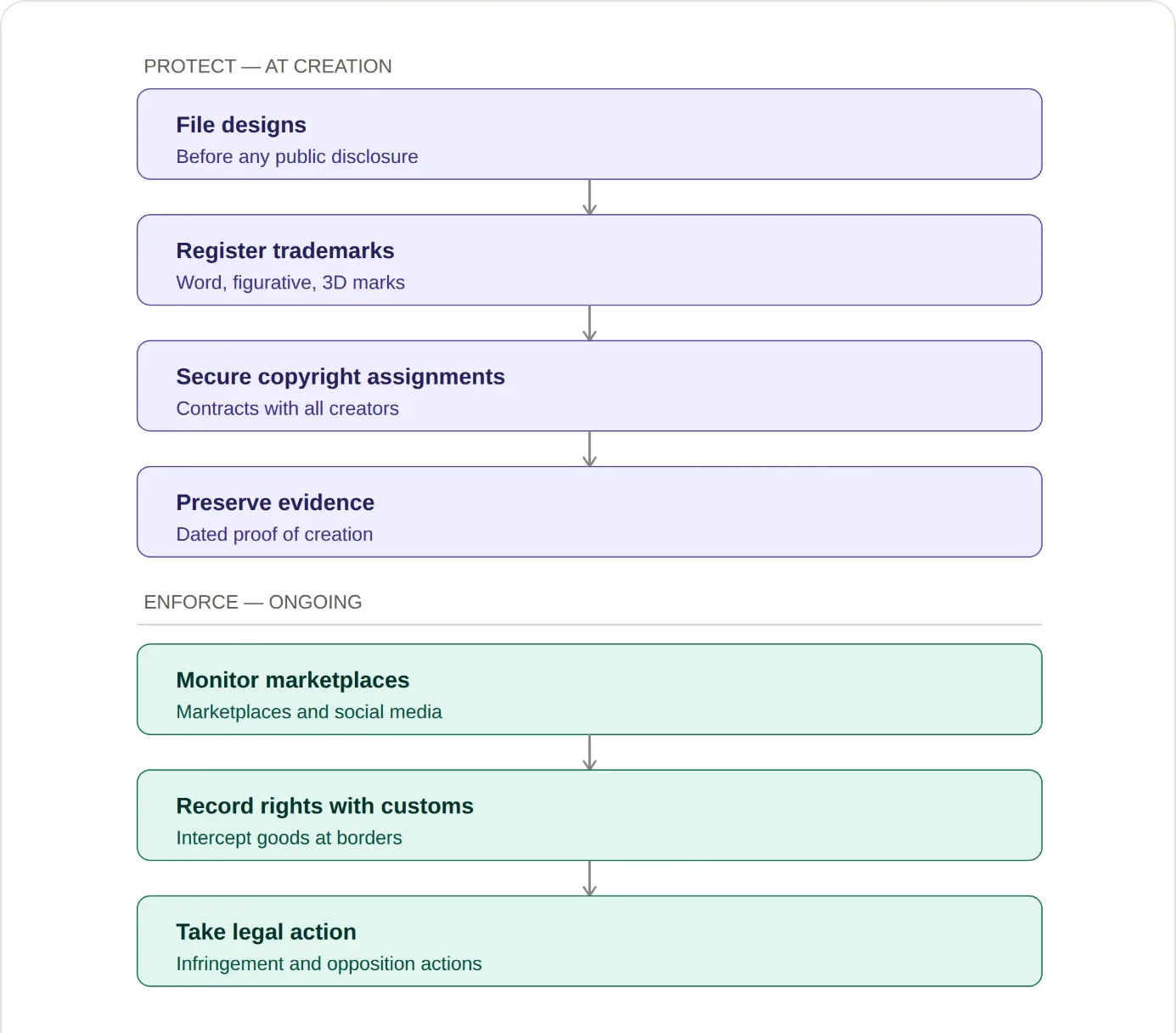
Essential checklist:
- File designs before any public communication, including on social media and in showrooms;
- Register strategic trademarks (word, figurative, three-dimensional) with the INPI, the EUIPO, or through the Madrid System for international protection;
- Secure clear rights assignment clauses in contracts with in-house and external designers, covering ownership and exploitation of the creations;
- Keep dated proof of creation (Soleau envelope, notarized deposit, or blockchain timestamping).
The Dreyfus firm details filing criteria and portfolio strategies in «Design & Model Law: What you need to know» and presents the sector’s general framework in «Fashion law in France: A strategic legal framework for the luxury industry».
b) Combining legal protection with an anti-counterfeiting strategy
Beyond filing, effectively defending a fashion brand rests on three complementary levers:
- monitoring marketplaces and social media, to quickly detect infringing listings;
- customs actions, through an application for intervention (AFA), which allows counterfeit goods to be intercepted at the EU’s borders under Regulation (EU) No. 608/2013, see «Customs Surveillance in Intellectual Property Matters »;
- judicial proceedings (infringement seizure, infringement action, interim relief) as well as opposition and invalidity proceedings before the INPI or the EUIPO, to challenge conflicting filings upstream. See «When should you seek the assistance of a trademark law expert: distinctive signs, infringement and defense strategies? » and, for enforcement procedures in English, «Counterfeiting: opposition procedures, formal notice».
Conclusion
Protecting fashion creations in France requires a combined approach, bringing together design rights, copyright and trademark law, while anticipating the specific risks posed by online counterfeiting, dupes and upcycling. In an environment where digital technologies and artificial intelligence are accelerating the spread (and the copying) of creations, only a proactive intellectual property strategy, built in from the design stage of a collection, allows designers and fashion houses to durably preserve the value of their intangible assets.
Dreyfus law firm supports its clients in managing complex intellectual property matters, offering tailored advice and comprehensive operational support for the full protection of their creations. The Dreyfus firm partners with a worldwide network of specialized intellectual property lawyers. Feel free to contact Dreyfus law firm for strategic support tailored to your brand.
Nathalie Dreyfus, with the assistance of the entire Dreyfus team
FAQ
1. Should a design be filed before presenting a collection? Yes. The novelty requirement means a design must be filed before any public disclosure, otherwise the creator destroys the novelty of their own creation (subject to the 12-month grace period).
2. What is the difference between unfair competition and counterfeiting in the fashion sector? Counterfeiting penalises the unauthorised reproduction of a registered or protected intellectual property right (trademark, design, copyright), whereas unfair competition and free-riding penalise wrongful conduct independent of any exclusive right, such as copying a competitor’s visual codes to unduly benefit from its reputation.
3. Does an independent designer have the same protections as a major fashion house? Yes, intellectual property rights apply in the same way regardless of a company’s size; only the resources devoted to monitoring and enforcing those rights typically differ between an independent designer and a large group.
4. How does artificial intelligence complicate the protection of fashion creations? It makes it easier to generate and reproduce designs almost instantly, which complicates the detection of online counterfeiting and requires fashion houses to strengthen their digital monitoring and keep dated proof of authorship.
5. How can a luxury brand be protected internationally? Through the Madrid System (WIPO) for simplified international filing, supplemented by targeted national filings in key development and commercialization markets, together with coordinated worldwide customs and digital monitoring.
This publication is intended for general public guidance and to highlight issues. It is not intended to apply to specific circumstances or to constitute legal advice.
Legal sources
- CJEU, 12 September 2019, Cofemel, C-683/17 (originality under copyright).
- Regulation (EU) 2024/2822 and Directive (EU) 2024/2823 on designs, applicable from 1 May 2025 (EUR-Lex).
- Regulation (EU) No. 608/2013 on customs enforcement of intellectual property rights.
- CJEU, 2 April 2020, Coty v. Amazon, C-567/18.
- Paris Judicial Court, 7 February 2025, No. RG 22/09210, Hermès (Kelly and Birkin bags); EUIPO; INPI PIBD.
- Marseille Judicial Court, 20 March 2025 (blockchain evidence in copyright).
- Paris Judicial Court, 10 April 2025, No. 22/10720, Hermès v. Maison R&C (Legifrance).
- Paris Judicial Court, 12 February 2025, No. 22/09315, Rolex v. Skeleton Concept.
- French Intellectual Property Code; INPI (inpi.fr); EUIPO (euipo.europa.eu); Madrid System (WIPO).