

Introduction
Since June 19, 2026, any trader entering into a distance contract with a consumer through an online interface must provide the consumer with a free withdrawal function.
Compliance requires more than placing a button on a website. The journey must be easy to locate and use, include an explicit confirmation step, generate an acknowledgement on a durable medium and connect with refund and return processes. Legal, digital, finance, logistics and data-protection teams therefore need to work from a single operational framework.
The reform originates in Directive (EU) 2023/2673, implemented in France through Order No. 2026-2 of January 5, 2026 and Decree No. 2026-3. Consumers generally have 14 days to withdraw from a distance or off-premises contract without having to give any reason. This period usually runs from the date the goods are received or, in the case of services, from the date the contract is concluded. In France, the 14-day withdrawal period was introduced more broadly by the Hamon Law of March 17, 2014, implementing Directive 2011/83/EU, and applies to contracts concluded from June 13, 2014 onwards.
An obligation extending beyond financial services
Although the European reform was adopted in the context of distance financial services, the French implementing measures also amended the general rules governing distance contracts. In practice, the obligation covers B2C contracts concluded through e-commerce websites, mobile applications, marketplaces and other online interfaces whenever a statutory withdrawal right exists. Sales of goods, services, subscriptions and digital products may therefore fall within scope.
The new function does not create a withdrawal right for contracts that are legally excluded. Bespoke goods, certain perishable products, services fully performed under the statutory conditions and some digital content supplied immediately may qualify for an exception. Businesses should therefore map their offers and avoid applying a single technical rule to every product without legal qualification.
The withdrawal function must be as easy to find as it is to use
A visible, permanent and unambiguous entry point
The French Consumer Code requires free, easy, direct and permanent access throughout the applicable period. The entry point must be labelled “Withdraw from the contract here” or use similarly unambiguous wording. A discreet reference in the terms and conditions, a generic contact page or a journey that requires repeated searches is unlikely to meet the accessibility standard.
Before the contract is concluded, the consumer must also be informed of the existence and location of the function. The terms and conditions, help pages, order confirmation and customer account should therefore describe the same journey that is actually available online.
A structured declaration and a time-stamped confirmation
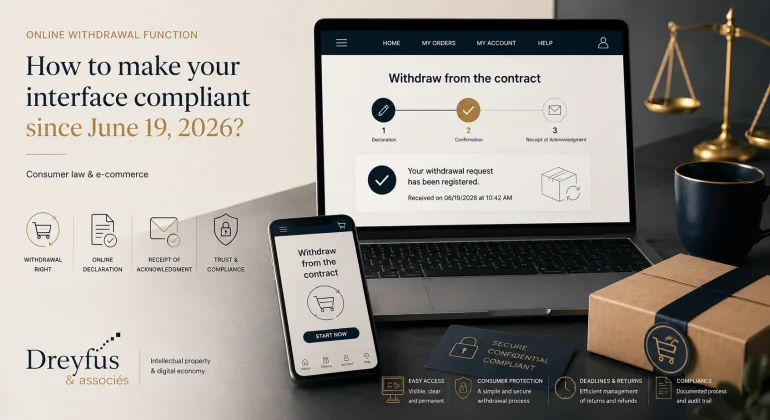
The form must allow the consumer to provide or confirm their first and last name, information identifying the relevant contract and the electronic means through which the acknowledgement should be received. A second action, labelled “Confirm withdrawal” or in equivalent unambiguous terms, must complete the submission. The trader must then send an acknowledgement within a reasonable time on paper or another durable medium, including the declaration and the date and time of submission. These requirements are set out in Article D. 221-5 of the French Consumer Code.
How should businesses organise operational compliance?
1. Map customer journeys and assign responsibilities
Each contracting channel, product category, applicable period and exception should be documented. Where a marketplace is involved, the parties must determine who displays the function, receives the request, issues the acknowledgement and retains the evidence. These responsibilities should match the agreements between the seller, platform, payment provider and logistics operator.
2. Build a genuinely functional UX and technical workflow
IT teams should integrate the function into both front-end and back-end systems:
- appropriate authentication,
- order-data retrieval,
- acknowledgement generation,
- date-and-time logging,
- CRM transmission and
- internal workflow initiation.
Testing should cover mobile devices, applications, guest checkouts, multi-item orders, incorrect email addresses and peak traffic. A visible function that fails in practice remains non-compliant.
3. Connect withdrawal requests with refunds and returns
For sales of goods, reimbursement must generally be made within 14 days after the trader is informed, subject to the right to defer payment until the goods are received or evidence of dispatch is provided. Finance and customer-service teams should verify that e-commerce payment service providers or comparable operators can process refunds through the appropriate payment method. Logistics systems must identify the return, update inventory and match the product with the withdrawal declaration.
4. Embed data protection and compliance evidence
The form processes personal data. The data-minimisation principle requires fields to be limited to what is necessary. Privacy information must be concise and accessible, security must be built into the design, and retention periods must reflect operational and evidentiary needs. Businesses should retain dated screenshots, release versions, technical logs, acknowledgements and refund records, while restricting internal access to those who need it.
What are the consequences of non-compliance?
Failure to provide a compliant function falls within the rules governing the exercise of the withdrawal right. Article L. 242-13 of the French Consumer Code provides for an administrative fine of up to EUR 15,000 for an individual and EUR 75,000 for a legal entity. Businesses may also face DGCCRF investigations, individual claims, refund disputes and loss of customer trust.
A missing function should be distinguished from a failure to inform the consumer of the withdrawal right. The latter may extend the consumer’s withdrawal period. A purely visual implementation, without updated pre-contractual information or evidence that the journey works, is therefore insufficient.
Conclusion
The online withdrawal function is now a mandatory component of the B2C contracting journey. Businesses should verify the legal scope, button accessibility, form fields, confirmation step, acknowledgement, refunds, returns and evidence trail as a single process. Organisations that deployed a solution before the deadline should continue to test, audit and document its actual operation.
For further information, we invite you to consult our article on the right of withdrawal applicable to sales made through social media, as well as our page dedicated to website and e-commerce law.
Dreyfus & Associés assists its clients in managing complex intellectual property cases, offering personalized advice and comprehensive operational support for the complete protection of intellectual property.
Dreyfus & Associés works in partnership with a global network of attorneys specializing in Intellectual Property.
Q&A
Does the online withdrawal function apply only to financial services?
The French implementing measures cover the general regime for distance contracts concluded through online interfaces and also contain specific provisions for financial services. Businesses should therefore review all B2C journeys, not only banking and insurance products.
Must consumers use the online function to withdraw?
The new journey facilitates withdrawal without removing other lawful methods of expressing an unambiguous decision, including a letter, email or standard form. Internal procedures should therefore be capable of handling several channels.
How should products excluded from the withdrawal right be handled?
The journey should reflect the legal classification of the contract. Any exception must be verified, clearly disclosed to the consumer and correctly configured in the interface, without extending the statutory exclusions.
How long must the function remain available?
It must remain accessible throughout the period applicable to the relevant contract. The system should calculate the period from the correct trigger: receipt of goods, conclusion of a service contract or any applicable special regime.
What evidence should be retained to demonstrate compliance?
A useful file includes journey versions, time-stamped screenshots, functional specifications, test results, submission logs, acknowledgements, refund evidence and internal procedures. Retention must remain proportionate and secure.
This publication is intended for general public guidance and to highlight issues. It is not intended to apply to specific circumstances or to constitute legal advice.