design

EU Design Protection: Complete Guide to the 2025 Reform

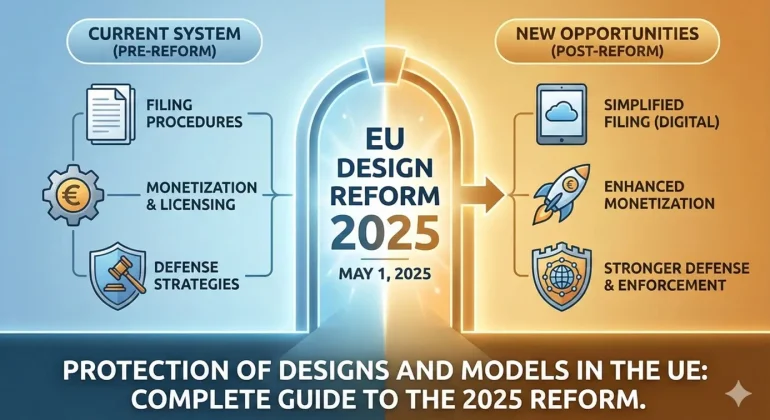
Designs are a major competitive lever. In the European Union, the protection of product appearance underwent a historic overhaul with the entry into force of Regulation (EU) 2024/2822 on May 1, 2025.

This expert guide breaks down the current system, the new opportunities from the reform, and strategies for filing, monetizing and defending your creations.

📅 Reform Timeline

December 8, 2024 Entry into force of the Regulation and Directive
May 1, 2025 Application of main provisions (Phase I) — now in effect
July 1, 2026 Application of secondary provisions (Phase II)
December 9, 2027 Deadline for Member States to transpose the Directive
December 9, 2032 End of transitional period for spare parts

1. Scope of protection: from physical to virtual

A modernized definition

Under the new regulation, a design means the appearance of the whole or a part of a product resulting from its features: lines, contours, colors, shapes, textures, materials, and now also movement, transitions and animation.

The reform has expanded the definition of “product” to explicitly include digital and non-physical creations. Now covered are:

  • Graphic elements: logos, graphic symbols, icons and graphic works
  • Digital interfaces: graphical user interfaces (GUI), typefaces, application animations
  • Virtual environments: objects in video games, metaverse products, virtual spatial configurations
  • Physical presentations: packaging, sets of articles, interior arrangements (e.g.: store design)

What remains excluded from protection

Pure technical function: Features dictated solely by technical function are not protected. The Court of Justice clarified in the Papierfabriek (C-684/21) ruling that the existence of alternative designs is not a decisive criterion for circumventing this exclusion.

Interconnections: Shapes necessary to mechanically connect two products are excluded. Notable exception: modular systems (interchangeable elements like construction bricks) remain protectable.

2. Registered or unregistered: the dual system

The EU offers unique flexibility depending on your products’ lifecycle and commercial strategy.

Characteristic Unregistered EU Design (UEUD) Registered EU Design (REUD)
Duration of protection 3 years from the date of first disclosure in the EU 5 years, renewable every 5 years up to a maximum of 25 years
Scope of protection Against copying only. Ineffective against independent creation. Complete monopoly. Protects against any similar design, even if created independently.
Formalities None — automatic protection upon disclosure Filing required with the EUIPO
Evidence Burden of proof on the holder (date of disclosure + copying) Registration certificate = official proof
Ideal for Fashion, seasonal trends, short-cycle products Flagship products, iconic designs, R&D investments

💡 Strategic advice

For short-cycle sectors like fashion, start with automatic protection (UCD), then register only the designs that achieve commercial success. You have 12 months (grace period) after first disclosure to file.


3. Registration procedure: strategies and pitfalls

Filing and simplification

An application can be filed directly with EUIPO or through WIPO (Hague System). Since May 1, 2025, submission of physical specimens has been abolished — only digital representations are accepted.

Important: Filing through national offices is no longer possible. Only EUIPO is now competent for European Union designs.

Simplified multiple filing

The class unity rule has been abolished. You can now group up to 50 different designs (for example, a chair, a logo and an interface) in a single multiple application, even if they belong to different Locarno classes.

Fast Track procedure and costs

Timelines:

  • Standard registration: approximately 10 working days
  • Fast Track procedure: 2 working days

Fee structure (since May 2025):

Registration fee (1st design) €350
Each additional design €125
Deferment of publication (1st design) €40
Deferment (additional designs) €20 / design

Mandatory representation

If the applicant has no domicile, headquarters, or real and effective establishment in the EU, they must appoint a qualified representative for all proceedings following the filing. The initial filing can be made without a representative.


⚠️ The priority trap (KaiKai case law)

For international filings, be vigilant. The Court of Justice confirmed in the KaiKai (C-382/21 P) ruling that it is impossible to claim the priority of an international patent application (PCT) for a European Union design. Only the priority of a utility model filed within the preceding 6 months is allowed.


4. 2025 Reform: the 3 major changes

The reform brought by Regulation 2024/2822 and Directive (EU) 2024/2823 introduces strategic changes:

  1. Fight against illicit 3D printing

It now constitutes infringement to create, download, copy or share digital files or software recording the design for the purpose of manufacturing a product. This provision anticipates the rise of 3D printing technologies.

  1. The “Repair Clause” (Spare parts)

Spare parts used for repair in order to restore a product’s original appearance are no longer protected. This measure aims to liberalize the spare parts market, particularly in the automotive sector.

Important transitional regime:

  • Parts protected before December 8, 2024 retain their protection for a period of 8 years
  • Member States have until December 9, 2027 to transpose this directive
  1. Grace period and self-disclosure

The 12-month grace period is maintained. The designer’s own use of their product during this period does not destroy novelty, even if the final design differs slightly from the tested prototype.

5. Commercial exploitation: licenses and assignments

A registered design is a valuable business asset.

Licenses: The right can be licensed exclusively or non-exclusively for all or part of the EU.

Third-party enforceability: Recording the license or assignment in the EUIPO register is crucial to make it enforceable against third parties. Without registration, a good faith acquirer could be unaware of prior rights.

Licensee’s action: The holder of an exclusive license can bring infringement proceedings alone if the owner fails to act after formal notice.

6. Defense and litigation

Jurisdictional competences:

  • EUIPO: Exclusive competence for direct invalidity (administrative action)
  • National courts (“EU Design Courts”): Competence for infringement and can rule on invalidity by way of counterclaim

Appeal filtering (CJEU): Access to the Court of Justice is restricted. An appeal is only admitted if it raises a significant question for the unity or development of EU law (Article 58a of the Statute of the Court).

7. Recent case law to remember (2023-2025)

Judgment of the General Court of April 10, 2024 (Case T-654/22) M&T 1997 v EUIPO – VDS Czmyr Kowalik — Overall impression and tactile perception

For a door and windows handles, the General Court confirmed that tactile differences (edge curvature) influence the overall impression on the informed user, as they affect how the object is handled. As a result, the design does indeed have an individual character. Key takeaway: perceptible functional aspects count in the assessment of individual character.

Judgment of the General Court of March 22, 2023 (Case T-617/21) ) – B&Bartoni spol. s r.o., v EUIPO — Complex product

A welding torch electrode was deemed a “separate product” and not a component of a complex product, thereby escaping the visibility requirement during normal use. Key takeaway: “separate product” qualification extends protection.

Judgment of the Court of September 4, 2025 (Case C-211/24) – LEGO A/S v Pozitív Energiaforrás Kft., — Informed user (LEGO)

The Advocate General suggests that for construction bricks, a child can be considered an “informed user” with a high level of observation. Key takeaway: the informed user adapts to the product and its target audience.

8. Filing checklist

✅ Pre-filing checklist for EU Design

Design preparation

  • ☐ Verify the design has not been disclosed more than 12 months ago
  • ☐ Ensure the design is not dictated solely by technical function
  • ☐ Prepare high-quality representations (multiple views recommended)
  • ☐ Identify the appropriate Locarno class(es)

Prior search

  • ☐ Conduct a prior art search
  • ☐ Check for similar designs already registered
  • ☐ Analyze the individual character of your creation

Filing strategy

  • ☐ Decide: single or multiple filing (up to 50 designs)
  • ☐ Assess the opportunity for deferment of publication (confidentiality)
  • ☐ Check if priority can be claimed (6 months max.)

Formalities

  • ☐ If you are located outside the EU: appoint a qualified representative
  • ☐ Prepare fee payment (€350 + €125 per additional design)
  • ☐ Create an EUIPO User Area account

After filing

  • ☐ Monitor the publication deadline (30 months max. if deferred)
  • ☐ Record licenses/assignments in the EUIPO register
  • ☐ Plan for renewal (5 years)

9. Frequently Asked Questions (FAQ)

What is the difference between a registered and unregistered design?
An unregistered design (UEUD) lasts 3 years and only protects against copying. A registered design (REUD) lasts up to 25 years and provides a complete exploitation monopoly, protecting even against independent creations producing the same overall impression.

Can I register my design if I have already shown it to the public?
Yes, you benefit from a 12-month grace period before the filing date. Your own disclosure during this period does not destroy the novelty of your design.

How much does it cost to register an EU design in 2025?
Since May 1, 2025: €350 for the first design, then €125 per additional design in a multiple application. Deferment of publication costs €40 for the first design and €20 per additional design.

Are automotive spare parts still protected?
The “repair clause” now excludes protection for parts used to restore a product’s original appearance. However, a transitional period of 8 years applies to existing rights (until December 9, 2032). Spare parts that do not aim to reproduce the original appearance remain protectable.

What are the registration timelines at EUIPO?
A standard registration takes approximately 10 working days. Under the Fast Track procedure, registration can be obtained in just 2 working days.

Can a 3D file be protected as a design?
The 2025 reform does not directly protect digital files as such. However, the design they enable to reproduce is protected, and the creation/distribution of such files without authorization now constitutes infringement. Also consider copyright protection for the file itself.

How to protect a graphical user interface (GUI)?
Since the 2025 reform, graphical user interfaces are explicitly included in the definition of protectable products. You can file screenshots or animations showing the transitions and interactions of your interface.


Need assistance protecting your creations?

Dreyfus & Associates supports you in filing, managing and defending your designs in the European Union and internationally.
Contact our experts

Read More

EU Design Law Reform: What It Means for Rights Holders — Insights from the Dreyfus law firm in Paris

On May 1st, 2025, the European Union officially launched the first phase of its long-awaited design law reform, with significant implications for businesses across the EU. While these changes modernize design protection — particularly in digital and fast-moving industries — they also introduce steep renewal fees, prompting companies to rethink their long-term strategy.

At Dreyfus, we’ve been supporting businesses for over 20 years in securing and optimizing their intellectual property. Our founding partner Nathalie Dreyfus was interviewed by MLex to share her insights on this reform and how companies can prepare.

Sharp Rise in Renewal Fees

The most immediate change is the increase in renewal fees. For example, renewing a single design now costs €150 for the first renewal (up from €90), and can rise to €700 for the fourth renewal.

“The significant increase in renewal costs poses a challenge, particularly for companies managing extensive portfolios,”
Nathalie Dreyfus, MLex interview

We advise clients to conduct a portfolio audit to determine which designs should be maintained long term and which could be streamlined or reorganized.

Download the original article in PDF: Click here to view

A Chance to Optimize Filing Strategy

While renewals are more expensive, the reform offers several improvements:

  • Lower initial application fees: €250 flat fee now includes both registration and publication.
  • Up to 50 designs per application allowed, with no grouping by product type.
  • Explicit protection for digital and 3D designs, including app interfaces and 3D print files.

At Dreyfus, we help clients adapt through proactive audits, portfolio optimization, and cost-efficient international filings, including via the Hague System.

Easier Access to Invalidation for SMEs?

A major feature — set to launch in 2027 — is the administrative invalidation procedure, designed to offer a faster, more affordable alternative to court-based challenges.

“To ensure fairness and legal certainty, administrative invalidation should be mandatory across all EU member states,”
Nathalie Dreyfus, MLex

Our team supports a harmonized approach to ensure SMEs can access efficient legal remedies regardless of jurisdiction.

Why Work with Dreyfus in Paris?

  • Tailored strategies – We analyze your business model, market targets, and product lifecycle to build the right protection plan.
  • International scope – We secure your designs in Europe and beyond.
  • Proactive legal monitoring – We continuously monitor legislative changes to keep your IP strategy ahead of the curve.

FAQ – EU Design Reform 2025

What are the new renewal fees?
€150 for the first renewal, up to €700 for the fourth. This reflects the EU’s goal of encouraging selective long-term protection.

Can I still submit multiple designs in one application?
Yes — up to 50 designs can be filed in a single application, without needing to group them by type.

Are digital and virtual designs now protected?
Yes — a key innovation of the reform. Designs like app interfaces, animated elements, and 3D files now enjoy explicit legal protection.

What’s changing in 2026 and 2027?
Administrative invalidation will roll out in July 2026. The “repair clause” — impacting spare parts and competition — takes effect in December 2027.

How can I decide which designs to renew or abandon?
We provide customized portfolio audits to assess the commercial value of each design and guide your strategic decisions.


Want to protect your design portfolio or plan for the new EU rules?
Contact our team to develop a secure, forward-looking strategy.


Read More

The new European Design reform: Key changes and strategic insights for rights holders

The reform of the European design law, introduced through Regulation (EU) 2024/2822 and Directive (EU) 2024/2823, marks a significant evolution in industrial design protection. With implementation beginning on May 1, 2025, and full transposition required by December 9, 2027, the reform redefines core aspects of how designs are protected, enforced, and managed across the EU.

This article provides a comprehensive breakdown of the key provisions and their practical implications for rights holders, businesses, and legal practitioners.

Summary of the reform and its strategic impact

The new EU legal framework introduces:

  • Modernized definitions reflecting digital and animated designs
  • Expanded procedural flexibility (multi-design filings, deferment)
  • Enhanced enforcement tools for both physical and digital infringements
  • Harmonized grounds for refusal and invalidity
  • Rebalanced fees that benefit SMEs but impact long-cycle industries
  • Clear ownership rules aligned with employment law
  • Legal clarity on unregistered designs and repair clause use

Rights holders are advised to audit their design portfolios, revise employment agreements, and reconsider filing strategies to optimize protection under the new regime.

Key dates and implementation timeline

  • May 1, 2025: Regulation takes effect (Phase I)
  • July 1, 2026: Secondary legislation provisions apply (Phase II)
  • December 9, 2027: Deadline for Directive transposition
  • December 9, 2032: Expiration of grace period for spare parts protections

Expanded scope of protectable designs

A – Digital and non-physical designs

The scope now includes graphical user interfaces, virtual objects, and spatial configurations in virtual environments. This reform reflects market trends in gaming, metaverse technologies, and digital user experiences.

B – Animated and virtual elements

Designs incorporating movement or transitions are now explicitly protected, such as app animations, dynamic web content, or virtual clothing.

Procedural innovations in design filing

A – Simplified multi-design applications

Applicants may include up to 50 designs in a single application, with no requirement to group them under the same Locarno class.

B – Visual representation and application requirements

Only visibly represented features in the application will be protected, resolving a longstanding ambiguity. Mandatory elements include applicant identity, visual representation, and indication of product use.

C – Harmonized deferment of publication

Applicants may defer publication for up to 30 months. A request to block publication must be submitted at least 3 months before deferment expiry.

Strengthened rights and enforcement mechanisms

A – 3D printing and digital file protections

Rights holders can now block unauthorized sharing or use of digital files enabling 3D reproduction, offering critical protection in an era of decentralized manufacturing.

B – Enforcement against infringement in transit

Design rights may be enforced even if the infringing goods are merely transiting through the EU, aligning with trademark law.

C – Fast-Track invalidity procedures

The EUIPO can now expedite invalidity procedures when uncontested, reducing enforcement delays.

Ownership clarifications and employment relationships

Ownership of a design belongs by default to the creator or successor, unless created during employment, in which case the employer becomes the owner. National laws and contracts may override this default rule.

Financial impact and new fee structure

The reform introduces a comprehensive revision of the fee structure applicable to designs within the European Union. While certain upfront costs have been reduced (notably, the filing fee for a single design has decreased from €350 to €250) renewal fees rise significantly from the third renewal period onwards.

This shift is designed to benefit SMEs and short product life-cycle industries (such as fashion, accessories, and digital goods) by easing entry costs and streamlining the registration process. Conversely, it may place a heavier financial burden on sectors with long product life cycles, including automotive, home appliances, and industrial engineering, where sustained protection over 20 to 25 years is critical. For these industries, the escalating renewal costs necessitate proactive budgeting and strategic portfolio management.

Harmonized grounds for refusal and invalidity

New optional grounds for refusal include designs that:

  • Misuse emblems or signs of public interest
  • Reproduce elements of national cultural heritage (e.g., monuments, traditional clothing)

Unregistered designs: a clarified regime

First disclosure outside the EU may still qualify for unregistered protection if it reasonably reaches the relevant EU public. This flexibility aligns the law with modern digital dissemination practices.

The new repair clause and its market implications

Effective December 9, 2027, the repair clause allows reproduction of design elements necessary to restore the original appearance of complex products (e.g., car parts).

  • Strict conditions apply: Must be used for repair only, and origin must be disclosed.
  • Does not apply to trademarks or parts not critical to visual restoration.

This clause fosters competition and circular economy goals, but raises compliance questions.

Enhanced legal certainty and creative freedom

Legitimate uses of protected designs now include:

  • Comparative advertising
  • Commentary and critique
  • Parody

These are permitted under fair trade principles and aim to preserve freedom of expression and market transparency.

Strategic considerations for international businesses

Businesses should:

  • Audit portfolios and renewals deadlines to identify models that require renewal or consolidation, taking into account the new fee structure, which imposes a heavier financial burden in the long term.
  • Update employment contracts regarding ownership, particularly for employees likely to create designs as part of their duties. The reform confirms that, by default, rights belong to the creator unless a contrary clause or specific national provision applies. A clear contractual clause prevents future disputes over ownership and strengthens the company’s legal security in case of litigation or rights transfers.
  • Always assess on a case-by-case basis whether it is more advantageous to opt for an international application under the Hague System or a Community design application, depending on the target countries, exploitation prospects, and budgetary constraints.

Conclusion

The reform modernizes EU design law for the digital age, introduces procedural efficiency, and fosters innovation through clarity and flexibility. While offering opportunities, it also requires proactive adaptation by rights holders.

Dreyfus Law Firm advises rights holders across Europe and internationally to implement these changes strategically.

The Dreyfus Law Firm is in partnership with a global network of lawyers specialized in Intellectual Property.

Join us on social media !


FAQ

1 – What rights are granted by a registered Community design in the EU?
A registered Community design (RCD) in the European Union grants its owner the exclusive right to use the appearance of a product or part of a product resulting from its visible features (such as lines, contours, shapes, textures, materials, or ornamentation). This right enables the holder to prohibit third parties from manufacturing, offering, placing on the market, importing, exporting, or using a product incorporating the protected design, or from holding such a product for these purposes. Protection extends throughout the EU and lasts for five years, renewable in five-year increments up to a total of 25 years.

2 – Can a design be transferred?
Yes. A registered design is an intangible asset that can be transferred through sale, contribution to a company, inheritance, gift, or via corporate restructuring (merger, demerger). To ensure enforceability against third parties, it is advisable to record the transfer in the register maintained by the EUIPO (or the national office for national designs). It is also possible to grant an exclusive or non-exclusive licence for the use of the design.

3 – Where should a design be filed for protection in Europe?
To obtain EU-wide protection, an application must be filed for a Registered Community Design (RCD) with the European Union Intellectual Property Office (EUIPO). This single application offers protection across all 27 EU Member States. Alternatively, the Hague International Design System administered by WIPO allows for international filings designating the EU and other jurisdictions in one procedure. National filings remain possible for country-specific needs or complementary strategies.

4 – What is the difference between a design and a model?
Under EU law, the terms “design” and “model” are used interchangeably to refer to the legal protection of a product’s appearance. However, in some national systems (e.g., French law), a practical distinction exists:

  • A design typically refers to a two-dimensional feature, such as a pattern or graphic interface;
  • A model refers to a three-dimensional shape, like a product, packaging, or industrial object.
    In both cases, protection concerns the aesthetic appearance, not the technical function of the product.
Read More

Entry Into Force on May 1, 2025 of the EU “Design Package”: Modernizing the EU Designs Framework

The recent publication of Regulation (EU) 2024/2822 and Directive (EU) 2024/2823 marks a key milestone in the modernization of the European legal framework for designs. These reforms, with certain provisions taking effect from May 1, 2025, foresee a phased implementation to harmonize, simplify, and adapt the system to the digital age.

Harmonization and modernization 

The term “Community design” has been updated to “European Union design” (EUD). This symbolic change modernizes the terminology while aligning it with that of European trademarks. To enhance identification, a visual symbol Ⓓ has been introduced, providing greater coherence within the system.

The reform expands definitions to incorporate technological advances. Animations, graphical interfaces, and digital twins are now included in the scope of protection, reflecting their essential role in modern industries. The concept of “product” has also been extended to non-physical forms, covering items used in video games or virtual environments such as the metaverse.

Filing procedures are now more flexible and better suited to creators’ needs. Applications can group up to 50 designs without classification constraints, and various digital formats are now accepted for design representations. Additionally, creators can defer publication for up to 30 months, offering strategic discretion to protect their designs while planning their market launch.

To promote accessibility, particularly for small and medium-sized enterprises (SMEs) and independent designers, some fees have been reduced or eliminated. Filing fees, for example, have been lowered, and the costs associated with the transfer of rights have been completely removed. However, a notable increase in renewal fees is expected. Previously, renewal fees for a 25-year period ranged from €90 to €180. Under the new framework, fees will start at €150 and rise to €700 by the fourth renewal cycle. This adjustment may disproportionately affect industries with longer product life cycles, such as automotive and industrial design, compared to industries like fashion, which are less impacted by the fee increase.

Enhanced protection of rights 

The EU reform clarifies key aspects of design visibility. From now on, visibility is no longer a general requirement for protection, except for components of complex products. This revision eliminates past ambiguities and extends protection to a wider range of contemporary and diverse designs.

A major innovation is the introduction of the repair clause. This provision removes legal protection for spare parts necessary to restore the appearance of a complex product, limiting exclusive rights in this domain. The measure strikes a balance between design protection and competition in the spare parts market. However, it requires manufacturers to inform consumers about the origin of the products used for repairs, enhancing transparency and enabling informed choices.

In the realm of 3D printing, the reform introduces an exclusive right allowing rights holders to prohibit the creation, dissemination, and use of digital files capable of reproducing a protected design via 3D printing. Although this technology remains relatively uncommon in households, the provisions anticipate its potential growth, safeguarding creators’ rights in this emerging field.

Lastly, the reform extends rights holders’ protections to goods in transit within the European Union, even if their final destination is outside EU territory. This change strengthens the enforcement of intellectual property rights in a globalized context, addressing the challenges posed by counterfeit goods in international trade.

Alternative dispute resolution and legal certainty 

The reform encourages EU Member States to establish administrative mechanisms for contesting the validity of national designs. Inspired by the EUIPO model for the European trademark (oppositions and cancelation actions), this approach offers a less expensive and faster alternative to traditional judicial procedures.

Additionally, the requirement for first disclosure within the EU has been abolished. Now, the initial disclosure of a design outside the EU can confer protection as an unregistered design. This change eliminates ambiguities from previous regulations, an important aspect in the post-Brexit context, where many designers chose the UK for their first presentations. This clarification further harmonizes the legal framework and reduces uncertainties for creators operating across multiple markets.

Key challenges to monitor 

While the reform has integrated significant advances for the digital age, uncertainties remain regarding the protection of AI-generated designs. This rapidly growing area raises fundamental questions about the adequacy of current legal frameworks, making it essential to ensure effective protection tailored to these new forms of creation.

Additionally, the growing divergences between EU and UK regimes, exacerbated by Brexit, require close attention. Creators and businesses must exercise caution to harmonize their design protection strategies in these two now-distinct territories, minimizing legal and commercial risks associated with this fragmentation.

Timeline and future prospects 

The new provisions will take effect in May 2025 for the regulation, while Member States have until December 2027 to transpose the directive into their national laws. This phased approach aims to ensure a harmonized application of the new rules across the European Union, offering creators an adjustment period.

The EU design reform represents a significant step forward in modernizing the legal framework and addressing 21st-century challenges. By clarifying key concepts, simplifying processes, and anticipating technological developments, the European Union offers a robust and inclusive system. For businesses and creators operating in Europe, adapting swiftly to these changes is essential to maximize the protection and competitiveness of their designs.

For assistance with managing and protecting your designs, our intellectual property experts are at your service. Dreyfus Law Firm with an international network of lawyers specializing in Intellectual Property.


Join us on social media!

Instagram

LinkedIn


Read More