
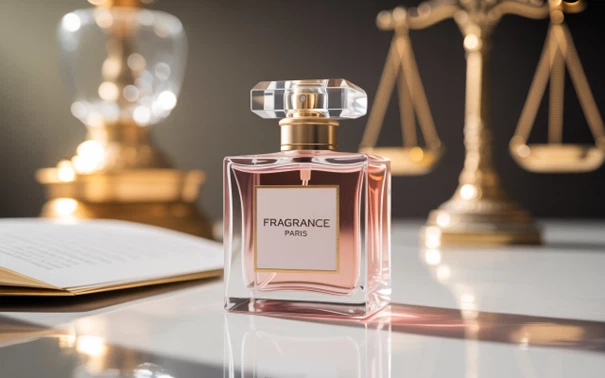

In the luxury industry, perfume is far more than just a fragrance: it is a complex intangible asset composed of multiple layers of creation. For effective protection, it is imperative to dissect the product into its four major components: the scent (the juice), the formula (the recipe), the packaging (the bottle/box), and the name (the trademark).
Each of these elements falls under a distinct legal regime. Dreyfus Law Firm offers this expert guide to navigating between Copyright, Trademark Law, Designs & Models, and Trade Secrets.
Sommaire
The scent (The Fragrance): The challenge of the intangible
This is the soul of the perfume, yet it remains the most difficult element to protect legally in France today. This is a subject we monitor closely, and one we have already addressed particularly in our article entitled Fragrance and Intellectual Property: which protection?.
Why copyright does not (yet) apply to scent
Unlike music or literature, current French case law refuses to consider the fragrance (the perceived scent) as a “work of the mind” (œuvre de l’esprit) protected by copyright.
- The Judicial Position: The French Cour de cassation considers that a fragrance proceeds from the implementation of technical know-how, rather than from a purely creative artistic endeavor identifiable with sufficient precision.
- The Consequence: One cannot sue for “copyright infringement” for the reproduction of a scent alone.
The solution: Acting on grounds of unfair competition
While the scent is not a “work,” servile imitation remains punishable. To protect a scent against “dupes” or copies, we take action based on unfair competition (concurrence déloyale) or free-riding (parasitisme).
- The Legal Argument: The goal is to prove that the competitor sought to appropriate the wake (sillage) of your perfume to benefit from your investments without cost, creating a risk of confusion or undue value capture.
The formula (the recipe): The realm of secrecy
If the scent is the result, the formula is the technical process (the list of chemical ingredients and their dosage) used to achieve it.
Trade secrets rather than patents
Patent filing is rare in perfumery because it requires disclosing the formula to the public (which enters the public domain after 20 years). The preferred strategy is that of Trade Secrets (Secret des affaires).
- The Principle: The formula must remain confidential information, known only to a very restricted number of people (the “nose,” the laboratory).
- Legal Protection: This relies on the implementation of reasonable protection measures (physical and digital) to prevent the theft of the formula.
Contractualization as a shield
For the secret to hold, it must be legally secured by contracts:
- Non-Disclosure Agreements (NDAs): Essential with laboratories, raw material suppliers, and employees.
- Non-Compete Clauses: To prevent a perfumer from joining a competitor with your formulas in mind.
Packaging (bottle and box): The alliance of design and trademark
The bottle is the first visual point of contact with the consumer. It is an industrial art object that benefits from powerful cumulative protections.
Designs & models and copyright
- Designs & Models: This is the premier protection for the aesthetic appearance of the bottle (its shape, lines). Filing must be done before the product is disclosed to guarantee its novelty.
- Copyright: If the bottle is original and bears the imprint of its author’s personality, it is protected by copyright from the moment of its creation, without formal registration (although a probatory deposit is recommended).
The three-dimensional trademark
In exceptional cases, the shape of the bottle itself can be registered as a trademark (3D trademark) if it is sufficiently distinctive for the consumer to recognize the origin of the product by its shape alone (e.g., the iconic Jean Paul Gaultier torso bottle).
The name: The trademark monopoly
The name is the most valuable asset in the long term. Once the scent has evaporated, the name remains.
Word mark registration
The perfume name (e.g., “N°5”) and the House name must be registered as word marks.
- Filing Classes: It is crucial to target Class 3 (cosmetics, perfumes) but also Class 35 (advertising, business management) for retail and distribution.
- Availability: An in-depth clearance search is indispensable to ensure the name is not already taken.
Protection against cybersquatting
The name must also be protected online. Reserving domain names (.com, .fr, and new extensions like .luxury) must be synchronized with trademark filing, as we explain in our article on Domain Names and New gTLDs.
Litigation expertise of Nathalie Dreyfus
Protecting these four elements requires a global strategy, but also the ability to defend one’s rights in court when counterfeiting occurs.
Dreyfus Law Firm stands out through the specialized expertise of its founder, Nathalie Dreyfus. As a French and European Trademark Attorney, she possesses recognized experience not only in strategic consulting but also in handling complex litigation.
Her expertise is regularly sought in high-stakes cases, requiring perfect mastery of case law from the French Cour de Cassation and Courts of Appeal regarding intellectual property. This fine-tuned knowledge of judicial decisions allows for the anticipation of legal risks linked to scent or shape protection and the construction of solid defense cases for perfume houses.
You can view our founder’s full profile here: Nathalie Dreyfus.
FAQ: Frequently asked questions
- Can you patent a scent?
No. A scent cannot be patented. Only the technical manufacturing process (the chemical formula) could theoretically be patented, but this requires publication, which contradicts the industry’s secrecy strategy.
- How do I prove my scent was copied?
Proof is generally established via chromatography analysis (chemical analysis) comparing the original juice and the copy, combined with olfactory tests by experts, to demonstrate economic parasitism.
- Should my perfume name be descriptive?
Absolutely not. A trademark must be distinctive. Naming a perfume “Rose Scent” may be refused registration because the term describes the product. It is recommended to choose an arbitrary or fanciful name.
- What is the difference between a “dupe” and a counterfeit?
Counterfeiting copies a registered right (the name, the logo, the bottle shape). A “dupe” often imitates the scent (not protected by copyright) and the vibe, while changing the name. Against a dupe, we act on grounds of unfair competition; against a counterfeit, we act for trademark or design infringement.
Dreyfus Law Firm is your strategic partner for securing your intangible assets. Contact us to audit the protection of your olfactory creations.