When it comes to intellectual property law, it is important to understand the differences between copyrights and patents. Both copyrights and patents protect creators and inventors from having their work stolen or copied, but they do so in different ways.
Copyrights are a type of intellectual property that protect the expression of an idea in a tangible form. This could include books, music, films, photographs, artwork, software, and other forms of creative expression. A copyright owner has the exclusive right to reproduce, distribute, display, and perform the work, as well as create derivative works based on the original. Copyright protection lasts for the life of the author, plus another seventy years.
Patents, on the other hand, are a type of intellectual property that protect inventions. This could include machines, industrial processes, chemical compositions, and other types of functional products. A patent owner has the exclusive right to make, use, and sell the invention, as well as to license others to do the same. Patent protection lasts for twenty years from the date the application for the patent was filed.
The most important difference between copyrights and patents is the type of protection they provide. Copyrights protect creative expression, while patents protect inventions. Copyrights protect the expression of an idea, while patents protect the physical idea itself. For example, a copyright would protect a book that describes how to build a new type of machine, while a patent would protect the machine itself.
Another key difference between copyrights and patents is the length of protection they provide. Copyrights last for the life of the author plus seventy years, while patents last for twenty years from the date the application for the patent was filed.
Finally, a major difference between copyrights and patents is the filing formality. While copyrights are automatically protected, an application must be filed with the appropriate Office in order to obtain patent protection.
For further information, do not hesitate to contact us:
contact@dreyfus.fr.
We offer our clients a dedicated and unique experience of expertise that is necessary for the exploitation of intangible assets. We will also endeavor to keep you informed and up-to-date about intellectual property and digital economic issues through our articles and newsletters written by the Dreyfus Legal Team.
When it comes to protecting your brand, registering a trademark is one of the most important steps you can take. A trademark can be anything from a word, a name, a logo, etc. or the combination of these elements that distinguishes the products or services of a company from competitors. Registering a trademark can provide the owner with certain legal rights and protections, and can be an important tool to help your business succeed.
The main advantage of registering a trademark is that it gives you exclusive rights to use the trademark in connection to designated goods and services. This means that you can prevent others from using the same or a confusingly similar mark in connection with the same goods and services. This can prevent competitors from taking advantage of the reputation of your mark.
It also prevents consumer confusion between your company and your competitors, which can lead to lost sales and decreased brand recognition. In addition to providing exclusive rights to exploit the mark, registration also proves the validity of the mark. Therefore, a third party cannot use the same or a similar mark as yours once you have successfully registered it.
However, it is important to note that registering a trademark only allows you to prevent the use of your trademark without consent in certain territories. For example, if you register your mark in the United States, Europe and other countries, this only prevents a third party from using your mark in those geographical areas.
Finally, trademark registration can be used as a way to monetize your brand. Once your trademark is registered, you can license the right to use your trademark to others, such as manufacturers or retailers. You can also use your trademark as a form of collateral to obtain loans or investments.
Registering a trademark can be a powerful tool to help you protect and grow your business. By registering your mark, you can prevent competitors from using the same or a similar mark, obtain a presumption of ownership and validity, and monetize your mark.
For further information, do not hesitate to contact us:
contact@dreyfus.fr.
We offer our clients a dedicated and unique experience of expertise that is necessary for the exploitation of intangible assets. We will also endeavor to keep you informed and up-to-date about intellectual property and digital economic issues through our articles and newsletters written by the Dreyfus Legal Team.
When it comes to protecting intellectual property rights, it is important to consult with a lawyer who is knowledgeable and experienced in the laws pertaining to intellectual property. But do you need to hire a licensed attorney? The answer is yes, you should always hire a licensed attorney when dealing with intellectual property matters.
In the United States, all attorneys must be licensed to practice law. This means that they must pass the bar exam and be admitted to practice in a particular state or jurisdiction. In the European Union, there are similar regulations for attorneys who specialize in intellectual property law. These attorneys must be licensed to practice in a specific EU member state, and they must have the knowledge and expertise to handle intellectual property matters in the EU. The primary reason why you should always hire a licensed attorney to help with your intellectual property matters is to ensure that you are receiving the best possible representation. Intellectual property is a complex area of law, and having a knowledgeable attorney at your side is essential. A licensed attorney will be able to advise you on the best ways to protect your intellectual property rights, as well as any potential risks that you may be facing. This knowledge and experience will help you make informed decisions about how to best protect your intellectual property. In addition, a licensed attorney will be able to provide legal advice and representation in any disputes that may arise. Intellectual property disputes can be complex, and having an experienced attorney by your side can help ensure that you are receiving the best possible outcome. This is especially important when it comes to matters of copyright infringement or other types of intellectual property theft. Finally, having a licensed attorney can help you navigate the legal system. A licensed attorney will be familiar with the laws and regulations that pertain to intellectual property, as well as the various courts and procedures that may be involved in any legal proceedings. This knowledge and experience can help ensure that you are well-prepared and informed when it comes time to defend your intellectual property rights.
In conclusion, it is important to always hire a licensed attorney when dealing with intellectual property matters. A licensed attorney will have the experience and knowledge to advise you on the best ways to protect your intellectual property rights, as well as any potential risks that you may face. Additionally, a licensed attorney can provide legal advice and representation in any disputes that may arise. Finally, a licensed attorney can help you navigate the legal system and ensure that you are well-prepared and informed when it comes time to defend your intellectual property rights.
We offer our clients a dedicated and unique experience of expertise that is necessary for the exploitation of intangible assets. We will also endeavor to keep you informed and up-to-date about intellectual property and digital economic issues through our articles and newsletters written by the Dreyfus Legal Team.
Intellectual property (IP) refers to any original creation of the mind, including inventions, literary and artistic works, designs, symbols, names and images. It is the owner’s exclusive right to his or her creation. Intellectual property protection is a legal framework that allows owners to benefit from their work and prevent others from using it without their consent. Without protection, businesses and individuals can be vulnerable to IP theft which can lead to costly consequences.
First of all, not protecting your IP can result in lost business opportunities. Competitors can easily copy your ideas and products and present them as their own. Without protection, you will not be able to take legal action even if you know that another company is infringing on your rights. You won’t be able to stop them from taking advantage of your hard work and then lose potential profits.
Second, failing to protect your IP can result in the loss of brand identity. The trademarks and logos associated with your IP are essential elements of your corporate identity. Without protection, your competitors can easily imitate your logos and brand identity or counterfeit your products. This can lead to confusion among consumers, who may not be able to distinguish between your original products and services and those reproduced by your competitor.
Third, failing to protect your IP can lead to costly legal disputes. If your IP is not formally registered with the appropriate Office, you will have difficulty proving in court that it is yours. This can lead to costly legal disputes that can take a long time to resolve. Even if you ultimately win the case, the process will be long and complicated.
Fourth, not protecting your IP can result in a loss of potential licensing revenue. Licensing allows the licensee to enjoy income by giving a third party the right to exploit an IP right. Companies may be willing to pay for the rights to exploit your IP, but without protection, you will not be able to enforce the terms of the agreement.
Finally, not protecting your IP can result in a loss of reputation. If your competitors are able to pass off your work as their own, it can damage your reputation. Customers may assume that you are not innovative or creative, which can lead to decreased sales.
It is clear that not protecting your IP can have costly consequences. To protect your IP and your business, it is important to consult a professional who can advise you on the best course of action. An IP lawyer can help you determine the best way to protect your work and ensure that you get the maximum benefit.
For further information, do not hesitate to contact us:
contact@dreyfus.fr.
We offer our clients a dedicated and unique experience of expertise that is necessary for the exploitation of intangible assets. We will also endeavor to keep you informed and up-to-date about intellectual property and digital economic issues through our articles and newsletters written by the Dreyfus Legal Team.
When it comes to protecting your intellectual property, it is important to hire a law firm that specializes in this area. An intellectual property law firm can provide you with legal advice and representation tailored to your specific needs. Here are some of the benefits of consulting with an intellectual property law firm.
Expertise and experience: When dealing with something as complex as intellectual property, it is important to have an experienced and knowledgeable legal team on your side. A law firm that specializes in this area of law will be familiar with the regulations surrounding intellectual property, as well as the best strategies for protecting it. They will have the expertise to help you understand the complexities of the process and ensure that your rights are protected.
Cost-effective solutions: An intellectual property law firm will be able to provide you with cost-effective solutions to protect your interests. They will understand the importance of keeping costs to a minimum and will be able to provide you with the most cost-effective ways to protect your intellectual property.
Comprehensive representation: When dealing with intellectual property, it is important to have a law firm that can provide you with comprehensive representation. A law firm that specializes in this area of law will be able to provide you with legal advice tailored to your specific needs. This means that they will be able to provide you with the most complete representation and help you efficiently protect your interests.
Strategic Planning: An intellectual property law firm will also be able to provide you with strategic planning advice. They will be able to help you develop a comprehensive plan to protect your interests and ensure that you take the necessary steps to protect your intellectual rights.
5. Dispute Resolution: Finally, an intellectual property law firm will also be able to provide you with dispute resolution services. If a dispute arises regarding your intellectual property rights, the law firm will be able to provide you with representation and advice to ensure that your rights are protected.
Consulting with an intellectual property law firm can offer you many benefits. From expertise and experience to cost-effective solutions and comprehensive representation, an intellectual property law firm can provide the protection you need to protect your interests.
For further information, do not hesitate to contact us:
contact@dreyfus.fr.
We offer our clients a dedicated and unique experience of expertise that is necessary for the exploitation of intangible assets. We will also endeavor to keep you informed and up-to-date about intellectual property and digital economic issues through our articles and newsletters written by the Dreyfus Legal Team.
Intellectual and industrial property law firms specialize in protecting the intangible assets of companies and individuals. They offer services ranging from registration to enforcement of industrial rights such as patents, trademarks or designs, and artistic rights such as copyrights. They also can help in drafting contracts related to intellectual rights. By hiring an intellectual property law firm, you can better protect your intangible assets and avoid costly litigation.
The activities of intellectual property firms are mainly focused on patents, trademarks.
Patents: Patents protect inventions from being copied or used without the owners permission. An intellectual property law firm can help you obtain a patent for your invention. filing a patent application with the appropriate office. In order to ensure the patentability of your invention, the firm can also assist you in conducting searches. In addition to this, the firm is able to meet other client needs such as: opposition, drafting of patent contracts, representation in court proceedings, etc.
Trademarks: A trademark can be a word, a name, a logo, etc. or the combination of these elements to distinguish the products or services of a company from those of its competitors. An intellectual property law firm can help you register a trademark with the appropriate office. The firm can also help you search the availability of a mark to ensure that it is registrable. In the event of disputes, the firm can act on your behalf to file opposition, negotiate licensing or assignment agreements, as well as before the Court for litigation proceedings.
Designs: They protect the appearance of a product or part of a product characterized by lines, contours, colors, etc. In order to protect your designs, the Intellectual Property Law Firm will provide you with services ranging from searching, filing the application with the competent Office to drafting the related contracts and representation in case of litigation.
Copyright: Copyright protects original works in tangible form, such as literary, artistic and musical works, etc. An intellectual property law firm can assist you in protecting your copyright from registration to defense in the event of litigation.
An intellectual property law firm can provide invaluable services to protect your assets. The firm can help you obtain patents, trademarks, designs, and copyrights, draft contracts, and enforce your intellectual rights. By hiring an intellectual and industrial property law firm, you can more effectively protect your intellectual property and avoid costly litigation.
For further information, do not hesitate to contact us:
contact@dreyfus.fr.
We offer our clients a dedicated and unique experience of expertise that is necessary for the exploitation of intangible assets. We will also endeavor to keep you informed and up-to-date about intellectual property and digital economic issues through our articles and newsletters written by the Dreyfus Legal Team.
If you’re in business, you’ll undoubtedly have heard of intellectual and industrial property rights. But do you know what these rights are and how they can help protect you and your business from legal issues and disputes?
Understanding the various types of intellectual property rights and how to protect them is critical to the longevity of your business. In this article, we will discuss the different types of intellectual property rights, the importance of protecting them, and which rights are best suited to your business.
Let’s begin by exploring what intellectual property is. Intellectual property rights are exclusive rights granted to the creators and owners of inventions, literary and artistic works, trademarks and trade secrets. These rights allow owners to control the use of their creations and to derive economic benefits from their use. Intellectual property rights are divided into two categories, literary and artistic property and industrial property.
The first category includes copyrights and related rights, which include literary works, musical works, works of visual art, films, photographs and software.
Secondly, industrial property is a form of intellectual property that concerns creations relating to industry, such as inventions, trademarks, industrial designs, geographical indications, trade secrets, and others. Industrial property aims to protect the property rights of the inventor or owner of creations and to encourage further innovation.
Once you understand the different types of intellectual property rights, you can begin to consider which ones are right for your business. It is important to note that different types of intellectual property rights offer different levels of protection. For example, trademark protection may include a name, logo, slogan or other visual or audio elements, while patents can protect a wide variety of inventions, such as machines, electronic devices, chemicals, industrial processes, drugs, tools and methods.
It is important to understand these different levels of protection and choose the ones that are appropriate for your business. It is also important to consider the duration of the protection. Some intellectual property rights are only valid for a certain period of time, whilst others may stand to last for decades. However, it is important to consider the long-term implications of the various types of protection and to choose those that are appropriate for your business.
Finally, it is crucial to understand the legal implications of these intellectual property rights. These rights can be complex and may require the assistance of a qualified legal professional such as an attorney or counsel.
In conclusion, understanding the different types of intellectual and industrial property rights is essential for the success of your business. It’s important to consider which rights are right for your business, how long the protection will last, and the legal implications of these rights. With the correct information and advice, you can ensure that your business is protected for years to come.
For further information, do not hesitate to contact us:
contact@dreyfus.fr.
We offer our clients a dedicated and unique experience of expertise that is necessary for the exploitation of intangible assets. We will also endeavor to keep you informed and up-to-date about intellectual property and digital economic issues through our articles and newsletters written by the Dreyfus Legal Team.
Registering a trademark is one of the most important steps in protecting it. A trademark is a sign or symbol that distinguishes your products and services from those of your competitors, and it can be a valuable asset for your business. But if you want to register a trademark in the EU, you will need to work with a lawyer or, more specifically, an Industrial Property Attorney (IPA), a professional specially qualified to assist you in this area. This article explains the cost of registering a European trademark when you seek the assistance of a lawyer or industrial property attorney.
Preliminary step: eligibility of the proposed sign as a trademark
The first step in the process of registering a trademark with a lawyer or industrial property attorney in the EU is to determine whether your trademark is eligible for registration. Under European law, a trademark must be capable of distinguishing the goods or services of its owner from those of other companies. It must also meet other strict criteria:
Non-descriptive character: the trademark must not consist exclusively of signs describing the quality, quantity, intended purpose, value, or origin of the goods/services designated.
Non-generic nature: the trademark must not consist of signs or indications that have become customary in the current language of trade.
The sign must not be contrary to public policy or morality.
The sign must not be deceptive, i.e., it must not be likely to mislead the public as to the nature, quality, or origin of the goods or services.
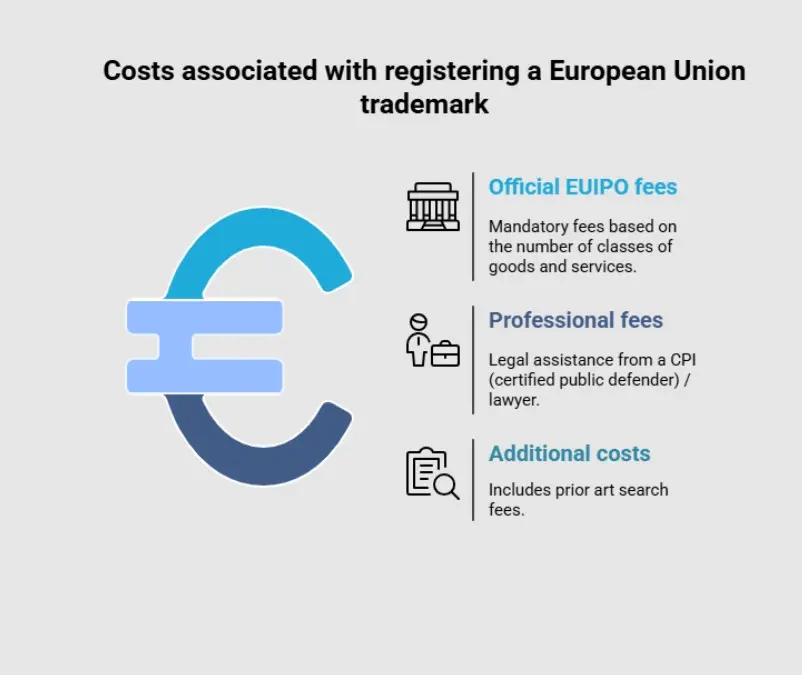
The next step is to determine the cost of registering a trademark with a lawyer or industrial property attorney. The cost of registration varies depending on the number of classes of goods and services designated. In addition, the fees of the lawyer or industrial property attorney must also be considered, as well as optional costs such as those related to prior art searches.
Application submission and registration
Once the registration cost has been determined, you will then need to file an application with the EUIPO (European Union Intellectual Property Office). This application must include all the necessary information about your trademark, the subject of the registration, such as the sign (word mark or logo) and the classes of goods and services designated. The EUIPO will then examine your application.
If there are no oppositions filed against the trademark application, the registration process, from the date of filing to official registration, generally takes around four to six months.
Once accepted by the EUIPO, the trademark will be officially registered for a period of 10 years and you will receive a registration certificate.
2025 Update: What you need to know about official taxes
To ensure that this article remains up to date, it is important to note that the official filing fees of the European Union Intellectual Property Office (EUIPO) are subject to annual adjustments. It is essential to check the official fee schedules directly on the EUIPO website at the time of filing each year.
For example, in 2024, the basic fees for a European Union trademark (EUTM) covering one class have generally remained stable compared to 2023, but an increase in agency fees and specialized prior art search fees should be anticipated.
The importance of using an Industrial Property Attorney remains unchanged, as this professional ensures that your application complies with current regulations and administrative practices of the EUIPO.
Conclusion
The cost of registering a European trademark with a lawyer or industrial property attorney is an important consideration for any company wishing to protect its trademark. Although the cost of registering a trademark may vary, it remains a necessary and significant investment in the protection of your intangible assets, guaranteeing you protection for a minimum of 10 years (a trademark can be renewed indefinitely).
Dreyfus & Associés assists its clients in managing complex intellectual property cases, offering personalized advice and comprehensive operational support for the complete protection of intellectual property.
The European Union Intellectual Property Office (EUIPO) is the entity responsible for registering European Union trademarks (EUTMs).
2. Is a prior art search mandatory before filing a trademark?
A prior art search is not strictly mandatory for filing a trademark with the EUIPO, but it is strongly recommended. It allows you to check whether an identical or similar trademark already exists and to assess the risks of opposition, thus avoiding unnecessary costs and procedures.
3. What rights does registering a European Union trademark with the EUIPO confer?
Registering a European Union Trademark (EUTM) with the EUIPO provides uniform protection in all current EU member states. The filing fees cover this pan-European protection.
4. How long is a European trademark valid for?
The registration of a European Union trademark (EUTM) is valid for a period of 10 years from the date of filing the application and is renewable indefinitely for periods of 10 years.
5. What is an opposition procedure and how does it affect the registration timeframe?
An opposition procedure is legal action brought by the owner of an earlier trademark who believes that your new trademark application infringes on their rights. If an opposition is filed, the registration timeframe can be significantly extended (often by more than a year) and requires the intervention of your attorney or industrial property attorney to reply to the opposition.
Trademark law covers a set of specific rules, with subtleties, that a specialist can help you to best understand your trademark issues.
The Industrial Property Attorney, a regulated profession, provides various services, the main ones of which are presented below:
Firstly, they can help you in registering your trademark by advising you on the registration of a word trademark (a name) or a stylized logo instead, which can help you to stand out from your competitors. They will analyzes your activity and the signs you use to indicate which trademark to register. Beforehand, he conducts a prior art search to make sure that the sign is available, i.e. that there is no prior trademark that could hinder your projects.
Secondly, when your trademark is already filed and registered, the Industrial Property Attorney can monitor future filings to detect those that infringe your rights, in which case he will attempt to resolve the situation by sending a detailed letter of formal notice. If necessary, an opposition to the litigious filing may be filed so that the Trademark Office (such as the INPI in France or the EUIPO in the European Union) rejects the trademark application.
Thirdly, the Industrial Property Attorney can also help you defend your brand on the Internet. Infringements are not uncommon and some companies, such as those specializing in fashion, are particularly affected during certain “peak” periods for counterfeiting: Black Friday, sales, Christmas, etc.
Finally, the Industrial Property Attorney negotiates your contracts for you: trademark transfer or license, coexistence agreement, memorandum of understanding following a conflict, etc. A trademark license is a good way to increase the value of your business by earning royalties.
These are the most common tasks entrusted to the Industrial Property Attorney, as far as trademarks are concerned. However, their activity is much broader!
For further information, do not hesitate to contact us:
contact@dreyfus.fr.
We offer our clients a dedicated and unique experience of expertise that is necessary for the exploitation of intangible assets. We will also endeavor to keep you informed and up-to-date about intellectual property and digital economic issues through our articles and newsletters written by the Dreyfus Legal Team.
If you are a victim of copyright infringement in the European Union (EU), hiring an intellectual property specialist can be an invaluable move. Intellectual property law is a complex and ever-changing field, and having the support of a skilled professional to help you navigate the complexities of the EU legal system is essential. Even if you have a basic understanding of copyright law, counsel can provide the expertise you need to protect your rights and interests.
Copyright infringement occurs when someone uses a protected creation (such as a writing or photograph) without the permission of the copyright owner. Copyright protection in the EU is provided by the European Copyright Directive. This directive establishes a minimum level of copyright protection that must be established in all member states.
Depending on the severity of the infringement, penalties can include heavy fines and even jail time. In addition, the copyright owner may be entitled to damages. If you believe that your copyright has been infringed, it is important to consult a specialist who can help you assess the situation and determine the best course of action.
They can also provide you with advice on how to best enforce your copyright. This may involve taking legal action against the infringer or seeking amicable solutions, usually recommended as a first step, by sending a letter of formal notice to open discussions and stop the infringement.
The specialist can also help you navigate the complexities of the EU legal system. The specialist can also provide you with advice on how to prevent copyright infringement in the future. This can be done by filing an Enveloppe Soleau in France, for example, which will help prove the integrity of your creation.
If you are a victim of copyright infringement in the European Union, it is imperative to consult an intellectual property specialist, who will provide you with the appropriate assistance to repair the damage. He or she can also help you obtain damages in a court of law.
For further information, do not hesitate to contact us:
contact@dreyfus.fr.
We offer our clients a dedicated and unique experience of expertise that is necessary for the exploitation of intangible assets. We will also endeavor to keep you informed and up-to-date about intellectual property and digital economic issues through our articles and newsletters written by the Dreyfus Legal Team.
Our site uses cookies to offer you the best service and to produce statistics, and measure the website's audience. You can change your preferences at any time by clicking on the "Customise my choices" section.
When browsing the Website, Internet users leave digital traces. This information is collected by a connection indicator called "cookie".
Dreyfus uses cookies for statistical analysis purposes to offer you the best experience on its Website.
In compliance with the applicable regulations and with your prior consent, Dreyfus may collect information relating to your terminal or the networks from which you access the Website.
The cookies associated with our Website are intended to store only information relating to your navigation on the Website. This information can be directly read or modified during your subsequent visits and searches on the Website.
Necessary cookies are absolutely essential for the website to function properly. These cookies ensure basic functionalities and security features of the website, anonymously.
Dreyfus is concerned about protecting your privacy and the Personal Data ("Data"; "Personal Data") it collects and processes for you.
Hence, Dreyfus complies every day with the European Union legislation regarding Data protection and particularly the European General Data Protection Regulation Number 2016/679 of 27 April 2016 (GDPR).
This Privacy Policy is aimed at informing you clearly and comprehensively about how Dreyfus, as Data Controller, collects and uses your Personal Data. In addition, the purpose of this Policy is to inform you about the means at your disposal to control this use and exercise your rights related to the said processing, collection and use of your Personal Data.
This Privacy Policy describes how Dreyfus collects and processes your Personal Data. The collection happens when you visit our Website, when you exchange with Dreyfus by e-mail or post, when exercising our Intellectual Property Attorney and representative roles, when we interact with our clients and fellow practitioners, or on any other occasion when you provide your Personal Data to Dreyfus, in particular when you register for our professional events.


 Written by Nathalie Dreyfus07/03/2023
 When it comes to intellectual property law, it is important to understand the differences between copyrights and patents. Both copyrights and patents protect creators and inventors from having their work stolen or copied, but they do so in different ways.






 When it comes to protecting your intellectual property, it is important to hire a law firm that specializes in this area. An intellectual property law firm can provide you with legal advice and representation tailored to your specific needs. Here are some of the benefits of consulting with an intellectual property law firm.

 Intellectual and industrial property law firms specialize in protecting the intangible assets of companies and individuals. They offer services ranging from registration to enforcement of industrial rights such as patents, trademarks or designs, and artistic rights such as copyrights. They also can help in drafting contracts related to intellectual rights. By hiring an intellectual property law firm, you can better protect your intangible assets and avoid costly litigation.

 If you’re in business, you’ll undoubtedly have heard of intellectual and industrial property rights. But do you know what these rights are and how they can help protect you and your business from legal issues and disputes?


 Trademark law covers a set of specific rules, with subtleties, that a specialist can help you to best understand your trademark issues.

 If you are a victim of copyright infringement in the European Union (EU), hiring an intellectual property specialist can be an invaluable move. Intellectual property law is a complex and ever-changing field, and having the support of a skilled professional to help you navigate the complexities of the EU legal system is essential. Even if you have a basic understanding of copyright law, counsel can provide the expertise you need to protect your rights and interests.