The research titled “Trademark and Patent attorney firm perspectives for the year 2021. Internationalization, digital transition, inter-professionalism: what are the growth factors?” refers to Dreyfus as an exemplar IP law firm in many areas including domain names and defense strategies for companies and individuals on the Internet. The study also mentions the Dreyfus IPweb platform as one of the firm’s competitive advantages as it facilitates communication by offering our clients the ability to track all the information related to their file in real time.
Our award-winning IP law firm continues to invest in research and development to provide clients with top-notch services.
The decision rendered in the case between Caudalie and 1001Pharmacies marks a significant milestone in French selective distribution law. By holding that Caudalie was entitled to prohibit the platform 1001Pharmacies from marketing its products, the French Supreme Court and, on remand, the Paris Court of Appeal clarified the conditions under which a trademark owner may exercise strict control over the online distribution of its products.
This case, at the crossroads of trademark law, competition law, and distribution law, remains a key reference for companies seeking to control their digital strategy.
Selective distribution and trademark image: a structured legal balance
From an economic perspective, a trademark serves as a rallying sign for consumers. A consumer purchasing a product under a specific trademark expects a certain level of quality, consistency, and trademark universe. This dimension is particularly significant for products positioned in the premium segment or comparable to luxury goods.
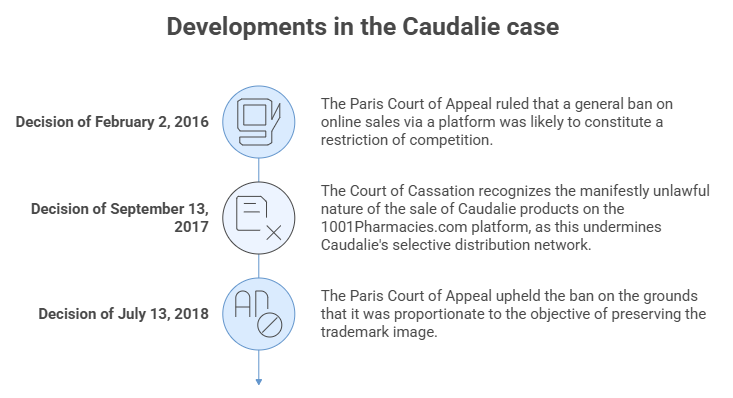
To preserve this coherence, companies frequently rely on selective distribution networks, a contractual mechanism permitted under competition law provided that reseller selection is based on objective, qualitative criteria applied uniformly and proportionately, as clearly reaffirmed by the Paris Court of Appeal in its July 13, 2018 decision.
Selective distribution thus enables control over sales conditions, advice provided to customers, and product presentation, including online.
This network was based on two distinct types of agreements: one governing in-store distribution within pharmacies, and another authorizing distance selling via the Internet, but exclusively through the approved pharmacist’s own website. Sales via third-party platforms or marketplaces were expressly excluded under the contractual terms.
The emergence of the platform 1001Pharmacies.com, operated by eNova Santé and offering pharmacists a shared space to sell their products, led Caudalie to challenge the presence of its products on the site on the grounds that it undermined the integrity of its selective distribution network.
As early as 2014, Caudalie initiated summary proceedings against eNova Santé for a manifestly unlawful disturbance resulting from the breach of its network, which led to an initial order requiring the removal of the products.
However, the Paris Court of Appeal subsequently held that a general prohibition on the use of non-approved platforms could constitute a restriction of competition. This decision was overturned by the French Supreme Court on September 13, 2017, which recognized Caudalie’s right to prohibit the sale of its products on 1001Pharmacies.com, thereby referring the matter back to the Paris Court of Appeal.
The French Supreme Court’s position: recognition of a manifestly unlawful disturbance
In its decision of September 13, 2017, the French Supreme Court held that the Court of Appeal had deprived its decision of a legal basis by failing to justify how administrative decisions or other references could exclude the existence of a manifestly unlawful disturbance resulting from the infringement of Caudalie’s selective distribution network.
The Court therefore acknowledged that Caudalie was entitled to prohibit the sale of its products on a non-approved online platform on the grounds that such sales undermined the effectiveness of its selective network, which had previously been validated by the Competition Authority.
This decision firmly reiterated that, where a selective distribution network is lawful, the trademark owner’s contractual freedom prevails over a superficial assessment of a potential restriction of competition, provided that the selective criteria are implemented consistently with the intended objective.
The prohibition confirmed by the Paris Court of Appeal
Following the remand, the Paris Court of Appeal, in its July 13, 2018 decision, applied the principles established by European case law, notably the Coty judgment (CJEU, December 6, 2017, C-230/16). This decision states that the establishment of a selective distribution network for luxury goods may be justified by the need to preserve their image and sense of luxury, which enable consumers to distinguish them from other comparable products and therefore contribute to the very quality of these products.
Thus, in order to validate the prohibition’s compliance with European Union law, the Paris Court of Appeal held that:
– Caudalie products fall within categories comparable to luxury goods, whose perceived quality depends not only on their intrinsic characteristics but also on their presentation, commercial environment, and associated image.
– The agreements concluded with pharmacists set out objective, uniform, and non-discriminatory criteria, particularly regarding online sales, which were strictly reserved for the pharmacist’s own website meeting specific conditions.
– The prohibition imposed on approved pharmacists against the visible use of third-party platforms for online sales was proportionate to the objective of preserving trademark image and did not go beyond what was necessary to achieve that objective.
The Court noted, for example, that 1001Pharmacies.com offered Caudalie products alongside goods unrelated to the dermocosmetic universe (such as fire alarms or video surveillance cameras), which was likely to undermine the prestige image sought by the trademark.
Scope of the decision
While this decision confirms established case law according to which only an objective justification may legitimize a sales prohibition within a selective distribution network, an important nuance must be emphasized.
The decision demonstrates that a case-by-case analysis is required, particularly where a company restricts its distribution network for image-related reasons. The assessment of what may or may not harm trademark image inevitably involves a degree of subjectivity.
Conclusion
The Caudalie case is a structuring decision for companies operating under selective distribution networks. It demonstrates that French law, in alignment with EU law, provides trademark owners with effective tools to preserve the integrity of their trademark image and the consistency of their online commercial strategy.
Dreyfus & Associés assists clients in managing complex intellectual property matters, providing tailored advice and comprehensive operational support for the full protection of intellectual property rights.
What is a selective distribution network?
A selective distribution network is a system whereby a trademark selects its distributors based on specific criteria (quality of the point of sale, staff training, product presentation, compliance with trademark image) and prohibits them from reselling to non-approved distributors. This mechanism is lawful under EU law provided that the criteria are objective, applied uniformly, and proportionate. It enables the trademark to preserve its image and ensure quality standards in the marketing of its products, including online.
Would the solution be different for non-premium products?
Potentially, yes. The Coty case law emphasized the need to preserve the image of luxury or luxury-like goods. Where a product does not have a qualitative dimension linked to its image or sales environment, the justification for prohibiting marketplaces becomes more difficult.
For mass-market products, the proportionality of such a prohibition would be examined more strictly.
What practical advice can be given to trademark owners?
To secure a selective distribution network legally, it is advisable to formalize precise and measurable qualitative criteria, include specific clauses relating to online sales, ensure uniform and documented application, actively monitor platforms, and anticipate European regulatory developments (VBER, DSA). A rigorous contractual strategy remains the cornerstone of protection.
What is the difference between “visible” and “invisible” sales via a marketplace?
European case law distinguishes between visible presence on a marketplace (where the consumer clearly identifies the platform) and technical solutions where the marketplace is not identifiable to the end customer. In the Coty judgment, the CJEU considered that the prohibition concerned the “visible” use of third-party platforms. This distinction may be decisive: if the consumer is unaware of a third party’s involvement, harm to trademark image may be more difficult to establish.
What strategic lessons can companies learn from this case law?
This case highlights the importance of a consistent legal strategy. Companies wishing to control the distribution of their products must structure their network with clear criteria, formalize specific rules for online sales, and actively monitor compliance with these obligations. A rigorous contractual policy and constant monitoring of platforms help limit the risk of circumvention and preserve brand value.
Following the vote of the British people on June 23, 2016 to leave the European Union, the British authorities have issued several statements about the impact of Brexit on trademark law. As the official date of the UK’s exit from the European Union approaches on March 29, 2019, it is increasingly likely that a Brexit without agreement (“hard Brexit”) will take place. This possibility must be taken into account in order to avoid any setbacks when the day comes.
This past summer the UK Parliament stated that EU trademarks will clone into the UK register, automatically and without payment of additional fees, following Brexit.
The latest communication on the matter comes from the Department of Business, Energy and Industrial Strategy, on September 24th. The latter issued a Guidance Notice in the event of a Brexit without agreement which confirmed the statements of the UK Parliament on the automatic duplication of EU trademarks in the United Kingdom, without additional fees, following the exit of the UK from the European Union. It was also announced that EU trademark applications pending on Brexit day would benefit from a 9-month period during which a national trademark application in the United Kingdom incorporating the same characteristics of the EU trademark would be possible.
It must be borne in mind, however, that nothing is definitively fixed and that the probability that a Brexit without agreement will take place is quite high. We therefore maintain our advice. Thus, out of caution, we strongly recommend that you register a national trademark in the United Kingdom alongside any EU or international trademark application designating the EU. In addition, for your most important European trademarks, it may be useful to register a national trademark in the United Kingdom. Finally, we also recommend that for any national trademark application filed in the United Kingdom to file in parallel a trademark application in the European Union in order to maintain the opportunity to file opposition against a European Union trademark after Brexit.
In the event of a Brexit with agreement, EU trademark applications or trademarks or international trademarks designating the EU would be protected in the United Kingdom, which could lead to duplication. In such a case, it will be necessary to redefine your trademark strategy.
In a decision dated April 5, 2018 (no. 16-19655), the Court of Cassation, provided clarifications on the requirements for assessing the likelihood of confusion in the mind of the public where there is a conflict between a trademark and a company name.
The case was between, on the one hand, two companies, Capstone System Industry and Capstone Properties and, on the other hand, Capstone. Both parties operated in the field of real estate. Capstone had registered the semi-figurative trademarks “Capstone” and “Capstone l’immobilier neuf”, both of which were subjected to revocation actions by the two companies, on the ground that these trademarks violated their prior company name. The companies based their claim on article L711-4 of the French Intellectual Property Code, which provides that a sign may not be adopted as a trademark if it infringes on prior rights, including a company name.
Although the Court of Justice, in the case “Laguiole” of April 5, 2017 involving knives and cutlery, had already provided clarifications on the conflict between a prior company name and a trademark, these two jurisdictions do not approach the problem from the same angle although their visions appear complementary. On the one hand, the Court of Justice recalled that the assessment of a likelihood of confusion must take into account the actual activity of the company claiming prior rights in a company name, and not the activities designated in the statutes. This position had already been taken by the French courts, notably in the case “Coeur de Princesse” of July 10, 2012. In that case, the Court of Cassation declared that “a company name is protected only for activities actually performed by the company and not for those listed in the statutes”. On the other hand, the 2018 decision delivered by the Court of Cassation gave the Court an opportunity to stand on the side of trademarks to provide additional clarifications on the assessment of the likelihood of confusion. In such cases, only the goods and services covered by the trademark must be taken into consideration. In contrast, the trademark’s actual activity will not have any impact on the outcome of the dispute. Thus, the Court of Cassation disagreed with the Court of Appeal for basing its decision on the actual activity performed by the holder and the conditions of use of the trademark.
Furthermore, this recent decision of the Court of Cassation reminds us that the likelihood of confusion must be assessed globally, based on the overall impression created by the invoked prior company names and the trademark. In this particular case, the Court of Cassation criticized the Court of Appeal for not stating the reasons why they discarded the term “Capstone” in the analysis of the likelihood of confusion.
Finally, the decision states that the elements unrelated to the invoked prior signs, for instance the logos, should not be taken into consideration. In the global assessment of the signs and the invoked prior company names, the Court of Cassation criticized the Court of Appeal for having relied on the clear difference between the calligraphic and graphic charter of the semi-figurative trademark “Capstone L’immobilier neuf” and Capstone Properties’ logo. By taking into consideration the logo chosen by the entity having the company name “Capstone Properties”, the Court of Appeal based its decision on an element foreign to the invoked prior signs. However, the Court should have only considered the company name in a strict sense – that is only considering the verbal elements.
Hence, this decision is instructive as it provides guidance on the Court’s stand as to when a company name is likely to constitute a right prior to a trademark.
The Court of Justice and the Court of Cassation have previously adopted a pragmatic and practical approach in the assessment of a likelihood of confusion when considering company names, by taking into account the actual activity of the company. In contrast, the Court of Cassation’s recent decision seems to take a more theoretical approach when it comes to trademarks. Indeed, the Court only retains the goods and services indicated in the trademark registration in order to determine the activity of the trademark owner. When it comes to the trademark, the actual activity will then be left, as we understand it, to an action based on unfair competition. It is therefore important to pay close attention to the action that one undertakes and to rely on the adequate grounds.
The decision rendered by the French Supreme Court on March 28, 2018 (n°16-20.018) constitutes a significant milestone in assessing victim liability in cases of banking fraud. While the legal framework had traditionally favored strong customer protection, this ruling introduces a rebalancing by placing the concept of gross negligence at the forefront, now interpreted more rigorously.
Under Article L.133-18 of the French Monetary and Financial Code, the principle remains that unauthorized transactions must be reimbursed immediately to the customer. However, the bank may avoid reimbursement if it can demonstrate fraud attributable to the customer or, more commonly, a serious breach of the customer’s duty of care. The central challenge therefore lies in identifying such negligence, the scope of which has been significantly broadened by recent case law.
A structured analysis of fraud scenarios to determine liability
Assessing the respective liability of the bank and the account holder requires a precise qualification of the factual circumstances. Traditionally, fraud cases fall into three distinct categories, each governed by a specific legal regime.
The first scenario concerns the interception of a bank card during delivery. In such cases, liability lies with the bank. Under Article L.133-15 of the French Monetary and Financial Code, payment service providers must ensure the confidentiality of security data associated with payment instruments. This obligation is reinforced by data protection law, particularly the GDPR, which requires appropriate technical and organizational safeguards. Where fraud results from deficiencies in these systems, the bank bears full responsibility, without any fault attributable to the customer.
The second scenario involves the loss or theft of a bank card. Here, the legislator has adopted a balanced mechanism. Under Article L.133-19 of the French Monetary and Financial Code, the customer may bear a limited loss capped at €50 at most, provided no gross negligence is established. However, this cap does not apply in certain situations provided for by the statute, and the payer shall bear the full amount of the losses in the event of fraudulent conduct or where the losses result from intentional misconduct or gross negligence in complying with their obligations. In practice, when the customer acts diligently, particularly by promptly reporting the incident, the bank remains liable for nearly the entire loss.
The third and most frequent scenario involves the misappropriation of banking data while the card remains in the customer’s possession. This includes various techniques such as card cloning, system intrusions, and, most commonly, phishing (fraudulent practice whereby an individual is deceived into disclosing sensitive information (such as login credentials, passwords, or banking details) by an impersonator posing as a trusted entity, such as a bank, public authority, or legitimate business). It is within this category that legal disputes are most complex, as the line between victimhood and fault becomes particularly blurred.
Phishing: a progressive reclassification of customer liability in case law
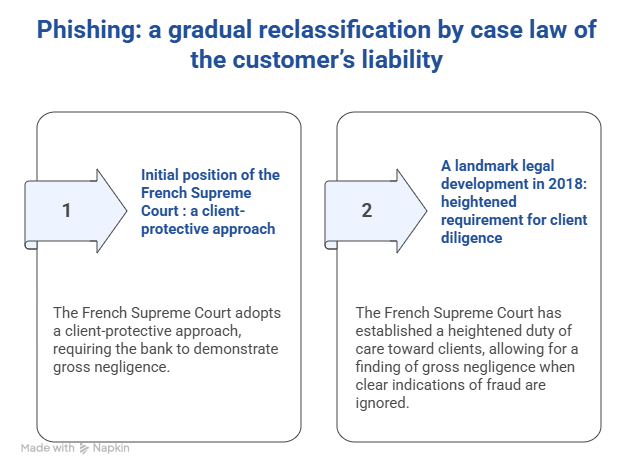
Phishing-related litigation clearly illustrates the evolution of judicial reasoning. Initially, the French Supreme Court adopted a protective stance, holding that the mere fact of being deceived by a fraudulent scheme was insufficient to establish gross negligence. The decision of January 18, 2017 (No. 15-18102) reflected this approach, requiring banks to prove manifestly imprudent behavior on the part of the customer.
However, the French Supreme Court decision of March 28, 2018 (No. 16-20.018) decision marks a turning point. The Court now accepts that gross negligence may arise from a failure to detect obvious signs of fraud, such as inconsistencies in website addresses, spelling errors, or unusual requests.
This shift introduces a heightened standard of vigilance, requiring customers to exercise critical judgment when confronted with suspicious communications. The assessment is now conducted in concreto, taking into account factors such as the apparent credibility of the fraudulent message, the context in which it was received, and the profile of the victim.
Key contribution of the decision: the decisive role of security systems in assessing fault
One of the most significant contributions of the March 28, 2018 ruling lies in the importance given to banking security mechanisms. The Court considers that the use of strong authentication systems, such as 3D Secure, may indicate that confidential data was compromised due to the customer’s conduct.
In practical terms, when a transaction requires the entry of a code sent personally to the account holder, it becomes more difficult for the customer to deny involvement in the fraudulent operation. Although this constitutes a rebuttable presumption, it significantly strengthens the bank’s position by providing technical evidence of insufficient vigilance.
This development reflects a shift in the allocation of responsibility. As security systems become more sophisticated, the level of care expected from customers increases accordingly. Technology, initially designed to protect users, thus becomes a key factor in assessing their potential fault.
Conclusion
The decision of March 28, 2018 marks a significant evolution in the legal treatment of banking fraud in France, introducing a rebalancing between customer protection and the customer’s own duty of vigilance. While the principle of immediate reimbursement of unauthorized transactions remains intact, its effectiveness now depends closely on the absence of gross negligence, which is assessed more rigorously and contextually.
Case law thus promotes a more accountable approach for account holders, particularly in response to modern fraud techniques such as phishing. At the same time, it fully integrates technological developments, especially strong authentication mechanisms, into the evaluation of customer behavior.
Dreyfus Law Firm . assists its clients in managing complex intellectual property matters by providing tailored advice and comprehensive operational support to ensure the full protection of intellectual property rights.
How is the burden of proof allocated in banking fraud cases?
The principle remains favorable to the customer: the bank must demonstrate that the transaction was properly authenticated and executed. However, to avoid reimbursement, it must also prove fraud or gross negligence by the customer, often relying on technical evidence such as strong authentication and transaction traceability.
Does disclosing banking data automatically constitute fault?
No. Case law adopts a nuanced approach. The disclosure of banking data does not automatically amount to gross negligence. Courts assess the specific circumstances, including the sophistication and credibility of the fraud. However, since 2018, a higher level of vigilance is expected when clear warning signs are present.
Does the customer’s reaction time affect liability?
Yes. Prompt action, particularly reporting the fraud without delay, is a key factor. A diligent response may exclude gross negligence and preserve the right to reimbursement. Conversely, delayed action may be interpreted as a failure to exercise due care.
Do banking security systems automatically exempt banks from liability?
No, but they play a crucial role. Strong authentication mechanisms, such as 3D Secure, may indicate that the transaction was validated using the customer’s credentials, creating a presumption of negligence. This presumption can, however, be rebutted in cases of sophisticated fraud.
Do new technologies increase customer responsibility?
Indirectly, yes. As security systems become more advanced, expectations regarding user vigilance rise accordingly. Customers are presumed to understand authentication processes and act cautiously. Technology thus becomes a key factor in assessing customer behavior.
Given the importance of the cybercrime issue, the Ministry of the Interior published a second report dedicated to cyber threats in May 2018. It is a comprehensive, in-depth overview of the cybercrime and the responses developed by the Ministry. This report includes three parts:
Strategic Issues Related to Cyber Threats
Uses, phenomena and perception of the threat
The actions taken by the Ministry of the Interior to manage cyberthreats.
The first part of the report identifies strategic issues related to cybercrime from social, economic and, legal perspectives. On social level it deals with the use of the Internet for terrorist purposes (crowdsourcing of terrorist activities), the development of information and communication technologies such as discussion forums and crypto – currencies, illicit traffic on Darknets (deep web) through increased use of encryption and anonymization tools. The economic level concerns the development of the cybersecurity market as well as economic counter-interference. For example, cyber-attacks motivated by greed, sabotage, espionage or economic interference have startling financial and reputational implications for organizations.
In the section on the legal issues related to cyber threats, the report includes information on the following developments: the evolution of French legislation, the impact of the directives (NIS Directive) and European regulations (GDPR),the CJEU jurisprudence in fight against cyber threats (judgment of 21 December 2016), the work of the Council of Europe, the United Nations General Assembly and the G7 Group, as well as international cooperation, considering the international dimension of cybercrime.
In the second part of the report concerning uses and threat perception, three factors were mentioned, namely: vulnerability, social engineering and malware. Theses are three main vectors of attacks such as targeted attack and deep attacks, misappropriation and theft of data, denial of service (DoS), disfigurement and telephone attacks.
The Internet with its penetration rate of 87% in France and 54% worldwide was identified as the main mean (especially through smartphones, tablets, Internet connected objects and smart spaces) used for terrorism, scams, extortion, bank card fraud, online criminal markets, attacks on minors, counterfeit works of the mind and ultimately undermining democracy. The study based on data collected by the national police shows a global increase in Internet offences by30% compared to 2016; more than 60% of these offenses are online frauds.
In the third part of the report concerning the actions of the Ministry of the Interior, three main actions were considered: prevention and protection, investigation, and innovation. Prevention actions include targeting general public, promoting awareness in the economic world, increasing territorial economic intelligence and protecting the Ministry’s information systems. The protection can be ensured by using cyber insurance to mitigate risk. Cyber insurance become common in France, regardless the fact that the intangible assets cannot be insured yet in a standardized way.
The report includes investigation procedures that go beyond current practice of acknowledging the victims of cybercrime. It is proposed to implement specialized investigation services for cybercrime as well as training and cooperation in the domain of cyber security.
Six main areas of innovation action were identified in the report:
Research and development (analytical & forensics tools as well as academic research project)
Public-private partnership
Digital transformation: better reporting,
Cyber communication (Neo PN / GN project, Digital Brigade of the Gendarmerie, establishing network of regional cyber threats
Crisis Communication: Population Alert and Information System (SAIP) and Emergency Management of Social Media (MSGU)), a better understanding of mass phenomena (Thésée Project, Perceval Project),
Remediation through platforms – assistance to victims of cyber-maliciousness, digital identity.
In the era of the digital economy and the digital transformation, cybersecurity is a crucial issue for consumers (including minors) who adopted online purchasing and usage, for the private sector (banking and financial sector, as well as the healthcare sector) and for the public sector. The strategy of fighting against cyber threats must be everyone’s business. It is therefore necessary to expand collective power to prevent and fight against terrorism.
In order to be prepared for any outcomes, including a “no deal” Brexit (a scenario in which the UK leaves the EU without agreement) the British government published on Thursday, August 16 a set of technical guidelines outlining the risks of a “no deal” outcome. The guidelines are intended to help businesses and individuals to get ready for the impact of a “no deal” scenario.
Although the 24 guidelines contain many topics, the government is planning to release 80 guidelines in total. Among other topics, the guidelines cover the issue of tobacco legislation.
The EU Member States are subject to EU Directive 2014/40 / EU “Tobacco Products” which regulates the manufacturing, distribution and sale of tobacco products in the EU. In the event of a “no deal” Brexit, the “tobacco products” legislation will no longer be applicable in the United Kingdom. It will be replaced by a UK legislation, which would contain minor amendments to the existing UK domestic law introduced in 2016.
However, another related issue remains unclarified, namely the graphic photo warnings that appear on cigarette packets, since the EU owns the copyrights for the photo warnings currently in use. In order to use copyrighted images, a copyrights owner’s permission is required. The “Tobacco Products” Directive grants the right to use the images on cigarette packets to the Member States, which makes the image bank of more than 40 photos unavailable to non-Members. In case of a “no deal” scenario, new UK images for cigarette packets will have to be introduced. In its’ notice regarding labelling tobacco products, the UK government states just that – tobacco manufacturers need to ensure that new picture warnings appear on tobacco products after Exit Day.
The tobacco products notice outlines the course of action that will need to be taken in the event of a “no deal” scenario. In September the UK Government will publish more technical details of the new regulation and the picture warnings that will minimize the burden associated with introduction of modifications. New information about the images used in the tobacco picture warnings will therefore be available when the new legislation is passed.
The 2024 Olympic and Paralympic Games represent an exceptionally important date for Paris. The city’s application was accepted by the International Olympic Committee (IOC) on 13 September 2017. This event is a major challenge for both the Olympic trademark and the partner trademarks which will be protected by intellectual property rights and competition law.
Challenges for the protection of the Olympic trademark and its notoriety
The Olympic Games are broadcast all over the world and have a global reputation, so the trademark must be protected against the high risks of parasitism and infringement.
This is when intellectual property rights have all their importance. Trademark law protects registered distinctive signs such as the official name of the event, logos, the hymn, etc. Similarly, article L141-5 of the French sports codes already stipulates that the French National Olympic and Sports Committee (CNOSF) is the owner of the national Olympic emblems, currency, hymn, the Olympic symbol and the terms “Olympic games” and “ Olympiad”. Any filing as a trademark, imitation, reproduction, apposition, suppression or modification of these signs constitutes an infringement and is punishable by the sanctions referred to in the French Intellectual Property Code.
Article 3 of the law specifies and reasserts the rights of protected signs. In this respect, it amends the terms of the French Sports Code and adds certain signs to the protection. The CNOSF is, thereupon, owner of the national Olympic emblems and custodian of the Olympic games flag, currency, emblems, hymn, logo, slogan and posters and of the mascot, the terms “Olympiques”, “Jeux olympiques”, “Olympiade”, “Olympien/Olympienne” “JO” and of the vintage “city+year”. Any commercial or promotional use of these signs or that could lead to a risk of confusion in the minds of the public suggesting a link with the Olympic Games is punishable under the dispositions of the Intellectual Property Code, as constituting infringements. Only the use in normal speech is tolerated.
Lastly, article 6 b of the Paris Convention signed on 20 March 1883 “for the protection of industrial property” states that any person who harms the image of a well-known trademark will be held liable. In this respect, it is incontrovertible that the Olympic trademark is entitled to this particular protection. In 2006, there was a case in which the CNOSF was up against the procurement group of Leclerc supermarkets which had called its promotional campaign “Olymprix” and filed this trademark for their products. The French courts highlighted the deterioration of the image of the “Olympique” and “Jeux Olympiques” trademark and the acts of parasitism, finding against Leclerc.
Challenges for sponsor trademarks
Behind the euphoria of the global event there are major financial interests at stake. One and a half billion Euros will be used to fund the event. Funding that is provided by the 15 major partner corporations, including LVMH, Suez, BNP Paribas, in consideration of which they will be promoted during the event and allowed to use the protected signs of the games. The increased protection afforded the Olympic emblems by the aforementioned legislation and the ad hoc legislation in particular is therefore at the heart of the smooth running of the games. Only partner undertakings can use the Olympic signs in their marketing strategies during the event, which constitutes major compensation for their funding. Without protection, no investment: without investment, no event. “The strongest guarantees must be given to the CNOSF to protect the terms of which they are the custodian. Their protection is in fact essential for the economic equilibrium of the Games. It is therefore imperative that the partners know their investment is guaranteed and their rights protected” explained Laura Flessel, French minister of sports, at the parliament sitting on 20 December 2017 at 15:00.
This represented a sizeable challenge for non-partner undertakings wishing to take advantage of a global, highly mediatised event in their marketing strategies. Some criticise the measures of the ad hoc law, as it undermines freedom of expression, or restricts the freedom of trade and industry. Severe provisions which, furthermore, go beyond the protection of trademark law by making it deviate from its core function of distinctiveness. While trademark law only protects distinctive signs, this ad hoc law protects terms that have no distinction, but with the aim of protecting the investments of the partner trademarks, in particular to stimulate sales.
Furthermore, the partner trademarks still have to face ambush-marketing. This practice consists in non-certified trademarks making themselves visible during the Olympic Games without having contributed investments in return. The Paris Tribunal de Grande Instance, on 30 May 2008, condemned this type of practice in respect of tortious liability and parasitism in a case opposing the French Tennis Federation and UNIBET. It stated that “UNIBET deliberately places itself in the wake of the Tournament to promote and develop its business inexpensively, which is the definition of parasitic behaviour entailing tortious liability”.
The unfolding of an event which has a global reach therefore poses challenges both for the well-known trademark which the Olympic trademark represents and for the partner trademarks for which protection is critical. France intends to provide effective protection for the Olympic trademark and its recognition, which represent valuable assets.
In case where the European Commission Draft Withdrawal Agreement is signed and ratified by the parties, it will offer advantages in terms of intellectual property rights protection by ensuring continuous protection in the UK. There are many unaddressed issues concerning trademark rights registered in the European Union. Today, less than eight months before the Great Britain leaves the EU, the chances of reaching an agreement are getting slimmer.
Although the European Commission is still working on an agreement, in July’s press release it called on its’ member statesto be ready for a “no deal”. This was enough to cause unease among the member states who counted on a transition period to be negotiated with respect to intellectual property rights. On August 9, 2018, Jeremy Hunt, British Foreign Secretary, declared at a press conference in Helsinki that: “Everyone needs to prepare for the possibility of a chaotic no-deal Brexit” which, of course, is a worst-case scenario for everyone.
There is still an uncertainty regarding the EU trademarks that were registered before the leave of the United Kingdom. The UKIPO (UK Intellectual Property Office) confirmed that the trademarks registered in the European Union would have a continuous protection in the UK. This position was to be formalized in the Withdrawal Agreement. If the parties fail to negotiate an agreement, it is likely that other ways will be found to ensure continuance of trademark rights in the UK, but it will certainly be more complex.
Given the circumstances, it is critical to take all necessary measures to secure your intellectual property rights. To that end, we advise our clients to register national trademarks in the United Kingdom for any new registration of a European Union trademark or an international trademark targeting the European Union.
The GDPR regulates the processing of personal data with regard to the European Union in a much stricter way than in the past. In this dynamic, the new European regulation now obliges the registries and the registrars to obtain the consent of the registrants to collect their personal data and prohibits its disclosure to the public. The WHOIS then raised a problem for the protection of personal privacy. The public circulation of the identity, or other information relative to the holder of a domain name, as well as the administrative and technical contacts who may be natural persons, opens the door to the commercial exploitation of their data without prior consent. Now, this is precisely one of the problem issues the regulation was intended to handle. Changes relative to access to the personal data on the WHOIS sheets were in this respect essential for effective compliance. The model of WHOIS was called into question by the German EPAG registrar, which purely and simply stopped collecting the administrative and technical contact details for the new registrations, due to a strict interpretation of the regulation. ICANN then initiated legal action before the regional court of Bonn to apply for the continued collection of all the WHOIS data, so that this data remained available to the parties able to establish a legitimate reason for accessing it. ICANN appealed this judgement and the regional court of Bonn decided to hear the file again.
The ICANN’s compliance
ICANN was therefore forced to modify its WHOIS policy. To this end, it amended its contracts with the registries concerning their collection of personal data on 31 July 2017 (point 2.18 of the Registry accreditation agreement ) requiring registries to obtain the consent of any person who is a domain name holder before the publication of their personal data on WHOIS. From this perspective, ICANN retained the provisional model of WHOIS, reduced to the minimum and applied to all the domain name holders, in and outside the European Union on 28 February 2018 called the “Calzone Model”. The aim was to enable short term compliance between the WHOIS directory and the provisions of the GDPR, prior to a full revision of the system to find an optimal balance between the fight against cybercrime and data privacy. The information made available to the public will be the sign of the domain name, the administrative and technical info (dates, status, name of the registry, dns servers), the state and country of the holder, the name of the organisation for companies and a means of contacting the holder (anonymized email or web form). In the “Calzone Model”, the other information will in principle be confidential and only users accredited through an official programme, to be developed in the near future, will have access. For example, specialists in intellectual property law will be able to apply for accreditation from ICANN.
Application of the GDPR by the registries
Following the communications of ICANN, the registrars had to amend their way of processing personal data. In this respect, it is interesting to note a lack of consistency in their new confidentiality policies. For example, some registries now only leave visible the technical information of the domain and the country of the registrant. To communicate with the holder of the registered domain name, it is possible to use an online form to contact the registrant directly (GoDaddy, United States). Other registries have introduced a proxy service enabling the confidentiality of the personal data of the registrants (Namecheap). On the other hand, the Chinese registries continue, for the moment, to disclose the information about European citizens.
Which strategy to adopt?
The above remarks lead us to believe that there is not yet stability regarding the application of the GDPR which remains disparate.
Faced with a project that is ongoing, the specialist counsels are still giving thought to the strategies to be adopted. In such a situation, it is in fact necessary to see how the dialogue will progress among the different players to find a model of WHOIS that is compliant with the GDPR, which will continue to be a key mechanism for combating cybercrime and more generally any infringement of rights perpetrated online.
At this stage, our team remains at your disposal for any further inquiries.
Our site uses cookies to offer you the best service and to produce statistics, and measure the website's audience. You can change your preferences at any time by clicking on the "Customise my choices" section.
When browsing the Website, Internet users leave digital traces. This information is collected by a connection indicator called "cookie".
Dreyfus uses cookies for statistical analysis purposes to offer you the best experience on its Website.
In compliance with the applicable regulations and with your prior consent, Dreyfus may collect information relating to your terminal or the networks from which you access the Website.
The cookies associated with our Website are intended to store only information relating to your navigation on the Website. This information can be directly read or modified during your subsequent visits and searches on the Website.
Necessary cookies are absolutely essential for the website to function properly. These cookies ensure basic functionalities and security features of the website, anonymously.
Dreyfus is concerned about protecting your privacy and the Personal Data ("Data"; "Personal Data") it collects and processes for you.
Hence, Dreyfus complies every day with the European Union legislation regarding Data protection and particularly the European General Data Protection Regulation Number 2016/679 of 27 April 2016 (GDPR).
This Privacy Policy is aimed at informing you clearly and comprehensively about how Dreyfus, as Data Controller, collects and uses your Personal Data. In addition, the purpose of this Policy is to inform you about the means at your disposal to control this use and exercise your rights related to the said processing, collection and use of your Personal Data.
This Privacy Policy describes how Dreyfus collects and processes your Personal Data. The collection happens when you visit our Website, when you exchange with Dreyfus by e-mail or post, when exercising our Intellectual Property Attorney and representative roles, when we interact with our clients and fellow practitioners, or on any other occasion when you provide your Personal Data to Dreyfus, in particular when you register for our professional events.


 Written by Nathalie Dreyfus13/11/2018