The open auction of previously reserved domain names has already generated over 50 million yuan, or more than 8 million dollars.
The auction of domain GAME.CN produced the highest offer of nearly 3 million yuan after 700 bids.
In second place was domain name GW.CN which is the Chinese abbreviation for “gou wu” or “guo wang“, meaning “shopping” or “national network”. Bids climbed to over 2 million yuan.
The domain LB.CN came next with over 1 million yuan. This can stand for “lao ban“, “libao” or “lian bang” which mean respectively “boss”, “gift” and “federal”.
The fourth best auction result was for the domain name CM.CN, much sought-after by investors and Chinese “domainers” and which brought in over 1 million yuan.
Thanks to these auctions the funds accumulated – after tax deductions – will be given to charity.
With effect from 8 January 2014, residents, companies and organizations based in Iceland, Lichtenstein and Norway can register .eu domain names.
This decision by the European Commission is based on regulation EC 733/2002 of the European Parliament and Council which foresaw the extension of .eu to the whole of the EEA.
The registration policy and the Whois policy, as well as the Terms and Conditions with regards to privacy were also updated.
After leading a study concerning the likelihood and impact of collisions between applied-for new gTLD strings and non-delegated TLDs, ICANN suggests to the community mitigation measures in order to avoid collisions.
Those problems may occur when local top-level domains in private namespace reach the public DNS while they already exist or when certificate authorities issue X.509 certificates for domain names that are not resolvable in the public DNS.
The study emphasises three categories of strings by the potential risk of name space collision: low risk, uncalculated risk and high risk. For each one of them, the program offers a determined and made to measure management process.
In this way,
for low risk gTLD strings, the study proposes proceeding with contracting and delegation of these strings but recommending additional mitigation measures without impacting their timeline for delegation,
for uncalculated risk gTLD strings, the delivery date should be extended by 3 to 6 months, and
for high risk strings which are .home and .corp, the process will be delayed until those strings goes to low risk category.
The new gTLD string delegation process is long and delicate. At this stage, all these steps are proposals only and opened to the Internet community’s comments.
The report published by European Commission for the year 2012 presents statistical information on the number of detentions and other customs actions over the past year(1).
The number of individual articles detained are down over 65%. Indeed 114,772,812 articles have been detained in 2001 to 39,917,445 in 2012. However, regarding instances of imports, the results have remained quite stable (91,245 detentions in 2011 to 90,473 in 2012).
This shift is due to the availability of goods online which infringe intellectual property rights. The goods arrive to Europe generally through post and couriers.
The articles come for the most part from China for CD, DVD and tobacco, Marocco for foodstuffs and Bulgaria for packaging materials.
In 90% of the cases, detained goods were destroyed either after the owner of the goods and the right holder agreed on destruction or after the right holder initiated a court action. The report says also that 8% of detentions have been released because the right owner didn’t react to a notification or because the goods were genuine.
It is important to set up a customs surveillance and seizures. Our law firm can advice and assist you to set up a monitoring of your company trademark at customs level in France, as well as in the European Union.
Dreyfus has been nominated “Boutique IP Law Firm of the Year” (1) in “Acquisition International” magazine’s “Legal Awards 2013”.
Nathalie Dreyfus explains in an interview that the firm’s expertise in the protection and enforcement of trademarks on the internet has played a key role in this recognition.
Since 10 years, Dreyfus routinely handles litigations and has acquired the necessary experience to anticipate the outcomes of disputes.
Dreyfus also points out that there are some trends in the field of intellectual property. Examples would include not only the opportunity to file – and protect – an international trademark in many countries in one shot, but also “the interdependence between intellectual property and the digital economy” with the launch of new gTLDs which will accelerate the need “to adjust the legal strategies of companies relating to the presence of their trademarks on the internet.”
Dreyfus has also been described as “excellent” in the rankings of the best IP law firms of “Décideurs” magazine (2). We find out what serves to distinguish the firm from the rest: a stronger “relationship between the protection of intellectual property and new technologies, especially concerning domain names” and its active involvement “with arbitration centers and with ICANN in particular.”
In a recent decision (1), the Trademark Trial and Appeal Board (TTAB) sustained an opposition requesting the rejection of the trademark EPI-KEY based on a likelihood of confusion with the trademark EPIPEN.
The TTAB is a body within the United States Patent and Trademark Office (USPTO) responsible for hearing and deciding certain kinds of cases involving trademarks. More specifically, the Trademark Trial and Appeal Board decides adversary proceedings involving notably oppositions to the registration of trademarks and petitions to cancel trademark registrations.
The main point to emphasize in this decision is the rejection of the applicant’s argument that any risk of confusion can be avoided by the need that the medicines be prescribed by a doctor.
Both marks were used for medical treatment of allergies with epinephrine. The Board found plausible that the patient requests the wrong device to his doctor thinking it was the other one. Patients and even physicians can also have the mistaken belief that both medicines are manufactured by the same company.
So, even if the products are prescribed by professional intermediaries there may still be a risk of confusion between two marks.
(1) Mylan, Inc. v. Beaufort County Allergy, opposition No. 91195868 (USPTO TTAB June 19, 2013)
AFNIC, the French domain name registry, will accept soon domain names with one and two characters, following its German and English counterpart’s footsteps. The idea was refused for a long time because of possible confusions with country extensions published by the International Organization for Standardization (ISO). However, there are few reasons to stop such registrations.
We can find indeed some restrictions leading to confusions, such as existing extensions in the AFNIC registry (<fr.fr>) and country or second level extensions (<uk.fr>, <co.fr>). Nevertheless, there isn’t any problem registering domain names like <a.fr> or <2ü.fr>.
Moreover, short domain names are popular. They are in limited number and easy to remember. Hence, their acquisition is not easy and the competition is tough.
Contrary to the German registry which offered in 2009 a procedure to best and quicker bidders, the English system processed by stages, a fairer method.
AFNIC plans to offer a procedure available by the majority of internet users and may propose different ways of release, such as « first come, first served » or an auction system.
Product placement is a widely used tool for companies seeking to enhance their visibility, particularly in a context of saturation of traditional advertising formats. Its effectiveness lies in its seamless integration into audiovisual and digital content; however, such integration is not legally neutral.
At the intersection of consumer law, European law and intellectual property law, its implementation requires careful consideration in order to secure operations and safeguard the company’s interests.
Product placement: a recognised and regulated marketing technique
Product placement is defined as the inclusion, in return for consideration, of a product, service or trademark within an audiovisual programme. This definition, derived from Article 1 of Directive 2007/65/EC of December 11, 2007 concerning the pursuit of television broadcasting activities, legally recognises this practice as a form of commercial communication.
Prior to this recognition, European law was grounded in a principle prohibiting product placement, subject to limited exceptions, notably in cinematographic works. This approach reflected a desire to preserve the separation between editorial content and advertising.
The 2007 Directive marked a turning point by authorising product placement while subjecting it to regulation. As a result, it can no longer be regarded as a mere narrative element; rather, it constitutes a regulated promotional practice, subject to a fundamental requirement: ensuring that the commercial nature of the content is identifiable by the audience.
What legal framework governs product placement in France?
The current legal framework for product placement in France originates in particular from the transposition of Directive 2007/65/EC (mentioned above), implemented by French law No. 2009-258 of March 5, 2009. This law introduced product placement into French law while setting clear limits on its use. This transposition does not amount to a liberalization, but rather to a regulated authorization. The legislator sought to reconcile the economic needs of the audiovisual sector with consumer protection, notably by imposing strict transparency requirements.
The implementation of this framework was further clarified by Decision No. 2010-4 of February 16, 2010 adopted by the CSA (now ARCOM), which governs practices in concrete terms by requiring that product placement be clearly disclosed to the public. This obligation constitutes the cornerstone of the regulatory regime.
This regime forms part of a broader European framework established by Directive 2010/13/EU of March 10, 2010 on audiovisual media services. This directive harmonizes the rules applicable within the European Union and enshrines the principle of regulated authorization for product placement, subject to several requirements:
• clear identification of product placement,
• prohibition of undue influence on editorial content,
• absence of direct encouragement to purchase,
• exclusion of certain sensitive products or programmes, particularly those aimed at children or news programmes.
It thus constitutes the harmonized foundation at the European Union level, on which French law is based, and which has been transposed through the adaptation of legislative and regulatory provisions.
Influencers and the regulation of product placement on social media
The rise of social media has profoundly transformed the modalities of product placement. Content disseminated on digital platforms such as YouTube, Instagram or TikTok now falls within the scope of the French Consumer Code, in particular Articles L.121-2 and L.121-3 relating to misleading commercial practices.
The principle is clear: any commercial communication must be identifiable as such. The absence of an explicit disclosure of a commercial partnership constitutes a concealment of commercial intent, likely to give rise to liability.
The French Directorate general for competition policy, consumer affairs and fraud control (DGCCRF) exercises increased scrutiny over these practices and regularly sanctions non-compliance. This framework has been further strengthened by Law No. 2023-451 of June 9, 2023, which specifically regulates commercial influence and imposes enhanced transparency obligations.
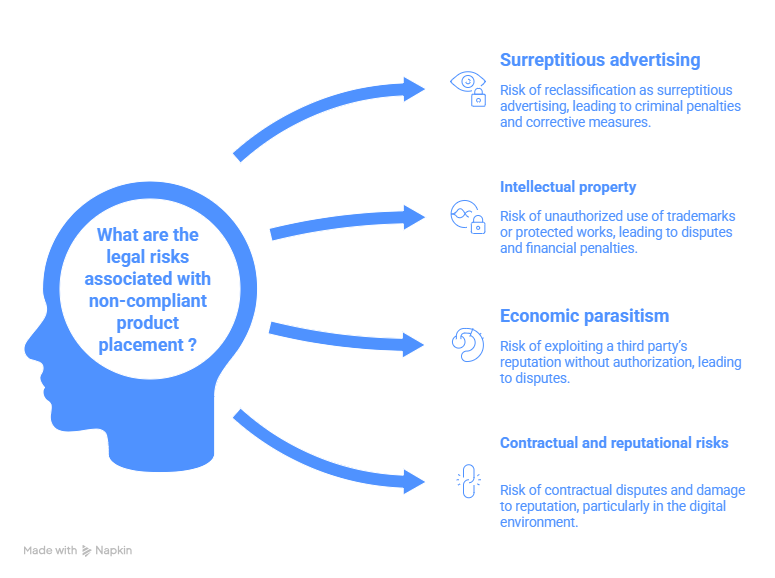
What are the legal risks associated with non-compliant product placement ?
The primary risk lies in the reclassification as surreptitious advertising, prohibited under Article 9 of Decree No. 92-280 of March 27, 1992 relating to audiovisual advertising. Such reclassification occurs where the commercial nature of the message is not clearly identifiable. In this respect, consumer law treats the concealment of commercial intent as a misleading commercial practice, capable of engaging the liability of its author.
Case law has also recognised situations of commercial parasitism, notably in a decision of the French Supreme Court of January 26,1999 (Commercial Chamber, January 26, 1999, No. 96-22.457), where a party unlawfully exploited the reputation of a third party without authorisation or compensation.
Finally, contractual and reputational risks must be fully taken into account. Poorly managed campaigns may give rise to disputes between the parties and damage trademark image, particularly in a digital environment where virality amplifies controversies.
How can a product placement operation be secured ?
Securing a product placement operation primarily relies on a robust contractual framework. Agreements must clearly define the terms of dissemination, transparency obligations and the rights relating to the use of protected elements.
Prior regulatory compliance checks are essential. These must ensure compliance with obligations arising from audiovisual law and consumer law, particularly with respect to the identification of commercial communications.
Finally, ongoing legal monitoring enables anticipation of regulatory developments and adaptation of strategies accordingly. This approach ensures the secure and sustainable exploitation of product placement.
Conclusion
Product placement constitutes a highly effective communication tool, provided that it is legally controlled. It is not merely a marketing instrument, but a regulated mechanism whose implementation requires rigour and foresight.
An effective strategy relies on the alignment of legal compliance, editorial coherence and digital optimisation. Such an approach makes it possible to secure operations while maximising their impact.
Dreyfus & Associés assists its clients in managing complex intellectual property matters by providing tailored advice and comprehensive operational support for the full protection of intellectual property rights.
1. Must product placement necessarily be paid to qualify legally?
No. The legal qualification of product placement does not rely solely on the existence of financial compensation. A benefit in kind, such as the free provision of a product, a trip, or any other advantage, may be sufficient to characterize a commercial communication. In such cases, transparency obligations remain fully applicable.
2. Is sending a product to an influencer without any obligation to post regulated?
The situation is more nuanced. In the absence of a commitment to publish, there is not necessarily a formal commercial relationship. However, as soon as there is an expectation, even implicit, surrounding the sending of the product, or if the influencer chooses to communicate about it, rules relating to commercial practices may apply, particularly regarding transparency.
3. Can product placement concern something other than physical goods?
Yes. Product placement is not limited to tangible goods. It may relate to services, applications, digital platforms, or even the promotion of a trademark as such. From a legal perspective, what matters is the presence of a promotional intent embedded within the content.
4. Are there sector-specific restrictions?
Yes, sectors such as healthcare products, alcohol, and gambling are subject to strict regulations, and in some cases, prohibitions.
5. Can a trademark freely reuse content created as part of a product placement?
No. In principle, the content remains the property of its creator, unless otherwise agreed. Any reuse by the trademark, particularly for advertising purposes, requires prior authorization or a transfer of rights. Failing this, it may constitute an infringement of intellectual property rights.
This publication is intended to provide general guidance and highlight certain legal issues. It is not intended to address specific situations and does not constitute legal advice.
Customs officers play an important role in identifying, at border-crossings, goods suspected of counterfeiting trademarks, models or patents.
What means do Customs officers have at their disposal to prove that articles are counterfeit?
Two types of seizures are permissible by law, one being preventative, the other prohibitive.
As a preventative measure, Customs authorities protect firms that have filed an interception request. This allows Customs officers to hold any suspicious goods for a period of ten days, limited to three days in the case of perishable goods.
As a prohibitive measure, Customs authorities implement a process of seizure where counterfeit is proven and thereby ensure the immediate withdrawal of counterfeit goods from sales channels, whilst at the same time taking the offenders to court.
PREVENTION: Customs retention
Intellectual property rights holders must file an interception request in order to activate a Customs watch which keeps them informed about the importation into France of allegedly counterfeit products.
When?
The request is made by simply providing the certificate of registration for a trademark, model or patent delivered by the National Institute for Intellectual Property (INPI) or other registration office. This measure is preventative and can be done before any cases of counterfeit are confirmed.
How?
The request form asks for certain information that ensures that Customs controls are effective:
The intellectual property title deed
Whom to contact (technical and administrative staff)
A technical description of the genuine goods, production lines and transport itineraries
A description of the illegal copy if the counterfeit goods are already in circulation
Duration?
The interception request is valid for one year from the date the dossier is approved by the administration. The cover can be renewed by written request. All information provided is confidential and may not be disclosed by Customs!
The advantages of the Customs retention process:
The information gathered enables Customs checks to be better targeted and therefore more effective.
The interception request is a prerequisite before any suspicious goods can be held for 10 days.
This procedure is carried out in close collaboration with rights holders
In order to file an interception request, the rights holder (or their representative) must comply with the following two conditions:
The holder must provide a very detailed description of the goods in order to help Customs officers spot possible counterfeit items.
This must be accompanied by relevant proof confirming that the request comes from appropriate rights holder.
In order to facilitate Customs checks and make them more effective, specific Customs training may be necessary. The rights holder has the possibility of training Customs officers in order to help authenticate goods examined by interception request.
PROHIBITION: Customs seizure
The intellectual property rights holder or their exclusive licensee must make a formal request to the president of the ‘Tribunal de Grande Instance’ (TGI or High Court) since seizure of counterfeit items comes under their jurisdiction. This seizure can be real or descriptive. In order to validate the seizure, the applicant must assign either as a civil entity before the TGI or directly before the Criminal Court within 15 days.
Civil responsibility
The lawsuit for counterfeit brought before the competent TGI authorities follows the rules laid down by common law and the case is to be heard within 3 years of the date of infringement. The case is usually brought by the rights holder, but their exclusive licensee can act in place of the holder if the latter, having been invited to proceed, declines to do so, unless the licensing agreement specifies otherwise.
When filing a lawsuit for counterfeit, the IP rights holder must prove that the act or acts of counterfeiting have occurred in accordance with the general principle of article 9 of the Civil Code according to which “it is the responsibility of each party to prove, in accordance with Law, the necessary facts in support of their claim.” Counterfeiting may be proven by all lawful means, but infringement seizure is the method most frequently used by rights holders.
In its final decision, the Court can ban the production of all counterfeit items, order the confiscation of goods bearing the counterfeit brand and award damages to the trademark holder in order to compensate all losses due to counterfeit.
Penal responsibility
This type of case is to be filed under the same conditions as with a civil case, in other words either by the trademark holder, or by his exclusive licensee. The public lawsuit is to be filed either by The Crown or by the victim via a civil case. Since counterfeiting is a crime, the case is to be heard within 3 years. This offence is punishable by four years imprisonment and a fine of 400,000€ (if the offence is carried out by organized crime the sentence can be extended to five years imprisonment and a 500,000€ fine). Judges have the right to pass additional sentences at their discretion: they can publish both the verdict and the sentence, as well as confiscating items and objects used to commit the crime.
Customs interceptions at French borders provide IP title holders with effective protection of their rights. Community Law established by two regulations(1) also ensures that Customs checks regarding IP rights are very effective.
On June 11 2013 the European Parliament adopted new regulations relating to Customs operations in order to ensure a greater respect for IP rights. This will be applicable from January 1st 2014 onwards and will replace European Community regulation 1383/2003 by introducing certain improvements:
The simplified procedure will lead to the destruction of counterfeit goods, without a Court Order, providing that the rights holder gives their agreement as must the importer.
Those who are surprised to receive small quantities (under 2 kilos) of counterfeit goods in the post, will have 10 days in which to consent to their destruction without having to pay for their storage or removal.
The list of protected IP rights has been extended to provide even greater protection (protection of commercial names, topographies of semi-conductors…).
The existing process for the rapid destruction of counterfeit goods is now compulsory in all member States.
Exercising the right to be heard has been harmonized concerning those for whom the seizure may be detrimental.
We cooperate regularly with Customs authorities in the fight against counterfeit and piracy in every area of intellectual property. We are available to advise you on the best strategy to adopt in order to establish an effective Customs watch.
(1)Regulation no 1383/2003 of July 27 2003, supplemented by regulation no 1891/2004 of October 21 2004
The Trademark Claims Service is a service offered by the Trademark Clearinghouse (TMCH). During the first 90 days of the general opening, alerts are sent to applicants wanting to register a name identical to the trademark registered with the TMCH including to the holders of the said trademark if the name could be registered.
The novelty lies in the service of sending notifications for post-registration to trademark holders, which will be expanded indefinitely whereas the pre-registration alerts directed to the applicant will only be active during the initial 90 day period.
This expansion of the service is an advantage for trademark holders as they will remain informed of the registration of names and may act accordingly even after the initial 90 day period. However the pre-registration alerts will be stopped, but this situation may be amended if the registrars are willing to cooperate in this matter.
This service is of particular interest to the extent that it enables monitoring – albeit limited- of trademarks registered with the TMCH. It is therefore perfectly suited to the defense of secondary trademarks which are not subject to extensive monitoring.
Our site uses cookies to offer you the best service and to produce statistics, and measure the website's audience. You can change your preferences at any time by clicking on the "Customise my choices" section.
When browsing the Website, Internet users leave digital traces. This information is collected by a connection indicator called "cookie".
Dreyfus uses cookies for statistical analysis purposes to offer you the best experience on its Website.
In compliance with the applicable regulations and with your prior consent, Dreyfus may collect information relating to your terminal or the networks from which you access the Website.
The cookies associated with our Website are intended to store only information relating to your navigation on the Website. This information can be directly read or modified during your subsequent visits and searches on the Website.
Necessary cookies are absolutely essential for the website to function properly. These cookies ensure basic functionalities and security features of the website, anonymously.
Dreyfus is concerned about protecting your privacy and the Personal Data ("Data"; "Personal Data") it collects and processes for you.
Hence, Dreyfus complies every day with the European Union legislation regarding Data protection and particularly the European General Data Protection Regulation Number 2016/679 of 27 April 2016 (GDPR).
This Privacy Policy is aimed at informing you clearly and comprehensively about how Dreyfus, as Data Controller, collects and uses your Personal Data. In addition, the purpose of this Policy is to inform you about the means at your disposal to control this use and exercise your rights related to the said processing, collection and use of your Personal Data.
This Privacy Policy describes how Dreyfus collects and processes your Personal Data. The collection happens when you visit our Website, when you exchange with Dreyfus by e-mail or post, when exercising our Intellectual Property Attorney and representative roles, when we interact with our clients and fellow practitioners, or on any other occasion when you provide your Personal Data to Dreyfus, in particular when you register for our professional events.

 Written by Nathalie Dreyfus16/01/2014
  The open auction of previously reserved domain names has already generated over 50 million yuan, or more than 8 million dollars.