Nathalie Dreyfus

The « Copyright in the Digital Single Market » Directive: transposition is on the way!

Protecting authors’ rights is a necessity in the digital age, as information flows more and more easily. That is why the European Commission reported in September 2017 that it was necessary to tackle illegal online content, while the French legislature has already transposed several European directives and has modified its literary and artistic property law.

In this respect, a great deal has been written by the Directive 2019/790 (EU), adopted on 26 March 2019 by the European Parliament. Among its 30 articles, we count in particular the establishment of a related right for press publishers (Article 15) and an obligation for platforms to control hosted content  (Article 17). These provisions have been fiercely debated, and have led to multiple lobbying campaigns by authors and performers, newspaper publishers, and web giants (Google, Facebook and YouTube). In the present article, we will examine the changes made by the Directive.

New exceptions to copyright

There are currently many exceptions to copyright. In that respect, the Directive introduces three new exceptions to author rights and related rights in the digital environment. These exceptions and limitations are:

– Text and data mining for the purpose of scientific research when carried out by research organisations and cultural heritage institutions. However, rightholders are allowed to put in place technical measures aimed at ensuring the security and integrity of the networks and databases where their works are hosted. They may also expressly reserve their rights “in an appropriate manner”, for instance by machine-readable means, such as a digital watermark (Articles 3 and 4);

– The use of works in digital learning activities including distance learning. States may, however, provide a fair compensation for rightholders (Article 5);

– The copying by cultural institutions, for conservation purposes, of works which are part of their permanent collections (Article 6).

French law already provides similar exceptions in the article L. 122-53°) e) 8°) and 10°) of the French Intellectual Property Code, but this is not necessarily the case for all member States.

Under both French law and the Directive, these exceptions must be strictly interpreted and require that the work has been lawfully published.. All the conditions required by law must be met in order to benefit from these exceptions without having to obtain the author’s prior consent..

Furthermore, these new dispositions do not modify existing limitations and exceptions, such as parody or short quotation, which are retained (Article 17 (7) of the Directive). However, Member States will now have to specify that reproductions of visual works of art in the public domain cannot be protected by copyright unless the reproduction itself is original enough to be protected (Article 14). In France, this clarification is a mere application of copyright: a work in the public domain is no longer protected by author rights. Consequently, it can be freely reproduced without authorization. By contrast, if the production  is original, it becomes a work on its own right and, as such, can be protected.

Licenses: out-of-commerce works, audiovisual video-on-demand works and collective management

The article 8 of the Directive authorizes collective management organisations to conclude non-exclusive licenses  for non-commercial purposes with cultural heritage institutions for exploiting (reproducing, distributing, etc.) out-of-commerce work which are in their permanent collections.

According to Article 8 (5) of the Directive, a work is out-of-commerce: “(…) when it can be presumed in good faith that the whole work or other subject matter is not available to the public through customary channels of commerce, after a reasonable effort has been made to determine whether it is available to the public.”

Such licenses do not require prior mandate from the rightholder, but the collective management organization must be sufficiently representative of rightholders. The owner may, however, exclude at any time his works from this licensing mechanism, whether this exclusion is general or specific. In addition, the moral right to authorship of the work must be respected by indicating the author’s name, “unless this turns out to be impossible” (Article 8(2)).

Therefore, there is a switch from a prior authorization regime to an implied consent regime, and this  will require greater vigilance on the part of authors and rightholders.

In France, article L. 134-4 of the French Intellectual Property Code already gives authors of out-of-commerce books the right to oppose to their exploitation.

Article 12 of the Directive provides that States may authorize collective management organizations to extend collective licenses to rightholders who have not authorized the organization to represent them.

Here again, the organization must be sufficiently representative of rightholders, and they in turn  may exclude their works at any time from this licensing mechanism.

Furthermore, article 13 of the Directive provides for a negotiation mechanism in which “an impartial body or of mediators” will be in charge, in order to assist in the conclusion of licensing agreements “making available audiovisual works on video-on-demand services”.

The related right of press publishers

Article 15 of the Directive creates a related right for newspaper publishers established in a Member State. They can now be remunerated for use of their content by information service providers, in particular news aggregators. This right is subject to strict conditions of application and does not apply to :

– Private and non-commercial uses;

– Hyperlinks;

– Use of isolated words or very short extracts of a press publication;

– Works published for the first time before the Directive’s entry into force.

Moreover, this right is only granted for two years from January 1st of the year following the date on which that press publication is published.

This related right is a right of its own, and thus publishers no longer have to demonstrate they indeed own the economic rights transferred to them by the author of the work.

Part of the remuneration paid by service providers to newspaper publishers must be paid to the authors. However, the Directive does not specify how this payment must be carried out. In addition, authors can exploit their works independently of press publication.

Online content-sharing service are fully responsible (Article 17)

In France, platform operators enjoy the protective status of article 6-I-2 of the law “for confidence in the digital economy” n° 2004-575 of 21 June 2004. They are not

liable if they “promptly” remove the content at stake.

Platforms will now be liable if they communicate to the public without authorization works protected by copyright. However, they will be exempt from liability if they have:

– “Made best efforts to obtain an authorization” from rightholders;

– “Made best efforts” to ensure the unavailability of the work and

– Acted “ expeditiously” to disable access to the work or remove it from their websites after receiving a « sufficiently substantiated notice” of the  rightholders.

Compliance with these requirements will be examined with regard to the type, audience, and size of the service, as well as the type of works downloaded. Article 17 (8) specifies that platforms are not subject to any general monitoring obligation, but its paragraph 4 (b) requires that they provide their “best efforts”, “in accordance with high industry standards of professional diligence”, to ensure the unavailability of protected works, which seems to be a sneaky way to require automatic content filtering.

Platforms that have been in service for less than three years, and which have an annual turnover of less than €10 million, will benefit from a less restrictive liability regime, as they will only have to make their best efforts to obtain an authorization and will have to act promptly upon receipt of a “sufficiently substantiated notice” from a right holder.

Furthermore, all platforms will be required to put in place an “effective and expeditious complaint and redress mechanism” so that users can challenge blocking or removal of a work posted online. States must also provide for alternative dispute resolution procedures.

Finally, it should be noted that authors and performers will now have to be remunerated in an “appropriate and proportionate” manner (Article 18). They must receive, at least once a year, information on the exploitation of their works (transparency obligation provided for in article 19). Contracts which are already concluded should be adapted to provide for an “additional, appropriate and fair remuneration” (article 20). Article 22 of the Directive also gives authors a right to revoke a license or a transfer of rights. These measures already exist in French law, but the Directive will harmonize European law.

The next step is the transposition of these provisions, which must be done by 21 June 2021 at the latest. France, which supports this text, should proceed with this transposition next summer. A proposal for a law on related rights with regard to press articles is already under consideration.

These developments are to be monitored…

Read More

Extension of the contract between the EURid and the European Commission: the Brexit influence

On March 29, 2019, the registry in charge of <.eu> domain names (EURid) announced the extension of its contract with the European Commission until October 12, 2022 under the Regulation (EU) 2019/517 of March 19, 2019 (“the 2019 Regulation”).

With one exception, the provisions of the 2019 Regulation will apply starting October 13, 2022, and repeal the Regulations (CE) 733/2002 and (CE) 874/2004. The exception is that the provision concerning eligibility criteria under Article 20 of the 2019 Regulation will apply from October 19, 2019. This provision allows any person holding European Union citizenship, regardless of country of residence, to register a <.eu> domain name.

The purpose of this new regulation is to adapt the rules governing the <.eu> ccTLD to the expansion of the domain names sector. In this regard, the EURid’s annual report shows a steady increase in registrations in six countries including Portugal, Ireland and Norway. Nevertheless, the uncertainty caused by Brexit led to a loss of 130,000 domain names for the 2018 period. This decrease is mainly due to the anticipation of registrants who face the impossibility of registering or renewing their <.eu> domain names in the near future.


This brief was published in the July-August 2019 issue of the French magazine “Propriété industrielle”.

Read More

An employee refuses to transfer domain names wrongly registered in his own name

WIPO, Arbitration and Mediation Centre, March 15, 2019, No. D2018-2944, Théâtre du Gymnase Marie Bell SAS versus Mr. Erol Topal.

This case illustrates the need for any company to define a clear policy for managing its domain names to ensure that these domain names are registered in the company’s name and remain under its control. If this is not done the company may lose some of its rights. Moreover, if an employee  registers domain names in his or her own name it could be difficult to recover these domain names.

The Théâtre du Gymnase Marie Bell, commonly known as the “Théâtre du Gymnase”, was registered in 1958. It is a Parisian performance hall which was classified as a historical monument in 1994.

In 2004, one of its employees registered the domain name <theatredugymnase.com> in his own name, but allegedly on behalf of the company. In addition, in 2018, he registered  four other domain names that include all or part of the company’s name: <theatre-du-gymnase.com>, <theatredugymnasemariebell.com>, <gymnasemariebell.com> and <letheatredugymnase.com>.

The day after these domain names were registered, the Théâtre du Gymnase noticed malfunctions on its official website located at www.theatredugymnase.com. No information was being displayed, not even the performances scheduled.

On October 25, 2018, the theatre fired the employee, on the grounds of his refusal to provide the codes to manage the official website. Subsequently, formal letters were sent but there was no response to these.

The Théâtre du Gymnase then filed a UDRP complaint seeking the transfer of the domain names.

The respondent, (now a former employee of the company) said that he retained the names because proceedings before the Labour Court were pending. He also claimed to have registered and managed a number of domain names for the complainant, without ever getting paid. He stated that in August 2018 an invoice of 36,000 euros was sent to the Théâtre, which acknowledged the due amount and indicated its intention to pay. However, the respondent has not received any payment because proceedings before the Labour Court were subsequently initiated.

Initially, the expert had to consider whether the complainant had trademark rights in its name, because ownership of a trademark is necessary to bring a successful complaint under UDRP.  Although the name “Théâtre du Gymnase Marie Bell” is not registered as a trademark, the company claimed to have rights in it, particularly due to its use as a company name, trade name and brand. The Expert therefore considered that the use of this name is such that the complainant enjoys unregistered trademark rights, (on which a complaint may be based). Therefore, the likelihood of confusion between the disputed domain names and the complainant’s prior rights could be  recognised.

Regarding the question of the respondent’s rights or legitimate interest or bad faith use of the domain names, four of the disputed domain names were registered on the eve of the malfunctions of the complainant’s web site, after which it was discovered that only the respondent had access to site management and refused to provide the complainant with the codes that would allow such access.

In addition, these four domain names pointed to what appeared to be the site of a Turkish specialty restaurant, and the other pointed to what appeared to be the official website of the Théâtre du Gymnase, but which indicated that there would be no performance whereas the new official website accessible at the address “www.theatredugymnase.paris” showed performances were ongoing.

Thus, the expert noted that the use made of the disputed domain names disrupted the claimant’s activities.

For these reasons, the transfer of the names to the Théâtre du Gymnase, was ordered without prejudice to the decision that will be made by the Labour Court.

Although this is a case of “all’s well that ends well” for the Théâtre du Gymnase matters might have gone differently.  If for example the expert had taken the view that this was a dispute over payment of an invoice legitimately incurred by the respondent in compliance with the complainant’s express wishes, the decision could have gone differently.  The existence of a clear, unambiguous domain name policy should leave no room for doubt whether an employee is acting within defined guidelines or is acting contrary to an employer’s guidelines – and therefore is clearly in bad faith. Consequently, this case reflects the importance of establishing a naming policy internally, setting clear rules and best practices for the registration and management of trademarks and domain names, in order to avoid disruption and potential asset loss.

Read More

The pseudonym: what protection?

As an Alias adopted to preserve anonymity, the pseudonym is frequently used in the public sphere for commercial purposes. This can be, for example, the pen name of an author, the identity under which a painter is known, etc.

 

French law does not provide any legal status for the pseudonym. However, it is recognized as a right of personality. As such, it enjoys an existence and legal protection.


When the pseudonym is intended for public use, the choice requires particular attention. Therefore there are limits established by law which must be respected. Thus, the pseudonym chosen must not violate public order or morality. The existence of prior rights, such as a registered trademark or prior use of the same pseudonym by another individual, is also a limiting factor.


In addition, Article L. 711-4 of the French Intellectual Property Code states that a sign may not be adopted as a trademark if it infringes an earlier right. These earlier rights include the personality rights of another person, particularly his surname, pseudonym or likeness.


The pseudonym may not only constitute an earlier blocking right for a trademark but may also be registered as a trademark. This has two consequences:


– the need to check whether the pseudonym infringes apreviously existing pseudonym used commercially


A pseudonym used in the private sphere raises few problems in practice. The same applies if it is used for a limited period of time. If it is not intended for commercial use, it is not necessary to check the existence of any previous use by a third party.


– the protection of a pseudonym may be increased if it is registered as a trademark


Registering a pseudonym as a trademark provides better protection. This registration also leads to its becoming an intellectual property asset in its own right and therefore increases its value. This provides security for the user of the pseudonym as well as for his business partners. It is then easier to carry out commercial operations using this pseudonym (assignment contracts, licensing, marketing operations, etc.)


Dreyfus can assist you in the registering of your trademarks in all countries of the world. Do not hesitate to contact us.

Read More

Fashion ID and Facebook : joint responsibility subject to debate

Introduction

The integration of third-party social plugins on professional websites has become a standard feature of digital strategies. Sharing buttons, advertising pixels, and analytics tools are widely perceived as levers for audience growth and commercial performance. However, these technical choices now entail legal responsibility for economic operators, particularly under European personal data protection law.

The Fashion ID judgment, handed down by the Court of Justice of the European Union, the July 19, 2019, constitutes a structuring decision in this respect. By recognising, under certain conditions, joint responsibility between a website publisher and Facebook as a result of integrating the “Like” button, the Court profoundly reshaped the analysis of digital chains of responsibility.

This solution, grounded in a functional and pragmatic approach, nevertheless continues to give rise to doctrinal and practical debate as to its actual scope and its operational implications.

The Fashion ID decision : a landmark in European data protection law

In the Fashion ID case, the company operating an online retail website had integrated Facebook’s “Like” button. This plugin triggered, as soon as the page loaded, the automatic transmission of visitors’ personal data (IP address, browsing data), regardless of any voluntary interaction with the social network.

The central question concerned Fashion ID’s legal qualification : could it be regarded as a controller even though it neither had access to the transmitted data nor exercised control over their subsequent use by Facebook ?

The Court adopted a resolutely concrete approach. It held that the voluntary integration of the social plugin, for purposes of visibility and commercial promotion, was sufficient to characterise participation in determining the purposes and means of processing, at least for the data-collection phase.

Fashion ID was therefore classified as a joint controller, alongside Facebook, for that specific phase of processing.

The concept of joint controllership applied to social plugins

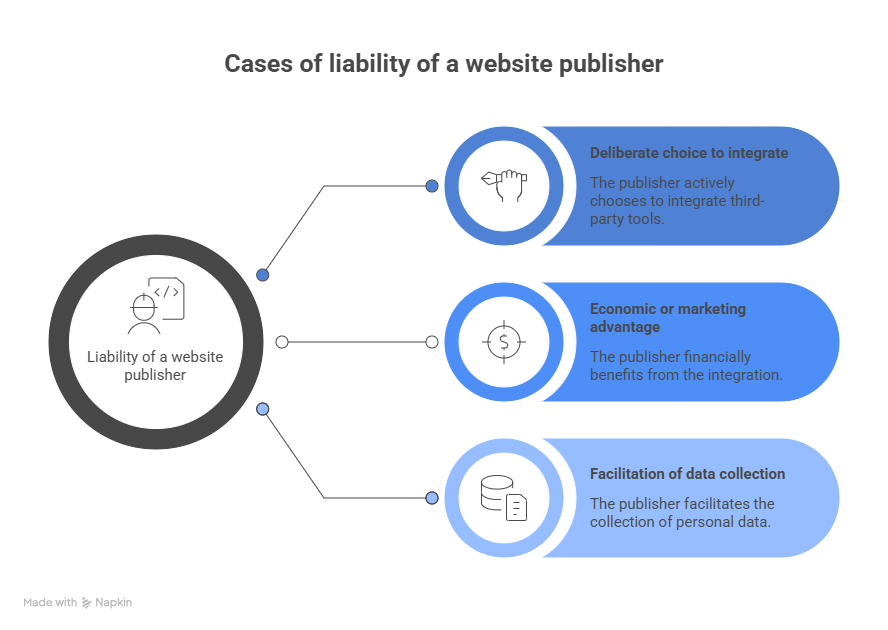
The Court confirms that joint controllership does not require equality of roles or identical access to data. It is based on a functional analysis, taking into account the effective involvement of each actor in the processing chain.

Accordingly, a website may be deemed a joint controller where it :

• deliberately chooses to integrate a third-party tool ;
• derives an economic or marketing benefit from that integration ;
• facilitates, even indirectly, the collection of personal data.

This analysis aligns with the positions adopted by European data protection authorities, in particular the recommendations issued by the CNIL regarding trackers and third-party tools.

The Court is careful to specify that joint responsibility is neither global nor unlimited. It is strictly confined to the operations over which the website publisher exercises real influence, namely the initial collection and transmission of data.

web publisher liability

The limits set by the Court : a strictly circumscribed responsibility

One of the key contributions of the Fashion ID decision lies in the clear delineation of responsibility. The website publisher is not held responsible for subsequent processing carried out by Facebook, insofar as it does not determine either the purposes or the modalities thereof.

This clarification is essential to preserving a balance between data protection and legal certainty for economic operators.

The decision does not establish a principle of automatic responsibility for any integration of a third-party module. Each situation must be assessed on a case-by-case basis, taking into account the reality of data flows, the intended purpose, and the degree of involvement of the website publisher.

Practical takeaways for companies and trademarks

Website publishers must clearly inform users of data collection through third-party modules, identifying joint controllers and the purposes pursued.

This transparency requirement is fully consistent with the General Data Protection Regulation of April 27, 2016 (GDPR) framework and the CNIL’s guidelines.

Where the data collected are not strictly necessary for the operation of the website, prior consent is required. Such consent must be effective, specific, and technically enforced, which often entails revisiting the default settings of social plugins.

Best practices and risk-management strategies

To limit legal exposure, companies may usefully implement the following measures :

• regular audits of integrated tools and plugins ;
• removal of non-essential modules ;
• use of deferred loading solutions (lazy loading) ;
• contractual framing of relationships with third-party providers ;
• documentation of technical and legal choices made.

Conclusion

The Fashion ID case clearly illustrates how the law now addresses digital architectures. Joint responsibility is no longer a theoretical construct, but a concrete operational risk for companies, particularly those whose reputation relies on their digital presence.

Dreyfus & Associés law firm assists assists its clients in managing complex intellectual property cases, ensuring GDPR compliance, and providing legal protection for their digital strategies.

Dreyfus & Associés works in partnership with a global network of specialised intellectual property lawyers.

Nathalie Dreyfus, with the support of the entire Dreyfus firm team.

Q&A

1. Can joint responsibility be established in the absence of a contractual relationship with Facebook ?
Yes. The existence or absence of a formal contract with Facebook is not decisive. The Court reasons outside any contractual logic, relying exclusively on the facts and the reality of data flows. A website may therefore be classified as a joint controller even if it has entered into no specific agreement with the provider of the social plugin.

2. What concrete risks arise in the event of an inspection by the CNIL or a European authority ?
The risks are multiple and cumulative: formal notice, injunctions to comply, administrative fines, as well as potential compensation claims by users. Beyond the financial aspect, reputational risk is often decisive, particularly for exposed trademarks or those operating in sensitive sectors.

3. Does removing the social plugin eliminate all legal risk ?
Not necessarily. Removal puts an end to future risk, but it does not erase past processing. Authorities may examine previous practices, especially where data were collected without proper information or valid consent. Hence the importance of documenting audits carried out and corrective measures implemented.

4. Can this case law extend to tools other than social networks ?
Yes, and this is a central point. The Fashion ID reasoning goes far beyond “Like” buttons alone. It is transposable to other technologies such as advertising pixels, audience-measurement tools, chat services, video players, or interactive maps, insofar as they entail the transmission of personal data to third parties.

5. How should joint controllership be distinguished from processing on behalf of a controller under the GDPR ?
The distinction is fundamental. A processor acts on behalf of the controller and in accordance with its instructions, which was not the case in Fashion ID. Where a third party pursues its own purposes, qualification as a processor is excluded.

6. Can a publisher rely on technical complexity to escape responsibility ?
No. The Court adopts a clear position : technical complexity does not constitute grounds for exemption. Companies are required to understand, at least in broad terms, the legal effects of the tools they integrate. This requirement reinforces the need for legal support upstream of technical decisions.

This publication is intended to provide general guidance and to highlight certain issues. It is not intended to apply to specific circumstances or to constitute legal advice.

Read More

Towards the protection of culinary creations by certificate?

To the delight of our taste buds, flavors and gourmet creations are part of our daily lives, but from a legal perspective, the situation is more delicate and the flavor more bitter. Indeed, there is a consensus on the need to protect culinary creations but intellectual property law currently offers only peripheral protection.
 

As we saw in a previous article, cooking recipes can be protected by author rights, the aesthetics or visual appearance of the creation is covered by designs, innovative techniques used in the creation may give rise to patent protection and the name can be registered as a trademark. None of these solutions protect the actual creations themselves. In addition, certain conditions must be met, which may not reflect practice. Under these circumstances, the most appropriate solution is usually author rights protection, which is intended to protect an original creation regardless of its form of expression (Article L. 112-1 of the French Intellectual Property Code). Nevertheless, the Court of justice of the European Union (ECJ, 13 November 2018, “Levola”, C 310/17) has refused to protect flavors in this way. The French Cour de Cassation has adopted a similar position on fragrances (Cass. Com., 10 December 2013, n°19872). In short, when it comes to culinary creations, the law remains speechless.


In order to fill this legal void, several deputies have submitted to the National Assembly a bill about the protection of recipes and culinary creations, on April 30, 2019.


The main purpose of the text is to clarify the situation of traditional recipes on one hand and culinary creations on the other hand.


Thus, the creation of a new institution, the “Fondation pour la gastronomie française”, is envisaged. This private non-profit legal entity would be in charge of listing and protecting traditional recipes in order to identify restaurateurs who respect them. The aim is to promote the knowledge, conservation and enhancement of French gastronomy as well as reassuring consumers.


Moreover, the bill provides for the creation of a public institution, the “Institut national de la création culinaire certifiée” (INCC), to ensure the protection of culinary creations. The INCC would issue a new industrial property title, the certificate of culinary creation, to provide protection for a period of 20 years. A hybrid between author rights and industrial property rights, this title includes economic rights as well as three moral rights (right of disclosure, right to the name, right to respect for culinary creation).


The conditions for granting such a certificate are:

  • the creation must be new with respect to the state of the culinary art;
  • the existence of a creative activity, not resulting in an obvious way from the state of the art for a skilled person;
  • an own gustatory character.


The bill excludes from protection a number of productions such as creations involving elements of the human body, narcotics or creations violating public order. The text also provides a specific regime for employees’ creations, close to the one existing in author rights, as well as an opposition procedure lasting two months from the publication of the application for the grant of a culinary creation certificate. Unsurprisingly, any infringement to this new property right would constitute an act of counterfeiting.


This bill, being a combination of trademark law and author rights, is not convincing. The Chefs themselves do not appear to be asking for such protection and the measure will probably mainly benefit the food industries. The bill has now been referred to the Committee on Cultural Affairs and Education. This is a case to follow.


Specializing in intellectual property, Dreyfus will know how to create the perfect recipe to enhance and protect your rights. Do not hesitate to contact us!

Read More

Generic trademarks: good practices to avoid ‘genericide’

Protecting intellectual property assets is a major concern of companies. Trademarks are a subject of immediate interest, because they allow consumers to associate products and/or services with a specific company. The company is therefore more easily recognized and is more likely to see customers buy its products.


Once a trademark has been duly registered, a company can start to exploit it.  That is when we must be most vigilant. Indeed, a trademark may lose its distinctiveness after its registration, by becoming a generic trademark.


What is a generic trademark?


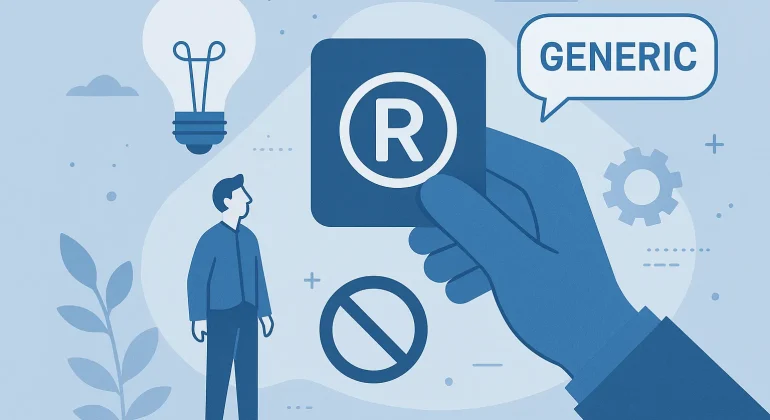
Put simply, a generic trademark is one that has become “The common name in trade for a product or service” One of the main criteria for the validity of a trademark is its distinctiveness (Article L. 711-2 of the French Intellectual Property Code). Under the article L. 714-6 of the French Intellectual Property Code, a generic trademark is devoid of distinctiveness because it has become “The common name in trade for a product or service”.


In other words, a generic trademark is a trademark that has become a common term for a type of product or service. It is used by both consumers and competitors of the trademark to refer to the product or service no matter by whom it has been provided. As a victim of its success, the trademark no longer enables consumers to identify products and services as coming from the company concerned. It falls therefore into the public domain.


As such, the company that created the trademark loses its exclusive right of exploitation. It will no longer be able to oppose the use of its trademark by third parties who seek to use it as the descriptive or ‘generic’ name of the product or service for which it has become famous. This is called genericide of a trademark.


Under the aforementioned article L. 714-6, an action for revocation or cancellation for genericide of a trademark that became generic requires two conditions:

– the trademark must have become the common name of the product or service;

– such use must be caused by the trademark owner, namely mostly his inaction.


Hence, the need for a company to act effectively against any use of its trademark as a generic term. If the owner acts effectively against any generic use, the trademark will continue to be protected by law.


Good practices to prevent a trademark from becoming generic


Acting before any commercialization, is the most effective way to prevent a trademark from becoming generic. It is also advisable not to misuse the trademark later on.


If you have created a totally new product or seek to become a brand leader in a new market, it is imperative to create – or use -a term to designate the new product, as there is a strong risk of confusion between the trademark and the product. For example, Apple’s trademark is iPhone, and the product to which it is applied is a “smartphone”.  Similarly, if a generic term exists but is particularly complex, it is useful to provide a simpler term, where your trademark is the market leader. It is also recommended to use the term defined in this way in agreements with third parties (e.g. letter of commitment, coexistence agreement, etc.).


In addition, the trademark must be used correctly in all circumstances, both externally and internally.


The use of the trademark must be particularly monitored during advertising campaigns. The trademark should be distinguished from the surrounding text promoting the marketed product or service by placing it in BLOCK LETTERS or, by Capitalising the first letter.

Using the trademark as a noun makes it more likely to be confused as the generic name. This practice should be discarded in favour of using it as an adjective. For example; “a Kleenex handkerchief” rather than “a Kleenex”.

Another good practice is to use the ® symbol or the ™ symbol. Although the latter have no legal value in France unlike in the United States, their use on the market is common. Promoting the trademark as an asset belonging to the company discouraging its use as a common term.


A trademark becomes generic mainly because of its misuse by the public. This misuse is not necessarily the result of an intend to harm. As such, it is recommended to carry out advertising campaigns aimed at consumers promoting correct use in order to avoid misuse. Preparing written standards defining the correct use of the trademark that can be easily distributed to third parties (licensees, consumers, etc.) also participates to this public education.

Avoiding misuse of the trademark also requires protection against abusive use of the trademark by third parties. It is therefore necessary to monitor product and service descriptions for new trademark applications and press publications mentioning the trademark.


Finally, because a trademark may be declared generic as a result of the owner’s actions or lack of action, it is in the company’s best interest to ensure that it can prove that it has taken steps to avoid the trademark becoming generic. In this respect, marketing files (advertising costs, unsolicited mentions in the press, etc.), letters of formal notice, summonses or even court decisions are all evidence to be kept.


In short, a potentially generic trademark remains protectable under trademark law if its owner has enforced actions against its misuse and gathered supporting evidences to prove that extent.


Dreyfus can assist you in the management of your trademarks portfolios in all countries of the world. Do not hesitate to contact us.

FAQ

What is a generic trademark?
A trademark that, through being used as a common name to designate a product or service, loses its distinctive function and falls into the public domain.

Can a trademark be protected against genericide?
Yes, by monitoring its use, educating the public and distributors, and ensuring it is always perceived as a trademark and not as a common name.

Can a generic trademark be recovered?
No, once a trademark has become generic and lost its legal protection, it is very difficult — if not impossible — to recover it as a registered trademark.

Read More

Disputes regarding domain names <.CN> and <.中国> : it is now possible to act before the WIPO Mediation and Arbitration Centre.

The China Internet Network Information Center (CNNIC), registry of the <.CN> and <.中国> ccTLDs, has designated WIPO to provide dispute resolution services under the China ccTLD Dispute Resolution Policy. Disputes in relation to these ccTLDs may be filed with WIPO from August 1, 2019.

The <.CN> Policy is ONLY applicable to <.CN> and <.中国> domain names that have been registered for less than three years.

This Policy applies to <.CN> and <.中国>domain names that are identical or confusingly similar, not only to a mark, but to any “name” in which the complainant has civil rights or interests (.CN Policy, article 8(a)), whereas the UDRP is limited to the protection of trademark rights.

It is sufficient for the complainant to prove that either registration or use of the disputed domain name is in bad faith, whereas the UDRP requires the complainant to prove both elements.

The appeal jurisdiction belongs to the Courts of China or the arbitration Chinese institution, and the proceedings language will be Chinese (unless otherwise agreed by the parties or determined by the Panel).

This adds to the over 75 other ccTLDs for which trademark owners can rely on WIPO’s dispute resolution services.

Read More

Spain: Proof of use of the trademark, a new mean of defense in opposition proceedings

On April 30, Spain finalized the reform of its trademark law, started in late 2018. From that date, the Royal Decree 306/2019 of 26 April 2019 amending the Regulations under Spanish Trademark Act 17/2001 entered into force.


The possibility to request proof of use in defense in opposition proceedings is one of the main innovations introduced into Spanish law by the 2018 reform. The European Union already provides for such a means of defense in article 47 of the European Union Trademark Regulation (EUTR). Thus, this reform of Spanish law is part of the welcome European harmonization.


The Royal Decree 306/2019, under discussion, establishes how this new defense will be implemented.


Thus, from now on, proof of use may be required for all opposition proceedings filed since May 1, 2019.


This mean of defense can be invoked against Spanish trademarks and trade names and against international trademarks designating Spain. However, not all prior right can be contested. To be challenged, the prior trademark or trade name must have been registered for at least five years. The holder of such prior rights will then have the burden of proof of the actual exploitation of the rights claimed.


If the evidence provided is insufficient, then the opposition request will be rejected. The relevant prior right or the existence of a likelihood of confusion will not be taken into consideration for the resolution of the dispute.


In this respect, the documents provided as evidence must refer to the goods and/or services for which the prior right is registered. If the opposition is based on part of the goods and/or services, then the right holder must provide the proof of a genuine use only for those goods and/or services. The supporting evidences must establish the real and serious exploitation of the prior right. This exploitation is established when products and/or services are offered for sale and put into the market.


The documents communicated must indicate the place, date, extent and nature of the sign’s use. For example, that may be catalogues, brochures, invoices, labels, advertisements, etc. Items provided by third parties constitute concrete and independent evidence. As such, their probative value is higher than the value given by the prior trademark owner’s evidence.

Read More

The dispute resolution policy which governs the domain has extended the term within which action may be taken from 2 to 3 years.

On March 2017, the new General Civil Chinese Law Rules extended the general limitation period for civil actions from 2 to 3 years.

Since then, many recommendations have been made about the need to change the China Internet Network Information Centre (CNNIC) dispute resolution policy which barred action against a <.cn> domain name which had been registered for more than two years to accord with the one established under the Civil regulation.

The CNNIC developed its first domain name dispute resolution rules in 2000, and following the provisions under the General Civil Law Rules of People’s Republic of China, in force at that time, set a term of 2 years following registration within which action had to be taken.

The CCNIC  was established June 3, 1997 who is the registry for domain names in China.

Indeed, the China Dispute Resolution Policy (CNDPR) is the only dispute resolution policy which sets a time limit within which to admit complaints about domain names.  This 2 year time-bar has been seen as an effective barrier to challenging any <.cn> registrations, because after the 2 years period, the only possibility was either to negotiate or attempt court action. Fortunately, in order to align the CNDPR time limit for action to the General Civil Law rule, it has been reviewed and extended to 3 years. This was implemented on 18 June 2019, and provides more flexibility to complainants to initiate alternative dispute resolution proceedings against domain names in the <.cn> name space.

Despite this good news there are still some unanswered questions; in particular whether the change to the new term has retroactive effect, or will apply only to those domain names registered after the change in the policy became effective.


To be continued…

Read More