The French Consumer Act, aka the Hamon Law (Act N˚ 2014-344 of March 17, 2014), will enter into force on June 13, 2014. It incorporates the provisions of the EU Directive on Consumer Rights of 2011 (Directive 2011/83/EU of October 25, 2011) which promotes e-commerce in the EU at national and cross-border level.
In order to comply with EU rules on consumer protection, e-merchants will need to provide more detailed information to consumers. This information obligation includes information on the obligation to pay, return costs, procedures to exercise the consumer’s withdrawal right and accepted modes of payment.
In the same vein, the Hamon law will bring in line with EU law the withdrawal and refund periods, which will be 14 days instead of 7 and the delivery period within the EU, which will be 30 days. The consumer will also have 30 days to make a request for cancellation of the sale based on non-delivery. Moreover, the Consumer Act prohibits contractual provisions which transfer the liability associated with the transport risk to the consumer.
Furthermore, the consumer’s consent will have to be obtained by opt-in; the consumer will compulsorily have to tick the boxes to notify his consent.
With regards to the protection of e-merchants, new exceptions to the withdrawal right will be established, mostly for hygiene purposes. E-merchants will also be able to hold consumers liable if the returned product has been overused. Finally, the e-merchants will not be held liable in case of loss or damage of products upon delivery, provided that the consumer chose his carrier. What are the required updates for e-merchants?
Amending general terms and conditions of sale in order to incorporate the changes in time limits and the new rules;
Training and educating employees and partners on the new procedures, particularly on returns and refunds;
Adjusting the order process to be in line with the new rules;
Sending order confirmations containing all the required information on a durable medium which the consumer can store;
Modifying the order button so it shows clearly the obligation to pay.
These measures form part of the EU’s fight for consumer protection. These measures are not limited to the regulation of e-commerce; they also provide for amendments in relation to litigation, with the introduction of class actions “à la française”.
Used as a marketing tool by economic operators, slogans are not only exploited in the real world but also in the digital world.
Protecting slogans over the Internet includes fighting against the use of third-party registered slogans in domain names. UDRP decisions show that assessing the likelihood of confusion in relation to slogans is similar to assessing such likelihood in relation to trademarks generally.
If a slogan has been registered as a trademark, the Panel will compare it with the domain name. On the other hand, if the slogan has not been registered as a trademark, then the existence of rights of a non-registered trademark (Common law rights) should be established. The applicant should establish an active use of the slogan, having created a link in the mind of the public between the slogan and its goods and services (D2005-0649 Ice House America, LLC v. Ice Igloo, Inc ; <icehouseamerica.com> and <icehouseamerica.net>). It should be established in concreto at the time of registration of the disputed domain name (D2002-1117 Arthur Guinness Son & Co. Limited, Guinness Anchor Berhad v. Josh.com.my a.k.a. Josh Lim ).
Sometimes domain names reproduce slogans in their entirety. Thus, the domain name <foreversport.com> was found to be similar to the slogan “FOREVER SPORT” by Adidas (D2000-1148 Adidas International B.V. v. Kadana Holdings Pty Ltd).
Domain names may also reproduce only part of the relevant trademark, which is also the slogan of the complainant. This has been the case for the domain name <morgandetoi.mobi> where the complainant was the holder of a complex trademark that included the slogan “Morgan de Toi” (D2012-2117, C.C.V. Beaumanoir v. Zhihao Zheng).
A likelihood of confusion may also be established where only part of the slogan is reproduced in the domain name, provided that the distinctive components of the slogan are used. Thus a shoe manufacturer holding the trademark “Think!” and using the slogan “Shoes by Think” successfully obtained the transfer of the domain name <think-shoes.net> (D2007-1007 Marko Schuhfabrik GmbH v. Mercom Group).
Domain names may also reproduce the slogan in a slightly different manner without excluding the risk of confusion. In the case concerning the domain name <thisisadamking.com>, the Panel found that the complainant had non-registered trademark rights on its slogan “Who is Adam King” and that the replacement of “Who” by “This” did not exclude the risk of confusion since, on the contrary, “This” could be viewed as an answer to the question asked by the slogan (D2002-1117 Arthur Guinness Son & Co. Limited , Guinness Anchor Berhad c/ Josh.com.my a.k.a. Josh Lim).
Domain names may also reproduce the slogan in combination with other terms. For instance, if a domain name reproduces the trademark of the complainant and adds it to its own slogan, the likelihood of confusion is even greater (D2010-2126, Akbank Turk A.S.c/. Axess Yeterbana <axessyeterbana.com> – trademark Axess + slogan “Yeter bana”).
However, where a domain name includes a slogan associated with a negative term, the likelihood of confusion does not necessary arise. The Panels’ opinions are divided with regards to domain names containing pejorative terms. Some refuse to recognize the existence of a likelihood of confusion in this case whilst others recognize it: it all depends on how one interprets the freedom of expression. Fighting against such domain names can therefore prove to be very difficult.
In this context, it is worth noting the decision regarding the domain names <mma-prejudice-moral-economique.com> and <mma-zero-tracas-publicite.com> rendered in favor of the insurer MMA in a way that was particularly favorable to rights holders (D2012-2136 MMA IARD c/ Eric François). The Panel noted a potentially confusing similarity on the grounds that, if had he found otherwise, this would “prevent right-owners from fighting many cases of cybersquatting”.
Finally, beyond the likelihood of confusion, the protection of slogans over the Internet also aims to prevent the exploitation of slogans by non-authorized third parties. It may include e.g. fighting against a misappropriation of the slogan on a third party’s website. The case D2004-0249 SEC SNC against Manakel Communication concerning the domain names <baton-de-berger.com> and <batondeberger.com> covered these two aspects. The domain names were identical to the complainant’s trademarks and were redirected to a pornographic website which displayed the slogan “There is no time for sucking it”, which is a misappropriation of the complainant’s slogan “There is no time for eating it.” The Panel based itself on the reproduction of the complainant’s trademarks to establish the likelihood of confusion and on the unjustified exploitation of the complainant’s slogan to establish the bad faith of the registrant.
Caution should therefore be exercised when acting against a domain name comprised of a slogan.
On February 5, 2014, the District Court of California ruled on a Legal Rights’ Objection (LRO) regarding the <.delmonte> gTLD (generic Top-Level Domain). The LRO was a protection awarded to trademark holders in ICANN’s New gTLD Program from June 2012 to March 2013. Trademark owners could file objections to new gTLD applications before the World Intellectual Property Organization (WIPO) to challenge the depositor’s rights to the gTLD.
Here, the court addressed a request to challenge a decision made by WIPO on the <.delmonte> in July 2013. The case involved two companies named Del Monte, a Delaware entity and its licensee, a Swiss company. The Swiss entity applied for the <.delmonte> gTLD as a license holder of the “DEL MONTE” trademark. However, the application was successfully contested by the Delaware entity by a LRO. In response, the Swiss company sued in US Federal Court to obtain the rights to the gTLD at issue and the Delaware company to give up its LRO.
The Swiss entity based its complaint on both the Anti-cybersquatting Consumer Protection Act (ACPA) and “reverse domain name hijacking”. Both of these claims involve domain names. The main question here is whether the claims can also apply to new gTLD applications.
Such a requirement begs the question of the new generic top-level domain’s registration. The court therefore questioned whether ICANN could be considered as a domain name registration authority. Texts and Case law diverge on the matter. In this case, ICANN was considered “much like a traditional domain name registrar” but the court’s analysis remained inconclusive for the new gTLDs.
It then turned to the registration and use of the new generic top-level domain. The court said that the <.delmonte> gTLD was never properly registered. Therefore, the ACPA’s requirement of “registration, trafficking or use” to constitute cybersquatting could not be asserted. As a result, the Delaware entity maintained the right it acquired with the LRO to the <.delmonte> gTLD.
This decision also highlights the fact that the ACPA was not written to take into account the new gTLDs. A reform of the Act should be considered to adapt it to ICANN’s new top-level domains.
The Office of Community Trademarks – OHIM and some national Offices published, in January of this year, a common communication on black and white trademarks.
What does it say? What are the implications in practice?
A trademark in black and white will be treated as identical to a sign in colour if the difference between the two is so insignificant as to be unnoticed by the average consumer. Thus, if only a reasonably observant consumer will see a significant difference when comparing the two trademarks, then the difference will be treated as insignificant.
The distinctive character of a trademark registered in black and white will not be changed by a change in colour provided that:
o The figurative elements are the same and remain as the main distinctive elements;
o The contrast of shades is respected;
o The colour or combination of colours does not have distinctive character in itself;
o The colour is not one of the main contributors to the overall distinctiveness of the trademark.
If an opposition is filed, signs will only be deemed identical if the difference of colour is insignificant, i.e. hardly noticeable to the average consumer. Even if the signs are not identical, they may be considered as similar and a likelihood of confusion may be found to exist.
For a priority claim, a trademark registered in black and white will not be treated as identical to the same trademark in colour, unless the difference in colour is insignificant.
In addition, there is regrettably some divergence with regards to the implementation date of this new common practice between OHIM (June 2, 2014) and the various participating national offices (e.g. July 15, 2014 for the UKIPO). Further, the different offices have not decided if this new practice applies to pending applications or only to those filed after the implementation date; but also whether it applies to pending proceedings or only to those initiated after the implementation date.
Finally, it remains advisable, based on the specifics of each case and with regards to the new common practice, that trademark owners register their trademarks in both black and white and colour, particularly when colour is a distinctive element of the trademark.
On February 13, 2004, the European Court of Justice intervened on the notion of disclosure of designs (C-479/12). In order to acquire protection for a design, that design must be a new one and must have an individual character compared with all the designs which have gone before. These designs have to have been made available to the public, that is, they must have been published following registration or otherwise, or exhibited, used in trade or otherwise disclosed “except where these events could not reasonably have become known in the normal course of business to the circles specialised in the sector concerned, operating within the Community” (article 7 regulation n°6/2002). The European Court of Justice has set out the contours of this exception.
Firstly, the concept of «specialised circles» has to be understood broadly. It does not only concern the persons who are involved in the creation of designs. Indeed, the Court also takes into consideration the disclosure to traders. However, this point remains unclear as it is considered to be a question of fact that must be solved by the national courts.
In addition, the Court considers that the events constituting disclosure must not necessarily have taken place within the European Union. Similarly, disclosure in a single undertaking in the sector concerned in the European Union is sufficient. However, the Court adds once again that it is a question of fact left to the national court.
Finally, the Court states that it is the person who is seeking to assert his or her rights who bears the burden of proof in demonstrating copying. It seems difficult for the rightholder to come up with this proof and therefore the national courts must counter that difficulty by lightening the onus of proof. Claims for compensation, destruction of infringing products and injunctions against the infringer must also be governed by national law.
If the decision of the European Court of Justice clarifies the notion of disclosure relating to designs, many elements must be determined by the national law. Therefore, we may fear an absence of harmonization in the national regulations and the practical difficulties.
On April 10, 2014, the Examiners of National Arbitration Forum rendered their first decision on a domain name carrying the gTLD .uno. They also took the opportunity to strictly remind the manner in which a trademark right should be established.
In the present case, the domain name <aeropostale.uno> had been reserved. However, the Aeropostale trademark was registered with the Trademark Clearinghouse (TMCH), a declaration-based database that allows trademark owners and registrants of a domain name carrying a new gTLD to be notified in cases of cybersquatting of the trademark.
This was the case here but the registrant clearly ignored the TMCH notification. On March 26, the company Aeropostale therefore filed an URS (Uniform Rapid Suspension) complaint with the NAF requesting the suspension of the disputed domain name.
The decision of the Examiner was swift. In one paragraph, he reminded that the first condition to obtain an order of suspension is to establish that the domain name is identical or confusingly similar to a trademark on which the complainant has a right. In the present case, however, whilst there are several Aeropostale trademarks, none of them bears the name of the company that filed the URS complaint.
Additionally, the complainant failed to show any relationship with the companies owning the Aeropostale trademarks. The Examiner could not logically consider that the first condition for URS complaints was met. He therefore did not bother to see whether the other conditions were met.
Thus, the Examiner ordered that the domain name remain to the respondent.
At first glance, this decision might seem surprising since it is clear that the Aeropostale trademark was identically reproduced in the domain name. Yet it is fully in line with previous decisions and the principles that govern the URS and URDP proceedings. To exercise these rights, it is not sufficient to establish the existence of trademarks; but one should be the owner thereof.
Dreyfus law firm specializes in domain name cybersquatting cases and can assist you in better managing your conflicts on the Internet. Please do not hesitate to contact us for any further queries.
Only a few days apart, two sections of the Paris Court of First Instance respectively cancelled the French trademark “Vente-Privee.com” and acknowledged its notoriety.
Vente-privee.com is a company specialized in private and exclusive sales through its website www.vente-privee.com. This site is one of the leaders of online private sales in France (“vente privée” literally “private sale”). The company owns the eponymous trademark “Vente-privee.com”, which was recently subject to contradictory rulings by the Court of First Instance of Paris (Court of First Instance of Paris, 3rd chamber, 1st section, November 28, 2013 ; Court of First Instance of Paris, 3rd chamber, 3rd section, December, 6, 2013).
The trademark was disputed by Showroomprive.com, another private sales company. They requested the cancellation of the trademark on the grounds of lack of distinctive character. On November 28, 2013, the Court ruled that the terms used were generic as of the trademark registration in 2009, and only descriptive of the activity of private sales. Therefore the Court held that the trademark did not acquire distinctivity through use. The court pronounced the cancellation of the trademark in respect of the services covered in class 35.
Only a week after that ruling, another section of the same chamber of the Court acknowledged the notoriety of the trademark “Vente-Privee.com” in another case. The company had filed an action against the holder of three domain names highly similar to its trademark and pointing to parking pages listing competitors. On December 6 2013, the Court held that the defendant had registered these names with the sole purpose of trading on the goodwill and reputation of the trademark. The Court concluded to trademark infringement and unfair competition, and acknowledged the notoriety of the distinctive sign “Vente-privee.com” as trademark, company name, trade name, trade sign and domain name.
Vente-privee.com appealed the first decision. It can be hoped that a harmonization will be made by the Court of Appeal.
These decisions enlighten the risks and weaknesses of the trademarks composed of generic terms.
It should be noted that French Courts seem to have adopted a restrictive position in respect to this kind of trademarks.
In another recent case, the Paris Court of First Instance (Court of First Instance of Paris, 3rd chamber, 1st section, November, 28, 2013) cancelled the “Argus” trademarks of the claimant for lack of distinctivity. It seems the Court is ruling harshly to remind the applicants to be very careful as to the descriptive character of their trademark. Legal certainty outweighs freedom of enterprise.
The UDRP dispute resolution process before WIPO’s Arbitration and Mediation Center allows action to be taken when a domain name infringes a trade mark, whether or not registered. This concept of unregistered trade mark is absent from French law but is characteristic of Anglo-Saxon laws. Thus, the user of a sign can be protected against infringements of this sign when it intends to use it as a trade mark.
The owners of a nightclub recently filed a UDRP complaint against the registrant of several domain names which included the words “bomba” and “ibiza”. The complainants claimed a trade mark right on the signs BOMBA IBIZA and LA BOMBA IBIZA whilst the respondents provided evidence of the use of these signs through a tweet dated January 2013.
Yet at that time, the nightclub did not bear the name of LA BOMBA IBIZA. The WIPO expert therefore considered that a tweet alone could not be sufficient to establish the existence of a trade mark right. Indeed, according to him it is unlikely that the name became a distinctive identifier in the time between the tweet and the registration of the domain name a month later. The sign could not be used to support the UDRP complaint, which was therefore dismissed.
With the arrival of new domain name extensions on the market, unregistered trade mark users will have to equip themselves to avoid cybersquatting.
Dreyfus & associés specializes in UDRP proceedings. Please contact us for details.
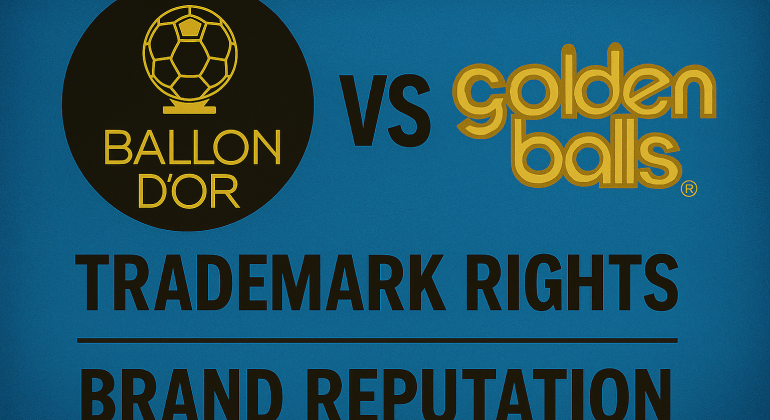
The dispute between Éditions P. Amaury, holders of the iconic “BALLON D’OR” trademark, and the British company Golden Balls Ltd, applicant for the “GOLDEN BALLS” trademark, sharply illustrates the complexity of assessing the likelihood of confusion within the European Union. By confronting two signs that differ linguistically yet are conceptually close, the various rulings highlight the limits of protection afforded to a well-known trademark when its intrinsic distinctiveness remains weak.
The origin of the dispute: confusion or linguistic coincidence?
The dispute began when Golden Balls Ltd sought to register the trademark “GOLDEN BALLS” as an EU trademark for goods and services partially identical or similar to those covered by the earlier trademark “BALLON D’OR”.
Les Éditions P. Amaury opposed the registration on two main grounds:
The General Court’s 2013 rulings: dissimilarity prevails
In its initial judgments in 2013 (T-437/11 and T-448/11), ), the EU General Court ruled in favour of Golden Balls Ltd, an outcome that initially surprised many intellectual property specialists. The judges found that the signs were visually and phonetically dissimilar. The signs differed notably in their language. Even if a conceptual similarity could be identified, it was deemed insufficient to create a likelihood of confusion in the mind of the average EU consumer. Consequently, the application for “GOLDEN BALLS” was provisionally accepted.
The ECJ’s historic correction in 2014: fame must be assessed
The French publisher appealed. In 2014, the Court of Justice of the European Union (ECJ) handed down a landmark decision, overturning the 2013 judgments of the General Court. The ECJ held that the General Court had failed to adequately examine the ground based on damage to fame, thereby committing an error of law.
The ECJ further clarified that even a low degree of similarity between two signs may be sufficient to establish a link in the mind of the relevant public, provided that the earlier trademark enjoys a high degree of distinctiveness and fame.
Following this decision, the case underwent a long and complex procedural journey, marked by several intermediate decisions issued by the EUIPO Opposition Division and Boards of Appeal, including a decision in 2016 (R 1962/2015‑1), before being referred back to the General Court.
In 2018, the General Court handed down its judgment in a confirming the fame of the “BALLON D’OR” trademark while adopting a nuanced stance on whether a sufficiently close link existed between the signs to justify a finding of unfair advantage.
Specifically, the Court clarified that Article 8(5) of Regulation (EU) 2017/1001 protects a well-known trademark only if the public establishes a link between the signs and if the use of the contested sign takes unfair advantage of or is detrimental to the fame of the earlier trademark. The “GOLDEN BALLS” trademark thus remained valid for classes of goods and services considered too far removed from the sporting field to give rise to unfair advantage.
The unexpected turning point: partial revocation of the “BALLON D’OR” trademark for lack of genuine use
A few years later, Golden Balls Ltd initiated revocation proceedings against the BALLON D’OR mark for non-use, under Article 58(1)(a) EUTMR.
In its judgment of July 2022 ((T-478/21), the General Court issued a nuanced decision redefining the scope of protection of the “BALLON D’OR” trademark.
While the Court accepted that the “organisation of sporting competitions and award ceremonies” constituted sufficient proof of use for the broader category of “entertainment services”, it upheld partial revocation for numerous other goods and services (such as printed matter, films, and telecommunications).
The evidence provided failed to demonstrate use of the trademark for each specific subcategory claimed during the preceding five-year period.
To learn more about assessing genuine use of a trademark for all classes of goods and services for which it is registered, please see our previously published article.
Proving genuine use of a trademark: evidence and best practices
To establish genuine use of a trademark, various forms of evidence may be submitted, such as:
Invoices, purchase orders, or delivery note;
Catalogues, brochures, and packaging displaying the trademark;
Print and digital advertisements;
Dated and archived website screenshots;
Market studies and opinion surveys demonstrating the fame
Contracts or licence agreements with third parties using the trademark.
Each item must be dated and correspond precisely to the goods and services covered by the registration. Use limited to only part of the designated goods or services may result in partial revocation.
Moreover, use must be uninterrupted or duly justified if interrupted. Sporadic or symbolic use is insufficient; the evidence must show an actual commercial presence, not merely internal use.
Conclusion
The Ballon d’Or vs Golden Ball dispute serves as a crucial reminder for trademark owners: fame is a powerful asset in trademark litigation, but it does not exempt the owner from the fundamental duty to prove genuine use for all registered goods and services.
A lack of proof, even for seemingly secondary classes, may result in partial revocation, thereby reducing the overall scope of trademark protection.
It is therefore recommended to engage an IP law firm or trademark attorney both upstream, to craft a precise and relevant specification of goods and services aligned with actual or intended use, and downstream, to evaluate risk, identify relevant evidence, and implement a robust use strategy that preserves the integrity of trademark rights.
Dreyfus & Associés assists its clients in managing complex intellectual property cases, offering personalized advice and comprehensive operational support for the complete protection of intellectual property.
1.What is revocation for non-use of a trademark?
Under Article 58(1)(a) EUTMR, a registered trademark may be revoked if its proprietor fails to prove genuine use of the trademark for the goods and services claimed during an uninterrupted period of five years. Revocation may be partial if use is shown only for certain goods or services.
2.What is the key takeaway from the Ballon d’Or / Golden Balls decision for owners of well-known trademarks?
The main lesson is to meticulously document genuine use for each product and service designated in the registration, particularly during the first five years following registration, to avoid subsequent revocation.
Can use in a single EU Member State preserve an EU trademark?
Ye, if that use produces commercial effects within the internal market, taking into account the economic context
4.What happens after revocation for non-use? Once revoked, the trademark is deemed never to have produced effects from the date set by the decision. It retroactively loses protection for the relevant goods and services. The proprietor can no longer rely on exclusive rights, oppose similar trademarks, or prevent third-party use. The trademark may then be re-registered by another party, provided this does not create a likelihood of confusion with still-valid prior rights.
5.What practical steps help prevent revocation and preserve a trademark’s evidentiary strength?
It is essential to:
actively monitor the trademark’s use and archive evidence (invoices, ads, publications, screenshots, etc.);
periodically renew communication campaigns linked to the trademark;
audit the portfolio to detect inactive registrations;
restrict filings to goods and services genuinely used, thus avoiding vulnerabilities in non-use challenges.
This publication is intended to provide general guidance to the public and to highlight certain issues. It is not designed to apply to specific situations, nor does it constitute legal advice.
The new gTLD program is now fairly advanced and the launches follow one another in rapid succession. To date, ICANN has signed over 400 registry agreements with applicants: 248 gTLDs have already been delegated in the Internet’s authoritative database (known as the Root Zone) of domain names.
Three Sunrise periods will terminate on April 28 (social, review and futbol) and four between April 29 and May 3 (wien, qpon, works, expert).
Amongst the gTLDs currently being launched, several of them may be useful to promote marketing strategies, particularly geographical gTLDS (london, nyc, cologne, wien). Other gTLDs such as .expert, .partner or .services are interesting in many ways. Registration rules are entirely open for these gTLDS. In order to avoid cases of harmful cybersquatting, we recommend the preventive registration of your trademarks by taking advantage of the Sunrise period.
We remind you that in order to participate in Sunrise periods, trademarks must be registered with the Trademark Clearinghouse (TMCH) and you must have the corresponding SMD files.
First conclusive results of Trademark Clearinghouse
Trademark Clearinghouse does not offer absolute protection but is highly effective nonetheless. By the end of March, TMCH said it had sent around 500,000 notifications to registrants notifying them of a potential case of cybersquatting. Only 25,000 of them, i.e. 5%, ignored these warnings.
As a reminder, the TMCH has two main functions:
To notify the trademark owner and the registrant of potential cases of cybersquatting;
To give a priority right for the registration of trademarks in the new gTLDs during the Sunrise period.
Donuts gTLDs
The Donuts program ended its first Sunrise period at the end of last month with .solar, .coffee, .international, .house and .florist. You will find below a list of current and forthcoming Sunrise periods:
Sunrise from February 25, 2014 to April 26, 2014: proposed gTLDs are: .COOL and .WATCH
Sunrise from March 4, 2014 to May 3, 2014: proposed gTLDs are: .WORKS and .EXPERT
Sunrise from March 11, 2014 until May 10, 2014: proposed gTLDs are: .FOUNDATION and .EXPOSED
Sunrise from March 18, 2014 to May 17, 2014: proposed gTLDs are: .VILLAS, .FLIGHT, .RENTALS, .CRUISES and .VACATIONS
Sunrise from March 25, 2014 to May 24, 2014: proposed gTLDs are: .CONDOS, .PROPERTIES, .MAISONS and .TIENDA
Sunrise from April 1, 2014 to May 31, 2014: proposed gTLDs are: .DATING, .EVENTS, .PARTNERS and .PRODUCTIONS
Sunrise from April 8, 2014 to June 7, 2014: proposed gTLDs are: .COMMUNITY, .CATERING, .CARDS and .CLEANING
Sunrise from April 15, 2014 to June 14, 2014: proposed gTLDs are: .TOOLS, .INDUSTRIES, .PARTS, .SUPPLIES and .SUPPLY
Sunrise from April 22, 2014 to June 21, 2014: proposed gTLDs are: .REPORT, .VISION and .FISH
Sunrise from April 29, 2014 to June 8, 2014: proposed gTLD is: .SERVICES.
Donuts also maintains its Early Access Program. This program started on April 23 for the gTLDs .CHEAP, .ZONE, .AGENCY, .BARGAINS and .BOUTIQUE and will start on April 30 with respect to .COOL and .WATCH. The Early Access Program is a period that offers fixed price names each day on a “first come-first served” basis; prices vary from $ 10,500 on the first day to $ 125 on 5th, 6th and 7th days.
Sunrise period for new geographical gTLDS
The Dot London Domains registry offers a Sunrise period for .LONDON from April 29 to July 31. A physical presence in London will initially be mandatory for the registration of domain names. The gTLD will later be opened unconditionally.
The NetCologne registry of gTLDS .COLOGNE and .KOELN will open the corresponding Sunrise periods on June 12, 2014.
Sunrise period for.ARCHI
StartingDot, which will offer inter alia gTLDs .SKI, .ARCHI and .BIO, opened a Sunrise period for .ARCHI which will end on June 8, 2014.
.ARCHI targets architects and their firms. .ARCHI aims to put under one roof a wide community of architects and architectural firms throughout the world.
Sunrises for new non-Latin’s gTLDs
Sunrise from April 2, 2014 to June 2, 2014: the proposed gTLD is: 世界 (which means “world” in Chinese)
Sunrise from April 7, 2014 to June 6, 2014: the proposed gTLD is: ДЕТИ (which means “children” in Russian)
Sunrise from April 22, 2014 to May 22, 2014: the proposed gTLDs are: .संगठन (which means “organisation” in Hindi), .机构 (which means “office” in Chinese) and ОРГ (which means “org” in Mongol)
The Chinese gTLD 商城 (“commercial complex”) will be opened in Sunrise mode as from May 6.
Dot trademark TLDs
The Specification 13 to registry agreement was adopted in Singapore at the last meeting of ICANN in late March. It exempts registrars of new gTLDS corresponding to trademarks (such as .chanel and .hermes) from opening a Sunrise period.
The registration of domain names in new gTLDs (new gTLDs)
As of 24 April, the five gTLDs with the largest number of registrations were as follows:
.GURU 52,084 registrations
.BERLIN 46,613 registrations
.PHOTOGRAPHY 33,112 registrations
.EMAIL 24,598 registrations
.LINK 22,384 registrations
In total, around 580,000 domain names carrying new gTLDS have already been reserved.
The second-hand market of new gTLDs
Sedo, an online marketplace for the sale of domain names, reported 513 transactions for an amount of around one million dollars.
The highest sales of Sedo this week were as follows:
fun8.com, sold for $25,000
gewerbeflächen.de sold for €16,000
Among the new gTLDs, the domain name <chinese.club> was sold for $13,750
Ten percent of the latest sales are .club domain names :
chinese.club $13,750
toys.club $12,500
meet.club $1,.500
talk.club $10,000
russia.club $10,000
black.club $10,000
UDRP proceedings
Since the launch of new gTLDs, cybersquatting has become more frequent. UDRP decisions have been made in relation to domain names using .CLOTHING, .HOLDINGS, .DIAMONDS, or even .CEO and .GURU.
It is therefore important to monitor closely new gTLDs. In order to avoid any cybersquatting, we recommend the registration of your trademarks with TMCH as well as the global monitoring of trademarks amongst domain names.
ICANN 49 Singapore
Several major announcements were made in Singapore:
Name Collisions
The Name Collisions are, in summary, terms that registries of new gTLDs will not be able to offer for sale as they may imperil the security and stability of the Internet. The terms which ICANN does not want to see registered may be highly valuable. Yet, ICANN remains cautious and wants to see first how the Internet’s authoritative database of domain names will “digest” all these names.
Replacement of WHOIS
The structure of WHOIS, an identity sheet of domain names, is under review. ICANN wants to make it more relevant and accurate. A task force will deliver the conclusions of its study at the next meeting of ICANN in June this year. The WHOIS will likely be replaced by RDS (Registration Directory Services). RDS would replace WHOIS which is too uniform and less adapted to current practices (frauds, data mining etc.) and would allow a genuine verification of the identify of registrants while relying on a flexible system, adapted to the legislations of various countries, particularly with regards to data retention (see below).
Governance
The NTIA, a U.S government agency which manages part of the Internet has announced its intention to transfer its powers to a new multi-stakeholders global governance scheme, which will be more open and transparent. The transition should be completed by August 2015. ICANN has announced in Singapore that it will focus on the process and the scope of the transition and on how to address the needs of the future stakeholders.
Data Retention
The agreement between the ICANN and registrars– the RAA – signed in 2013, stipulates that the latter must retain for two years all data concerning domain names holders. This is in breach of European law, which imposes a maximum duration of 1 year. ICANN has therefore set out exceptions for Europeanregistrars.
2nd phase of applications for new gTLDs
ICANN had undertaken to open a new phase of applications for new gTLDs. The issue was discussed at the meeting in Singapore but no deadline has been set yet.
The next meeting of ICANN will take place in London in July 2014.
Our site uses cookies to offer you the best service and to produce statistics, and measure the website's audience. You can change your preferences at any time by clicking on the "Customise my choices" section.
When browsing the Website, Internet users leave digital traces. This information is collected by a connection indicator called "cookie".
Dreyfus uses cookies for statistical analysis purposes to offer you the best experience on its Website.
In compliance with the applicable regulations and with your prior consent, Dreyfus may collect information relating to your terminal or the networks from which you access the Website.
The cookies associated with our Website are intended to store only information relating to your navigation on the Website. This information can be directly read or modified during your subsequent visits and searches on the Website.
Necessary cookies are absolutely essential for the website to function properly. These cookies ensure basic functionalities and security features of the website, anonymously.
Dreyfus is concerned about protecting your privacy and the Personal Data ("Data"; "Personal Data") it collects and processes for you.
Hence, Dreyfus complies every day with the European Union legislation regarding Data protection and particularly the European General Data Protection Regulation Number 2016/679 of 27 April 2016 (GDPR).
This Privacy Policy is aimed at informing you clearly and comprehensively about how Dreyfus, as Data Controller, collects and uses your Personal Data. In addition, the purpose of this Policy is to inform you about the means at your disposal to control this use and exercise your rights related to the said processing, collection and use of your Personal Data.
This Privacy Policy describes how Dreyfus collects and processes your Personal Data. The collection happens when you visit our Website, when you exchange with Dreyfus by e-mail or post, when exercising our Intellectual Property Attorney and representative roles, when we interact with our clients and fellow practitioners, or on any other occasion when you provide your Personal Data to Dreyfus, in particular when you register for our professional events.

 Written by Nathalie Dreyfus22/05/2014
  The French Consumer Act, aka the Hamon Law (Act N˚ 2014-344 of March 17, 2014), will enter into force on June 13, 2014. It incorporates the provisions of the EU Directive on Consumer Rights of 2011 (Directive 2011/83/EU of October 25, 2011) which promotes e-commerce in the EU at national and cross-border level.