The 65th international meeting of the ICANN took place in Marrakech, from the 24th to the 27th of June 2019. Several topics have been discussed such as the new gTLDs issues, the compliance between ICANN procedures and the GDPR provisions and the review of the rights protection mechanisms.
Future new gTLDs issues
Recently, ICANN faced an increase in the number of applications for top-level domains (gTLDs). In 2012, almost 2000 applications for new gTLDs were submitted to ICANN. At the end of this first round, more than 1000 gTLDs were created, for instance the <.brands>. ICANN awaits similar applications for the next round, which should take place in 2022.
Thus, new strategies have to be implemented to handle with those requests. At first ICANN foresees establishing priorities, based on the new gTLDs applications, to make the process more efficient. This process could be opened every year for a period of 4 months. However, ICANN could seek to limit the number of applications to 1000 per year.
Furthermore, TLDs with 2 characters will be permitted under the new process if these are composed by one letter and one number. Nevertheless, singular and plural versions of the same extensions are likely to be banned as coexisting gTLDs in the future.
The ICANN Board had authorized the use of this gTLDs whereas several GAC members had expressed their concerns about the risk of the Amazon case becoming a precedent and expressed concern that a mutually acceptable solution had not been achieved. The GAC has requested ICANN Board to formulate its grounds for its approval. In addition, several South American governments object to its use.
GDPR and EPDP
The Expedited Policy Development Process Working Group (EPDP) implemented a compliance policy in regard to the GDPR, on March 2019. In our article about ICANN 63, we explained that when the GDPR came into force, it would produce several effects on the Whois protocol. For instance, personal data will no longer be accessible to the public. The EPDP has now to develop a unified access system centralizing protected data, based on the legitimate interests of IP owners.
Furthermore, some details about the Registration Data Access Protocol (RDAP) were given in the ICANN 65. This protocol has been created to eventually replace the Whois protocol. In fact, it performs the same functions as Whois, but its aim is to standardize data access. It shall be implemented by Registries and Registrars by the 26th of August 2019.
Review of protection mechanisms provided by ICANN
TheRights Protection Mechanism (RPM) Working group is reviewing several ICANN procedures concerning gTLDs. It has developed preliminary recommendations about Sunrise and Claims periods. In the same way, some proposals have been developed to allow trademark owners to acquire a priority right to register their trademark as a domain name. In the absence of such a registration, third parties could register terms corresponding to the trademark.
Up to now, the first phase of the working group scheme consists in reviewing Uniform Rapid Suspension(URS) and the Trademark Clearinghouse(TMCH) mechanisms. Similarly, the UDRP procedure remains on the horizon, and the Group is expected to begin work on that in mid-2020. This will be the second phase of its work.
Meantime, as their work is not yet completed, we will have more information once their report is completed, which is expected to be in April 2020.
On the other hand, another working groupwas also formed to study Subsequent Procedures (SubPro) for new gTLDs. This working group confirmed its support of a User Guide, under the assumption that it becomes more precise, to make it easier to understand what gTLDs are.
Similarly, the SubPro working group expects to better communicate with trademark owners in order to limit the risk of counterfeiting, and to show how those new gTLDs could have a good effect on their activity.
Thus, ICANN 65 provided an opportunity to evaluate the work done thus far by the working groups. However, if clarifications have been made, few concrete changes have been put in place. The projects should take shape at the next meetings organized by ICANN.
The next ICANN meeting will take place in November 2019, in Montreal. We will continue to follow this matter closely.
According to the judgment « Adidas AG / EUIPO », T-307/17, of the 19th of June 2019, the General Court (ninth chamber) of the European Union dismissed an appeal by Adidas against the decision of the EUIPO to declare the famous « three-stripes » figurative trademark invalid on the grounds it lacked distinctive character.
This began when Adidas opposed the registration of the 2 stripes trademark of its competitor, Shoe Branding, who counterclaimed to have the Adidas “three-stripes” registration declared invalid on the grounds it lacked distinctive character. By a decision of 30th June 2016, the cancellation division of the EUIPO declared the Adidas registration invalid, and by decision dated 7th March 2017, the second Board of Appeal of the EUIPO upheld the original decision to cancel the Adidas trademark.
Therefore, Adidas appealed that decision to the General Court arguing that the challenged trademark had acquired distinctiveness through use. However, the Court ruled that there was a lack of inherit distinctiveness and also refused to recognise the acquisition of distinctiveness through use. In doing so, the Court said that Adidas did not provide sufficient evidence of distinctive character. According to the Court, Adidas had proved only that the necessary distinctiveness had been proved in only 5 of the EU member states.
It is important to remember that the distinctiveness is not established by providing evidence of sales and marketing figures for the products and services, but is judged by reference to the relevant public’s perception of the trademark. The Court said that distinctive character must be assessed, first, by reference to the goods or services in respect of which registration has been applied for and, second, by reference to the perception which the relevant public has of those goods or services. This meant that the Court considered the relevant public consists of all potential consumers of those goods in the European Union, and on the evidence filed said they would not make an obvious link between the « three-stripes » and the owner (Adidas). Although the « three-stripes » became the symbol of Adidas a long time ago the evidence filed by Adidas did not demonstrate an obvious link between the sign as registered and the products for which it is registered. There was no direct evidence the “three-stripes” as registered were actually used on the products covered in the registration. Therefore, the trademark’s distinctive character, and so its validity, could not be upheld.
The Court already accepted that a repetition of signs for a figurative trademark could be a valid trademark (TUE, 9th of november 2016, Birkenstock Sales/EUIPO, T-579-14 Representation of a pattern of wavy, crisscrossing lines). Nevertheless, in this case, the Court thought the trademark is composed of obvious non-distinctive elements.
Arguably, according to the Council Regulation n°207/2009, the European Court is going against the past judgments, but the decision is a necessary reminder of the need to prove distinctiveness acquired through use, in each country of the Union.
In the circumstances of this case, an appeal to the Court of Justice of the European Union is to be expected because of the effect of this decision on Adidas, which has registered several figurative trademarks of this kind. It may also have an effect on many other trademark owners. This judgement relates only to the specific trademark registration challenged and does not directly affect the other trademarks of Adidas, nor of any other owners.
Nathalie Dreyfus has been admitted as panelist and arbitrator in the CIRA Panel (Canadian Internet Registration Authority).
The CIRA Panel is a new Alternative Dispute Resolution Centre which belongs to theBritish Columbia International Commercial Arbitration Centre(BCICAC).
The main aim of CIRA is to settle disputes concerning domain names through a quick and relatively low cost mechanism, led by out-of-court arbitrators who meet certain requirements according to CIRA’s Canadian Presence.
The process is initiated by a complaint received in the CIRA Complaint Center which locks the disputed domain. A copy of the complaint is redirected to the Registrant who has twenty days to deliver a response. If so, a Panel of experts is appointed, whereas if there is no response the complainant may elect a single panelist. In both cases, a decision is given within twenty one days.
This decision is directly implemented by the CIRA.Since BCICAC was founded more than hundred cases have been solved by this institution.
Dreyfus can assist you in the management of your trademarks portfolios in all countries of the world. Do not hesitate to contact us.
In the decision of June 18, 2019, the General Court of Justice of the European Union applied Article 7, paragraph 1, m) of Regulation No. 2017/1001, which prohibits the registration of trademarks that consist of “an earlier plant variety denomination registered in accordance with Union legislation” or “or reproduce in their essential elements, an earlier plant variety denomination”.
In this case, the German company Kordes filed an application for the European trademark “KORDES’ ROSE MONIQUE” in Class 31 for the following description of goods: “Roses and rose bushes as well as products facilitating the multiplication of roses”. However, the European Union Intellectual Property Office (EUIPO) refused the registration of the trademark in question because it is composed of the term “MONIQUE”, corresponding the variety denomination “MONIQUE” registered in the Dutch register of plant variety protection.
To do so, the EUIPO must rely on the fact that the plant variety denomination “MONIQUE” is reproduced in the same way in the trademark applied for, and also the fact that this term is an essential element of the trademark.
Kordes appealed to the General Court of the European Union to reverse the EUIPO’s decision. In this respect, the company argued that the term “MONIQUE” cannot be considered as an “essential element”. In addition, the company argued that the public would perceive the trademark as an indicator of roses of the “Monique” variety commercialized by the company Kordes.
The Court held that the distinctive and dominant element of the mark KORDES’ ROSE MONIQUE is the element “KORDES”, placed at the beginning, this word is the essential element and the indicator of the source of origin. Accordingly, the Court considered that the variety denomination “Monique” cannot constitute an “essential element” of the trademark.
Consequently, the Court reversed the decision of the EUIPO refusing the registration of the trade mark KORDES’ ROSE MONIQUE.
According to the judgment “Société Roche Bobois Groupe v. Société Caravane” of 23 January 2019, n° 17-18693, the French Cour de cassation held that a sign used to reference a piece of furniture may constitute a trademark infringement. In the present case, Roche Bobois had marketed sofas referenced as “Karawan”. Caravane, considering this exploitation damaging, sued Roche Bobois for infringement of its “Caravane” trademarks (both French and international).
Asserting that the use of a sign as a reference is common in the furniture sector, Roche Bobois claimed that the consumer was not likely to think that the sign “Karawan” was an indicator or origin of the products and is therefore not used as a trademark. Thus, Roche Bobois claimed that there was no infringement of the trademark “Caravane”. In its decision, the French Cour de Cassation ruled in favor of Caravane. The Court states that “the presence of the trademark “Roche Bobois” and the marketing of the products in a store dedicated to this trademark were not such as to remove the function of the disputed sign as an indicator of origin”.
The French Cour de Cassation applied article L. 713-3 b) of the French Intellectual Property Code, which prohibits “The imitation of a mark and the use of an imitated mark for goods or services that are identical or similar to those designated in the registration.”
As such, Roche Bobois was counterfeiting. Indeed, the Court held that the sign “Karawan” was not solely used as a sign to reference but as a trademark. Relying on different indicators, the Court found that the sign was used as trademark. Indeed, the sign “Karawan” was not only written in large letters and clearly displayed on advertising posters but the trademark “Roche Bobois” was not clearly visible to the customer (at the bottom of the advertising posters, in small characters, etc.). Furthermore, a Google search combining the terms “sofas” and “Karawan” led to products of Roche Bobois. The sign was therefore not used for referencing purposes but solely for distinguishing and individualizing products as being those of Roche Bobois. Then, there was a risk of confusion in the minds of the public between the trademark “Caravan” and the designation “Karawan”. As a consequence, the use of the sign “Karawan” by Roche Bobois infringed the “Caravan” trademark.
The use of a sign as a reference is common practice in the furniture sector, but the decision of the French Cour de Cassation requires companies resorting to this practice to be more careful in the choice and the use of a sign as a reference. It is essential to avoid any risk of confusion in the minds of the public. The trademark associated with the marketed product must therefore be clearly visible and distinct of the sign used to reference.
Only the graphical representation requirement is removed by the draft orders. The other conditions of validity of a mark are still grounds for invalidity proceedings. The owner of prior rights may request the invalidation a trademark infringing his rights, while the public prosecutor may request it pursuant to all the other conditions of validity (Article L. 714-3). The owner of a well-known trademark may also initiate invalidity proceedings against a trademark registered subsequently to his own (Article L. 714-4).
The French draft orders introduce the possibility to raise as a defense in invalidity proceedings the non-use of the prior trademark. In other words, the owner of a challenged mark may argue in defense that the earlier mark has not been used seriously for an uninterrupted period of five years. The plaintiff must provide proof of this serious use. Thereupon, there are two scenarios under the new Article L. 716-2-3.
If the earlier trademark has been registered for more than five years prior to the date of the institution of the invalidity proceedings, but less than five years before the filing of the later trademark: the owner of the mark thus challenged must provide proof of serious use during the five years preceding his application or provide adequate reasons for this non-use;
If the earlier trademark has been registered for more than five years at the time that the later trademark is filed: the owner of the mark thus challenged will have to provide proof of serious use for the five years preceding the filing of the prior trademark and during the five years preceding his application. Here again, only adequate reasons for its non-use will be able to excuse lack of serious use.
Invalidity proceedings become imprescriptible
Invalidity proceedings are currently subject to the ordinary law prescription provided by article 2224 of the French Civil Code, namely “five years from the day the holder of a right knew or should have known the facts enabling him to exercise his right”. Article L. 714-3 of the French Intellectual Property Code furthermore states that a trademark owner cannot institute invalidity proceedings if the contested trademark “was filed in good faith and if he had tolerated its use for five years”.
The French draft orders make invalidity proceedings imprescriptible in a new Article L. 716-2-6. Only well-known trademarks, within the meaning of Article 6bis of the Paris Convention, will remain subject to a statute of limitations of five years from the date of registration, unless the application has been made in bad faith (Article L. 716-2-7, new).
It can be argued that making invalidityproceedings imprescriptible weakens the rights of trademark owners because their rights can be challenged at any time..
The new measures put in place by the French draft orders transposing the “trademark reform package” must therefore encourage trademark owners to check with great care the validity of their sign before registering it as a trademark.
Social media and online reviews now constitute a decisive factor in consumers’ purchasing decisions and in shaping a company’s overall reputation. While this increased visibility represents a strategic opportunity, it also exposes economic operators to practices of unfair competition online, the effects of which may be immediate and particularly damaging. It is no longer uncommon to observe organized denigration campaigns, the publication of fraudulent reviews, or strategies aimed at artificially undermining a competitor’s reputation.
In this context, it is essential for any business to understand the applicable legal mechanisms and to implement an effective strategy to defend against harm to its online reputation.
Understanding unfair competition on social media
Unfair competition cannot be reduced to any wrongful conduct causing harm to a competitor. It falls within the general framework of civil liability and requires proof of fault, loss, and a causal link between them. It serves to sanction conduct that is contrary to fair commercial practice where such conduct infringes the interests of an economic operator.
When applied to the digital environment, this legal classification takes on increased significance due to the rapid dissemination of information and its direct impact on corporate reputation. Social media platforms are no longer merely communication tools: they constitute a competitive environment in which commercial practices may be diverted for unlawful purposes.
One of the main challenges lies in the often fragmented and anonymous nature of such conduct. A series of negative reviews, seemingly isolated, may in fact result from a coordinated strategy. This dispersion of responsibility complicates the identification of the perpetrators, but does not preclude the legal characterization of the conduct where fault and damage can be established.
Identifying unlawful practices related to online reviews
One of the most common forms of misconduct is commercial disparagement, namely the dissemination of information likely to cast discredit on a product or service marketed by another undertaking, regardless of the absence of direct and actual competition between the parties, where that information does not concern a matter of public interest, lacks a sufficient factual basis, and is not expressed in measured terms. This analysis is consistently confirmed by the courts (French Supreme Court, Commercial Chamber, January 9, 2019, No. 17-18.350 ; French Supreme Court, Commercial Chamber, March 4, 2020, No. 18-15.651).
On digital platforms, this often takes the form of misleading or exaggerated reviews intended to divert customers. Case law holds that “the disclosure of information likely to discredit a competitor constitutes disparagement, regardless of whether such information is accurate” (French Supreme Court, Commercial Chamber, September 24, 2013, No. 12-19.790).
Fake consumer reviews represent another widespread form of unfair competition. Where a review does not reflect a genuine customer experience or is manipulated for commercial purposes, it may qualify as a misleading commercial practice. French authorities have strengthened their scrutiny in this area, recognizing that such conduct undermines market fairness and consumer trust. The directorate general for competition, consumer affairs and fraud control (DGCCRF) has notably reported that 74% of internet users have already refrained from purchasing a product due to negative comments or reviews.
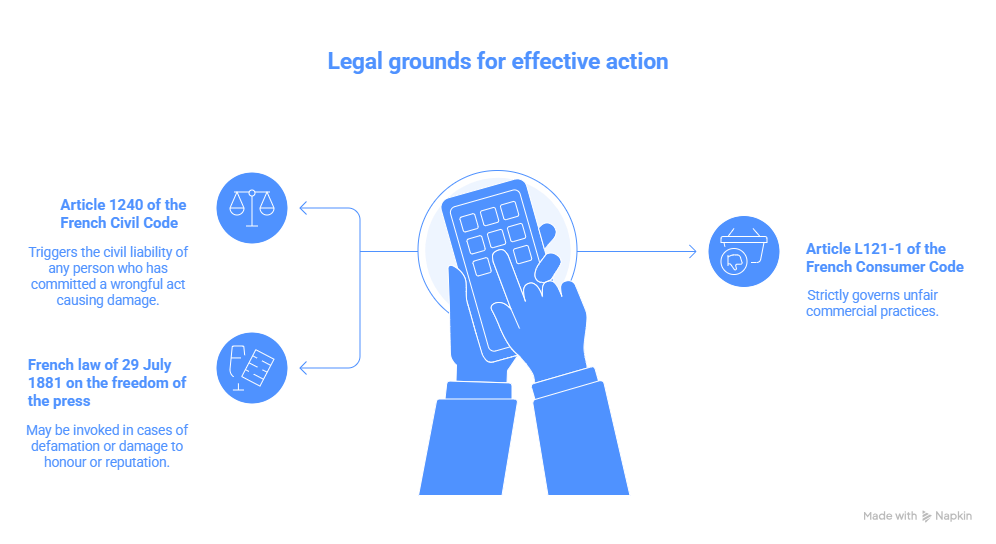
Legal grounds for effective action
Article 1240 of the French Civil Code constitutes the primary legal basis for an action against unfair competition, allowing civil liability to be established for any fault causing damage. Its flexibility enables it to encompass a wide range of situations, including those arising from digital technologies.
Article 29 of the French Law of July 29, 1881 on freedom of the press may also apply where statements harm the honor or reputation of a company. The legal classification of the facts is crucial, as it determines both the applicable procedure and the relevant limitation periods.
In this respect, it is essential to distinguish between disparagement and defamation. Disparagement targets a competitor’s products or services, whereas defamation concerns damage to the reputation of a legal or natural person. The French Supreme Court has further clarified the circumstances in which freedom of expression may preclude a finding of defamation. Where the statements form part of a debate of general interest and are based on a sufficient factual foundation, the courts assess their scope with a degree of flexibility and may accordingly recognize the author’s good faith (French Supreme Court, Criminal Chamber, January 7, 2020, No. 18-85.159).
This distinction, although technical, is strategically important in litigation.
New sanctions for fake online reviews
While commercial disparagement and misleading commercial practices have traditionally served as legal grounds to address excessively negative or false reviews, the French legislature has enacted specific provisions to regulate fake online reviews.
In this context, three implementing decrees of the French Law for a Digital Republic entered into force on January 1, 2018. Now codified, in particular, in Article L111-7-2 of the French Consumer Code, these provisions require operators engaged in the collection, moderation, or publication of online consumer reviews to provide fair, clear, and transparent information regarding the processing and publication of such reviews.
In particular, platforms must indicate, in proximity to the reviews, the date of publication, the date of the relevant consumer experience, and whether or not a review verification process is in place. These provisions replace the former voluntary adherence to the AFNOR standard, which was intended to ensure the reliability of online reviews.
Under French law, the publication or purchase of fake reviews is generally classified as a misleading commercial practice.
Pursuant to Article L132-2 of the French Consumer Code, offenders face up to two years’ imprisonment and a €300,000 fine. These penalties may be increased depending on the benefits gained, reaching up to 10% of the average annual turnover or 50% of the advertising expenditure linked to the practice. When the offence is committed online, penalties are aggravated and may rise to five years’ imprisonment and a €750,000 fine, along with additional sanctions such as bans on conducting business or managing a company.
In parallel, platforms hosting reviews must comply with specific transparency obligations regarding how reviews are collected, processed and displayed. Failure to do so may result in administrative measures, including injunctions and fines imposed by the French authority (DGCCRF).
Finally, affected businesses may bring civil actions under Article 1240 of the French Civil Code to obtain compensation for financial and reputational harm.
These new obligations reflect a strengthened regulatory framework in this area. They demonstrate that, while unfair competition law has long provided a useful legal basis, the widespread nature of fake reviews has led to the adoption of specific rules aimed at better protecting both businesses and consumers.
Practical strategies for prevention and defense
Protection against unfair competition online primarily requires a proactive approach. Implementing ongoing monitoring allows for the rapid identification of harmful content and timely action before lasting damage occurs.
A public response may be considered in order to reassure clients and preserve the company’s image; however, it must be carefully crafted to avoid exacerbating the situation. At the same time, legal steps may be taken, including issuing a formal notice or notifying platforms in order to obtain the removal of unlawful content.
In more serious cases, judicial proceedings may be necessary. Summary proceedings (référé) allow for the swift removal of harmful content, while proceedings on the merits enable the recovery of damages. The effectiveness of such actions depends on thorough preparation and a detailed analysis of the available evidence.
Evidence and procedures: securing your claim
The establishment of a robust evidentiary record is central to any litigation strategy. It is essential to preserve accurate records of the disputed content, notably through a bailiff’s report (constat d’huissier), which ensures the legal validity of the evidence collected and enhances its reliability (Paris Court of Appeal, July 2, 2010, RG No. 09/12757). While screenshots may be useful, they should be supplemented by technical evidence capable of establishing the origin and dissemination of the content.
Timeliness is also a critical factor. In certain cases, limitation periods are particularly short, requiring immediate action upon discovery of the facts. Delayed action may not only aggravate the damage but also compromise the prospects of success.
Conclusion
Social media and online reviews constitute a fully-fledged competitive arena in which traditional legal rules are applied in a renewed context. The proliferation of unfair competition practices online requires businesses to adopt a proactive and structured approach, combining monitoring, legal analysis, and targeted action.
The protection of online reputation cannot be addressed through isolated responses but must form part of a comprehensive risk management strategy. In this context, the involvement of legal professionals ensures the effectiveness of the measures taken and the long-term protection of the company’s market position.
Dreyfus & Associés assists its clients in managing complex intellectual property matters by providing tailored advice and comprehensive operational support for the full protection of intellectual property rights.
1. Can a customer review give rise to liability even if posted on social media? Yes. Where a review goes beyond a mere opinion and becomes excessive or misleading, it may engage the civil liability of its author, even when published on a third-party platform.
2. Can a company be held liable for reviews posted by its employees? Liability may arise where a connection with the company is established, particularly in cases involving internal instructions or coordinated strategies aimed at harming a competitor.
3. What are the risks for a company posting fake reviews? In addition to civil liability, such practices may lead to administrative and criminal penalties, as well as significant reputational damage if publicly exposed.
4. Is it possible to take action against a competitor established abroad? Yes, subject to certain conditions, particularly where the damage is suffered in France. International cooperation mechanisms may be used to initiate proceedings.
5. Do platforms have an obligation to verify the authenticity of reviews? No. They are not required to verify reviews or to generally monitor user-generated content. Their liability may arise if they fail to act after being notified of manifestly unlawful content.
This publication is intended for general public guidance and to highlight issues. It is not intended to apply to specific circumstances or to constitute legal advice.
On May 20 2019, EUIPO and EURid, the European Registry for Internet Domains, announced in two separate press releases that they have launched a new monitoring service for domain names in .eu and .ею (See EUIPO press release and EURid press release).
According to these two press releases, this new service aims at fighting cybersquatting and bad faith domain name registrations. Since May 18, 2019, applicants and holders of European Union trademarks may opt in to receive an alert as soon as a .eu or .ею domain name, identical to their European Union trademark application, is registered.
It is specified that this new service is advantageous both in terms of speed and efficiency. It allows applicants and holders of European Union trademarks to be informed of the registration of these domain names more quickly than if they would have to monitor registrations themselves, and they are thus able to act more quickly if necessary. In addition, this service will also detect earlier the registrations of other domain names by third parties, in the event of multiple bad faith domain names registrations.
Finally, these two press releases specify the that EUIPO and EURid have collaborated since 2016 and that they signed a second letter of collaboration at the Annual Meeting of the International Trademark Association (INTA) in Boston, which was held from May 18 to May 22, 2019, thus strengthening the collaboration between these two entities.
Dreyfus is a specialist in domain names matters and can assist you in managing your domain name portfolio.
As a result, since May 6, 2019, the United Kingdom Office no longer collects and forwards to the International Bureau of WIPO (World Intellectual Property Organization) the fees due under these regulations.
In other words, any payment of these fees pursuant to a registration requested of the United Kingdom Office must be made directly to WIPO, as is already the case in France. As a result of this administrative change, a payment can now be made in four ways:
– By debiting a WIPO current account;
– By credit card, but only for payments of fees related to renewal of registered marks, notification of irregularities issued by the Office, or for additional fees relating to the designation of additional contracting parties after the trademark has been registered. Such payments are made in Swiss francs and require a WIPO reference number;
– By bank transfer;
– By postal transfer for inter-European payments.
To be handled correctly, payments by bank transfer must include the name and complete address of the payer, the transaction code (EN), the trademark number, the trademark name, if available, or its verbal elements, and the name of the trademark holder, if different from the payer. In the case of multiple requests, a list containing each request and the amount paid for each request is also required.
It is important to pay all fees in full, otherwise an irregularity notification will be issued. This notification shall specify a payment period beyond which the request shall be deemed to have been abandoned.
As the United Kingdom Registrar no longer makes these payments to WIPO, it is up to the applicant or his representative to be vigilant and diligent when making them.
One of the main innovations introduced by the “Trademark Package” Directive of 16 December 2015 (2015/2436 EU) is the introduction of an administrative procedure for revocation or declaration of invalidity. Some countries, such as Great Britain or Germany, have already introduced this new scheme into their legislation, but this was not the case in France. As the Directive did not specify how this new procedure must be implemented, the Government undertook this task with its draft project of the “Trademark reform Package”. The draft orders introduce several new articles in the French intellectual property Code (CPI) which aim at regulating how this administrative procedure can be implemented before the National Institute of Industrial Property (INPI).
Until now, pursuant to article R. 712-17 of the CPI, the INPI only addressed the issue of revocation for non-use if it was introduced by a trademark owner in an opposition proceeding. The French draft orders make the INPI competent to judge an application for revocation or invalidity of a trademark in a larger number of cases.
The INPI thus becomes primarily competent to deal with applications for invalidity and revocations of trademarks, even if there is no pending litigation. The courts remain competent to deal with counterclaims, asking the court to revoke or invalidate a trademark, and for applications for invalidity as a principal based on commercial names, domain names or author rights. More generally, courts remain exclusively competent to deal with other civil actions and trademark claims, including related issues of unfair competition. The same applies for invalidity or revocation applications’ presented in a case of an infringement request (as a principal or counterclaim), or when provisional or protective measures are being enforced (Articles L 411-4 and L. 716-5 new).
The administrative procedure before the INPI is provided by the articles L. 716-1 and R. 716-1 to R. 716-11 (new) and includes an adversarial investigation phase. The INPI must decide on the application of invalidity or revocation within three months of the end of this phase, otherwise the application is deemed to have been rejected.
The application for invalidity or revocation submitted to the INPI must include:
– the identity of the applicant;
– the indications allowing to establish the existence, nature, origin and scope of the prior rights invoked;
– the references of the trademark and the goods or services covered by the application for invalidity or revocation;
– the presentation of the means;
– the proof of payment of the fee (within one month);
– the authorization of a potential representative.
This request must be carefully prepared since once it has been made its basis and scope cannot be extended.
The instruction phase begins with the notification to the owner of the contested trademark of the action filed against him. This leads to adversarial exchanges through written observations. These written exchanges between the parties may be punctuated by oral observations. Once the instruction phase has been completed, the INPI decides on the application.
In this respect, all these INPI decisions ruling on an application for revocation or invalidity must be reasoned (Article L. 411-5, new) and may be the subject of an action for invalidity or reform before the French Court of appeals of the applicant’s place of residence (Articles L. 411-4-1 and R. 411-19, new).
With this new administrative procedure, it is no longer mandatory to go to court. However, the invalidity of a trademark is often part of a broader litigation, which may itself concern several titles. Not all the multiple issues thus raised will be within the competence of the INPI. Consequently, the judicial judge will recover exclusive jurisdiction to rule on the case (e.g. if there is a related issue of unfair competition). Although his jurisdiction will be mainly limited to counterclaims for revocation and invalidity, the judicial judge is therefore not entirely set apart from this new procedure. The courts will retain their jurisdiction over the more complex cases, and their role will thus be complementary to the role assigned to the INPI.
Though the INPI is given greater jurisdiction, it is unlikely that the new procedure will be less costly, simpler, and faster and that it will indeed declutter the INPI’s registry from many unused trademark, as it was expected.
Our site uses cookies to offer you the best service and to produce statistics, and measure the website's audience. You can change your preferences at any time by clicking on the "Customise my choices" section.
When browsing the Website, Internet users leave digital traces. This information is collected by a connection indicator called "cookie".
Dreyfus uses cookies for statistical analysis purposes to offer you the best experience on its Website.
In compliance with the applicable regulations and with your prior consent, Dreyfus may collect information relating to your terminal or the networks from which you access the Website.
The cookies associated with our Website are intended to store only information relating to your navigation on the Website. This information can be directly read or modified during your subsequent visits and searches on the Website.
Necessary cookies are absolutely essential for the website to function properly. These cookies ensure basic functionalities and security features of the website, anonymously.
Dreyfus is concerned about protecting your privacy and the Personal Data ("Data"; "Personal Data") it collects and processes for you.
Hence, Dreyfus complies every day with the European Union legislation regarding Data protection and particularly the European General Data Protection Regulation Number 2016/679 of 27 April 2016 (GDPR).
This Privacy Policy is aimed at informing you clearly and comprehensively about how Dreyfus, as Data Controller, collects and uses your Personal Data. In addition, the purpose of this Policy is to inform you about the means at your disposal to control this use and exercise your rights related to the said processing, collection and use of your Personal Data.
This Privacy Policy describes how Dreyfus collects and processes your Personal Data. The collection happens when you visit our Website, when you exchange with Dreyfus by e-mail or post, when exercising our Intellectual Property Attorney and representative roles, when we interact with our clients and fellow practitioners, or on any other occasion when you provide your Personal Data to Dreyfus, in particular when you register for our professional events.


 Written by Nathalie Dreyfus07/08/2019
 The 65th international meeting of the ICANN took place in Marrakech, from the 24th to the 27th of June 2019. Several topics have been discussed such as the new gTLDs issues, the compliance between ICANN procedures and the GDPR provisions and the review of the rights protection mechanisms.

 According to the

 Nathalie Dreyfus has been admitted as panelist and arbitrator in the CIRA Panel (Canadian Internet Registration Authority).



 According to the