The Institute now has the obligation to examine the occurrence of pre-existing trademarks when it assesses the name of a company. Indeed, the name of a company should be refused if it is considered as offensive or undesirable: the name of a company will be considered as such if it includes a trademark which has already been registered.
However, it is possible to bypass this requirement by seeking the consent of the holder of the pre-existing trademark and requesting to be able to register the company name, despite the pre-existing registered trademark.
Finally, the Office’s obligation in terms of the company name does not apply the other way round: the Kenyan Industrial Property Institute need not examine pre-existing company names when evaluating applications for trademarks.
On February 29, 2016, the National Assembly of the Republic of Korea adopted legislation profoundly reforming the trademark law framework. This reform entered into force on September 1, 2016 and represents one of the most significant developments in South Korean trademark law since the major revisions of the 1990s.
Trademark protection in South Korea is obtained through registration with the Korean Intellectual Property Office (KIPO), the competent administrative authority for intellectual property matters and the functional equivalent of the French INPI.
Since 2016, several successive waves of amendments have pursued the same objective: improving procedural efficiency, introducing greater flexibility for applicants, and strengthening remedies against infringement and intentional misconduct.
The challenge is clear: filing in South Korea is no longer merely about “reserving” a sign. It now requires anticipating a modernized legal framework in which use, coexistence, and procedural speed play a central role.
The pillars of the 2016 reform of South Korean trademark law
A Deliberately more “functional” definition of a trademark
Prior to the reform, Article 2(1)(i) defined a trademark as “a means used on goods related to the business of a person engaged in commercial activities […] to distinguish them from the goods of others.” This definition was accompanied by an exhaustive list of visually recognizable signs, including symbols, characters, illustrations, three-dimensional shapes, or combinations thereof.
This approach, strongly rooted in the requirement of visual perception, had become increasingly ill-suited to contemporary developments in marketing and the identification of products and services.
Since September 1, 2016, Korean law defines a trademark in deliberately functional and abstract terms as “a sign used to identify and distinguish the goods or services of one person from those of another.” The explicit reference to the form of expression has been abandoned. This evolution allows for a broader understanding of distinctive signs, regardless of their mode of perception, and aligns Korean law more closely with international standards.
Removal of the legal standing requirement
Under Korean law, a registered trademark may be cancelled if it has not been put to genuine and continuous use during the three years preceding the cancellation request.
Under the former legislation, Article 73(6) restricted non-use cancellation actions to “interested parties,” requiring applicants to demonstrate a direct and current legal interest.
The reform expressly removed this requirement. Article 119(5) of the revised law now provides that “any third party,” without having to justify a specific interest, may file a non-use cancellation action. This legislative choice marks a clear break with previous practice and reflects a strong commitment to clearing the register of dormant trademarks.
Retroactive effect of judicial cancellation
The reform also amended the former Article 73(7), which provided that trademark rights ceased on the date when the cancellation decision became final. Article 119(6) now introduces retroactive effect: the right is deemed to have ceased as of the filing date of the cancellation request.
This retroactivity significantly strengthens the effectiveness of cancellation actions and their impact on related proceedings, particularly on the examination of subsequent applications.
Modification of the examination of identical or similar trademarks
Korean law prohibits the registration of trademarks identical or similar to earlier registered trademarks. Former Article 7(1)(vii) required examiners to assess similarity as of the filing date. Any subsequent changes affecting the earlier mark, such as cancellation, invalidation, abandonment, or assignment, were irrelevant.
Article 34(2) of the revised law introduces a fundamental change: examination must now be conducted as of the examination date, not the filing date. As a result, a cancellation or invalidation decision issued during the examination process must be taken into account and may allow the later mark to proceed to registration.
Abolition of statutory waiting periods: towards a more streamlined trademark life cycle
The 2016 reform repealed the rule under former Article 8, which imposed a six-month waiting period between the filing of a trademark application and the initiation of a non-use cancellation action against an earlier trademark.
Today, only the criterion of anteriority between the registration application and the cancellation request remains, without any minimum waiting period.
The reform also repealed Article 7(1)(viii), which imposed a one-year waiting period before filing a trademark identical or similar to a cancelled third-party trademark. Its removal contributes to shortening registration timelines and improving system predictability.
New provisions of trademark law in South Korea: Exceptions, letters of consent, and modifications to opposition period
The previous user in good faith: an exception to consumer confusion
The Korean Unfair Competition Prevention Act (UCPA) defines consumer confusion as an act of unfair competition. However, the issue of whether the continued, good faith use of an identical or similar mark before it became widely known constitutes unfair competition has been a subject of debate. The Supreme Court of Korea ruled in 2004 that such use should be considered as unfair competition.
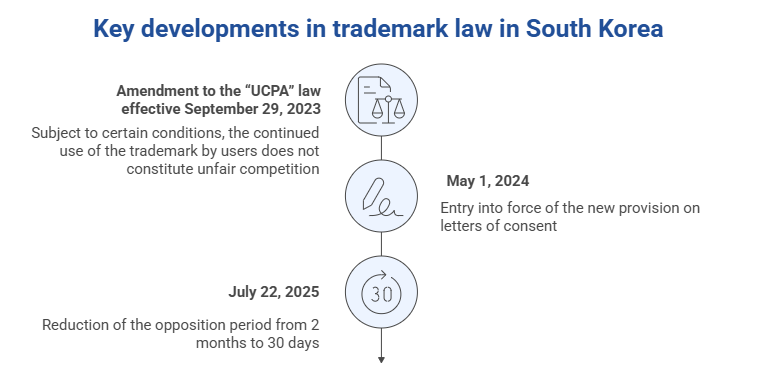
However, the amended Korean Consumer Protection Act (UCPA) introduces an exception for previous users in good faith. It stipulates that, in certain cases, the continued use of the mark by these users does not constitute unfair competition, as long as they used the mark before it became widely recognized and without malicious intent. The law also grants owners of well-known marks the right to request preventive measures to avoid confusion among consumers.
New provision of the 2024 reform: acceptance of letters of consent
A provision that entered into force on May 1, 2024 introduced a legally recognized possibility to accept letters of consent issued by prior rights holders in order to overcome examiner objections based on identity or similarity.
This measure applies to all pending applications and allows applicants to submit a letter of consent to address confusion risks identified by examiners, without immediately resorting to litigation or cancellation proceedings.
On this basis, an applicant facing a provisional refusal based on similarity may:
• submit a letter of consent from the prior trademark owner,
• accompany it with a broader coexistence agreement governing future use,
• or establish contractual restrictions designed to prevent confusion in relevant markets.
This provision enhances flexibility under Korean trademark law and aligns Korean practice with that of other jurisdictions that recognize contractual consent mechanisms.
Key changes in 2025: accelerated opposition proceedings
As of July 22, 2025, the opposition period has been reduced from two months to 30 days for trademarks published from that date onward.
This change has significant implications, as monitoring systems must become more responsive and internal processes detection, assessment, decision-making, and file preparation—must be optimized.
Conclusion
The reform of South Korean trademark law represents a decisive shift towards broader, more deterrent, and more internationally aligned protection.
In an economic environment where trademark value is central, this reform requires heightened vigilance and advanced legal expertise in order to transform legislative developments into sustainable competitive advantages.
Dreyfus & Associés assists its clients in managing complex intellectual property cases, offering personalized advice and comprehensive operational support for the complete protection of intellectual property.
Is it mandatory to appoint a local representative to file a trademark in South Korea?
Yes. Applicants who have neither domicile nor establishment in South Korea must act through a KIPO-accredited representative. This requirement applies to both national filings and subsequent procedures, including responses to objections, oppositions, and cancellation actions.
What is the term of protection of a trademark in South Korea and how can it be renewed?
A registered trademark is protected for ten years from the date of registration. Upon expiry, the owner must renew the registration to extend protection for a further ten-year period. This process may be repeated indefinitely, subject to compliance with applicable formalities and deadlines.
What are the average timelines for trademark registration in South Korea?
In the absence of objections or opposition, registration generally takes between six and eight months. However, shortened opposition periods and active examination practices may significantly extend the process in contested cases.
Is prior use required before registration?
No. The Korean system is based on the filing principle rather than prior use. However, failure to make genuine use for a continuous three-year period exposes the trademark to cancellation for non-use, now available to any third party.
Does KIPO conduct an ex officio examination of distinctiveness?
Yes. Distinctiveness is examined ex officio. Descriptive, generic, or non-distinctive signs may be refused even in the absence of earlier rights.
This publication is intended to provide general guidance and highlight certain issues. It is not intended to apply to specific circumstances or to constitute legal advice.
The Sultanate of Oman, a Middle Eastern country situated in the south of the Arabian Peninsula, has undergone several major changes in its intellectual property law through the decision no. 124/2016 of the Ministry of Trade and Industry.
A major reform for trademark holders
This act is mainly designed to regulate the registration of trade names and to extend trademark protection for the benefit of holders of intellectual property rights. Prior to this reform, trade names were not published as trademarks and could not, therefore, be subject to an opposition. The new act now allows all trademark holders to apply for the cancellation of any trade name, if the latter is similar to a national or international trademark already registered and protected in Oman.
Dr. Ali bin Masoud al Sunaidy, Minister of Commerce and Industry, also recalled a fundamental principle in the field of Omani intellectual property law. Indeed, registered trade names must be composed of Arabic words, except if they are names of international companies registered in the Sultanate.
In addition, a trade name with political, religious or military connotations, or containing the word “Oman” will also be refused.
The use of a trademark as a hashtag on social networks sometimes causes problems for companies who feel that their intellectual property rights have been infringed.
Opposition to an unrestricted and free use of the hashtag, in this case #Rio2016, also originated from several Olympic Committees in the context of the 2016 Summer Olympic Games in Rio.
The firm position of the Olympic Committees
During the Summer Olympic Games of 2016, the hashtag “#Rio2016” was obviously widespread across the Internet and on various social networks. Many Internet users and companies have frequently used the hashtag to support and encourage their national team.
However, not everyone was enthusiastic about this practice. In fact, several Olympic Committees, including Germany and the US, banned the use of the hashtag by non-Olympic sponsor companies. The Committees considered that the companies were not entitled to use the hashtag since, according to the Committees, such use is an act of counterfeit which infringes their intellectual property rights.
In the United States, the Committee served notice to a women’s ready-to-wear company, Oiselle, to remove a picture posted on Instagram of a track and field athlete of the national team who is also the brand ambassador, and under which the caption included the hashtag #RoadtoRio. The founder of the trademark, Sally Bergeson, has also reacted to the controversy by posting on her blog an article about the rule that is causing this prohibition, “Rule 40“. The rule, enshrined in the Olympic Charter states that “except as permitted by the IOC Executive Board, no competitor, team official or other team personnel who participates in the Olympic Games may allow his person, name, picture or sports performances to be used for advertising purposes during the Olympic Games.”
However, the decision was not unanimously nor positively welcomed. Some companies in the United States defended themselves by suing the Committee and condemned a ridiculous and far too strict restriction policy.
Abusive bans
In Europe these prohibitions also seem absurd. In reference to the judgment of the Court of Justice of the European Union on September 22, 2011 involving Interflora and Marks & Spencer, the use of a trademark as a Google AdWord can be an act of counterfeit if that use has adverse effects on the functions of the trademark, that is, on the specific image which the company wants to create in the mind of the consumer. One can draw a parallel between Google AdWords and hashtags and consider that only a hashtag which adversely affects the functions of the trademark can be prohibited.
Yet, if the company simply wishes to support its country in the context of the competition and if no business link is established between the Olympic Games and company (i.e. if the hashtag is not used in relation to the goods and services of the company), then it is entitled to use this hashtag.
The hashtag #Rio2016 therefore cannot be protected in the same manner as the Olympic rings symbol for example, because it is not a trademark or a design within in the strict legal sense of the term. Thus, its use should not be as limited as some Olympic Committees are arguing.
Despite no Regulation having been adopted, the law on industrial property of January 6th, 2014 is now in force in Uganda. The new act affects a major part of intellectual property law but does not reform trademark law.
Regulated protection for patents
The first revisions made, affect patents. The duration of protection has now been set at 20 years from the application date.
Furthermore, it allows for a formal establishment of exclusions: a list of everything that is not patentable. One of the most important exclusions is that of the human body and all its elements, in whole or in part. Natural substances are also excluded from patentability, whether they are purified, synthetic or isolated from nature by any other method. Finally, there is ban on the patentability of pharmaceutical products.
The protection of “Utility Models”
Only minor inventions are referred to by the notion of “Utility Models”, an intellectual property right unknown to French law. “Utility Models” need to have characteristics similar to those applied to patented inventions: they must be new and have an industrial application.
The protection period is 10 years from the date the “Utility Model” status was granted.
It should be noted that a patent application can be converted into an application for a “Utility Model” at any moment during the registration process.
The protection of industrial designs
National protection is now possible in this area, thus replacing the Anglo-Saxon system which allowed for designs to be registered automatically by extension. However, any rights existing before the reform will not be affected.
The protection of industrial designs has a duration of 5 years and is renewable twice. A single application may include two or more designs, provided they belong to the same class under the Locarno classification, or to the same set or composition of articles.
On behalf of Dreyfus & associés, CEO and Managing Partner Nathalie Dreyfus will be attending the upcoming AIPPI conference in Milan, from the 16th to the 20th of September. The wonderful metropolis of Milan is indeed an excellent choice for what promises to be an event full of insightful meetings and networking opportunities.
If you would like to meet Nathalie in Milan, please contact our team.
For more information on the AIPPI event, please click here.
Following the results of the referendum and the resignation of David Cameron, Theresa May has now been appointed Prime Minister and shall lead the Brexit. As laid out in our previous articles on the Brexit (Brexit: How to prepare oneself for the consequences?; The consequences of Brexit on trademarks and patents), implications on intellectual property law are to be expected, and in particular, on trademark and patent law. Such implications however, are not yet clear.
As tensions rise between concerning their future relationship between the United Kingdom and the European Union, here is a brief overview of the systems the U.K. could adopt once the divorce has been finalized.
First option: membership with the EFTA together with a free trade agreement
The United Kingdom has first and foremost the possibility to join the European Economic Area. The country would be joining Norway, Liechtenstein and Iceland. This would allow the U.K. to have complete access to the Single Market while accepting the principles of freedom of movement of persons, capital, goods and services. It would therefore be bound by the majority of European legislation and be subject to the jurisdiction of the ECJ – without taking part in actually making the European legislation. As a member of the EFTA, the UK could negotiate its own trade agreements. However these principles, particularly the principle of freedom of movement of people, are one of the main reasons behind the Brexit campaign! Therefore, it seems unlikely that the United Kingdom will opt for this model.
Second option: EFTA membership without a free trade agreement
The United Kingdom could be a member of the EFTA without being a member of the EEA, like Switzerland who negotiates agreements with the EU bilaterally. The United Kingdom could thereby freely decide which sectors to open to the Single Market. This would be particularly relevant to the banking sector.
This scenario, just like the previous one, sees the UK as a member of the EFTA having necessarily to accept the free movement of persons and more specifically, of workers. It would also involve participation in the European budget. A bilateral agreement could then be signed with the European Union in terms of access to the Single Market. Consequently, even though in theory the United Kingdom would not automatically be bound by European legislation, it would in practice need to comply with it so as to guarantee mutual access to the Single Market. Just like Switzerland, it would be able to have restricted access to the European banking market.
Third option: abide by the rules of the WTO
Some say this would be the “safety net” if no agreement of free trade is entered into by the United Kingdom and the European Union. Unlike in the scenarios where membership to the EFTA is sought, the United Kingdom here, would not need to accept the principle of free movement and would hence be free to establish its own policies, especially in matters of immigration and trade. Moreover, the United Kingdom would be free to negotiate bilateral agreements – however, these would not necessarily be as advantageous as the ones applied when the United Kingdom was a member of the European Union.
In spite of this, the application of the rules of the WTO entail a number of complications, especially relating to customs since this would imply re-establishing customs barriers, evaluating goods at customs and verifying the origins of products.
The new gTLDs were launched in October 2013. More than 1000 new gTLDs have been created since, and more than 20 million domains bearing a new gTLD have been registered. While this development provides a wider choice to Internet users who want to register a domain name, it poses a threat to trademark holders who now face a higher risk of usurpation of their trademarks.
Still waiting for second round
There are less and less available domain names with standard extensions (like .com or .net), which is why a second round of new gTLDs is now becoming necessary. It would encourage more trademark holders to create their own domain name.
During its last meeting in Helsinki on June 27, 2016, ICANN annouced that the second round will not take place before 2018.
The review of rights protection mechanisms
Before opening a second round, ICANN must review and improve current trademark protection mechanisms. Indeed, the tools have not been changed since the emergence of new gTLDs in 2013 and are sometimes not in line with the current context.
ICANN has in particular worked on special procedures for post-delegation dispute resolution, and notably the URS and UDRP procedures. These procedures allow trademark holders to find alternatives for when their trademark is usurped as a domain name. The Trademark Clearinghouse, a general database allowing a trademark holder to check necessary information for the protection of his/her rights, has also been examined by ICANN.
The aim of all these improvements is to offer sufficient protection to trademark holders, especially in the current context where more and more new gTLDs may appear in the coming years.
Breakfast by Dreyfus / Petit-déjeuner – conférence
Tuesday, 27 September, 2016 – 9am to 11am / mardi, le 27 septembre 2016 de 9h à 11h
On behalf of Dreyfus, it is with great pleasure that our founder and director Nathalie Dreyfus invites you to what promises to be an insightful discussion on,
The protection of trademarks, domain names, social media networks and mobile application in Iran
Presented by Nathalie Dreyfus and special guest speaker, Mr. Mohammad Badamchi (Raysan Patent & Trademark Agents)
As of January 2016, economic sanctions on Iran were lifted and opportunities have since arisen in a market with 360 billion euros in GDP.
Today, Iran is considered an emerging market economy. With a population of 80 million people and a high growth forecast, Iran now offers opportunities for business development across a wide range of industries including: tourism and hospitality, the automotive industry and the oil and construction industries.
It is throughout the development of these industries that the protection and enforcement of trademarks, designs and domain names is becoming an increasingly complex area of discussion. Rapid economic growth makes this discussion fundamental for businesses involved in the advancement of the Iranian economy.
We will be addressing several key points during the meeting including:
Setting up a company in Iran; ownership by foreigners
Running fashion and fast-moving consumer goods companies in Iran
Recent judicial decisions in the areas of trademarks, designs, domain names social media platforms and the impact these decisions have on major economic players in Iran
How to fight counterfeit, in practice and in theory
The best strategy to enforce your trademarks in Iran
The current legal stance on domain names, social media networks and mobile applications
Nathalie Dreyfus
Founder and director of Dreyfus in Paris, Trademark Attorney and appointed expert consultant to the Court of Appeal of Paris.
Mohammad Badamchi
LLM., Attorney at Law, Raysan Patent & Trademark Agents, London and Tehran
The breakfast and discussion will take place in English.
Please RSVP by the 26th of August 2016
Nathalie Dreyfus a le plaisir de vous inviter à un petit-déjeuner et conférence sur le thème,
Iran: protection des marques, noms de domaine, réseaux sociaux, applications mobiles
Présenté par Nathalie Dreyfus avec l’éclairage de notre conférencier invité, Monsieur Mohammad Badamchi (Raysan Patent & Trademark Agents)
Depuis janvier 2016, les sanctions économiques contre l’Iran ont été levées et des opportunités d’un marché de 360 milliards d’euros de PIB s’ouvrent aux entreprises.
Aujourd’hui, l’Iran est considéré comme un nouveau marché émergent. Fort de 80 millions d’habitants, une prévision de croissance élevée, l’Iran représente un potentiel de développement pour les entreprises dans de nombreux secteurs : biens de consommation, tourisme, industries automobile, pétrolière et BTP. Dans ce contexte, la protection et la défense des marques, des dessins & modèles et des noms de domaine devient un sujet complexe et clé pour les entreprises.
Problématique d’ouverture d’une société en Iran pour les étrangers
Developper une société dans le secteur de la mode et des biens de consommation en Iran
Jurisprudence récente en matière de droit des marques, dessins & modèles, noms de domaine, réseaux sociaux et impact sur les acteurs économiques en Iran
Comment lutter contre la contrefaçon? Le droit et la pratique
Quelle stratégie pour défendre ses marques en Iran?
Situation au regard des noms de domaine, des réseaux sociaux et des applications mobiles
Nathalie Dreyfus
Conseil en propriété industrielle, fondatrice et gérante de Dreyfus, Experte près la Cour D’Appel de Paris
Mohammad Badamchi
LLM., Attorney at Law, Raysan Patent & Trademark Agents, Londres et Téhéran
NB: La conférence sera en langue anglaise
Merci de bien vouloir vous inscrire avant le 26 août 2016
In or Out? The majority of the British people (51.9%) voted in favor of leaving the European Union (EU) on June 23rd of this year. The consequences of a Brexit are still unclear but what we do know, is that there will be an undeniable impact on intellectual property rights in Europe.
It is important to keep in mind that the referendum is not legally binding. The referendum does not specify when or how the UK should leave the EU. The withdrawal of the UK from the European Union will not be immediate.
Article 50 of the Lisbon Treaty allows Member States the possibility to withdraw from the EU. A Member State who decides to withdraw, shall firstly notify the European Council of its intention. Following the notification, the EU and the UK will proceed to negotiate the arrangements for the U.K’s withdrawal as well as the framework for their future relationship. Article 50 also provides for a two-year period following the notification from the UK to the European Council, after which the treaties will cease to apply. The UK would therefore not completely leave the EU before the end of 2018.
Over the next two years, it’s “business as usual” in the field of intellectual property
It is important to note that no immediate change is expected: no loss of rights will occur and no immediate action needs to be taken. Indeed, throughout the negotiation period, European intellectual property rights (European trademarks, Registered Community designs and European patents) will be entitled to the same level of protection.
What are my options after the Brexit has become effective?
Patents:
The EPO, which operates independently from the EU is responsible for reviewing applications and issuing European patents. Non-EU member countries however (e.g. Switzerland) can also be a part of the EPO; therefore, in theory, this should allow the UK to maintain its position within the EPO. As such, European patents designating the UK may continue to be issued.
Moreover, the implementation of the Unitary Patent Court (UPC),, scheduled for early 2017 will be delayed. Indeed, the implementation of the UPC requires the ratification of the Regulation by 13 member states, including France, Germany and the UK. As EU membership is a condition of being part of the UPC and the Unitary patent, Brexit makes the setting up process more complex.
European trademarks (EUTMs) and Registered Community Designs (RCDs)
EUTMs and RCDs in force prior to the UK’s official withdrawal from the EU will continue to cover the UK.
We do not yet know the consequences of the UK’s withdrawal from the EU on EUTMs and RCDs nor when these changes will occur. What we can say, is that the new EUTMs and RCDs filed with the EUIPO will not maintain the same value, as they will no longer cover the UK. To benefit from the same level of protection, one must be the holder of a European IP right (excluding the UK) and a British national IP right; therefore, in order to guarantee the same level of protection, one has to proceed with the registration of a European trademark with the EUIPO and the registration of a British trademark (the latter may be done either through national registration with the IPO or by registering an international trademark).
However, there is still the possibility of the UK reaching an agreement under which EUTMs and RCDs in force prior to the Brexit, continue to be valid on UK territory: for example, the possibility of converting European titles into British national trademarks or designs.
Copyright law:
No change is expected in the area of copyright law insofar that copyright is not very harmonized in Europe and no registration is necessary for protection. Courts will still look to the Berne Convention and the Universal Copyright Convention, but legal interpretation in accordance with EU Directives, is still to be confirmed. One needs to be cautious however in the area of contracts relating to copyright law, once the UK leaves the EU (please see below).
Contracts:
It is advisable to review each contract, especially existing license agreements, in order to examine the clauses relating to ‘territory’ and whether the EU is mentioned. One should then determine whether the term ‘EU’ in the contract refers to the EU as constituted at the date of agreement or, refers also to changing circumstances relating to the EU. This is to ensure that such contracts are in line with the original intent of the contracting parties. Agreements which are signed over the next two years will need to clearly state what is actually meant by “European Union”.
Data protection:
Whilst the Regulation on the protection of data has only just been adopted by the European Parliament (April 27, 2016) it may not actually apply to the UK. We are not presently aware on how the UK will decide to organize the flow of data but specific arrangements on this particular subject between the UK and EU member states are foreseeable.
.eu domain names:
In order to register a domain name in .eu, it is necessary to have an address within EU territory (or in Iceland, Liechtenstein or Norway), proving the registrant is subject to European law and relevant trading standards.
The UK’s withdrawal from the European Union could also have an impact on hopeful British .eu registrants.
However, EURid, the registry manager in charge of .eu and .ею (.eu in Cyrillic script) confirmed that there will be no immediate change, provided the political and legal processes have not commenced. Moreover, for some, this should not be an issue insofar as large companies will have the ability to register .eu domain names through subsidiaries located on EU territory. For smaller businesses and individuals, solutions should be devised over the next few months.
National rights:
British intellectual property rights will not be affected by the Brexit, whether these concern the acquisition or the assertion of rights over trademarks, designs and patents.
Practical guidance:
Given the current uncertainty surrounding the Brexit decision, it is now essential to analyze your intellectual property rights portfolio and to establish a strategy for your existing rights and registrations to come.
For your existing core trademarks, consider filing a UK registration at the Intellectual Property Office in addition to your EUTM. This also applies to any new EUTM filing.
A national filing is neither too costly, nor too long a process but offers a priority right so it provides a better level of protection in case EUTM filings no longer apply in the UK.
On the other hand, if the EUTM continues to apply to the UK, a national filing would allow the possibility of a seniority claim, meaning that the EUTM also includes UK registration.
Dreyfus & associés can assist and advise you on the best strategy to enhance and protect your rights.
Our site uses cookies to offer you the best service and to produce statistics, and measure the website's audience. You can change your preferences at any time by clicking on the "Customise my choices" section.
When browsing the Website, Internet users leave digital traces. This information is collected by a connection indicator called "cookie".
Dreyfus uses cookies for statistical analysis purposes to offer you the best experience on its Website.
In compliance with the applicable regulations and with your prior consent, Dreyfus may collect information relating to your terminal or the networks from which you access the Website.
The cookies associated with our Website are intended to store only information relating to your navigation on the Website. This information can be directly read or modified during your subsequent visits and searches on the Website.
Necessary cookies are absolutely essential for the website to function properly. These cookies ensure basic functionalities and security features of the website, anonymously.
Dreyfus is concerned about protecting your privacy and the Personal Data ("Data"; "Personal Data") it collects and processes for you.
Hence, Dreyfus complies every day with the European Union legislation regarding Data protection and particularly the European General Data Protection Regulation Number 2016/679 of 27 April 2016 (GDPR).
This Privacy Policy is aimed at informing you clearly and comprehensively about how Dreyfus, as Data Controller, collects and uses your Personal Data. In addition, the purpose of this Policy is to inform you about the means at your disposal to control this use and exercise your rights related to the said processing, collection and use of your Personal Data.
This Privacy Policy describes how Dreyfus collects and processes your Personal Data. The collection happens when you visit our Website, when you exchange with Dreyfus by e-mail or post, when exercising our Intellectual Property Attorney and representative roles, when we interact with our clients and fellow practitioners, or on any other occasion when you provide your Personal Data to Dreyfus, in particular when you register for our professional events.


 Written by Nathalie Dreyfus04/10/2016
 Kenyan trademark law has recently undergone reform. The enactment of the Companies Act 2015 and Companies (General) Regulations 2015 has resulted in a change in practice for the Kenyan Industrial property Institute.


 Following the results of the referendum and the resignation of David Cameron, Theresa May has now been appointed Prime Minister and shall lead the Brexit. As laid out in our previous articles on the Brexit (Brexit: How to prepare oneself for the consequences?; The consequences of Brexit on trademarks and patents), implications on intellectual property law are to be expected, and in particular, on trademark and patent law. Such implications however, are not yet clear.


