Indeed, the agreement has led to a number of reforms, particularly in relation to intellectual property law. New types of trademarks such as holograms, olfactory and sound marks have emerged in Guatemala. In addition, the creation of an online newsletter published on the website of the Registry for Intellectual Property now allows individuals to view the trademarks which are registered in Guatemala online.
The year 2016 therefore marks a further step in the development of Guatemala’s intellectual property law.
The Trademark Law Treaty is expected to enter into force on December 12, 2016.
The accession of Guatemala to the TLT results in the harmonization and simplification of the procedures for the registration and renewal of trademarks in Guatemala (except for holograms, sound, olfactory and collective trademarks).
Simplifying trademark registration applications
It will be simpler in the future for a foreign trademark holder to register a trademark in Guatemala given that the same power can now be applied to one or more applications or to one or more trademark registrations.
The adoption of “multi-class” trademark applications
Another important development is the introduction of “multi-class” trademark applications in the intellectual property law of Guatemala.
This system has many advantages, including a simplified management of trademark applications and the reduction of examination time for trademark applications. It also facilitates the monitoring of trademark renewal procédures.
Dreyfus & associés can assist you with your applications for Guatemala trademark registration by selecting the best strategy for promoting and protecting your rights.
Trademark protection on social media has become a major strategic issue as platforms such as Instagram, Snapchat and TikTok have established themselves as essential visibility channels. While this massive exposure represents a powerful acquisition lever, it also leads to a significant increase in infringements of intellectual property rights.
We observe that the most successful companies no longer rely solely on marketing presence: they implement a comprehensive strategy combining visibility, SEO and legal protection. In this context, controlling the risks associated with the use of distinctive signs online has become an operational necessity.
Why have social media become essential for trademarks?
A convergence between visibility, SEO and trademark awareness
Social media now play a central role in the digital ecosystem. They are no longer just communication channels but true extensions of trademark identity, visible both on platforms and in search engine results.
In practice, a well-optimized Instagram or TikTok account frequently appears among the top Google results for trademark-related queries. This presence helps control online image while strengthening credibility with clients and partners.
An engagement-driven performance model
Trademark performance is no longer measured solely by audience size but by the ability to generate engagement, particularly among younger audiences. Interactions (comments, shares, reactions) directly influence content distribution through platform algorithms.
In this context, editorial strategy must align with legal protection: poorly managed viral content can generate as many risks as visibility.
Strategic specificities of Snapchat, Instagram and TikTok
Snapchat: encourages spontaneous and authentic communication, ideal for humanizing the trademark.
However, despite their ephemeral nature, content can be captured and reused, requiring basic internal safeguards.
Instagram: enables the development of a consistent and high-performing trademark image through professional tools.
Each published element (photo, caption, hashtag) must comply with trademark law, especially when using third-party distinctive signs.
TikTok: offers rapid visibility through a powerful algorithm.
This virality increases the risk of misuse or misappropriation of the trademark, requiring active monitoring.
What are the legal risks associated with using a trademark on social media?
Unlawful appropriation of usernames
Fraudulent registration of usernames is one of the most common infringements. Third parties may use identical or similar names to capture traffic or create confusion among users.
This phenomenon, comparable to domain namecybersquatting, requires swift action to prevent trademark dilution.
Counterfeiting and unauthorized commercial use
Social media have become major distribution channels, including for counterfeit goods. Fake accounts reproducing logos or promoting misleading offers are increasingly common.
Such practices infringe exclusive trademark rights and may result in significant financial and reputational damage.
Reputational harm and unfair competition
Beyond traditional infringements, social media facilitate:
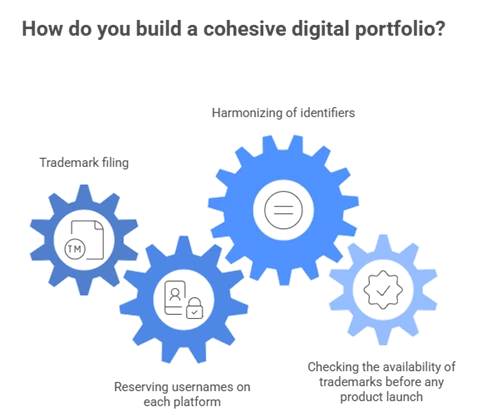
Harmonizing identifiers across platforms to ensure consistency and recognition;
Checking the availability of distinctive signs before launching campaigns or products.
This proactive approach helps prevent conflicts and ensures consistent trademark communication.
Monitor: implement continuous trademark watch
Effective monitoring relies on technological tools capable of detecting infringements in real time. This includes surveillance across social media, marketplaces and emerging channels.
The objective is to identify infringements early and limit their impact.
Act: deploy appropriate legal mechanisms
In case of infringement, several actions may be taken. An initial response typically involves a takedown procedure, i.e. a formal notice to platforms requesting removal of infringing content or accounts.
Where infringement is more serious (impersonation, infringement, fraudulent commercial use), a structured approach is required, including:
Sending cease-and-desist letters;
Initiating username recovery procedures;
Bringing legal actions based on trademark infringement or unfair competition.
A rapid and structured response generally leads to effective outcomes, including content removal or account recovery.
The presence on Instagram, Snapchat and TikTok represents a major strategic opportunity, provided it is supported by an appropriate protection policy. Controlling legal risks not only preserves intangible assets but also strengthens long-term competitiveness.
Dreyfus & Associés assists its clients in managing complex intellectual property cases, offering personalized advice and comprehensive operational support for the complete protection of intellectual property.
1. Is a trademark vulnerable if it is not active on social media? Yes. Lack of active presence facilitates abusive registrations by third parties and complicates recovery actions.
2. How can I prove that a social media account infringes my trademark? Proof relies on demonstrating likelihood of confusion, unauthorized use and, where applicable, damage. Evidence may include screenshots or monitoring reports.
3. How long does it take to remove a fraudulent account? It depends on the platform and the strength of the claim. A well-documented takedown may succeed within a few days.
4. Can hashtags constitute trademark infringement? Yes, when they exploit a protected trademark for commercial purposes without authorization.
5. Is a company liable for content posted by its employees? Yes, liability may arise in case of unlawful publication.
This publication is intended to provide general guidance and highlight certain issues. It is not intended to apply to specific situations or to constitute legal advice.
Hypertext links are central to the functioning of the Internet. They make it possible to direct users to an article, photograph, video or any other content published on a third-party website.
However, creating a hypertext link is not always neutral from a copyright perspective. Since 2014, the Court of Justice of the European Union has progressively clarified the circumstances in which a link may constitute an act of “communication to the public” requiring the authorisation of the right holder.
The principle of freedom to create hypertext links
In its Svensson decision of February 13, 2014 (C-466/12), the Court of Justice of the European Union held that creating a clickable link to a protected work that is already freely accessible on another website with the authorisation of the right holder does not require further authorisation.
Admittedly, providing the link enables Internet users to access the work. However, it does not target a “new public”. Where content is freely accessible online, the right holder is deemed to have taken all Internet users into account as the potential public.
A website may therefore, in principle, provide a hypertext link to a work that is freely and lawfully accessible on another website. This approach preserves the normal functioning of the Internet, which largely relies on the circulation of information through hypertext links.
Links to content published without authorisation
The position is different where the hypertext link leads to a work that has been made available online without the authorisation of the right holder.
The Court notably distinguishes between hypertext links published without a profit-making purpose and those made available in the course of a commercial activity.
Where a person creates a hypertext link without pursuing a profit-making purpose, it is necessary to determine whether that person was aware of the unlawful nature of the initial publication. The liability of the author of the link is not automatic. The risk nevertheless becomes significant where the person posting the link knows that the content is unlawful, has been informed of its unlawful nature by the right holder, maintains the link despite receiving a substantiated takedown request, or enables users to circumvent an access restriction.
Where a hypertext link is published in the course of an activity carried out for profit, the Court adopts a stricter approach. The person posting the link is presumed to have carried out the necessary checks and to have been aware that the initial publication may have been unlawful. This presumption may be rebutted, but it requires the professional operator to demonstrate that it could reasonably believe that the content had been published with authorisation.
The commercial nature of the website is not, in itself, sufficient to establish counterfeiting. It is nevertheless an important factor where the hypertext link is used to attract traffic, generate advertising revenue or facilitate access to manifestly unlawful content.
Circumvention of access restrictions
Even where a work was initially published with the authorisation of its author, a hypertext link may require authorisation if it makes the work accessible to a public that was not taken into account when it was first made available online.
This may be the case where the link circumvents a subscription, a paywall, an authentication system, a restriction limiting access to certain users or a technological protection measure.
In such circumstances, the hypertext link makes the work available to a “new public” and may therefore constitute a communication to the public.
A distinction must accordingly be drawn between a simple link to a freely accessible page and a link that neutralises a restriction effectively implemented by the right holder.
Framing and the embedding of third-party content
Framing consists in embedding content from another website into a webpage without necessarily creating a new copy of that content. A photograph or video may therefore appear directly on a third-party website while technically remaining hosted on the original website.
In its BestWater order of 2014, the CJEU accepted that a freely accessible work could, in principle, be embedded by means of framing, provided that it was neither communicated using a different technical means nor made available to a new public.
The Court subsequently clarified this approach in its VG Bild-Kunst decision of March 9, 2021 (C-392/19). Where the right holder has adopted or imposed technological measures intended to prevent framing, circumventing those measures constitutes a communication to a new public and therefore requires authorisation.
In practice, the direct embedding of content on a third-party website may therefore create greater legal risks than a simple clickable hypertext link clearly redirecting the user to the original website.
Services Facilitating Access to Unlawful Content
European case law is not limited to individual hypertext links. It also takes into account the role played by persons or services that organise, facilitate or encourage access to protected content made available without authorisation.
In the Filmspeler decision of April 26, 2017 (C-527/15), the Court held that the sale of a multimedia player preconfigured with links to unlawful streaming websites constituted a communication to the public. The seller deliberately intervened to enable its customers to access protected works easily.
In the Pirate Bay judgment of June 14, 2017 (C-610/15), the Court also held that the operation of a platform facilitating the location and sharing of protected works could constitute a communication to the public. The administrators did not necessarily upload the works themselves, but they played an essential role in making them available.
The distinction between a purely technical intermediary and an operator actively participating in the distribution of unlawful content is therefore decisive.
Its liability may nevertheless arise where, beyond merely providing the platform, it contributes to giving the public access to unlawful content.
This may notably be the case where the operator knows that protected content is unlawfully available and fails to remove it promptly, participates in its selection or promotion, provides tools specifically designed to facilitate its sharing, or adopts a business model that encourages copyright infringement.
This case law must now be considered together with the specific obligations applicable to online content-sharing platforms.
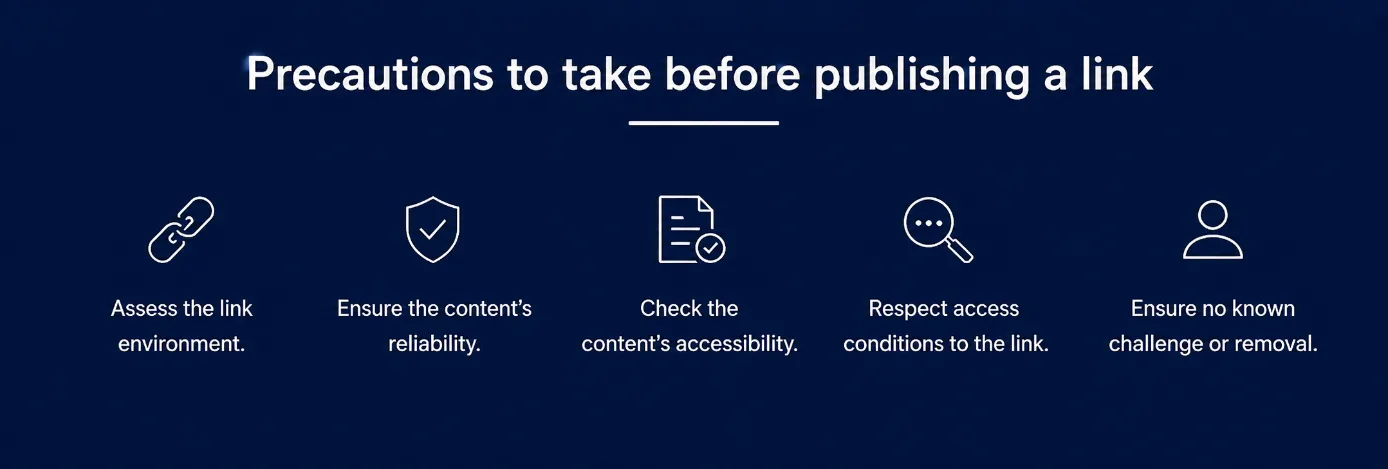
Precautions to take before publishing a hypertext link
Creating a hypertext link to protected content is not prohibited as a matter of principle. However, prior checks remain advisable, particularly in a professional context.
It is notably appropriate to verify:
that the content is freely accessible;
that the original website appears legitimate;
that the work appears to have been published with authorisation;
that the link does not circumvent any restriction;
that the content is not embedded in breach of an anti-framing measure;
and that no takedown request has been received.
Conclusion
The principle remains that hypertext links may freely be created to content that is freely and lawfully accessible.
That freedom is nevertheless subject to limits where the link knowingly leads to unlawful content, circumvents an access restriction, neutralises a technological measure or actively contributes to the distribution of infringing works.
The lawfulness of a hypertext link therefore depends on its context, the origin of the content, the purpose pursued and the role actually played by the person posting it.
Dreyfus Law Firm assists its clients in managing complex intellectual property cases, offering personalized advice and comprehensive operational support for the complete protection of intellectual property.
Is authorisation required to link to the homepage of a website?
In principle, no. A hypertext link to the homepage of a freely accessible website generally does not require authorisation, provided that it does not create confusion as to the existence of a partnership or commercial relationship.
Should a link that subsequently becomes unlawful be removed?
Yes, once the person who posted the link becomes aware of the change in circumstances. A link that was initially lawful may become problematic if the destination content is modified or replaced with unlawful content.
Can a link to a foreign website give rise to liability in France?
Yes. The location of the target website is not, in itself, sufficient to exclude the application of French law, particularly where the link is published on a website aimed at the French public or where the harm is liable to occur in France.
Does removing the link eliminate all liability?
Prompt removal may reduce the risk, but it does not necessarily erase an infringement that has already occurred. The circumstances, duration of publication and knowledge of the unlawful nature of the content may still be taken into account.
Does a shortened link create any particular risk?
Using a shortened hypertext link is not prohibited. However, it may conceal the actual destination and make it more difficult to identify the website concerned. A transparent presentation is therefore preferable.
This publication is intended for general public guidance and to highest issues. It is not intended to apply to specific circumstances or to constitute legal advice.
ICANN manages the global resources of the Internet, that is to say it handles the management and coordination of Internet addresses such as IP address allocation, DNS and IP Protocols. Such functions are referred to as IANA: Internet Assigned Numbers Authority function. This particular function, managed by ICANN, was carefully guarded by the U.S. government since it is a critical function.
The U.S. was committed to preserving the IANA function since the creation of ICANN in 1998. When the internet was handed over to the private sector, the U.S. government was awarded a contract placing the federal courts as the final arbiter of disputes. The U.S. thus had the final say on every ICANN decision and could block decisions perceived as contrary to its interests.
While this emancipation was a long-term stated objective since ICANN’s inception in 1998, the project materialised only after the revelations of Edward Snowden in summer 2013 and the surveillance scandal involving the NSA. Weakened with respect to global diplomacy, the U.S. had to give in to pressure from over 150 countries including China, Russia and France along with the Afnic association (Association Française pour le Nommage Internet en Coopération, historic operator of .fr). It was not only the U.S. who had control over the internet however: Chinese companies like Alibaba, Tencent or even Baidu hold the same value as GAFA(Google, Apple, Facebook and Amazon).
What does this mean for the Internet and its users?
Prior to the expiration of the contract, ICANN was under the control of the U.S. Department of Commerce which had the power to force ICANN into bankruptcy. But the U.S. control over the Board of Directors has now been eliminated.
Henceforth, all Internet stakeholders will have a say and can participate in decisions. A general assembly alongside counter powers was thus created. This general assembly is made up of four groups:
– the private sector, involving stakeholders like GAFA, large companies and SMEs;
– the technical community;
– governments, composed of 160 members with one vote each;
– the civil society: consumer protection associations, civil rights associations.
If there is a consensus, this assembly may block a decision of the Board.
Americans are not excluded from any decision of ICANN. They form part of the general assembly, have a voice and can oppose any decision of the board. But with time and changing power relations, they could lose their influence.
ICANN’s main concern will therefore be to implement this new multi stakeholder model. The organisation must introduce changes in its culture so that it duly takes into account differences in culture, age, gender, language, career paths. Each community should be able to voice their concerns fully and be capable of influencing the organisation.
A significant change in the trademark law of the Cayman Islands
Previously, under The Patents and Trade Marks Law 2011, it was possible to gain trade mark protection in the Cayman Islands by way of an application for a UK or Community trade mark registration. With only a registration number, extension of that trademark protection could be requested in the Cayman Islands. The CIIPO would then conduct only a minimal examination of the trademark.
Furthermore, since the Cayman Islands is not a signatory of the Paris Convention, priority could not be claimed and trademark protection would be effective as of the registration date. The International Classification system was used and multi-class applications were allowed to the extent that these classes were requested for the registration of a UK or European Community trademark. Previsouly, the law also required the payment of maintenance fees payable to the Government of the Cayman Islands in January of each year. These fees could be paid up until March 31st of that year. Failure to pay annual fees would result in the suspension of protection of the trademark until payment was received. Beyond twelve months, the Registrar may cancel the record of the trademark.
What changes does the new law bring about?
As of now, the CIIPO will only accept national registration applications made directly to the Registrar.
In addition, the examination process will not be minimal, as applications will be examined on both absolute and relative grounds. There will also be a provision for opposition to the registration of the trademark.
The requirement to pay annual maintenance fees in order to maintain a valid trademark registration has however been retained.
Recommendations for registering your trademark
With the new law, which should enter into force during 2017, the timeframe to obtain a trademark registration will be extended.
We encourage you to register your trademarks directly with the Cayman Islands Registrar so as to prepare for the coming into force of the new law and for the potential issues that could arise. It is better to take prompt action in order to anticipate delays and the difficulties that the national Registrar will encounter in order to adapt to the new law.
Dreyfus & associés will certainly inform you of the developments in trademark law in the Cayman Islands. We remain available should you require any additional information.
The blockchain refers to data storage and transmission technology which is transparent and secure and operates without a central governing body nor any intermediary. It is an unalterable database that contains the history of all exchanges between its users, since its inception. Each transaction is encrypted and becomes a ‘block’ which is then validated automatically by the network. It operates with a digital currency; the bitcoin is the most common form. This currency allows for the creation a dematerialised settling of transactions.
A new type of organisation
The blockchain is thus based on a fundamental principle: the removal of an intermediary between two people involved in a transaction. There is therefore no need for trust among people interacting since the entire process is automated. While since its inception in 2007, the blockchain has been limited to financial transactions, it continues to grow and is now more widespread. It is therefore important to instill trust and confidence back in to interactions that involve more than one human individual.
What we are witnessing is the emergence of a new type of organisation. The central body that coordinates the interactions between individuals and recovers the generated value has disappeared. In these new systems, individuals themselves work together directly, without the intermediary. The operation system is indeed much more collaborative.
With this kind of decentralised collaborative application, the question now is whether to remove not only the intermediary but also the administrator, the “trusted third party” who certifies the validity of authentic deeds (for example, a notary).
The legal issues surrounding the blockchain
Henceforth, new legal challenges have begun to crop up, in particular the issue of liability. Indeed, if all actions are performed independently and anonymously, who will be liable for opening an illicit network? Even if the creator of the blockchain is identified (which seems difficult in view of the principle of anonymity which is omnipresent in such technology), the operations cannot be stopped since they are carried out independently of the blockchain.
Clearly, it is unreasonable to apply traditional legal rules to this new and expanding digital environment. It is therefore essential to establish a new legal framework that can support, in particular, the development of the blockchain. The expression “code is law” illustrates the need for a new techno-legal revolution for the digital world, independent of the physical one.
As to the regulation issue, one may wonder what position the government will adopt vis-à-vis the blockchain. While the blockchain can afford to evade the rules in force as well as State control, it can also lose its potential if the States seek to have too much influence on it.
The legal status of the blockchain
Discussions have already been held at the National Assembly in France. On May 13, 2016 an elected representative of Eure-Et-Loir département, filed an amendment to the recognition of the blockchain in payment systems and conferring upon it the same legal status as a deed. Although the amendment was rejected and the Minister of justice stated that the blockchain would not replace a notarial deed, this proposition proves that the blockchain and its legal status undoubtedly stirred debate within the government.
Another interesting debate is the legal recognition of smart contracts that are based in the blockchain. These standalone software automatically predefine certain conditions without the need for any human intervention. The advantage of this is that the conditions cannot be modified while the contract is running, thus preventing abuse or contractual fraud. Therefore, the cost of verification, enforcement and arbitration are reduced. This in turn, relates back to the idea of avoiding intervention from a “trusted third party”.
Smarts contracts are software, rather than contracts, and like the blockchain itself, do not possess any legal status. They are not binding on third parties (or at least not yet).
These technical applications of contracts could be applied to many areas: tax (collection and automatic deduction of value-added tax), insurance (traveller compensation system in case of flight delays on the Ethereum platform), real estate (registration of title deeds), health (management of patients’ information), transport (decentralised carpool service) or even online voting (secure system preventing fraud).
In any case, we are still at the beginning of what is likely to become a revolution in the coming decades. All current decisions will influence the future of the blockchain, that of our society and its organisation. Implementation of a legal framework for the blockchain is key and it is the government’s role to provide legislation on the subject.
According to the decision, from now on, anyone wishing to file an opposition must do so via an E-service, therefore fully accepting the Institute’s terms of use regarding the electroning filing of an opposition against a trademark registration as well as the use of E-Procedures. It is no longer possible to file such an opposition by any other means than the E-service.
In short, since May 1st, 2016, the French National Trademark Institute has made the online filing of an opposition to a trademark registration on the INPI website mandatory.
Futhermore, all subsequent exchanges and the submission of observations must be done exclusively via the online service of the Institute.
The legislation of the Republic of Belarus has recently evolved through a law adopted on January 5, 2016. The law will allow Belarusian law to advance its current practices in the field of trademark law. Further opportunities for trademark applicants have also been implemented. The amendment came into force on July 15, 2016.
First and foremost, with the new law, trademark registrations with the National Intellectual Property Center can now be filed not only by companies but also by citizens, including foreign citizens. Indeed, before this law was adopted, it was impossible for a foreigner to register a national Belarusian trademark.
Some of the other significant changes in the law adopted on January 5, 2016, include:
Grounds for refusal of registration
A list of grounds for refusal of registration was added and amended by the law of January 5, 2016. Before the law was enacted, the registration of trademarks exclusively composed of symbols or indications used to designate the following was not authorized:
– kind,
– quality,
– quantity,
– property,
– value of the goods,
– process of their manufacturing or selling.
According to the amendment, registration will now be refused only if the abovementioned symbols or indications are dominant components of the trademark being registered, rather than on grounds of their mere presence.
Also, if a sign is identical or confusingly similar to a design or a plant variety protected in Belarus, and if the goods or services are themselves identical of similar, it is impossible to register such a sign as a trademark.
Integration of the International Classification for goods and services (Nice Classification)
From now on, the trademark registration application must bear reference to the Nice Classification for goods and services. Before the law was adopted on January 5th, 2016, such an indication was optional.
What we have here is clearly a desire for the Republic of Belarus to harmonize its IP law with international law standards.
Restoration of expired time limits
It is now possible to restore a number of expired time limits:
– the time limit for responding to a preliminary examination request;
– the time limit for responding to an expert examination request;
– the time limit for submission of a petition for conducting an expert re-examination;
– the time limit for lodging a complaint with the Court of Appeal.
However, it is only possible to restore the abovementioned time limits within three months of the date of their expiration. In addition, time limits will only be restored in exchange for payment of the restoration fees. Finally, the applicant needs to provide proof of a reasonable justification for missing the deadline.
Additional changes have been introduced by the law adopted on January 5th, 2016, such as the prohibition of voluntary licenses between commercial entities. These amendments have allowed the Republic of Belarus to bridge the gap between its legislation and that of other countries, having signed international conventions such as the Nice Agreement.
A hashtag is a word or phrase (“tag” in English) preceded by a symbol similar to the hash (“hash”), used to thematically classify content on social networks.
In a notice published in the Official Journal of January 23, 2013 , the General Commission of Terminology and Neology defined “hashtag”, or “mot-dièse” in French, as: “A meaningful sequence of characters without spaces starting with # (hash), which indicates a topic of interest and is inserted in a message by the author to facilitate the identification thereof.”
The hashtag was first used on Twitter in August 2007. Technically, the hashtags allow the author to contextualize a publication and consolidate the contents consisting of the same keywords. Therefore, in the same manner as the domain name, the hashtag has become a real communication tool and a significant, intangible asset for companies. Faced with the extensive use of the hashtag, it is necessary that limitations on its use are set and it therefore seems legitimate to question its legal status.
The hashtag and fundamental freedoms
Under French law there is no express provision relating to hashtags. However, if some hashtags are considered illegal such as ” #UnBonJuif”, “#AntiNoir” or more recently ” #JeSuisKouachi”, it falls both within the scope of the Law on the Freedom of the Press of July 29, 1881 on racial defamation offences as well as the recent counter-terrorism law of November 13, 2014 .
Use of such hashtags is unfortunately common in that social networks do not review messages published by users until after they are published and often, only if they are subject to a specific report. This suggests that the derogatory liability, according to which the host of the publication will not be held liable if the latter is not aware of the message before it has been posted (Article 6 I. 2 of the Law of June 21, 2004 regarding Confidence in the Digital Economy ), applies to social networks and cannot be questioned in cases of disputed hashtags. Thus, there is no doubt that a user who shall commit an offence or tort through the use of a hashtag that is provided for by the law could be prosecuted and convicted by the French courts, alone or along with the social network.
However in most cases, the disputed hashtags originate from, or are taken up by persons using a pseudonym, thus making their identification complicated. One can take the example of the hashtag ” #UnBonJuif”, for which Twitter had been served a notice by various associations to take prompt action to remove them and to reveal the identity of the authors of the impugned words. Having faced controversy over the res judicata of the decision on account of the international nature of the social network, in July 2013 the associations finally managed to obtain – through mutual agreement with Twitter – the identification details of the authors of the contentious tweets.
As such, the hashtag which is used as a tool for expression and communication, falls under various criminal and civil law provisions on the protection of fundamental freedoms. Any abuse is therefore legally actionable. Despite numerous requests for the removal of tweets, so far, only Twitter has been subject to very few convictions in France, due to the abusive nature of hashtags. France alone accounts for 87% of requests worldwide.
Considering that a hashtag may enjoy legal protection under intellectual property law is a significant advantage for companies as they could avail themselves of civil and criminal law provisions to protect their trademark and image on social networks. However, no legislation has established the legal framework for this symbol yet or provided for penalties in the event of abusive practices.
Is the hashtag a work of the mind and can it be protected by copyright?
Article L. 112-1 of the Intellectual Property Code provides protection for “all works of the mind, “whatever their kind, form of expression, merit or purpose.” The following article provides a non-exhaustive list of works that can be considered works of the mind. This list allows any new creation to be considered as a work of the mind provided that it fulfills the conditions for copyright which are: originality (the imprint of the author’s personality) and physical layout of the work. It would seem that case law with respect to copyright protection can be transposed to the hashtag. However, the appreciation of originality remains subjective and case law may vary.
The tangent character of the concept of originality contributes to the uncertainty of protecting a title by copyright. A hashtag composed of a single word can hardly be protected by copyright unless it is particularly original.
Moreover, one must dissociate the hashtag symbol from the word or words that follow it. The hashtag symbol does not seem to bring originality in itself inasmuch as it has been trivialized since its first use in 2007. Therefore, the content in its entirety will not necessarily be original only because it has been attached to a word or to a group of words.
Is the hashtag a distinctive symbol or a symbol subject to trademark protection?
As with domain names or usernames, the legal nature of the hashtag is not confirmed. Indeed, the symbol is chosen and used freely and openly on social networks. In order to prevent misuse of their trademark, increasingly, trademark owners are applying for the registration of their trademark or their slogan accompanied by the symbol, “#”. The law is silent on this issue and case law is inconsistent. If it was admitted a few times that a hashtag can be protected by trademark law, it is not automatic and hashtag will only be protected by trademark law provided that they meet the criteria of a trademark which are: to be available, to have distinctive character and to be lawful.
In 2015, there were 1,398 application requests worldwide for the registration of trademarks including a hashtag, among which 159 were in France. Companies register hashtags as trademarks when developing an advertising or marketing campaign and when they want to enjoy legal protection. In the US, the operator T-Mobile USA registered in January 2015 the trademark “# 7NIGHTSTAND CHALLENGE.” At community level, one will note the application for registration of the trademark “#LOVE” by Sony Pictures. In France, the trademark “#CLIENT ADDICT” was applied by Future Telecom on June 6, 2014 and the registration was accepted by the National Institute of Industrial Property.
When registering its trademark, a company protects that trademark against any illegal reproduction or imitation and thus has legal means to fight against competitors who could, using an identical hashtag for their own trademark, generate commercial gains and thus resort to practices of economic parasitism.
In the US, in Fraternity Collection, LLC v Fargnoli, a decision dated March 31, 2015, a designer, after terminating business relations with its manufacturer, used hashtags adopting the manufacturer’s trademark (“#fratcollection” and ” #fraternitycollection”) on Instagram to sell his own creations. The Southern District of Mississippi considered that the use of a competitor’s name or of any of its products on social networks as a hashtag can in some circumstances lead to the consumers being misled.
In addition, companies have the opportunity to buy “sponsored tweets” on Twitter thus allowing them to gain better visibility on the social network. These tweets will indeed be emphasised and will normally be seen by Internet users who use that hashtag. A parallel can be drawn between hashtags used in these tweets and Google AdWords. The CJEU case law tends to consider that the use of a trademark as AdWords can amount to infringement if its use causes prejudice to the functions of the trademark, that is the specific image that the company wants the customers to have in mind.
The hashtag “#Rio2016” widespread on the Internet during the summer Olympic Games of 2016 has notably been subject to conflicts in Europe. Indeed, the German Olympic Committee banned the use of the hashtag to non-Olympic sponsor companies, citing an appeal to counterfeiting and an infringement of their intellectual property rights. However, with reference to the CJEU case law, use of this hashtag can only be prohibited if it causes prejudice to the functions of the trademark. A company is entitled to use this hashtag if it simply wants to support its country in the context of the competition, and no commercial link is established between the Olympic Games and the company (i.e. if the hashtag is not used in connection with the company’s goods and services). The hashtag “#Rio2016” was also subject to discussion in the US to the extent that the Olympic Committee has prohibited the use of the hashtag by non-Olympic companies. Some companies however, responded by confronting the Committee on the grounds of an excessively strict prohibition on social networks and therefore reminding the CJEU of its code of conduct.
If some companies have managed to protect trademarks containing the hashtag symbol, a decision of the Court of Appeal of Paris has nevertheless asserted its secondary character. The French Institut National de la Propriété Industrielle (INPI) also considered that due to its frequent use, the symbol “#” is secondary (CA Paris, December 5, 2014, No. 14/14773). The assessment of a trademark containing a hashtag is therefore made without this symbol, as a traditional trademark.
The United States does not agree with this since the trademark “#” has indeed been registered on November 25, 2014 at the USPTO. The USPTO stated that a trademark which consists wholly or partly of the character “#” or “hashtag” can be registered as a trademark if it indicates the origin of the goods or services of the applicant and provided they meet the traditional criteria of validity of a trademark. However, the California Central District Court ruled against this view in the case of Eksouzian against Albanese on August 7, 2015. The dispute concerned two competitors between whom there was an agreement prohibiting them from using the association of certain words as a trademark to promote products. The judge found that the hashtag was descriptive and as such, could not be considered as a trademark. The registration of a trademark including a hashtag is thus not automatic.
Therefore, if previously the registration of trademarks could result from a preventive exercise on the part of the holder in order to prevent a third party in bad faith from registering a hashtag infringing the trademark, the assessment of the validity of a trademark with a hashtag is now exclusively on the word or expression following the “#”. The best way to protect a hashtag will depend on its intrinsic characteristics. Whether by copyright or trademark law, the mechanisms are however not absolute and the case law remains inconsistent.
Following “@” and “.com” what is the future of “#” ?
Our site uses cookies to offer you the best service and to produce statistics, and measure the website's audience. You can change your preferences at any time by clicking on the "Customise my choices" section.
When browsing the Website, Internet users leave digital traces. This information is collected by a connection indicator called "cookie".
Dreyfus uses cookies for statistical analysis purposes to offer you the best experience on its Website.
In compliance with the applicable regulations and with your prior consent, Dreyfus may collect information relating to your terminal or the networks from which you access the Website.
The cookies associated with our Website are intended to store only information relating to your navigation on the Website. This information can be directly read or modified during your subsequent visits and searches on the Website.
Necessary cookies are absolutely essential for the website to function properly. These cookies ensure basic functionalities and security features of the website, anonymously.
Dreyfus is concerned about protecting your privacy and the Personal Data ("Data"; "Personal Data") it collects and processes for you.
Hence, Dreyfus complies every day with the European Union legislation regarding Data protection and particularly the European General Data Protection Regulation Number 2016/679 of 27 April 2016 (GDPR).
This Privacy Policy is aimed at informing you clearly and comprehensively about how Dreyfus, as Data Controller, collects and uses your Personal Data. In addition, the purpose of this Policy is to inform you about the means at your disposal to control this use and exercise your rights related to the said processing, collection and use of your Personal Data.
This Privacy Policy describes how Dreyfus collects and processes your Personal Data. The collection happens when you visit our Website, when you exchange with Dreyfus by e-mail or post, when exercising our Intellectual Property Attorney and representative roles, when we interact with our clients and fellow practitioners, or on any other occasion when you provide your Personal Data to Dreyfus, in particular when you register for our professional events.


 Written by Nathalie Dreyfus07/12/2016
 Guatemala’s accession to the “multi-class” trademark application system