


Introduction
Ten years after the judgment delivered on March 9, 2016 by the UK Supreme Court in PMS International Ltd v. Magmatic Ltd (UKSC/2014/0147), commonly referred to as the “Trunki” case, its full significance can now be properly appreciated. While the decision is today regarded as a leading authority in design law, its outcome and strict reasoning initially took many practitioners by surprise in 2016.
In order to understand its enduring influence, it is necessary to revisit both the factual background and the judicial trajectory of this landmark case.
The facts of the case: confrontation between a registered design and an inspired product
In the mid-2000s, the British company Magmatic Ltd marketed the “Trunki” children’s suitcase, designed as cabin luggage that could also be ridden by children. The product’s commercial success relied heavily on its appearance: a rigid shell with rounded contours, incorporating protruding elements suggestive of the horns of a stylized animal, combined with a smooth and minimalist surface.
To protect this appearance, Magmatic filed a Registered Community Design pursuant to Regulation No 6/2002. The filed representations consisted of computer-generated images depicting a suitcase devoid of visible ornamentation and characterized by marked tonal contrast. No written claim or description accompanied the filing.
In 2013, PMS International marketed a competing suitcase in the United Kingdom under the name “Kiddee Case.” While it adopted the concept of an animal-shaped ride-on suitcase for children and featured similar protrusions at the front, those elements more closely resembled ears or antennae rather than horns. In addition, the Kiddee Case incorporated decorative elements and color combinations absent from Magmatic’s registered representations.
Alleging infringement of its Registered Community Design, Magmatic initiated proceedings under Articles 10 and 19 of Regulation No 6/2002, contending that the Kiddee Case produced the same overall visual impression on the informed user.
Judicial trajectory: a progressive redefinition of the scope of protection in design law
The significance of the case lies as much in its procedural path as in its outcome, revealing initial judicial hesitations concerning the interpretation of the “overall impression” test.
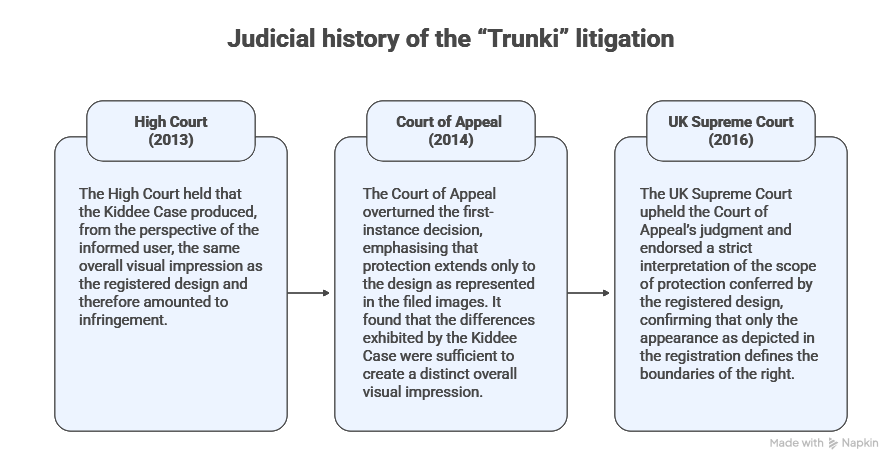
The UK Supreme Court ultimately reaffirmed several foundational principles of design law:
- Protection extends solely to the appearance of the product as represented in the registration.
In the absence of any written claim, the registered images alone determine the scope of the exclusive right. - A registered design does not protect a general idea or product concept.
The concept of an animal-shaped ride-on suitcase is not, as such, appropriable; only the specific appearance embodied in the representations may be protected. - Visible graphical elements, including tonal contrasts and the absence of ornamentation, constitute defining characteristics of the design.
The monochrome treatment and smooth surface were not neutral features; they contributed to the overall visual impression conveyed by the registered design.
The UK Supreme Court emphasized that the distinction between “horns” and “ears” was not a trivial detail. Consequently, the Kiddee Case did not produce the same overall impression as the protected design, and the infringement claim was definitively dismissed.
This reasoning was consistent with established case law of the Court of Justice of the European Union, notably PepsiCo v Grupo Promer (C-281/10 P, 2010), which confirms that assessment of overall impression must take into account the designer’s degree of freedom and must be based on the visible characteristics of the design as disclosed. In this respect, the UK Supreme Court did not depart from the European framework; rather, it applied its methodological requirements with particular rigor.
A divided reception: rigor in the service of legal certainty
In 2016, the Trunki decision prompted contrasting reactions within professional circles. Many designers and rights holders perceived the ruling as severe, even unsettling. The notion that a product clearly inspired by a commercially successful model could avoid a finding of counterfeiting appeared counterintuitive from an economic and creative standpoint. However, such reactions reflected a persistent confusion between commercial inspiration and legally relevant reproduction.
By contrast, litigation practitioners and design law specialists regarded the judgment as a welcome clarification. The UK Supreme Court unequivocally reiterated that the monopoly conferred by a registered design is strictly confined to the graphical representations filed under Regulation No 6/2002. The judgment reaffirmed that protection extends neither to ideas, nor to market positioning, nor to product concepts, but exclusively to the appearance as objectively fixed in the registration.
Ten years later, this strict approach appears less as a restriction than as a salutary clarification. It has reinforced legal predictability in design litigation and confirmed that the scope of protection cannot exceed what has been formally disclosed and registered.
The emergence of a litigation-conscious filing strategy
The most enduring impact of Trunki lies in its influence on filing strategies. The case served as a revealing reminder that graphical representations are not mere illustrations; they define the very boundaries of the exclusive right.
Since 2016, filing practices have evolved significantly. Applicants increasingly favor line drawings to prevent shading effects, tonal contrasts or decorative details from being interpreted as limiting characteristics. Multiple variants are more systematically filed to encompass different aesthetic iterations of a product. The use of broken lines and visual disclaimers has developed to delineate precisely which features are claimed and which are excluded.
Most importantly, strategic reflection now takes place upstream. Color contrasts, neutral areas and visible structural elements are carefully assessed in light of their potential impact on the overall visual impression. Filing is no longer regarded as a mere administrative formality at the end of the creative process; it has become a structuring legal act undertaken in anticipation of possible litigation and judicial scrutiny by reference to the informed user.
The decision also contributed to a clearer articulation between different intellectual property regimes. This clarification has fostered more sophisticated combined strategies. Companies developing design-driven products now secure, where appropriate, the appearance through registered designs, technical features through patents, and distinctive signs through trademarks including three-dimensional or figurative trademarks. In this respect, Trunki did not merely refine infringement analysis; it professionalized design protection strategy and reinforced the principle that effective protection rests on a comprehensive and coordinated IP approach.
Conclusion
Ten years after its delivery, Trunki no longer appears as a harsh decision but rather as a mature and methodologically clarifying judgment. By reaffirming that the exclusive right arises from and is limited by the filing, the UK Supreme Court firmly anchored design law within a framework of objectivity and predictability.
More than a simple infringement case, Trunki marked a methodological turning point: it shifted the center of gravity of protection to the act of filing itself. In design law, strategy now begins well before litigation.
Dreyfus & Associés assists its clients in managing complex intellectual property cases, offering personalized advice and comprehensive operational support for the complete protection of intellectual property.
Nathalie Dreyfus with the support of the entire Dreyfus team.
FAQ
1. What is “overall visual impression” in design law?
Overall visual impression refers to the overall perception produced by a design on the informed user. It is not the result of a point-by-point analytical comparison, but rather a holistic assessment of the visible characteristics of the design, taking into account the designer’s degree of freedom in the relevant sector.
2. Who is the “informed user”?
The informed user occupies an intermediate position between the average consumer and the technical expert. This user is familiar with existing designs in the sector, demonstrates a heightened degree of attention, yet does not engage in technical or expert analysis.
3. Does the unregistered community design provide equivalent protection?
No. The unregistered community design offers a shorter term of protection (three years from first disclosure within the European Union) and generally requires proof of deliberate copying.
4. Is the infringer’s intention relevant?
In the context of registered design infringement, intention is in principle irrelevant. The decisive criterion remains whether the contested product produces the same overall visual impression on the informed user.
5. Can a registered design be modified after registration?
Only corrections of clerical errors or obvious inaccuracies are permitted. No substantive modification affecting the visible characteristics of the registered design is allowed after filing. Any alteration of the appearance requires the filing of a new design in order to preserve legal certainty and priority.
6. What is the principal strategic lesson derived from the Trunki case?
That effective design protection is constructed at the filing stage. Litigation cannot remedy an imprecise or poorly structured registration.
The purpose of this publication is to provide general guidance to the public and to highlight certain issues. It is not intended to apply to particular situations or to constitute legal advice.