


Introduction
Paying annual fees for plant variety rights is the very condition for the legal survival of protected varieties. A late payment, an unread notification, or a simple administrative oversight is now enough to turn a strategic intellectual property asset into a definitive forfeiture. The judgment delivered by the Court of Justice of the European Union on August 1, 2025 (Case C-426/24 P, Romagnoli Fratelli v. CPVO – Melrose variety) confirmed this without nuance: the right holder’s diligence is now elevated to a central obligation, and the digital communication carried out through the MyPVR platform entails significant procedural consequences. For breeders, seed companies, and agro-industrial groups, mastering the payment schedule, anticipating CPVO reminders, and implementing portfolio audits is no longer a matter of organisational comfort but of legal security.
The legal framework governing annual fees for plant variety rights
A plant variety right rests on a simple but demanding balance : in exchange for an exclusive exploitation monopoly conferred by Council Regulation (EC) No 2100/94, the holder must pay an annual maintenance fee. This payment is not a mere formality : it conditions the very existence of the title, in line with the same logic governing patents, trademarks, and designs.
Distinction between Community and national protection
At the European level, Community protection is administered by the Community Plant Variety Office (CPVO). Annual fees are set out in Commission Regulation (EC) No 1238/95 and collected pursuant to Article 9 of that text. At the national level, each Member State retains its own regime : in France, the French National Institute for Plant Variety Rights (INOV) administers plant variety certificates issued under the French Intellectual Property Code.
The legal nature of the annual fee
The annual fee, sometimes referred to as an annuity, is due from the date the right is granted and throughout its protection term, namely twenty-five years, extended to thirty years for vines, trees, and potatoes. Its amount typically increases over time, prompting the holder to weigh, on economic grounds, whether to maintain underexploited varieties. Failure to pay is sanctioned by cancellation of the title pursuant to Article 21(2)(c) of Regulation (EC) No 2100/94. It is then published in the Office’s Official Journal.
Payment schedule that the CPVO impose
The CPVO’s payment schedule is uncompromising and reflects an automated logic that no longer tolerates improvisation. Understanding its stages is the first condition of secure portfolio management.
Issuance of the debit note and the initial deadline
Each year, the CPVO sends the holder a debit note specifying the fee due, the payment deadline, and the reference of the title concerned. Since the exceptional measures adopted during the Covid-19 pandemic ended, the Office has reverted, as of 21 September 2020, to a strict regime : if payment is not received by the deadline, a reminder is issued, opening a new, and final, one-month period to settle the amount. This rule, expressly confirmed by the CPVO official communication, is the unavoidable benchmark for any portfolio manager.
The central role of the MyPVR platform
The MyPVR platform has become the official communication channel between the CPVO and right holders. Debit notes, reminders, procedural notifications: everything transits through the holder’s electronic space, accompanied by email alerts. The CJEU confirmed, in the Melrose judgment, that the President of the Office is empowered, under the basic Regulation, to impose this electronic mode of communication. Opting for MyPVR, or implicitly accepting it through use, therefore entails the full enforceability of notifications uploaded to the dedicated space.
The Court emphasises that it is for the holder to consult its MyPVR space regularly. Failing to open a message cannot be equated with absence of notification : the presumption of receipt applies as soon as the document is made available on the platform. This approach, assumed by the European judge, transforms regular consultation of MyPVR into duty for serious players in the seed sector.
Sanctions for non-payment in light of the Melrose case
The judgment Romagnoli Fratelli SpA v. CPVO delivered on August 1, 2025 by the CJEU is now the leading authority on forfeiture for non-payment. Its scope reaches well beyond the individual dispute : it redefines the diligence standards applicable to all holders of Community rights and serves as a key reference in current IP litigation before the European courts.
Economic and contractual consequences of non-payment
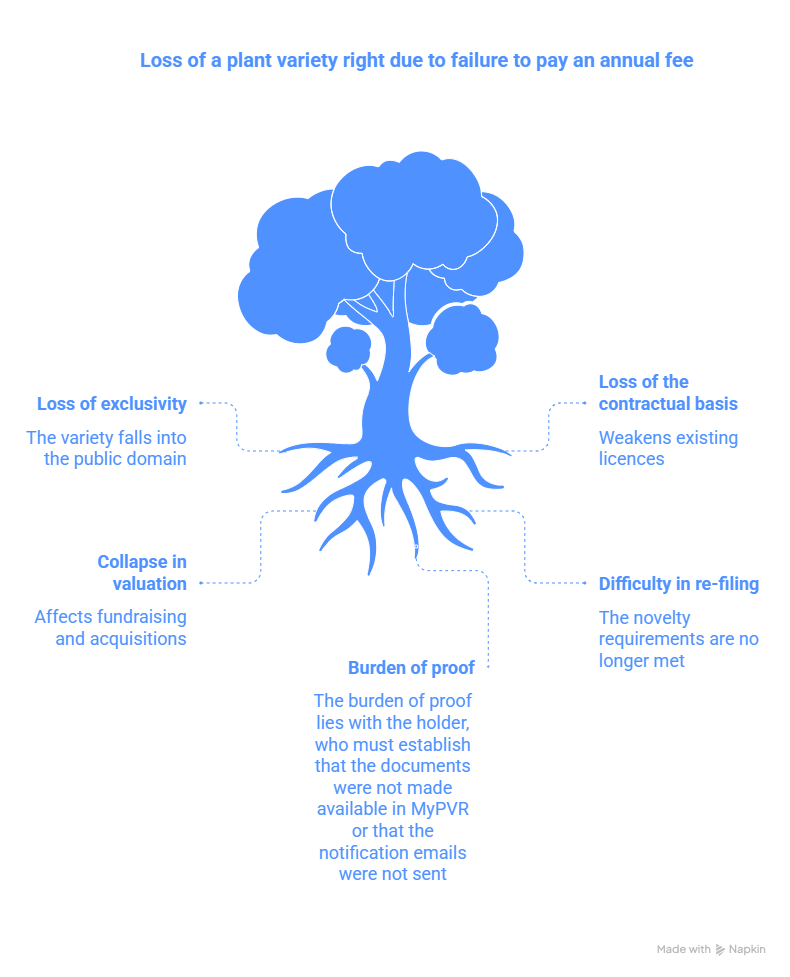
The loss of a plant variety right is never trivial : it produces cascading effects across the holder’s entire contractual and patrimonial ecosystem.
- Irreversible loss of the exploitation monopoly : the variety falls into the public domain and may be freely propagated and marketed by third parties.
- Collapse in the asset’s valuation : forfeiture directly impacts IP due diligence exercises during fundraising rounds, mergers and acquisitions, or licensing transactions.
- Disruption of intellectual property licensing agreements : royalties, warranties, and obligations toward licensees become weakened or extinguished.
- Potential internal liability of the team or service provider in charge of the portfolio, where economic damage can be demonstrated.
- Near-impossibility of refiling : the criteria of novelty and the DUS (distinctness, uniformity, stability) requirements are, in practice, no longer met once the variety has been commercially exploited.
How to prevent forfeiture through alerts and portfolio audits?
Faced with a now uncompromising framework, prevention is non-negotiable. A structured policy of alerts, audits, and internal governance neutralises the risk of forfeiture and sustainably secures the economic value of the variety portfolio.
Setting up an alert system
An effective alert system relies on several independent layers, ensuring that no single failure can cause the loss of the right. We advise our clients to combine the following pillars :
- Continuous updating of the email contact details registered with the CPVO, especially during reorganisations, departures, or changes of administrative contact.
- Internal deadline calendar integrated into a dedicated IP portfolio management software, with automated alerts at 90, 60, 30, and 7 days prior to each deadline.
- Backup oversight by a specialised intellectual property attorney.
Conducting a regular variety portfolio audit
The portfolio audit is a decisive management tool. Carried out annually or biannually, it enables the holder to map the entire set of titles, identify strategic varieties, question whether marginal varieties should be maintained, and rationalise annuity costs. It is also an opportunity to verify the accuracy of MyPVR contact details, test internal alert procedures, and integrate recent regulatory developments, chief among them the Melrose case law. Such audits play a role comparable to IP due diligence exercises conducted during corporate transactions, providing decision-makers with reliable visibility on the portfolio’s resilience.
Conclusion and strategic recommendations
Managing annual fees for plant variety rights is no longer a mere treasury matter : it has become a genuine test of organisational maturity. The Melrose judgment unequivocally confirmed the proactive responsibility of the right holder, endorsed the evidentiary force of MyPVR, and tightened the post-reminder window to one strict month. In a digital environment fully embraced by European institutions, vigilance has become the very condition for the durability of rights.
Dreyfus & Associés assists its clients in managing complex issues related to plant variety rights by offering tailored advice and comprehensive operational support for the implementation and optimization of protection strategies that incorporate all intellectual property tools (plant variety certificates, patents, trademarks, and know-how).
Dreyfus & Associés is partnered with a global network of Intellectual Property attorneys.
Nathalie Dreyfus with the support of the entire Dreyfus team.
Q&A
1. Is the CPVO required to verify that the holder has actually become aware of the reminder before declaring forfeiture ?
No. The CPVO system is based on the principle that notification is deemed effective as soon as it is made available on MyPVR. The Office is not required to prove that the holder has actually taken notice of it. This approach, endorsed by case law, places an increased duty of vigilance on the holder. In practice, failure to consult the platform does not constitute a valid excuse, except in duly proven exceptional circumstances.
2. Can restitutio in integrum still be used to recover a right lost for non-payment ?
Theoretically yes, on the basis of Article 80 of Regulation (EC) No 2100/94, but the Melrose ruling has drastically narrowed its scope. The holder must demonstrate an involuntary and exceptional impediment, unrelated to any negligence in consulting MyPVR or in updating its contact details.
3. Is engaging an attorney mandatory for the payment of annual fees ?
No, but it is strongly recommended. A specialised intellectual property attorney acts as an independent safety net, capable of monitoring MyPVR, anticipating deadlines, and reacting in the event of any technical or organisational issue affecting the holder.
4. Can an internal error (IT failure, staff absence, poor internal communication) justify restitutio in integrum ?
In principle, no. European case law adopts a strict approach : internal failures fall within the holder’s sphere of control and are generally considered negligence. To be admissible, the request must be based on an external, unforeseeable, and unavoidable impediment. This implies that companies must demonstrate the existence of robust internal procedures, including redundancy and control systems.
5. Can forfeiture for non-payment give rise to liability towards commercial partners ?
Yes, and the risk is far from theoretical. The loss of the right may constitute a breach of contractual obligations (warranty of quiet enjoyment, maintenance of the right in force, etc.). It may also trigger tort liability where partners (licensees, distributors) suffer damage. In practice, contracts often include liability or indemnification clauses that may be invoked.
This publication is intended to provide general guidance to the public and to highlight certain issues. It is not intended to apply to specific situations or to constitute legal advice.