

Introduction
China adopted a substantially revised Trademark Law in June 2026. The new legislation, comprising 87 articles, is expected to enter into force on 1 January 2027. It addresses malicious filings, trademark hoarding, deceptive signs, excessive enforcement practices and misconduct by trademark agencies.
Filing activity must reflect a legitimate business rationale
Chinese authorities are seeking to distinguish commercially justified filings from speculative accumulation. Bad faith may be inferred from repeated imitation of third-party signs, large numbers of unexplained applications, appropriation of public resources, infringement of prior rights or systematic squatting.
A company should therefore no longer file extensive lists of marks and goods without being able to justify their utility. We recommend documenting the following at the time of filing:
- the intended use of each mark;
- the relationship between the specification and the planned activity;
- how the sign was selected;
- which clearance searches were performed;
- whether distributors, manufacturers or local partners had prior access to the brand.
These records may become important where an application pattern is challenged as excessive or inconsistent with genuine commercial needs.
Brand owners must supervise enforcement agents
Recent case law also demonstrates that enforcement cannot be outsourced without governance. In a Shanghai case, a trademark owner had issued blank authorizations to an agency and law firm that brought repetitive, profit-driven claims. The owner was held jointly liable because it had failed to exercise reasonable care.
Representatives should identify the relevant infringements, permitted measures, settlement authority, reporting obligations and internal approval thresholds. A brand protection program should remain targeted, documented and proportionate.
A rigorous assessment of a trademark’s validity by the courts
Chinese case law takes a more stringent, but also more fact-based, approach to absolute grounds for refusal.
First of all, deceptive trademarks require an objective misleading effect. Article 10 prohibits signs capable of misleading the public as to the quality, origin or characteristics of goods. However, an assumed association or promotional suggestion does not necessarily establish deception.
MAMBA FOREVER, filed for computer game software, was accepted after the CNIPA refusal was overturned. Although “Mamba” was associated with Kobe Bryant, the expression did not misdescribe an inherent characteristic of the software or objectively mislead purchasers.
Similarly, promotional wording included in a mark for baby nappies was accepted because it remained within ordinary consumer expectations.
The outcome was different for a tea mark combining “1837”, prestige-related French expressions and “THE FINEST TEAS OF THE WORLD”. The sign conveyed potentially inaccurate claims regarding history and exceptional quality. Continued use later resulted in an administrative fine of RMB 400,000, illustrating that an absolute-ground objection may create a use-related compliance risk rather than merely prevent registration.
Second of all, contemporary public perception is increasingly important. A linguistically neutral term may acquire an unlawful or damaging market meaning. The Chinese term BIQUGE had become associated in the online literature sector with piracy-based reading platforms. Its registration was invalidated because that established meaning adversely affected copyright administration and public interests.
Clearance work should therefore cover platform terminology, sector-specific slang, social-media usage and meanings that may have developed after filing.
Penalties for bad faith and trademark squatting
Combating trademark brandjacking in China remains a priority, but the courts are now seeking to ensure that this policy does not penalize bona fide trademark owners.
Knowledge of a trademark acquired through a relationship with a distributor may constitute bad faith. Subsequent commercial use, even if prolonged, does not necessarily validate a fraudulent registration. However, when a trademark initially registered in bad faith is subsequently repurchased by its true owner, some rulings refuse to hold the owner liable for the consequences of the original fraud.
One particularly significant ruling ordered the fraudulent applicant to withdraw its pending applications and have its registrations canceled. This civil injunction could reduce trademark owners’ reliance on a series of administrative opposition, invalidation, and appeal proceedings.
New forms of counterfeiting to anticipate
Virtual and physical goods may be considered related. In the G. Patton case, a car trademark was used on virtual vehicle skins in a video game. The court considered that the absence of a physical product did not automatically exclude similarity. The commercial relationship between the goods and the likelihood that consumers would assume a common source remained decisive.
Businesses in the automotive, fashion, sports, entertainment and luxury sectors should review their protection for virtual objects, gaming content, avatars and immersive environments.
Classification does not override marketplace reality. In the Jinwei dispute, an alcoholic beverage was compared with a well-known non-alcoholic drink. Despite their classification differences, the court examined packaging, sales channels and target consumers and found a significant likelihood of confusion.
Watching only identical goods within the same class will therefore fail to identify material commercial risks.
Upcycling may fall outside trademark exhaustion. A company transformed second-hand luxury bags into new products while retaining visible monograms. The court held that exhaustion did not apply after substantial alteration. Recycling does not authorise a trader to make a third party’s famous mark the central selling point of a materially different product, particularly without a prominent disclaimer.
The effective remedies in China
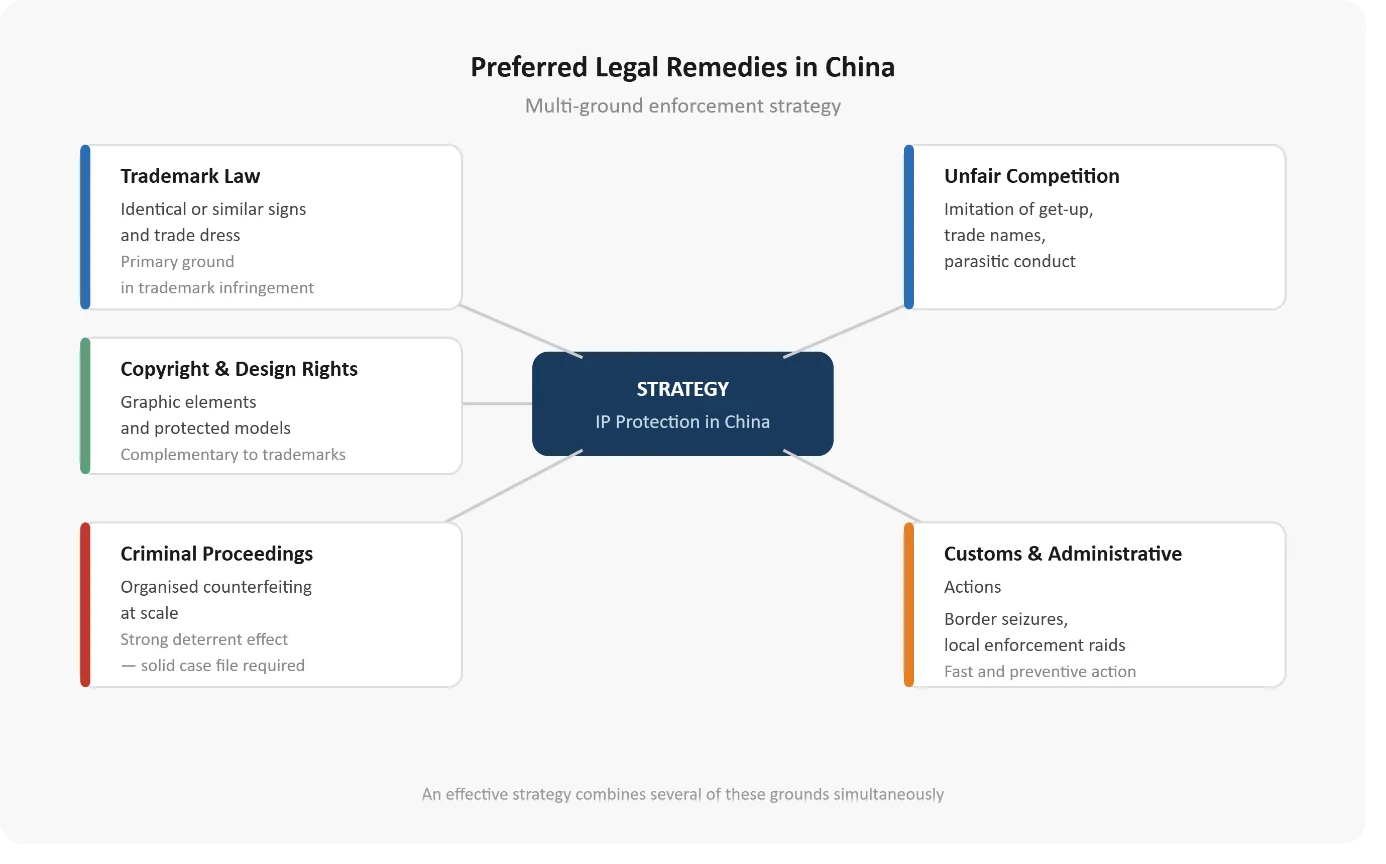
A coordinated Chinese enforcement strategy may combine:
- trademark infringement claims;
- unfair competition proceedings involving imitations of product presentation, trade names, and parasitic conduct;
- copyright or design rights for certain graphic elements;
- Criminal proceedings in cases of organized counterfeiting
- Customs measures and local administrative actions
Courts are showing greater willingness to award punitive damages where infringement is intentional and serious.
Criminal protection has also expanded. The 2025 judicial interpretation issued by the Supreme People’s Court and Supreme People’s Procuratorate clarified the handling of criminal intellectual property cases, including the protection of service marks.
Conclusion
Recent developments in trademark law in China confirm four key trends: stricter regulations on trademark applications, a practical assessment of the market, a diversification of legal remedies, and more deterrent penalties. A regular audit of the Chinese trademark portfolio should therefore cover registered trademarks, pending applications, Chinese translations, digital assets, local partners, and evidence of use.
Dreyfus Law Firm assists its clients in managing complex intellectual property cases, offering personalized advice and comprehensive operational support for the complete protection of intellectual property.
Q&A
Should a Chinese-language version of the trademark be filed?
This is strongly recommended where consumers, distributors or the media use a transliteration or translation of the mark. Otherwise, a third party could appropriate the name used locally.
How can a trademark filed in bad faith be cancelled?
The rights holder may consider opposition proceedings, invalidation proceedings, an action based on prior rights or, depending on the circumstances, a civil action for unfair competition. Evidence of prior dealings and the applicant’s knowledge of the mark will be decisive.
Can a registered trademark be cancelled if it is not used?
Yes. A trademark may be subject to cancellation where it has not been used for three consecutive years without a legitimate reason. The owner must then be able to provide dated and geographically relevant evidence of use directly linked to the goods or services covered.
Which documents should be retained to prove use of a trademark in China?
It is advisable to retain invoices, distribution agreements, customs documents, catalogues, advertisements, screenshots from online sales platforms and photographs of packaging. These materials should show the trademark, the goods concerned, the dates of use and, where possible, the Chinese territory.
Can a company take action against the use of its trademark in a Chinese company name?
Yes. The incorporation of an earlier trademark into a company or trade name may be challenged where it creates a likelihood of confusion or reveals an intention to benefit from the reputation of the rights holder. An unfair competition action may supplement remedies based on trademark law.
This publication is intended for general public guidance and to highest issues. It is not intended to apply to specific circumstances or to constitute legal advice.