

Introduction
The registration of trademark does not depend solely on its distinctiveness or the availability of the sign. A sign may also be refused where it is considered contrary to public policy, morality or, depending on the legal system, the public interest. The assessment of these grounds for refusal can be particularly complex where a trademark has political connotations or refers, directly or indirectly, to public figures. The “Volodya i Medvedi” case provides an interesting illustration: it shows that such an allusion is not, in itself, sufficient to justify a refusal and that the competent authority must carry out a concrete assessment of the sign, the goods and services concerned, the perception of the relevant public and the social context.
The “Volodya i Medvedi” case, a vodka trademark becomes a Russian political case
Facts
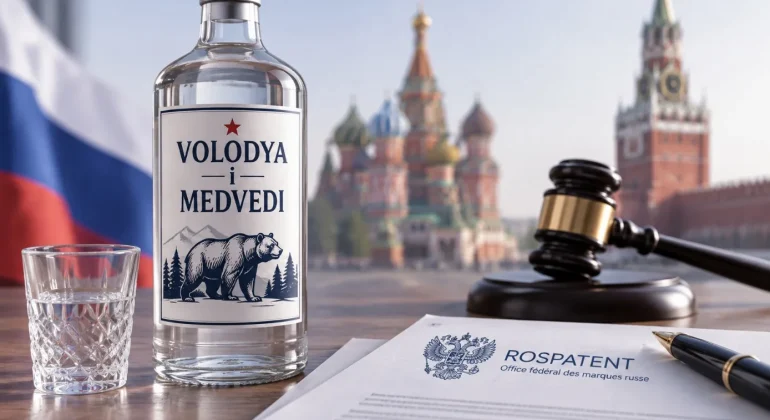
On December 18, 2009, Royalty applied to register the sign “Volodya i Medvedi” for alcoholic beverages, beer, fruit juices and sparkling water.
The expression may be translated as “Volodya and the Bears.” “Volodya” could be understood as a reference to Vladimir Putin, while “Medvedi,” derived from the Russian word for bear, could be associated with Dmitry Medvedev. The bear was also a symbol connected with the United Russia party.
At the filing date, Dmitry Medvedev was President of the Russian Federation and Vladimir Putin was Prime Minister. Rospatent therefore considered that the sign indirectly referred to the country’s two leading political figures.
On October 10, 2010, the Russian trademark office refused the application. It argued that using such a sign for beverages, particularly alcoholic beverages, could damage the image of the State and conflict with the public interest.
Royalty challenged the refusal before the Moscow Commercial Court. It submitted that “Volodya” was a common familiar form of the name Vladimir and that the expression could also refer to a fictional or folkloric story without necessarily identifying Vladimir Putin or Dmitry Medvedev.
Decision
The Moscow Commercial Court upheld Royalty’s claim and declared Rospatent’s refusal unlawful. That outcome was subsequently confirmed on appeal.
The courts found that Rospatent had failed to provide sufficient objective evidence that the mark would actually harm the public interest or the image of the State.
A sociological study submitted during the proceedings indicated that only a limited proportion of respondents both associated the sign with the relevant political figures and considered that its use for vodka could damage the State.
The court did not rule out the possibility of a political allusion. It nevertheless considered that the reference was indirect, ambiguous and insufficient, by itself, to establish a conflict with the public interest.
Following the judicial decisions, the application proceeded to registration as Russian trademark No. 461393 on May 11, 2012.
Significance
The principal significance of the case lies in the limits it places on Rospatent’s discretion. A trademark cannot be refused merely because it humorously, critically or indirectly evokes a political personality.
The trademark authority must establish that the sign, assessed as a whole and in relation to the relevant goods, genuinely conflicts with public interests, principles of humanity or morality.
The case also illustrates the evidential importance of public perception. A linguistic or symbolic connection identified by the trademark office is not sufficient where that connection is not clearly shared by the relevant public.
The ruling does not establish an unrestricted right to commercialise the name or image of a political leader. The direct reproduction of a name, portrait, pseudonym or official emblem may remain subject to separate prohibitions. It nevertheless confirms that a public-policy objection must be based on a contextual, substantiated and legally reasoned assessment.
Companies should assess politically sensitive trademarks
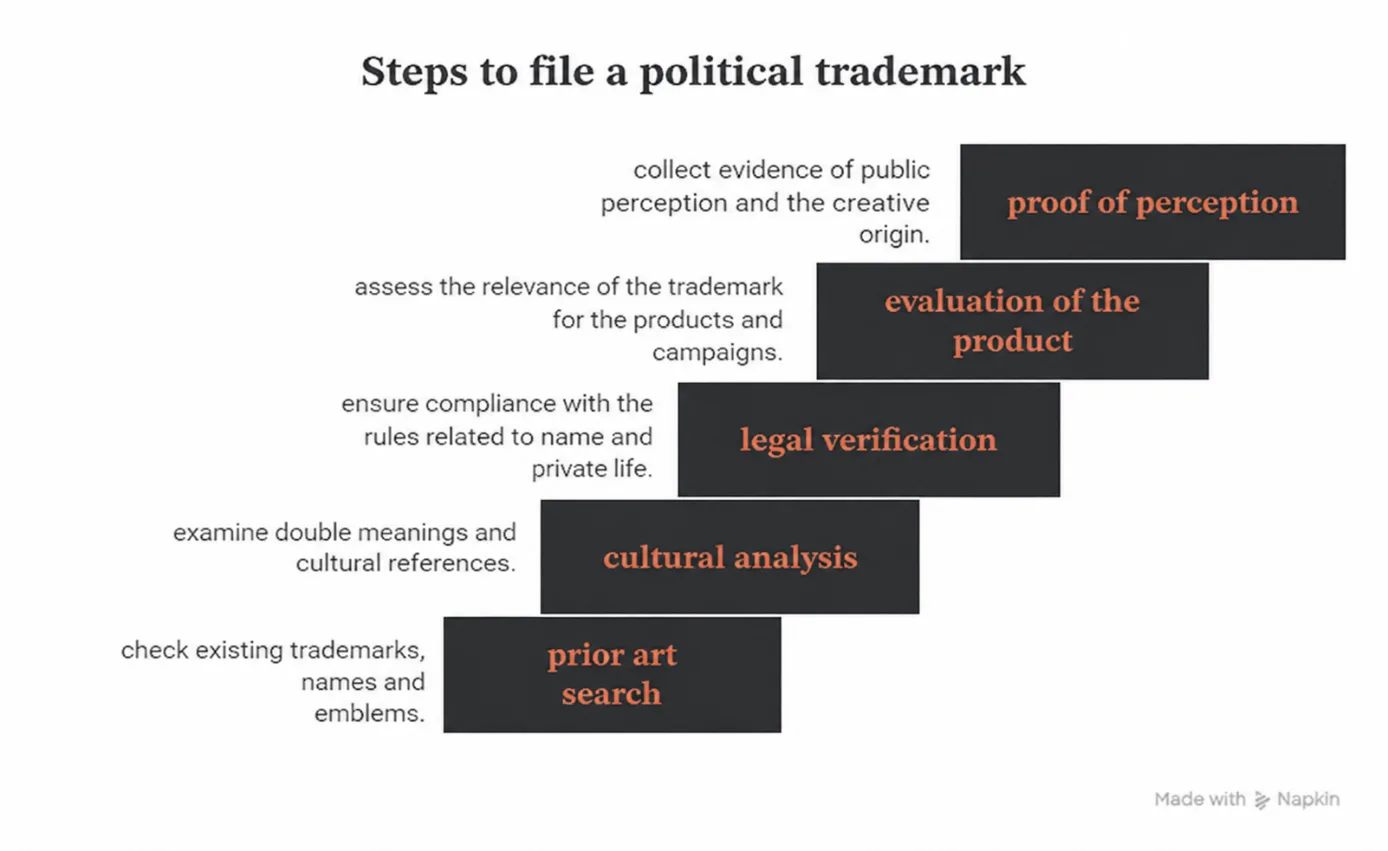
Before filing, we recommend that businesses:
- search earlier trademarks, personal names, pseudonyms and protected emblems;
- investigate translations, transliterations, nicknames and local double meanings;
- review personality, image, privacy and publicity rights;
- assess the trademark together with its packaging and intended advertising;
- document the origin of the name and, where appropriate, obtain evidence of public perception.
International clearance must be conducted territory by territory. A politically suggestive sign accepted in one jurisdiction may be rejected elsewhere because public policy, morality and personality rights are interpreted through local legal and cultural standards.
How does this compare with French and EU trademark law?
Article L. 711-2 of the French Intellectual Property Code provides that a trademark contrary to public policy, or whose use is legally prohibited, cannot be validly registered and may be declared cancelled.
European common-practice materials likewise favour a contextual assessment at the filing date, considering the sensitivity and tolerance of the relevant public. Mere bad taste is not necessarily enough. A refusal should be connected with identifiable fundamental values and supported, particularly in public-policy cases, by reliable and objective sources.
Conclusion
The “Volodya i Medvedi” case remains relevant because it illustrates the evidential limits of a trademark refusal based on an alleged political association. The registration of the trademark does not mean that any reference, even an indirect one, to political figures would necessarily be lawful. Rather, it reflects the fact that Rospatent had failed to demonstrate, in a sufficiently concrete and objective manner, that the use of the sign for the goods concerned was contrary to the public interest.
Dreyfus Law Firm assists its clients in managing complex intellectual property cases, offering personalized advice and comprehensive operational support for the complete protection of intellectual property.
Nathalie Dreyfus with the support of the entire Dreyfus team
Q&A
Can freedom of expression be taken into account when examining a politically sensitive trademark?Yes. In European law in particular, freedom of expression may form part of the relevant legal context. However, it does not create an absolute right to registration and must be balanced against the rules allowing signs contrary to public policy or accepted principles of morality to be refused.
Can a political slogan be registered as a trademark?A political slogan is not, by its very nature, excluded from trademark protection. It must nevertheless satisfy the usual requirements for registration, including distinctiveness, and must not fall within an absolute ground for refusal such as public policy or morality.
Are official emblems or symbols subject to the same rules as references to political figures?No. Certain flags, coats of arms, State emblems and signs of international organisations are subject to specific rules of protection. Their reproduction in a trademark may therefore give rise to an objection independently of any broader assessment of the sign’s political or satirical nature.
Can a change in the political context after filing affect an already registered trademark?The assessment of grounds for refusal is, in principle, closely linked to the circumstances existing at the relevant filing or examination date. A subsequent change in the political context does not therefore automatically result in the loss of trademark rights. However, the manner in which the sign is actually used may raise separate legal issues.
Can a trademark office take current political events into account when assessing a sign?Yes. The interpretation of a political reference may depend on the context existing at the relevant time. Contemporary events, public perception, or the meaning acquired by certain words or symbols may therefore be taken into consideration, provided that the assessment is based on sufficiently objective evidence.
This publication is intended for general public guidance and to highlight issues. It is not intended to apply to specific circumstances or to constitute legal advice.