


Introduction
The significant increase in trademark fees in the Middle East has become a key strategic parameter for any company operating in or planning to expand in the region. Far from being a simple, one-off budgetary adjustment, this development reflects a structural transformation of public intellectual property policies. Several Middle Eastern states have undertaken in-depth reforms of their national trademark offices, resulting in a marked revaluation of filing, registration, renewal, and post-registration fees.
This evolution directly affects the budget planning of international groups, the structuring of their trademark portfolios, and their regional expansion strategies. A rigorous legal and economic analysis is therefore essential to secure intangible investments in these rapidly evolving jurisdictions.
A marked and progressive increase in trademark fees in the Middle East
The first increases: a turning point in the United Arab Emirates
The first significant changes appeared in 2015 in the United Arab Emirates, with a substantial revision of official fees applicable to trademark filings, publications, and registrations. This reform marked a clear break from nearly a decade of relative fee stability.
Subsequently, Kuwait followed a similar trajectory, introducing an even more pronounced increase in administrative costs related to registration formalities. More recently, Bahrain and Syria have also revised their fee schedules upward, affecting filing procedures and pre-registration stages.
In Saudi Arabia, the restructuring implemented by the Saudi Authority for Intellectual Property led to a reassessment of registration and renewal fees as part of a broader economic modernization policy.
These adjustments have reshaped the economic balance of regional trademark protection strategies. The Gulf countries now rank among the most expensive jurisdictions for trademark registration.
An aggravating factor: the single-class filing principle
A significant feature of several Middle Eastern jurisdictions is the requirement to file a trademark application on a single-class basis. Unlike the multi-class system in force within the European Union and other international countries, each class requires a separate application and, consequently, separate official fees.
For companies operating across diversified sectors, this rule has a direct and substantial impact on overall protection budgets. A trademark covering five classes entails five distinct procedures and five sets of official fees.
This structural constraint mechanically amplifies the financial impact of the fee increases observed in recent years.
A more demanding local procedure: strengthened documentary formalities and increased compliance requirements
Beyond official fees, local procedures frequently require the submission of specific documents. Authorities may request legalized powers of attorney, priority documents, or additional certificates depending on the circumstances.
These formalities must comply with strict deadlines. Failure to meet these deadlines may result in refusal of registration or loss of priority rights. In certain jurisdictions, notarization or consular legalization procedures remain mandatory, thereby extending processing times and generating indirect costs.
The regional trend also reflects stricter formal and substantive examinations. Trademark offices now scrutinize applications more rigorously. While this enhances the legal security of registrations, it requires applicants to prepare their filings with greater precision and strategic planning.
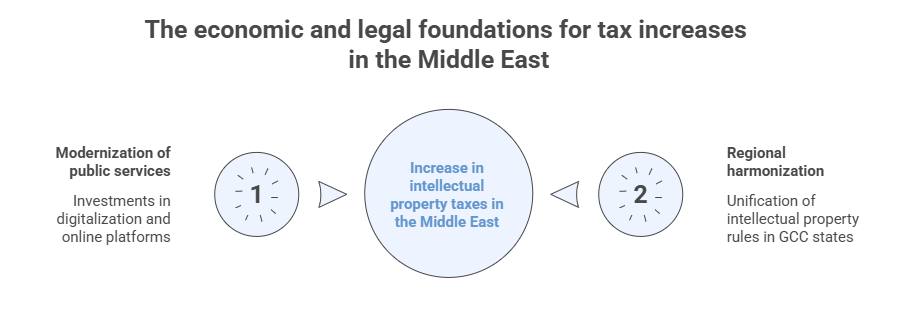
The economic and legal foundations of the fee increase: modernization and regional harmonization
One of the main explanations for the increase in trademark fees lies in the modernization of public intellectual property services. Gulf states have invested heavily in the digitalization of procedures, the creation of online platforms, and improved access to trademark databases.
This administrative upgrading requires additional financial resources, which partly justifies the revaluation of official fee schedules.
The evolution of fees must also be understood within the context of legislative harmonization among the Member States of the Gulf Cooperation Council (GCC). The revised GCC Trademark Law aims to unify substantive rules applicable in Bahrain, Kuwait, Oman, Qatar, Saudi Arabia, and the United Arab Emirates.
Protection remains national in scope and requires a separate filing in each country. Nevertheless, the harmonization of procedural and substantive rules contributes to the modernization and coherence of the regional system.

Strategic consequences for businesses
The significant increase in trademark fees in the Middle East requires companies to reassess their portfolio strategies. Businesses must now make precise determinations regarding priority territories, genuinely exploited classes, and renewal timelines.
A purely expansive filing strategy is no longer economically neutral. Trademark protection must be calibrated in accordance with commercial realities and local competitive risks.
Recourse to the Madrid System, administered by the World Intellectual Property Organization (WIPO), may constitute an alternative for Member States such as Bahrain and Oman. However, it does not cover all Gulf countries, making a jurisdiction-by-jurisdiction analysis necessary.
Conclusion
In light of rising costs, trademark portfolio management must be reconsidered within a comprehensive strategic framework. Companies should identify priority markets, anticipate renewals, and assess the coherence between legal protection and actual commercial exploitation.
Targeted and controlled protection enables businesses to optimize investments while securing intangible assets in high-potential markets. The response cannot be improvised. It must rely on coordinated strategic, financial, and legal analysis, integrating local specificities and commercial objectives.
Dreyfus & Associés assists its clients in managing complex intellectual property matters by providing tailored advice and comprehensive operational support to ensure full protection of intellectual property rights.
Dreyfus & Associés works in partnership with a global network of intellectual property attorneys.
Nathalie Dreyfus with the support of the entire Dreyfus team
Q&A
Which countries are most affected by these increases?
Saudi Arabia and the United Arab Emirates are among the jurisdictions that have implemented the most significant revisions, but other Gulf states have also adjusted their fee schedules.
Do the increases affect renewals as well?
Yes, the increases apply not only to initial filings but also to renewals and post-registration formalities.
Is there a single GCC trademark registration?
No, despite harmonized rules, there is no unitary GCC trademark. Separate filings are required in each country.
What is the Madrid System administered by WIPO?
It allows applicants to file a single international application, in one language, and designate multiple Member States.
Should companies reconsider their filing strategy in the region?
Yes, a strategic review is essential to align protection with commercial objectives and budgetary constraints.
Is it still advisable to invest in trademark protection in the Middle East?
Despite increased costs, the region remains strategically important due to its economic dynamism and role as an international commercial hub.
This publication is intended to provide general guidance and highlight certain issues. It is not intended to apply to specific situations or to constitute legal advice.