

Introduction
Fragrance represents a major economic asset for perfume, cosmetics and luxury companies. Yet its legal protection remains paradoxical: although a perfume formula may embody years of research, investment and expertise, the scent itself is currently neither satisfactorily protected by copyright nor, in practice, registrable as an olfactory trademark in France or before the EUIPO.
Why is a perfume fragrance difficult to protect by copyright?
French courts do not recognise fragrance itself as a copyright work
French copyright law protects original works of authorship regardless of their genre, merit or intended purpose. The principal difficulty with fragrance is therefore not its ephemeral nature, but whether the protected subject matter can be identified with sufficient legal certainty.
In 2006, the French Cour de cassation held that the fragrance of a perfume resulted from the implementation of know-how and did not constitute a form of expression eligible for copyright protection (Cass. 1re civ., June 13, 2006, No. 02-44.718).
The Court confirmed its position in 2013, in the case Lancôme Parfums et Beauté & Cie, GA Modefine and Prestige et Collections International (Cass. com.,December 10, 2013, No. 11-19.872), holding that copyright protects creations in a perceptible form only where that form can be identified with sufficient precision to permit its communication. A fragrance did not meet that requirement.
This reasoning is consistent with the broader European requirement that copyright subject matter must be identifiable with sufficient precision and objectivity. The CJEU adopted a comparable approach concerning the taste of a food product in Levola Hengelo ((CJEU, November 13, 2018 , C-310/17).
Accordingly, a fragrance in itself remains outside French copyright protection, although many elements surrounding a perfume may benefit from separate intellectual property rights.
Can a fragrance be registered as an olfactory trademark?
Removing the graphical representation requirement did not solve the problem
European and French trade mark law no longer require a sign to be represented graphically since the EU Trademark Law reform. However, the sign must still be represented on the register in a manner that allows the subject matter of protection to be determined clearly and precisely. Under French law, the representation must notably be clear, precise, self-contained, easily accessible, intelligible, durable and objective.
This reform initially appeared capable of opening the door to olfactory trademarks. In practice, it has not done so.
The French INPI expressly states that the technical requirements for representing smell and taste signs cannot currently be satisfied and that an odour or taste is therefore not protectable as a trade mark at present. The EUIPO takes the same position: chemical formulae, written descriptions and physical samples do not provide a sufficiently clear, precise and objective representation of a smell.
The previous version of this article therefore requires an important update: abolishing graphical representation did not make olfactory marks effectively registrable in France or at EU level.
Protect the signs through which consumers identify the perfume
Trademark law nevertheless remains central to a fragrance protection strategy. Businesses can protect the perfume name, range name, logos and visual identifiers, and, subject to the relevant requirements, certain distinctive product or bottle shapes.
The filing strategy should be coordinated with monitoring of prior rights and commercial uses.
The bottle and packaging may also qualify for design protection. French Intellectual Property Code expressly provides that the appearance of a product, including packaging, may be protected as a design where the applicable requirements are satisfied.
How can a perfume formula and manufacturing process be protected?
Trade secrets are often the most commercially valuable form of protection
For perfume houses, the principal confidential asset is frequently the formula itself, the proportions of ingredients, manufacturing processes, testing data and research information.
Under Article L.151-1 of the French Commercial Code, information may qualify for trade secret protection where it is not generally known or readily accessible, has commercial value because it is secret, and is subject to reasonable measures designed to preserve its secrecy.
Access to formulas should therefore be restricted, confidential information securely stored and appropriate non-disclosure obligations imposed on perfumers, laboratories, manufacturers, suppliers and commercial partners. WIPO itself identifies the process of making a perfume as information potentially capable of trade secret protection.
Patent or trade secret: a strategic choice
Perfume-related innovation may also qualify for patent protection where it constitutes a new technical invention involving an inventive step and capable of industrial application. Purely aesthetic creations, by contrast, are not patentable as such.
Patents may therefore be relevant to new fragrance molecules, compositions producing a specific technical effect or innovative manufacturing or delivery processes. Patent applications relating to fragrance compositions continue to be filed and published internationally.
The choice between patent and secrecy requires careful assessment: a patent involves disclosure of the invention, whereas a trade secret may potentially remain confidential indefinitely but cannot prevent independent development or certain lawful methods of obtaining the underlying information.
What remedies are available against perfume imitations?
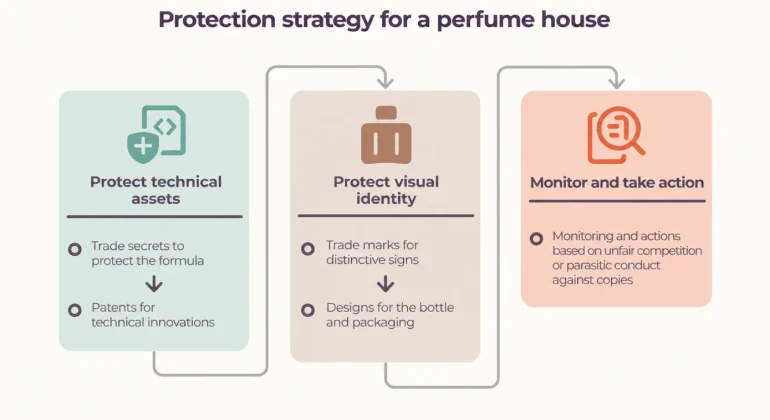
For a perfume house, an effective strategy relies on several complementary tools:
- trade secrets to protect the formula;
- patents for technical innovations;
- trade marks for distinctive signs;
- design rights for the bottle and packaging;
- monitoring and actions based on unfair competition or parasitic conduct to address copies.
This combined approach helps protect all the assets that contribute to the perfume’s value.
Conclusion
Fragrance and intellectual property protection therefore require a nuanced strategy. While the scent itself remains difficult to monopolise, the formula, manufacturing process, name, bottle, packaging and commercial investments surrounding it can each benefit from effective legal protection.
Protection should be organised before disclosure and commercial launch and supported by ongoing monitoring to identify copies, counterfeiting and parasitic practices as early as possible.
Dreyfus Law Firm assists its clients in managing complex intellectual property cases, offering personalized advice and comprehensive operational support for the complete protection of intellectual property.
Nathalie Dreyfus with the support of the entire Dreyfus team
Q&A
1. Is it lawful to chemically analyse a competitor's perfume in order to identify its formula?
It may be. French trade secret law expressly recognises observation, study, disassembly or testing of a product made available to the public or lawfully possessed as lawful means of obtaining information, subject in particular to applicable contractual restrictions. Chemical analysis of a commercially available perfume does not therefore automatically constitute unlawful acquisition of a trade secret.
2. Who owns a formula developed by an independent perfumer for a perfume house?
Payment for the development work should not be assumed to resolve every issue concerning ownership, confidentiality and further use. The agreement should identify the results of the assignment, confidential information, any rights relating to technical inventions and the conditions under which the formula or underlying know-how may subsequently be reused.
3. Can a “dupe” brand state that its fragrance is equivalent to a famous perfume?
As a matter of principle, a “dupe” brand may not present its fragrance as the “equivalent”, “imitation” or “reproduction” of a fragrance marketed under a protected trademark. Such a presentation is liable to go beyond the limits of lawful comparative advertising, even in the absence of any likelihood of confusion. The comparison must also remain objective and non-misleading and must not take unfair advantage of the reputation of the competing trademark.
4. Does the trade mark of a discontinued perfume remain protected indefinitely?
Not necessarily. Under French law, a trade mark proprietor may face revocation where the mark has not been put to genuine use for the relevant goods or services for an uninterrupted period of five years, without proper reasons for non-use. Discontinuing a fragrance should therefore be accompanied by a review of the relevant trade mark portfolio and available evidence of use.
5. Can an e-Soleau filing protect a perfume formula?
An e-Soleau filing may be useful for establishing a certain date and preserving evidence that a formula, R&D development or related documentation existed at a particular time. It does not, however, create an exclusive intellectual property right and cannot replace either patent protection or an appropriate trade secret strategy.
This publication is intended for general public guidance and to highlight issues. It is not intended to apply to specific circumstances or to constitute legal advice.