
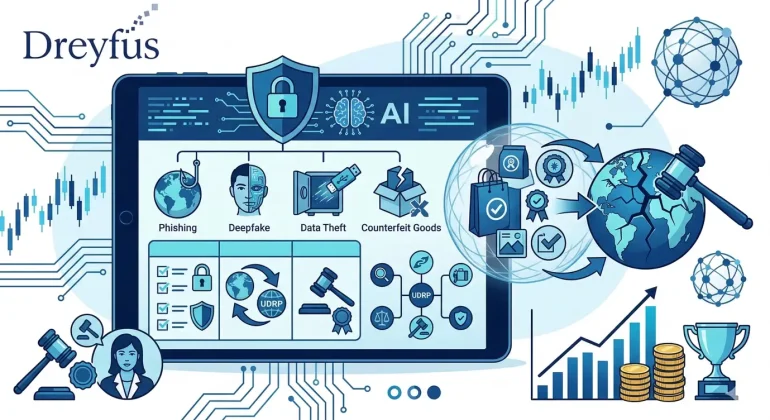

In 2024, France’s National Cybersecurity Agency (ANSSI) handled 4,386 security events, a 15% increase over 2023, and confirmed 1,361 successful malicious attacks. Meanwhile, CNIL received 5,629 data breach notifications, up 20%. These figures reveal a reality that intellectual property rights holders can no longer ignore : cyber threats are directly targeting companies’ intangible assets.
Dreyfus a firm specializing in intellectual and industrial property, integrates cybersecurity into each of its advisory and support services. Nathalie Dreyfus, a court-appointed expert accredited by the French Supreme Court (Cour de cassation, Trademark specialty) and the Paris Court of Appeal (Trademarks and Designs specialty), brings this expertise to bear through a legal approach adapted to the realities of cyberspace.
This article analyzes the main cyber threats to intellectual property assets, the applicable legal framework, and concrete solutions to protect your trademarks and sensitive data.
- Protection against phishing, trademark impersonation and trade secret theft
- Compliance with regulatory obligations : NIS2, GDPR, AI Act
- Defense against digital counterfeiting on marketplaces and social media
- Anticipation of emerging threats related to generative AI and deepfakes
- Comprehensive legal support, from prevention to litigation, by a court-appointed expert
Sommaire
Cyber threats targeting intellectual property
Phishing and trademark identity theft
Phishing is one of the most widespread and damaging threats for trademark holders. Malicious actors register domain names imitating well-known trademarks to create fraudulent websites designed to collect personal or banking data. In 2025, WIPO recorded a historic high of 6,282 domain name disputes, a growing share of which involve phishing schemes. Domain name monitoring enables early detection and action before damage materializes.
Theft of trade secrets and sensitive data
Cyber intrusions frequently target confidential information related to intellectual property : formulas, manufacturing processes, patent filing strategies, and client databases. ANSSI documented 144 ransomware compromise cases in 2024, involving 39 different strains (LockBit 3.0, RansomHub, and Akira leading). Personal data protection and GDPR compliance are integral parts of any cybersecurity strategy.
Digital counterfeiting and marketplaces
Online commerce platforms facilitate the global distribution of counterfeit products. The 2025 joint EUIPO-OECD report estimates the global counterfeit trade at $467 billion, representing 2.3% of worldwide imports and up to 4.7% of European Union imports. The French cosmetics industry alone suffers €800 million in annual losses. Online trademark protection requires active monitoring and rapid content removal actions on these platforms.
Emerging threats : generative AI and deepfakes
The rise of generative artificial intelligence adds another layer of complexity. Deepfake technologies can reproduce logos, packaging, and visual identities with unprecedented realism, facilitating the creation of fake websites and advertisements. AI systems can also automatically generate thousands of domain name variations targeting a trademark , rendering manual monitoring entirely insufficient. According to ENISA, 35% of social engineering attacks in Europe now use AI-generated content to enhance their credibility.
The legal framework : bridging cybersecurity and IP law
Cybersecurity in the context of intellectual property relies on a rapidly evolving European regulatory framework. The NIS2 Directive, transposed into French law, strengthens corporate security obligations and broadens the scope of affected entities. GDPR governs personal data processing, while the AI Act introduces new requirements. Dreyfus commands the full range of these regulations through its expertise in compliance.
In the blockchain and Web 3.0 space, new issues are emerging around the protection of decentralized digital assets. NFTs, smart contracts, and decentralized autonomous organizations (DAOs) raise unprecedented questions regarding ownership and counterfeiting. The firm has developed dedicated expertise in Web 3.0 asset protection, covering NFT law, blockchain, and related compliance.
An integrated approach : Dreyfus’ services
Facing the convergence of intellectual property and cybersecurity, Dreyfus deploys a cross-functional approach covering the entire lifecycle of intangible assets, from prevention to remediation.
Upstream, prior art searches verify sign availability before any filing, limiting the risk of future conflicts. Trademark and design filing and renewal are accompanied by a reflection on digital naming strategy and the protection of sensitive variants.
Active portfolio management involves continuous monitoring of domain names, trademark registries, and digital spaces (social media, app stores, marketplaces). When an infringement is detected, the firm implements the appropriate procedures : cease and desist letters, UDRP proceedings, host notifications, or legal actions.
For contentious situations, expertise in counterfeiting and unfair competition enables effective defense of corporate rights before the competent courts. The firm’s experience in conducting French trademark oppositions and European trademark oppositions complements this framework.
A strategic collaboration with business law attorneys
Cybersecurity and intellectual property issues sit at the crossroads of several legal specialties. Business law attorneys facing cases involving digital IP dimensions find in Dreyfus a natural partner whose expertise complements their own.
Whether securing an M&A deal involving sensitive digital assets, assisting a client who is the victim of a cyberattack targeting their trademarks, structuring an international protection strategy, or assessing the impact of a data breach on an IP portfolio, Dreyfus ’ network of specialized attorneys offers a cooperation framework adapted to each situation.
The designation as a court-appointed expert recognized by the French Supreme Court and the Paris Court of Appeal gives the firm particular credibility in cases requiring technical expertise before the courts. This dual legitimacy—legal and technical—is a decisive advantage for business lawyers seeking solid support on digital IP matters.
Conclusion
The convergence between cybersecurity and intellectual property is no longer a trend,it is a daily reality. Companies that neglect this intersection expose themselves to financial losses, reputational damage, and increasingly severe regulatory penalties.
Dreyfus provides an integrated response to these challenges, combining intellectual property legal expertise with mastery of cybersecurity issues. Contact us to secure your digital assets against current and future threats.
Q&A
What is the link between cybersecurity and intellectual property ?
Cybersecurity protects the digital infrastructure that hosts and exploits intellectual property assets. A security breach can lead to the theft of trade secrets, trademarkimpersonation, distribution of counterfeit products, or compromise of client data linked to licenses. The two disciplines are complementary and must be addressed together.
What actions can be taken to combat domain name abuse and phishing targeting a trademark ?
The first step is domain name monitoring to detect fraudulent registrations. Rapid actions then follow : cease and desist letters, UDRP proceedings, reports to hosts and registrars. Implementing email authentication protocols (SPF, DKIM, DMARC) further strengthens protection by preventing domain spoofing for sending fraudulent emails.
Does the GDPR make it more difficult to identify the registrants of abusive domain names ?Yes. GDPR has significantly reduced access to domain name WHOIS data, making it more difficult to identify holders of abusive domain names. Specific mechanisms, such as RDAP (Registration Data Access Protocol) or disclosure procedures with registrars, nevertheless allow this information to be obtained in the context of defending intellectual property rights.
What does the NIS2 Directive require of French companies ?
The NIS2 Directive broadens the scope of entities subject to enhanced cybersecurity obligations. It notably requires an early notification within 24 hours, the implementation of risk management measures, and executive liability. For companies holding critical IP assets, these obligations provide a structural framework that aligns with best practices in intellectual property protection.
Why should a business lawyer collaborate with an IP specialist on cyber issues ?
Cases involving cyberattacks on IP assets require dual expertise : business law for managing contractual risks, regulatory compliance, and corporate implications, and IP law for identifying, protecting, and defending rights. This collaboration ensures comprehensive treatment of each situation and avoids legal blind spots that could prove costly.