


Introduction
On 1 June 2025, the revised Regulations of the People’s Republic of China on the Protection of New Plant Varieties entered into force. Adopted in April 2025 by the Executive Meeting of the State Council, this text constitutes the first major revision since the promulgation of the original Regulations in 1997.
This reform reshapes the entire architecture of Chinese plant variety rights law by extending the scope of protection, introducing new mechanisms aligned with the international standards of the International Union for the Protection of New Varieties of Plants (“UPOV”), and substantially strengthening the enforcement tools available to right holders.
A Reform context driven by the growth of the seed industry
China’s seed industry has experienced spectacular growth over the past two decades, establishing itself as one of the key drivers of national food security. By the end of 2024, Chinese authorities had recorded more than 12,000 applications for plant variety protection, including nearly 6,000 grants. This exponential growth highlighted the shortcomings of the regulatory framework then in force.
The 2025 revision also forms part of an effort to align the Regulations with the Seed Law of the People’s Republic of China, as revised in 2021, several provisions of which had created inconsistencies with the 1997 Regulations. This is therefore a systemic reform designed to ensure consistency across the entire legislative and regulatory framework governing the protection of plant innovation in China.
Extension of the scope of protection: from propagating material to harvested products
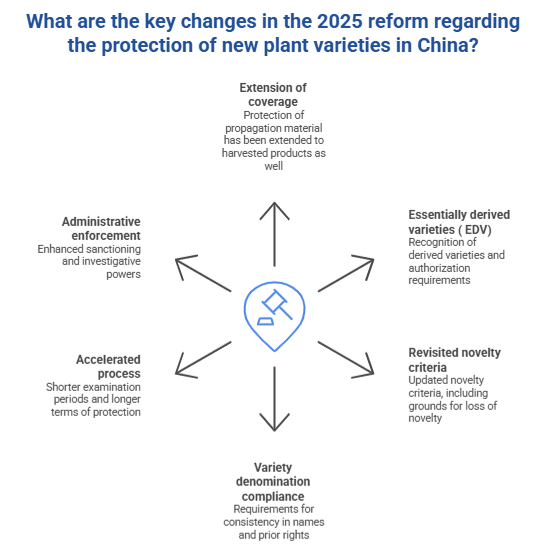
The most significant development lies in the considerable broadening of the scope of protection. Until now, only propagating material seeds, cuttings and seedlings was covered. Harvested products fruits, flowers and grains now also fall within the scope of protection where they have been obtained from unauthorised material.
This extension addresses a practical issue: the distinction between propagating material and harvested products was frequently exploited by infringers who marketed harvested products directly without ever selling seeds, thereby evading enforcement action.
In addition, the list of acts requiring authorisation has been substantially expanded. Beyond production and sale, the Regulations now cover processing for propagation purposes, offering for sale, importation, exportation and storage.
Introduction of essentially derived varieties ( EDV) into chinese administrative law
This is one of the innovations most anticipated by the international breeder community. The system of essentially derived varieties (“EDVs”) has been incorporated into the Chinese regulatory framework for the first time. Under this regime, any commercial exploitation of a variety that is essentially derived from a protected variety requires the prior authorisation of the holder of the rights in the initial variety.
The determination of EDV status is based on a combination of molecular testing and phenotypic assessment, with the possibility of examining the breeding process in the event of a dispute.
In October 2025, the Supreme People’s Court of the PRC issued two leading judgments, No. 1201 and No. 44 of 2024, endorsing a comprehensive approach to varietal identification. The courts no longer confine themselves to isolated molecular analysis reports; they now assess all relevant constituent elements, including the identity of varietal denominations, similarity of key morphological traits and additional documentary evidence.
Reconsidering novelty: new grounds for loss of rights
The Regulations also introduce several new circumstances capable of affecting the novelty of a variety, a concept that is decisive for obtaining a protection title. These new grounds for loss of novelty are aligned with the 2021 Seed Law and warrant particular attention from applicants:
- the promotion of propagating or harvested material for more than one year in China before the filing date, or for more than four or six years abroad depending on the species;
• official recognition that a variety has reached widespread cultivation, assessed on the basis of the cultivated area;
• approval or registration of a crop variety for more than two years without any application for protection having been filed.
It should be emphasised that recent case law has introduced an important qualification in this respect. According to the Supreme People’s Court, judgment No. 891 of 2024, unauthorised dissemination by a third party cannot be attributed to the right holder and does not affect the novelty of the variety. This clarification is essential for breeders who fall victim to unlawful disclosures.
Compliance of denominations and prior rights: A strategic issue for applicants
The Regulations now impose a requirement of consistency in denominations throughout the life cycle of a variety: the application for protection, approval, registration, marketing and promotion must all use one and the same denomination. The Regulations expressly prohibit denominations that infringe third-party prior rights, including trademark rights.
This provision requires applicants to exercise increased diligence upstream. It is now essential to conduct a cross-clearance search covering both existing varieties and registered trademarks before filing, failing which the application may be rejected during preliminary examination.
In practice, any applicant must now carry out an in-depth search covering both previously registered plant variety denominations and third-party trademarks likely to give rise to confusion. Failure to do so exposes the applicant to rejection at the preliminary examination stage, with the resulting loss of time and resources.
An accelerated examination process and extended terms of protection
Reduction of the preliminary examination period
The Regulations reduce the preliminary examination period for protection applications from six months to three months, with a possible three-month extension for complex cases. This reduction is far from incidental: pursuant to Article 34 of the Regulations, the applicant may claim retroactive compensation for acts carried out between publication of the preliminary approval and grant of the final certificate.
Reducing this period therefore mechanically shortens the window of uncompensated exploitation and enables faster market entry in an economy where time-to-market is decisive.
Terms of protection harmonised with UPOV 1991
The term of protection has been increased to 25 years for trees and vines, as opposed to 20 years previously, and to 20 years for all other species, as opposed to 15 years previously. This extension aligns with Article 19 of the 1991 Act of the UPOV Convention, although China remains a signatory to the 1978 Act.
However, some uncertainty remains: the Regulations do not expressly state whether these new terms apply retroactively to rights already granted. The right holders concerned will therefore need to monitor future administrative guidance clarifying this point.
Strengthened administrative enforcement
The reform is not limited to the expansion of substantive rights; it also profoundly overhauls the administrative enforcement mechanism. Three structural developments deserve particular attention:
- First, sanctioning powers have been transferred from the provincial level to the county level, thereby bringing the competent authority closer to the field and promoting greater responsiveness to infringements.
- Secondly, the ceiling for administrative fines has been doubled: the maximum fine has increased from five to ten times the value of the infringing goods, together with a newly introduced minimum fine of RMB 10,000.
- Thirdly, administrative authorities have been granted extended investigative powers, including access to production premises, sampling, sealing and seizure of equipment and stocks. These prerogatives, previously reserved to the courts, give administrative authorities an unprecedented capacity to collect evidence.
Conclusion
China’s reform of the protection of new plant varieties marks a decisive turning point in the structuring of plant variety rights law in Asia.
By broadening the scope of protection, introducing the system of essentially derived varieties and equipping administrative authorities with genuine investigative powers, China is sending a strong signal to the international breeder community: the Chinese market now intends to offer a competitive and reliable legal environment for varietal innovation.
FAQ
1. Which plant varieties are protectable in China since the 2025 reform?
Since the revised Regulations entered into force on 1 June 2025, protection extends not only to traditional propagating material, such as seeds and seedlings, but also to harvested products such as fruits and flowers, provided that they have been obtained from unauthorised material. This considerably broadens the range of varieties and acts covered by protection.
2. What is an essentially derived variety under Chinese law?
An essentially derived variety is a variety which, while displaying distinctive characteristics, retains the essential genetic material of an initial protected variety. The 2025 Regulations now provide that the commercial exploitation of such a variety is subject to the authorisation of the holder of the rights in the initial variety. EDV qualification is based on molecular testing, phenotypic assessment and, where necessary, analysis of the breeding process.
3. How does the reform strengthen rights enforcement in the event of infringement?
The Regulations decentralise sanctioning powers to county-level authorities in order to allow faster responses in the field. The maximum fine has been increased to ten times the value of the goods at issue, with a newly introduced minimum fine of RMB 10,000. The authorities also have broader inspection powers, including the ability to conduct seizures and seal premises.
4. Does the 2025 reform apply to varieties already protected?
The question of the retroactive application of the new terms of protection remains open. The Regulations contain no express provision on this point. It is likely that only varieties for which the application is filed, or the title granted, after 1 June 2025 will benefit from the extended terms — 25 years for trees and vines, and 20 years for other species. Administrative clarification is expected.
5. What risks does an applicant incur if no prior search is carried out for the denomination of its variety?
Since the reform, varietal denominations must remain consistent across all procedures and must not encroach upon third-party prior rights, including registered trademarks. Failure to carry out a prior search exposes the applicant to rejection during preliminary examination, as well as to subsequent disputes with trademark holders. Such verification is therefore indispensable before any filing.
This publication is intended to provide general guidance to the public and to highlight certain issues. It is not intended to apply to specific circumstances or to constitute legal advice.