


Introduction
In practice, many companies believe that owning a trademark is sufficient to recover an identical domain name. The Sunshine case on domain names clearly contradicts this assumption. In its decision of June 9, 2009, the French Supreme Court (Cour de cassation) set clear limits: the transfer of a domain name can neither be automatic nor easily obtained through summary proceedings.
In a digital environment where domain names represent strategic assets, this decision requires companies to exercise heightened vigilance and to rethink their protection strategies. We provide here an in-depth analysis of this ruling and its practical implications for rights holders.
Legal background of the Sunshine case
The case reflects a common situation in practice, involving on one side a trademark owner, and on the other, a domain name holder.
In this case:
- A “Sunshine” trademark was registered in 2001 for clothing and footwear
- A third party registered the domain name sunshine.fr in 2005
Considering that this domain name infringed its rights, the trademark owner initiated summary proceedings to obtain its transfer.
By an order dated 13 July 2007, the Paris Tribunal de grande instance refused to order the transfer of the domain name sunshine.fr and also dismissed any claim of abuse in the proceedings.
The judge noted that the domain name had been registered in 2005 for the needs of a company that was indeed incorporated that same year, and above all prior to the entry into force of the decree of 6 February 2007.
He concluded that the alleged disturbance was not manifestly unlawful, which is an essential condition for summary proceedings. The claim was therefore dismissed, and the parties were referred to proceedings on the merits to resolve the issue of the likelihood of confusion with the trademark.
The Paris Court of Appeal ruled in its favour by applying the Decree of February 6, 2007, this text, which entered into force after the registration of the disputed domain name, now requires its holder to demonstrate either a right or a legitimate interest in holding that name.
Relying on this new regulatory requirement, the court found that the holder of the domain name sunshine.fr had failed to provide sufficient evidence of such a right or legitimate interest. It therefore concluded that maintaining the registration was unlawful and upheld the claim, thereby reflecting a strict interpretation of the new rules introduced by the decree. However, this analysis was subsequently overturned.
Prior to the entry into force of this decree, domain name allocation was primarily based on a technical approach governed by the “first come, first served” principle, with little control over prior rights.
Key legal principles established by the Sunshine case and domain names
The Sunshine decision of June 9, 2009, builds on existing case law by reiterating several well-established principles:
A fundamental rule: no retroactive application of the law
The French Supreme Court reaffirmed a core principle of French law under Article 2 of the Civil Code: a new law cannot undermine a situation that was lawfully established. In other words, a domain name that was properly registered before a new regulatory framework took effect cannot be challenged on the basis of that framework.
Trademark ownership does not grant automatic rights over a domain name
The Court of Cassation also notes in this ruling that simply holding a trademark does not automatically entitle one to recover a domain name and is not sufficient to establish infringement.
The Court also referred to Article R. 20-44-45 of the French Postal and Electronic Communications Code, which provides that the registration or renewal of a domain name may be challenged when it infringes third-party rights (notably a trademark), or the holder lacks a right or legitimate interest. A concrete, fact-based analysis is therefore required.
The decision imposes a particularly high evidentiary standard.
The ruling also requires that the a trademark owner seeking the transfer of a domain name must now demonstrate bad faith, either at the time of registration or during its use.
However, these points serve more as reminders of existing law than as genuine contributions
The central contribution of the decision: limiting recourse to summary proceedings
The main significance of the Sunshine decision lies in the French Supreme Court’s procedural analysis. Referring to Article 809 of the Code of Civil Procedure, the Court reiterates that a judge in summary proceedings may only order protective measures or measures to restore the status quo aimed at preventing imminent harm or putting an end to a manifestly unlawful disturbance.
However, the Court held that the transfer of a domain name cannot be classified as such a measure. Indeed, such a decision is not provisional in nature but produces definitive effects by altering ownership of the domain name. By ordering this transfer, the Court of Appeal had therefore exceeded the powers vested in it.
Through this decision, the French Supreme Court puts an end to a widespread practice consisting of using summary proceedings to quickly obtain the transfer of a domain name. It thus endorses a strict interpretation of the role of the summary judge, incompatible with measures that effectively resolve the dispute on the merits.
A reshaping of strategies in domain name disputes: towards faster and more efficient alternative routes
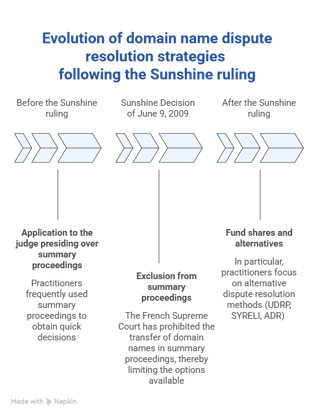
Before the Sunshine decision, recourse to summary proceedings was a common reflex. This procedural route made it possible to obtain decisions within relatively short timeframes, with immediate impact on the disputed situation. The possibility of securing a transfer through summary proceedings—even if debated—offered a significant strategic advantage.
The position adopted by the French Supreme Court in this decision has profoundly altered this balance. By excluding transfers from the scope of measures that may be ordered in summary proceedings, it deprives rights holders of a particularly effective procedural tool.
This shift has led practitioners to rethink their strategies. Judicial litigation remains available, but it is now primarily conducted through proceedings on the merits, which are longer and require a higher standard of proof. These actions, however, have the advantage of allowing for the award of damages, which extrajudicial procedures do not provide.
At the same time, there has been significant growth in the use of alternative dispute resolution mechanisms, such as:
- UDRP (international level),
- SYRELI (AFNIC) – for a better understanding of the strategic importance of the .fr domain in this context, see our dedicated article: Why .fr is becoming a key lever of digital sovereignty,
- ADR.
The 2025 Comprehensive Guide to Domain Name Disputes outlines all available avenues.
These mechanisms, specifically designed for domain name disputes, offer speed and efficiency well suited to the digital environment. In particular, they allow for the transfer of a domain name within relatively short timeframes, without the need to initiate full judicial proceedings.
Thus, the Sunshine decision has indirectly, yet decisively, encouraged the use of these specialized mechanisms.
Conclusion
The Sunshine case on domain name transfers requires a renewed understanding of the relationship between trademark law and the digital environment.
It establishes the primacy of prior registration, a reinforced requirement to prove good or bad faith and the need for a proactive and strategic approach
Rights holders must therefore anticipate and actively manage their digital assets.
Dreyfus & Associates assists its clients in managing complex intellectual property matters by providing tailored advice and comprehensive operational support to ensure the full protection of intellectual property rights.
Dreyfus Law Firm works in partnership with a global network of intellectual property attorneys.
Nathalie Dreyfus, with the assistance of the entire Dreyfus team.
Q&A
1. Why should domain names be registered at the same time as a trademark?
Because the “first come, first served” principle remains decisive. A domain name registered earlier even by a third party can be difficult to recover without proof of bad faith.
2. How does the Sunshine case impact trademark strategy?
It imposes a proactive approach. Trademark owners can no longer rely on recovering domain names after the fact and must secure their digital assets in advance.
3. Who bears the burden of proof in domain name disputes?
The burden of proof lies entirely with the claimant. The trademark owner must demonstrate both infringement and the domain holder’s bad faith.
4. What does good faith mean in domain name law?
It implies legitimate use, without any intention to unfairly benefit from another party’s reputation.
5. What best practices should be adopted to protect domain names?
Companies should implement a structured strategy: register strategic domain names (including variations and extensions) , monitor third-party registrations and centralize the management of their domain name portfolio
This publication is intended to provide general guidance and highlight certain legal issues. It is not intended to apply to specific situations or to constitute legal advice.