

Introduction
The title of a book, film, podcast, video game or digital creation often embodies a substantial part of its commercial value. It enables audiences to identify the work, supports its promotion and may become the foundation of a franchise or merchandising programme. Nevertheless, no single legal mechanism provides absolute protection for a title.
An effective strategy normally combines copyright law where the title is original, trade mark protection where it indicates commercial origin, evidence preservation, contractual arrangements and, where appropriate, unfair competition or parasitic conduct claims.
The protection of a work by copyright law
Originality is the decisive requirement. Under Article L. 112-4 of the French Intellectual Property Code, an original title is protected in the same way as the work itself. Protection arises automatically, without registration, provided that the title results from free creative choices and possesses an individual character.
Novelty alone is insufficient. A title may never have been used before and still remain commonplace, descriptive or exclusively composed of ordinary words. Conversely, an unexpected association, unusual structure, linguistic contrast or creative wordplay may demonstrate originality.
An author relying on copyright should therefore identify the specific creative choices reflected in the title. A general assertion that the title is unique or personal will rarely establish originality.
The importance of documenting the title’s creation date
Copyright exists without filing, but enforcement requires evidence of authorship and creation date. Drafts, research notes, successive versions, editorial correspondence and timestamped files should therefore be retained.
The INPI’s e-Soleau service, a formal record or deposit with a judicial officer or notary , or registration with a collecting society may strengthen evidence of prior creation. These measures do not create copyright and do not establish originality by themselves; their principal purpose is to record the existence of particular material on a specific date.
Registration of the title of a work as a trade mark
The title must indicate commercial origin. Trade mark law serves a different purpose. A trade mark does not protect a title merely because it identifies an artistic work. It protects the sign where consumers perceive it as distinguishing the goods or services of one undertaking from those of others.
The sign must therefore be distinctive, available and not exclusively descriptive of the relevant goods or services. French law excludes signs that lack distinctive character or consist exclusively of indications describing characteristics of the goods or services concerned.
A title may consequently be original for copyright purposes but descriptive under trademark law. Conversely, a title that is insufficiently original for copyright protection may still be registered as a trade mark if it performs a distinctive commercial function.
Registration is particularly valuable where the title identifies a series, collection or franchise; several books, films, podcasts or games marketed under a common banner; publishing, production, entertainment or educational services; merchandising or licensed products; a creative universe intended for exploitation across several media.
A clearance search should be conducted before launch. It should cover identical and similar trademarks, existing titles, company names, trade names, domain names and earlier copyright. Article L. 711-3 of the French Intellectual Property Code expressly recognises several of these rights as earlier rights capable of preventing registration.
The ANIMAL FARM and 1984 decision: what limits apply to famous titles?
Facts
On March 6, 2018, the Estate of the Late Sonia Brownell Orwell applied to register ANIMAL FARM and 1984 as European Union word trademarks. The applications covered, among other things, audiovisual and digital media, publications, printed material, games and educational and entertainment services.
Following partial refusals by the EUIPO in 2019, the appeals were referred to the Grand Board of Appeal because of divergent approaches to the registrability of famous work titles. The cases were ultimately joined.
The Grand Board’s decision
In its decision ANIMAL FARM and 1984 of May 27, 2026 (R 1719/2019-G and R 1922/2019-G), the Grand Board upheld the refusal for goods and services capable of containing, communicating, adapting or exploiting the content of the novels.
A significant part of the relevant public would immediately recognise ANIMAL FARM and 1984 as the titles of George Orwell’s works. When used for books, recordings, digital publications, games or entertainment services, the signs would therefore be understood as describing the subject matter or content offered, rather than identifying the undertaking responsible for those goods or services.
The reasoning reflects a fundamental distinction:
- a work title identifies an intellectual creation;
- a trademark identifies the commercial origin of goods or services.
The fame of a title is not an independent ground for refusal. However, extensive recognition may reinforce the public’s perception of the sign as the designation of a work rather than a badge of commercial origin. To overcome that perception, an applicant would need convincing evidence that consumers have been educated through use to perceive the title as a trade mark.
Practical significance
The decision does not establish a general prohibition on registering titles as trademarks. Registrability remains dependent on the goods and services concerned.
A title may be refused for books or audiovisual content while remaining registrable for sufficiently unrelated products.
The decision therefore calls on applicants to assess the position on a product-by-product and service-by-service basis. Overly broad applications should be avoided, the categories selected should correspond to a genuine intended use, and, for each category, it should be determined whether the title will be perceived as content or as a trade mark.
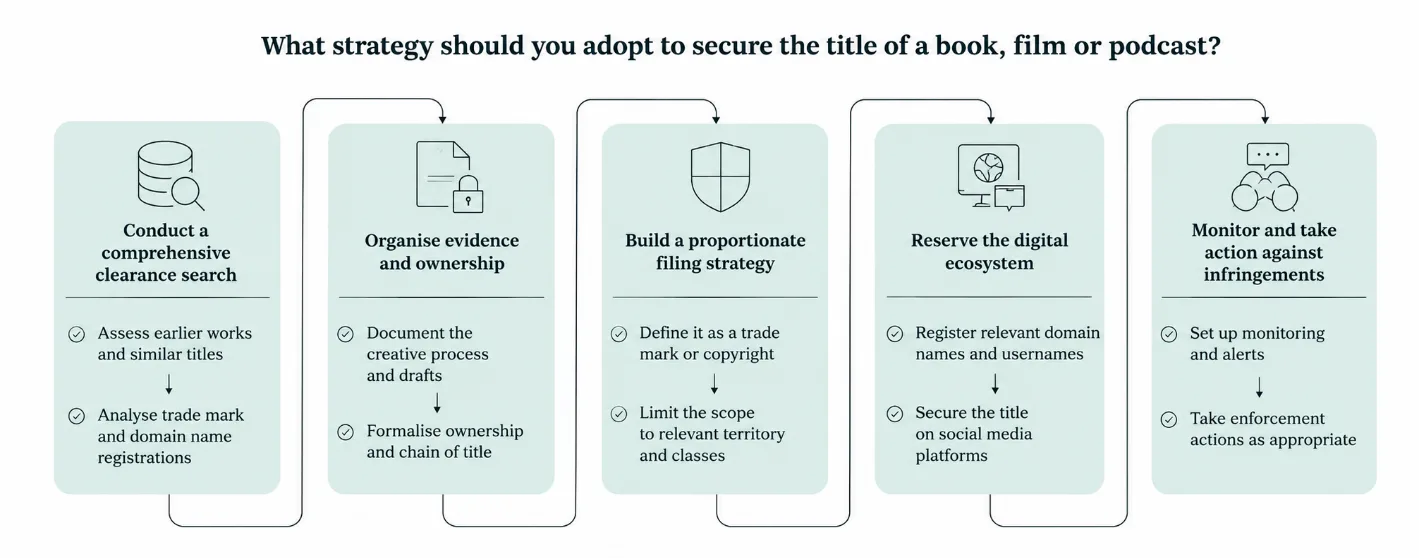
What strategy should be adopted to secure the title of a book, film or podcast?
Protecting a title does not rest on a single formality. It requires a combination of legal and operational measures to verify that the title is available for use, establish ownership, organise its potential protection as a trade mark, and prevent competing uses. This strategy should be implemented as early as possible, ideally before any public announcement or communication campaign. The following measures should therefore be considered:
1. Conduct a comprehensive clearance search
2. Organise evidence and ownership
3. Develop a proportionate trade mark strategy
4. Secure the digital ecosystem
5. Monitor and enforce
Conclusion
Protection should be considered before commercial disclosure. Copyright law protects original titles; trademark law protects titles that perform a distinctive commercial function; unfair competition and parasitism may address particular forms of wrongful conduct. The ANIMAL FARM and 1984 decision nevertheless confirms that even a globally famous title does not automatically function as a trade mark.
Dreyfus Law Firm assists its clients in managing complex intellectual property cases, offering personalized advice and comprehensive operational support for the complete protection of intellectual property.
Dreyfus Law Firm works in partnership with a global network of attorneys specializing in Intellectual Property.
Q&A
Is the title of a work automatically protected?
It is automatically protected by copyright only if it is original. No filing is required, but evidence of authorship and creation date remains essential.
Can two books or films have the same title?
Coexistence may be possible where the earlier title is not original, no enforceable trade mark exists and the circumstances do not create confusion. The nature of the works, their audiences, presentation and reputation must be assessed.
How long is the title of a work protected?
Where it is original, the title is, in principle, protected for the same period as the work itself, until seventy years after the author’s death.
Does an e-Soleau filing protect the title?
No exclusive right results from an e-Soleau filing. It timestamps deposited material and strengthens evidence that it existed on a particular date.
How can a title be protected internationally?
Protection must be planned territory by territory through applicable copyright rules, national or regional trade mark filings, domain name registrations and contractual arrangements. An EU trade mark may cover all EU Member States, provided that no ground for refusal applies anywhere in the Union.
This publication is intended for general public guidance and to highlight issues. It is not intended to apply to specific circumstances or to constitute legal advice.