

Introduction
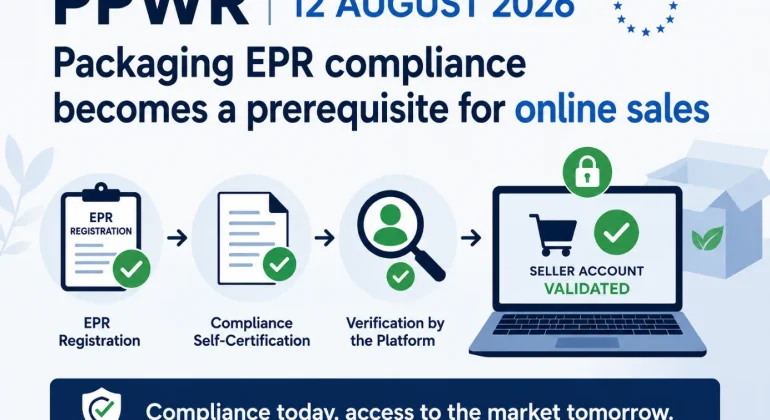
Since August 12, 2026, Regulation (EU) 2025/40 on packaging and packaging waste (PPWR) has generally applied throughout the European Union, subject to provisions governed by later implementation dates. It applies to companies that sell products with packaging, regardless of the industry in question, including food products, cosmetics, clothing, electronic equipment, toys, industrial goods, as well as the packaging itself. EPR compliance for packaging is no longer merely an environmental obligation that takes effect after the sale. For online platforms falling within the relevant rules, it has become part of the gateway to the sales channel itself.
Article 45 requires the online platforms concerned to obtain, before allowing a producer to use their services, information demonstrating the producer’s registration in the EPR register of the Member State where the consumer is located, together with a self-certification confirming compliance with packaging EPR obligations. Platforms must also make best efforts to assess the reliability and completeness of that information, including by checking available public databases or online interfaces. The practical effect is clear. An EPR documentation failure can now become a direct market-access issue.
Why has packaging EPR compliance become a marketplace access control?
Article 45 turns online platforms into compliance gatekeepers
The key change is procedural. EPR compliance is no longer checked only through environmental authorities, producer responsibility organisations or national reporting systems. It may now be examined at the very point at which a seller seeks access to an online market.
The PPWR does not establish a universal rule automatically removing every undocumented listing on August 12, 2026. Actual restriction or suspension procedures will also depend on the platform’s compliance process and contractual terms. Nevertheless, a platform subject to Article 45 cannot indefinitely disregard unreliable or incomplete registration information when EU law expressly requires it to collect and check such information.
There is still no single EU-wide EPR registration number
Although the PPWR harmonises the framework, it does not immediately replace national producer registers with one European number. Identifying the relevant EPR obligation requires an assessment of where packaging or packaged products are first made available in a Member State and where the packaging is expected to become waste. Cross-border e-commerce therefore requires a country-by-country and supply-chain analysis.
For distance sales, holding a registration in the seller’s home Member State does not, by itself, constitute an EU-wide EPR passport. This explains why Article 45 focuses on the relevant registration in the Member State where the consumer resides.
The French IDU must cover the correct legal entity and EPR stream
Under Article L. 541-10-13 of the French Environmental Code, producers subject to EPR must register and receive a unique identifier, or IDU. ADEME specifies that an IDU is assigned by EPR sector. A company holding an identifier for electrical equipment, for example, cannot rely on it as proof of registration for packaging.
The IDU must also be disclosed in the general terms and conditions of sale or another contractual document supplied to the buyer and, where the producer operates a website, under conditions comparable to those applicable to statutory website information.
France already imposed specific obligations on electronic interfaces under Article L. 541-10-9 of the Environmental Code. The PPWR now reinforces this approach at EU level by introducing an express pre-access verification mechanism.
Foreign sellers must review their representative arrangements
Since July 10, 2026, Article L. 541-10-9-1 of the French Environmental Code requires a person not established in France but subject to French EPR obligations to appoint, in writing, a natural or legal person established in France to ensure compliance with the obligations covered by the mandate, subject to the statutory exception concerning certain electronic interfaces.
At EU level, an important legislative development must not be confused with existing law. The Commission has proposed suspending until January 1, 2035 certain PPWR authorised-representative requirements for producers established in one Member State and operating cross-border. As at August 13, 2026, procedure 2025/0395(COD) remains legislative work in progress; the proposed suspension cannot yet be treated as applicable law.
Why does the PPWR matter to trademark owners and packaging strategies?
“Manufacturer” and EPR “producer” are separate legal concepts
For international groups, licensors and trademark owners, looking only at the company physically producing the goods can lead to the wrong conclusion. Commission guidance distinguishes the manufacturer, responsible for relevant packaging compliance obligations, from the producer, which bears EPR responsibilities in the Member State concerned. Depending on the supply chain, both roles may be held by the same entity or by different entities.
Where packaging is designed or manufactured under a company’s own name or trademark and the PPWR criteria are satisfied, the brand owner may therefore fall within the manufacturer analysis. Licence, manufacturing and distribution agreements should clearly address who determines the materials, dimensions, artwork and other packaging characteristics. Contractual drafting, however, cannot override a statutory qualification imposed by the PPWR.
For further background, see our analysis of the impact of packaging regulation on trademark and design owners.
Packaging placed on the market after 12 August also requires review
The immediate compliance exercise goes beyond EPR registration. Article 15 requirements include information allowing packaging and its manufacturer to be identified, such as a type, batch, serial or other identification element and the manufacturer’s name, trade name or registered trademark and relevant contact details, under the conditions laid down by the Regulation.
Adding such information, including through QR codes where permitted, can alter packaging artwork and should therefore be coordinated with trademark, design and copyright portfolios.
What should companies audit now to prevent online sales disruption?
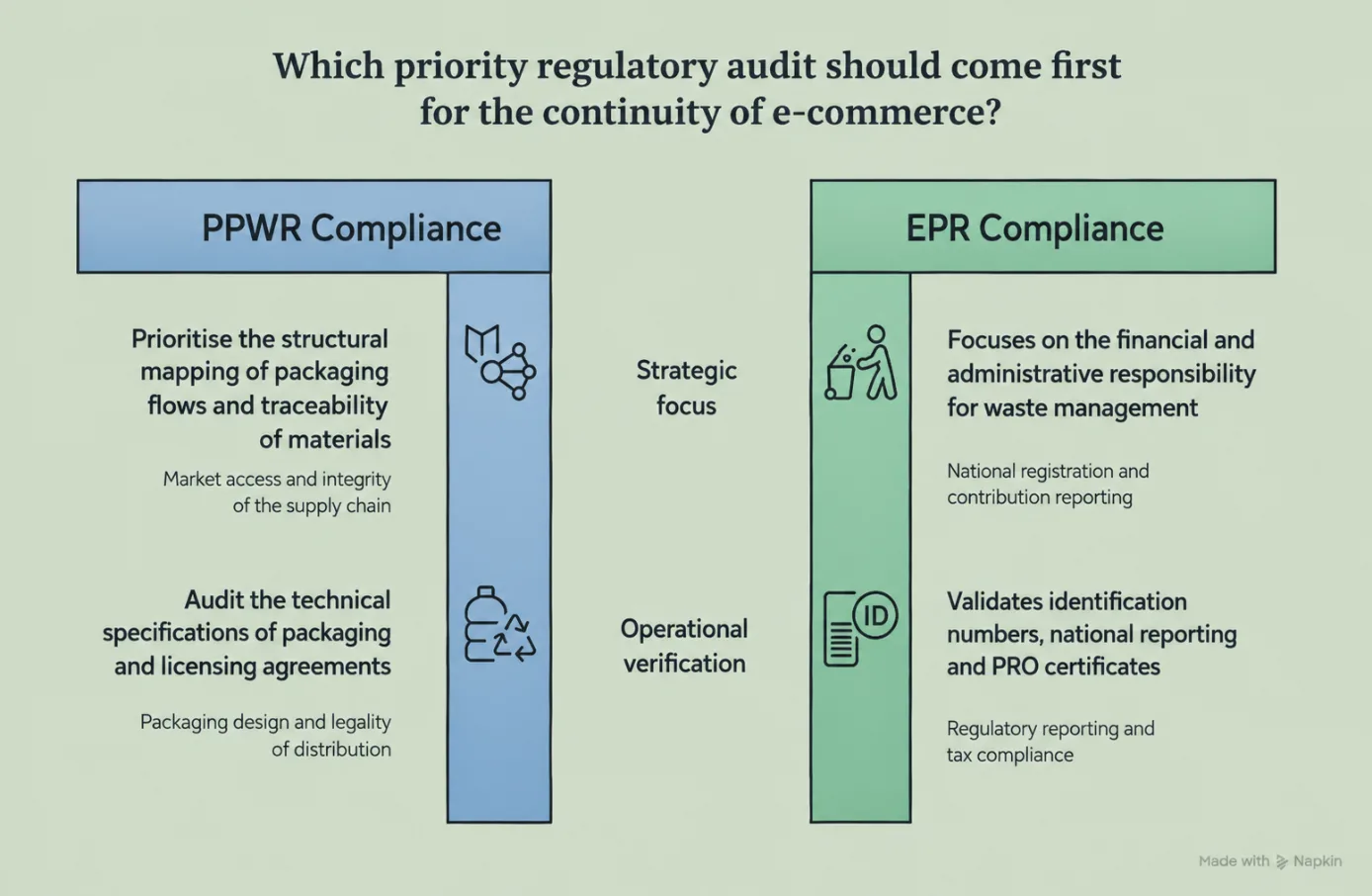
We recommend treating PPWR and EPR compliance as a market-access audit:
- map products, packaging formats, destination countries and sales channels;
- identify, for each flow, the manufacturer, EPR producer, importer, distributor, trademark owner and seller-account entity;
- verify national registrations and, in France, the correct packaging IDU;
- reconcile EPR declarations with actual volumes and confirm outstanding contributions;
- review the need for and scope of representative mandates;
- prepare a marketplace evidence file containing registration evidence, PRO certificates, self-certification, declarations and supporting records;
- align company names, addresses and producer identities across registers, PRO records, terms of sale, invoices and seller accounts;
- review packaging traceability and amend licence, manufacturing, import and distribution agreements where required.
What are the risks of failing to demonstrate packaging EPR compliance?
The most immediate risk is commercial: seller onboarding may fail, further evidence may be requested, an offer may be restricted, or sales may be interrupted in accordance with the platform’s applicable procedures. The PPWR therefore turns an environmental compliance issue into a potential product-availability and brand-exploitation risk.
French administrative exposure is separate. Article L. 541-9-5 of the Environmental Code provides, in particular, for an administrative fine of up to €30,000 for specified failures relating to registration, reporting or disclosure of the IDU. The statutory enforcement regime also provides for a daily penalty of up to €20,000 in relevant circumstances.
Conclusion
The PPWR applicable since August 12, 2026 changes the compliance sequence. For online platforms within scope, businesses can no longer assume that packaging EPR formalities may simply be regularised after launch. They must be able to identify the correct producer, evidence its registration, provide consistent self-certification and substantiate compliance before an administrative discrepancy becomes an obstacle to sales.
Protecting a trademark now also requires protecting the legal ability to place the branded product on the market.
Dreyfus Law Firm assists its clients in managing complex intellectual property cases, offering personalized advice and comprehensive operational support for the complete protection of intellectual property.
Q&A
Does the PPWR apply to sales made through a company’s own e-commerce website?
Yes. The producer’s EPR obligations remain applicable. However, the specific prior-verification mechanism applicable to intermediary online platforms does not apply in the same way to a seller marketing products directly through its own website.
Are B2B sales subject to the marketplace verification mechanism under the PPWR?
The specific mechanism under Article 45 targets platforms enabling consumers to conclude distance contracts with producers. A business operating exclusively on a B2B basis must nevertheless comply with the other PPWR and EPR obligations applicable to it.
Are products distributed free of charge covered by the PPWR?
Yes. The concept of making packaging available also covers packaging supplied free of charge in the course of a commercial activity. Samples and promotional campaigns must therefore be included in the compliance assessment.
Do fulfilment service providers also have verification obligations?
Yes, in certain circumstances. The PPWR also imposes specific obligations on fulfilment service providers when they enter into contractual relationships with producers.
Does an EPR contribution paid in one Member State remain valid if the product is ultimately marketed in another?
Not necessarily. Where contributions have been paid in one Member State but the packaging is subsequently made available for the first time in another, a reimbursement mechanism may need to be applied, as EPR obligations must ultimately be fulfilled in the relevant Member State.
Does the PPWR also apply to packaging for products imported from outside the European Union?
Yes. The Regulation applies to packaging placed on the EU market, including packaging accompanying products imported from third countries. The origin of the product therefore does not exempt the operator from PPWR and EPR compliance obligations.
This publication is intended for general public guidance and to highlight issues. It is not intended to apply to specific circumstances or to constitute legal advice.