Acme Billing, the US-based online retailer, faces a burgeoning phenomenon, namely, the theft of domain names. Last August, the company found out that 35 of its domain names had been stolen by an anonymous person located in China, who transferred the domain names to acquire them.
On October 21, the company filed suit in the US District court of the Eastern District of Virginia against an anonymous hacker based in China for “knowingly and intentionally access Acme Billing’s domain name management (…) without authorization.” Acme also accused the hacker of having acted in “bad faith.” To date, Acme Billing has successfully retrieved only 21 of the 35 domain names. For the other 14 domain names, it seems that the hacker has put them for sale.
Domain name theft can be particularly harmful to business, especially for an online sales company, such as Acme Billing. Clearly, by stealing domain names from an online platform, the company is deprived of the principal asset required to conduct its business. The theft of domain names can thus have grievous financial consequences for the turnover of the company, which will be directly and severely impacted. In light of this, Acme Billing’s CEO, Greg Stranahan, stated that “the theft of domain names is a growing form of intellectual property rights violation, with potentially devastating consequences for American businesses.” The decision is highly anticipated.
While the French Supreme Court (Court of Cassation) has still not ruled on the issue in France, the demands of the town of Laguiole seem to have arrived to the Court of the European Union. The town wishes to regain the use of its name. In a recent judgment[1], the European Court of Justice annulled the trademark “Laguiole” registered for cutlery by the entrepreneur Gilbert Szajner in favour of the company Forge de Laguiole.
In 2001, Szajner successfully sought registration of the Community Trademark at the Office for Harmonization in the Internal Market (OHIM). Forge de Laguiole, which markets the famous knife, subsequently obtained cancellation of the trademark by an OHIM decision on the 1st June 2011. Szajner, a businessman from Val-de-Marne without any connection to the village, brought an action against this decision before the European Court of Justice. This latter recognized “the anteriority of Forge de Laguiole which relaunched this product in 1987 and its specificity” and partially annulled the Laguiole brand.
However, the decision of the OHIM was overruled regarding the nullity of the Laguiole brand for products other than “tools and instruments hand operated”, comprising cutlery. The Court noted that even if “Forge de Laguiole was solely engaged in the cutlery industry,” he stated that Szajner could also continue to use the trademark “for products and services in other sectors.” Consequently, except for the “tools and instruments hand operated“, the entrepreneur is entitled to sell other products under the Laguiole brand.
However, for the EU the brand was partially annulled, the same cannot be said for France as the town [still] awaits the judgment of the French Supreme Court. The town of Laguiole, which alleges despoilment of its name, has waged a fierce battle against the entrepreneur for several years. The town alleged in front of the Court of Appeal of Paris that there were a deceptive commercial practice and a violation of its name, image and reputation. It was unsuccessful as the Court dismissed the case in a judgment delivered on 4th April, 2014. The town appealed. The recent decision from the European Court should rekindle the hope of the Mayor of Laguiole, Vincent Alazard.
While the Laguiole knives won their name back, the Aveyron village, renowned worldwide for cutlery, waits impatiently. The mayor seeks to recognize commercial deception, since he believes that the businessman is using the name of his town for products manufactured in Asia. Under the current law, local authorities do not have an exclusive right for the sign and can only preventively protect their names by filing a trademark registration with the National Institute of Industrial Property (INPI). Deauville, which protected its name in 1998, is a prime example.
Nonetheless, with the advent of the Hamon consumer protection law on 17th March 2014, local authorities can now request INPI to inform them in the event of a third party’s trademark application containing their name. They can also contest it within two months with the Director of the INPI. A town can thus exercise this application under Article L711-4-d and -h of the Code de la Propriété Intellectuelle, in respect of an infringement of its name, image or reputation or in respect of a breach of a geographical indication including its name. But the decree setting out the essentials for implementation of this law is still in the works.
However, the protection offered by the novel law appears to be limited to the goals of regional communities carrying out public service as the TGI of Paris had previously held that a town “cannot, through its interest in its name, forbid companies to operate their business on its territory by using its name, unless it is shown that such use causes a likelihood of confusion with its own competences or is likely to cause prejudice to it or to its citizens.” It only remains to be seen whether the Cour de Cassation will steer towards this direction or make its decision in light of the recent European case law. This judgment is expected to defend the names of local authorities.
[1] Court of the European Union, 21 October 2014, Gilbert Szajner c/ OHMI, aff. T-453/11.
The state of Rhode Island recently passed a new law on the protection of employee privacy on social networks. The new law prohibits employers from requiring employees, during job interviews or working hours, as the case may be, to disclose the password of their social networks accounts.
This law was made necessary by increasing abuses by employers. Many require the passwords of job seekers’ social network accounts and even exert pressure to access e.g. their Facebook profile. While it is now common for employers to conduct research on candidates and gather all kind of information, they can only access so-called “public” content. By seeking passwords from candidates, employers really wished to have full access to so-called “private” content configured to be shielded from everyone’s view, and thus to more interesting information as though they were close to the individual concerned. Such private content may be e.g. pictures, messages and other personal exchanges with other members of the social network. Likewise, the new law prohibits employers from compelling employees to add them as contacts, i.e as a “friend” on Facebook, so that the latter can indirectly access the account.
However, there is an exception that allows employers to access one or more social networks account (s) of their employee in their presence provided certain conditions are met. An employee may be required to provide their username and password only when an investigation is required, i.e. where there has been an infringement of employment law rules. But the law does not specify the circumstances in which the employer can reasonably rely on this exception. Harassment, which is prohibited under employment law, comes to mind, as it can materialize through exchanges on social networks.
To date, seven states have already enacted similar laws in the United States, particularly in Illinois and Louisiana, and the trend looks set to continue. Indeed, such laws are being enacted in 28 other states. Should we expect such provisions in Europe?
The term GOOGLE is one of the clearest examples of a trademark that has entered everyday language without, to date, losing its essential legal function. It is common to hear users say that they will “google” a person, a company, a product or a legal issue. For a trademark owner, this linguistic success may appear ambivalent: it reflects exceptional reputation, but it may also raise a risk of genericide.
In Elliott v. Google, the U.S. courts confirmed that the GOOGLE trademark had not become generic for internet search engine services. The case remains a key reference for distinguishing the popularity of a term from the loss of its legal distinctiveness.
Elliott v. Google: an attempt to cancel the GOOGLE trademark
The dispute arose after David Elliott and Chris Gillespie registered several hundred domain names incorporating the term “google”, often combined with trademarks, public figures or places.
Google first obtained the transfer of those domain names through UDRP proceedings. The domain name holders then sought to cancel the GOOGLE trademark, arguing that the term had become a generic verb meaning “to search the Internet”.
Under U.S. law, the analysis is based on the “ primary significance test ”. This consists in determining the main meaning of the sign for the relevant public. If the public still perceives the sign as an indication of commercial origin, the trademark may remain valid. In the Google case, the plaintiffs relied heavily on the verbal use of the term, but failed to prove that the public primarily understood GOOGLE as the generic name for search engines.
In a decision rendered on May 16, 2017, the U.S. Court of Appeals for the Ninth Circuit upheld the decision in favor of Google. The significance of the appellate decision may be summarized as follows:
The everyday use of a trademark in ordinary language is not sufficient, in itself, to cause its genericide.
The use of a trademark as a verb, for example “to google”, does not automatically mean that the trademark has become a common name.
The central criterion is the perception of the relevant public: it must be determined whether the sign primarily designates a commercial origin or a category of goods or services.
A very well-known trademark may therefore remain protected, even if it is widely used in everyday language.
The decision nevertheless reminds trademark owners of the importance of monitoring and controlling the use of their signs in order to prevent them from gradually becoming generic designations.
What is the approach under French law and European Union law?
French law and European Union law also recognize the mechanism of trademark genericide.
In France, Article L.714-6 of the French Intellectual Property Code provides that a trademark owner may be deprived of their rights where the trademark has become, through their own conduct, the usual designation in trade for the relevant product or service. In such a case, the trademark is no longer distinctive, as it no longer enables consumers to identify the commercial origin of the product or service concerned.
At European Union level, Article 58(1)(b) of Regulation (EU) 2017/1001 provides for revocation of an EU trademark where, because of acts or inactivity of the proprietor, the trademark has become the common name in the trade for a product or service for which it is registered.
What best practices should be adopted to protect a strong technology trademark against genericide?
The GOOGLE case is particularly useful for companies active in artificial intelligence, SaaS software, digital platforms, mobile applications, marketplaces and specialized search engines. In these sectors, a service may quickly become part of everyday vocabulary.
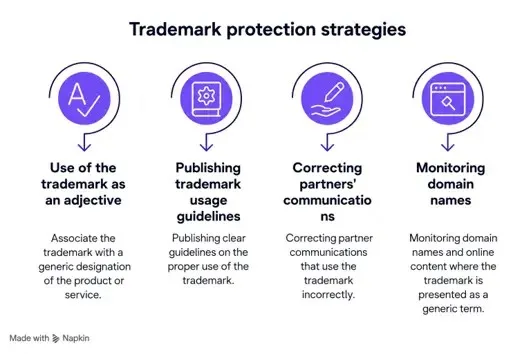
For trademarks known to a significant part of the public, it is essential to regularly remind users that they are not common names, but trademarks designating the products or services they cover, in order to prevent them from becoming generic. What form can this strategy take?
Companies may
Use the trademark as an adjective and associate it with a generic designation of the product or service;
Publish trademark usage guidelines;
Correct partners’ communications;
Monitor domain names and online content that present the trademark as a generic term.
To learn more about best practices for preventing the genericide of your trademark, we invite you to read our previously published article.
Conclusion
The GOOGLE trademark remains valid because it has not been shown that the public primarily understands it as the generic name for search engines. The use of a trademark as a verb may create a risk, but it is not sufficient, in itself, to establish genericide.
The broader lesson is that the more successful a trademark becomes, the more carefully it must be managed. Trademark owners must monitor uses, correct generic uses and preserve the sign’s function as an indication of commercial origin.
Dreyfus & Associés assists its clients in managing complex intellectual property cases, offering personalized advice and comprehensive operational support for the complete protection of intellectual property.
Not necessarily, but it is difficult to reverse once it has taken hold. The more a sign is perceived by the public as a generic term, the harder it becomes to restore its distinctive function. This is why prevention is essential.
Can a trademark become generic only for certain goods or services?
Yes. Genericide is assessed in relation to the goods or services concerned. A trademark may lose distinctiveness for a specific category, while remaining protected for other activities if the public continues to perceive it as an indication of commercial origin in those areas.
Should a start-up be concerned about genericide from the launch of its trademark?
Yes. Even if the risk may seem remote at the beginning, good practices should be implemented from launch: choosing a distinctive trademark, ensuring consistent communication, using appropriate trademark notices, monitoring usage and educating marketing teams. It is easier to prevent banalization than to correct it once it has become established.
Can a company encourage the use of its trademark while avoiding banalization?
Yes, but it must strike the right balance. A company may naturally seek to make its trademark visible and memorable, but it must avoid encouraging its use as a common name. Communication campaigns should therefore strengthen the association between the sign and the company, rather than presenting the trademark as the generic name of the service.
Is a very famous trademark more exposed to the risk of becoming generic?
The more a trademark becomes dominant in its sector, the more likely it is to be used by the public to refer to an entire category of goods or services. Reputation is therefore a commercial asset, but it also requires increased vigilance to prevent the trademark from becoming the common name of the product or service concerned.
The admissibility of evidence from the Archive.org website has gradually become an important debate in intellectual property and digital litigation. In disputes over trademarks, domain names, unfair competition or online counterfeiting, the ability to establish the state of a website on a given date is often a decisive factor in the outcome of the case.
Long regarded with suspicion by the French courts, the captures from Wayback Machine have seen a notable jurisprudential evolution, under the combined effect of the maturation of judicial reasoning in terms of digital evidence and the massive increase in litigation related to digital uses.
Internet Archive.org: nature and functioning
Archive.org is a foundation with the mission of preserving and archiving the memory of the web on a global scale. Through its emblematic tool, the Wayback Machine, it carries out an automated collection of freely accessible online content, allowing to consult previous versions of websites on given dates, sometimes over several decades.
The functioning of this tool is based on automated indexing and archiving processes, without systematic human intervention and outside any contradictory framework. The captures made result from periodic passages of indexing robots, whose frequency, completeness and scope are neither constant nor exhaustive. Consequently, the proposed archives do not guarantee either the total integrity of the contents displayed on a given date or the absence of subsequent modifications affecting certain elements of the site concerned.
The starting point of digital evidence in French law
In French law, the proof of legal facts is governed by the principle of freedom of evidence. In accordance with Article 9 of the French Code of Civil Procedure, it is for each party to establish the facts necessary for the success of its claims. Legal facts can thus be demonstrated by any means, including elements of a technical or digital nature.
This principle cannot, however, be interpreted as conferring an equivalent probative value on all the pleadings produced. The freedom of evidence is tempered by the sovereign power of assessment of the judge, who remains particularly attentive, in matters of digital evidence, to the reliability, integrity and authenticity of the evidence with regard to its evolving character and easy alteration.
It is in this context that the evidentiary question of the archives from Internet Archive.org fits. The captures generated by the Wayback Machine result from an automated archiving process, carried out outside any contradictory framework and without certification of the collected content. They do not, therefore, benefit from any legal presumption of reliability and are clearly distinguished from traditionally recognized forms of evidence, such as the judicial officer’s certificate, which has enhanced probative force.
The jurisprudential assessment of the admissibility of web archives
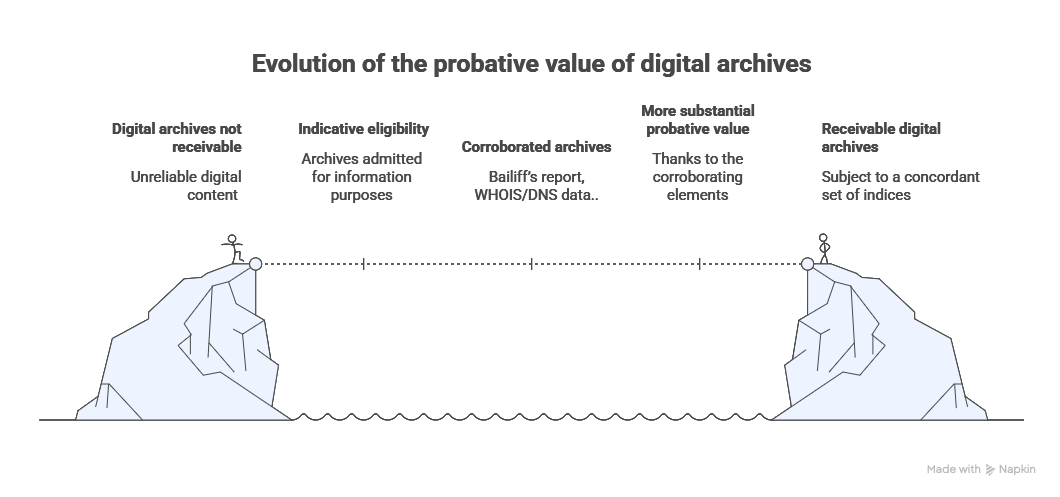
For several years, the French courts excluded the archives from Internet Archive.org, considering that they were not sufficient to guarantee neither the exhaustiveness of the archived contents nor their exact conformity with the state of the site at the invoiced date, in the absence of sufficient guarantees regarding their method of collection and conservation.
However, the case law has evolved gradually, first at the level of the courts and then at the level of the courts of appeal. Faced with the increasing difficulty of establishing the previous state of digital content, jurisdictions have started to admit these archives for information purposes, before recognizing them a more substantial probative value when they were corroborated by other elements contributed to the debates. This development reflects a pragmatic approach, based on a concrete assessment of the circumstances of the case. The French Cour de Cassation, on the other hand, has not yet ruled on this probative question.
Practical conditions of admissibility before the judicial judge
As part of this in-depth assessment, the judge examines in particular the consistency of the archives produced with the other elements of the file, the stability of the archived content over time, and the absence of serious objections to their manipulation or alteration. These criteria reflect a requirement of overall reliability of the evidence, assessed in the light of all the circumstances of the case.
In contentious practice, the archives from the Wayback Machine thus gain credibility and effectiveness before the judicial courts and appellate courts when they are systematically corroborated by complementary elements. They can thus usefully be associated with:
Screenshots contemporaneous with the litigious facts or even dated commercial or advertising exchanges.
This cumulative approach makes it possible to place the web archives in a bundle of concordant clues, the only one capable of satisfying the judicial judge’s requirements regarding digital evidence.
Towards enhanced security of digital evidence: the contribution of blockchain technologies
The identified limits of traditional digital evidence modes have led to the emergence of technical solutions aimed at strengthening the reliability and traceability of produced elements in court. Among these, blockchain-based technologies occupy a growing place.
The principle is based on writing the cryptographic fingerprint (hash) of a digital content in a distributed, tamper-proof and time-stamped register. This footprint, unique in nature, varies from the slightest modification of the original file. Its registration in the blockchain thus makes any subsequent alteration detectable, giving this process strong guarantees of integrity and dating.
Unlike automated archiving systems, blockchain is based on a decentralized validation mechanism and the immutability of registered blocks. Judicial jurisdictions have started to admit evidence based on this process as serious evidentiary elements, notably to establish the anteriority and integrity of digital content, as illustrated in particular by the judgment of the judicial tribunal of Marseille (1st ch., March 20, 2025, RG n° 23/00046).
However, blockchain proof cannot be understood as an exhaustive probative solution. If it can attest to the existence of content at a given date and guarantee its integrity, it remains insufficient, on its own, to establish the ownership of rights or the identity of the author of the time-stamped content. It attests to a fact, not a right. In practice, it does not reveal either the real identity of the applicant or the conditions for creating content, except to be linked with additional identification elements.
Blockchain evidence thus finds all its relevance when it is part of a broader evidentiary framework, notably associating contractual elements, dated exchanges, findings or other consistent technical evidence.
Conclusion
The admissibility of evidence from Internet Archive.org is accepted at certain levels, but their probative value remains limited and subject to an assessment in concreto. The inherent limitations of automated archiving require, in practice, systematic corroboration by other evidence.
In this logic, the blockchain appears as a complementary probative security tool, offering reinforced guarantees in terms of dating and integrity of digital content. It cannot, however, be a substitute for the legal requirements relating to the establishment of ownership of rights, which presupposes the production of a set of coherent indices.
Dreyfus & Associés assists its clients in managing complex intellectual property cases, offering personalized advice and comprehensive operational support for the complete protection of intellectual property.
Does the absence of a position by the French Cour de Cassation create legal insecurity?
The absence of a position from the French Cour de Cassation does not call into question the admissibility of these digital evidence elements which are partly admitted by the courts on the merits. This lack of position, however, maintains an assessment essentially in concreto, leaving variations according to the jurisdictions and circumstances of the case.
In practice, this situation does not prohibit the use of these elements, but it requires increased vigilance in the evidentiary strategy, which must be systematically corroborated in order to limit the vagaries related to the judge’s sovereign discretion.
Is the use of a bailiff’s report sufficient to permanently secure evidence from Internet Archive.org?
The bailiff’s report significantly strengthens the credibility of the evidence, but it does not transform the web archives into perfect proof. The judge retains the right to assess its scope, particularly if the method of consultation, the technical parameters or the date of the archives are contested in a serious manner.
Does digital evidence require an adaptation of traditional litigation reflexes?
Absolutely. Digital evidence requires increased anticipation, methodical collection of technical elements and rigorous articulation of the evidence. It is no longer limited to noting a fact, but requires demonstrating its stability, context and accountability.
Can a blockchain proof be disregarded for lack of sufficient technical explanation?
Yes. A blockchain proof produced without explanation about the protocol used, the hash method or the registration conditions can see its probative scope greatly reduced, or even be dismissed. The technical evidence must be intelligible to the judge in order to be usefully used.
Can a blockchain proof be combined with a bailiff’s report?
Yes, and this combination is a particularly effective practice. The bailiff’s report allows secure access to the evidence and its attachment to a party, while the blockchain reinforces the guarantees of integrity and dating of the observed content.
Under the previous IP regime in Burundi, registered trademarks were indefinitely protected without the need for any possible renewal.
With the new IP law which came into force on July 28, 2009, trademarks registered in Burundi must now be renewed once every 10 years.
The question then arose as to whether the novel requirement to renew was applicable to trademarks registered prior to July 28, 2009, when the current law was enacted.
According to the transitional provisions in the law, trademarks registered prior to the new law were not subject to mandatory renewal and remained valid indefinitely, except in instances of cancellation or expiry of the trademark.
The entry into force of the new law has clarified matters: all trademarks, including those registered under the former law shall need to be renewed for 10-year period before July 28, 2019.
It is yet to be determined as of which date it will be allowed to file application for the renewal of these old trademarks.
Under the prevalent Canadian law, a trademark can only be registered if it is currently used or if the applicant plans to use it. Applications based on the use of a trademark in Canada have to mention the date of first use in respect of the designated goods and services. The holder of a trademark registered and used abroad can also file an application in Canada without ever having used that mark there.
Once the new law, presently under discussions, becomes effective, the requirement for a declaration of use in Canada prior to the issuance of the certificate of registration will be removed. It will not be necessary to specify whether the claim is based on an existing or intended local use of the trademark.
The new law is expected to enter into force by end of 2015 or early 2016. Removal of the declaration of use requirement will prove beneficial to all pending registrations. However, anyone who applies for registration of a trademark in Canada must still intend to use it for all designated goods and services.
On the one hand, this change is a good thing because all issues surrounding dates of use will disappear at the application stage. In addition, the applicant will no longer have to require lengthy time extensions to start using the trademark for all the goods and services listed in the application.
On the other hand, since the registry will no longer provide information concerning the use of trademarks, it will be more difficult to determine whether a new trademark is available. This is an important consideration as it will still be feasible to claim acquired rights through use. In the event of a dispute between two applicants, an investigation will be required to determine who is genuinely the first user of the trademark and in respect of which goods and services.
The prospective amendment to Trademark Law relaxes the registration procedures of trademarks. The concept of use of the trademark is not ruled out yet. Instead, it remains critical as far as trademark rights are concerned. The principle remains unchanged: the first user, not necessarily the first applicant, retains rights over the trademark. It is actually the filing strategy which requires revamping: it is imperative to file a registration application for all potential goods and services at the soonest available opportunity.
The real world and the Internet have long been segregated. Today however, these two worlds tend to overlap and as paradoxical as this may sound, registering your trademark can prove to be quite a useful protection on the Internet.
The reasons for the importance of trademark registration are increasing with the rise of cybersquatting. This has led to registered trademark owners enjoying new benefits in relation to the protection of their rights over the Internet.
Firstly, it has become increasingly important to protect trademarks on social networking sites. Since 2009, Facebook allows its members to create user names which are easily accessible and which can include trademarks. Before 2009, Facebook allowed a short period of time for registered trademark owners to identify their trademarks and to prevent their use by other members.
Most social media platforms secure usernames on a “first come, first served” basis. As far as rights enforcement is concerned, it is easier to be the owner of a registered trademark to be able to notify a breach of trademarks rights in accordance with the platforms’ terms of use.
Secondly, all trademarks on the Internet must be protected on search engines and particularly in sponsored links. Through its AdWords system, Google allows advertisers to select keywords so that their advertisements become visible to web surfers when they enter these words in the search engine. Conflicts arise when advertisers buy keywords containing trademarks whilst having no rights to them.
Holding trademark rights thus becomes an important factor in countering unfair competition practices.
Thirdly, trademark owners must also pay attention to the increasing number of new domain name extensions gTLDs. To date, more than 300 new gTLDs have been delegated, and hundreds more are soon to follow. In view of the potential conflicts with protected trademarks, a new mechanism has been made available to trademark owners: the Trademark Clearinghouse. It is a centralized database for all registered trademarks. Once the trademark is registered there, trademark owners can participate in the Sunrise Periods for newly-launched gTLDs and are informed when third parties register domain names that are identical or similar to their trademark. The person filing for the domain name in question is also informed that he may be infringing on the rights of a trademark owner.
Finally, if a domain name identical to or containing a trademark is registered, specific administrative procedures such as the Uniform Rapid Suspension (URS) and the Uniform Domain Resolution Policy (UDRP) can assist trademark owners in taking action against cybersquatters. These specific procedures are only accessible to trademark owners.
Thus, being a trademark owner is now almost a requirement to protect and defend your rights on the Internet, even if your company does not have a strong Internet presence.
Dreyfus is specialized in the protection of rights over the Internet. Please do not hesitate to contact us for any information.
On March 21, 2014, the Crimea was annexed by Russia. Formerly a part of Ukraine, this region now has a dual legal status, particularly as concerns intellectual property rights.
On 22 July 2014, the Ukrainian government met to discuss intellectual property protection in the Crimea. This region was then conferred the legal status of an occupied territory and will remain subject to the Ukrainian regime in intellectual property matters.
On the same date, Russian President Vladimir Putin signed a new law to regulate IP protection in the Crimea. The new law provides for the protection of inventions, utility models, industrial designs, service marks and appellations of origin originally registered in Ukraine by persons who are permanent residents of the Crimea, provided that these rights are revalidated in Russia prior to January 1, 2015. Trademarks rights which are already protected in Russia will be automatically protected in the Crimea. There will be no requirement to register anew.
To ensure a blanket protection of trademarks in the Crimea, it is henceforth imperative to hold a registered trademark in both Ukraine and the Russian Federation.
While the free reproduction of works in the public domain is allowed, e.g. Auguste Rodin’s notable sculpture, The Thinker, it is imperative that any such reproduction respects the moral rights of the author. The latter is indeed “perpetual, inalienable and imprescriptible” in accordance with Article L. 121-1 of the French Code de la Propriété Intellectuelle.
One of the most seminal counterfeit lawsuits witnessed in the French legal landscape in the recent years is being tried in the Criminal court – Tribunal correctionnel de Paris. The action is based on counterfeiting and false advertising in relation to the sale of several copies of Rodin sculptures which have since lapsed into the public domain. The judgment has been reserved for November 20. This decision is particularly awaited in the art world as concerns moral rights. Moral rights may be transferred upon death to the heirs of the author or to a third party under the provisions of a will. August Rodin bequeathed all his works to the French government, more precisely to the Musée Rodin which is now holds the moral rights in these works by a by decree of February 2, 1993. It is in this capacity that the Musée has exercised its rights and filed suit.
Gary Snell, an American businessman, bought plasters of Rodin’s sculptures from merchants, including the Thinker and The Age of Bronze in various dimensions. He then mass-produced a series of copies. According to a court-appointed expert, more than 1,700 copies were sold, thus warranting the qualification of “quasi-industrial” production by the Prosecutor.
In addition, the right to the author’s name was violated as some reproductions flaunted a Rodin signature and sometimes even the mark of the foundry used by Rodin, the Rudier foundry, in lieu of the mark of the Italian foundry which actually manufactured these copies. Yet, according to Article 8 of the Decree of March 3, 1981 on fraud prevention in art and collectibles, “any facsimile, molding, copy or other reproduction of a work of art or a collectible must be designated as such.” Therefore, while reproduction of Rodin’s works is not prohibited under French law, it is imperative that they are clearly identified as such, for the purchaser to take cognizance of the low value of the work – something that was lacking in the present case. Similarly, some of the reproductions were so poor that they were a violation of Rodin’s moral right in respect of his works, which all the more betrayed the artist’s vision. As a result, the Prosecutor argued that these reproductions should be treated as counterfeits under French law.
The argument put forward by the accused party, namely that French law does not apply because the reproductions, according to the latter’s Counsel “were never offered or sold in France,” is inadmissible since the it was established that the copies were advertised on an site that could be accessed from France at the time.
The Prosecutor requested the Court to levy a fine of 150,000 euros on Gruppo Mondiale, a company incorporated in Liechtenstein headed by Gary Snell, and accused of having displayed or sold, the counterfeit works of Rodin which it manufactured on a “quasi industrial” scale, by presenting them as originals. Moreover, the Prosecutor also prayed the Court for a suspended sentence of eight months and a 30,000 euro fine against the businessman. Stay tuned!
Our site uses cookies to offer you the best service and to produce statistics, and measure the website's audience. You can change your preferences at any time by clicking on the "Customise my choices" section.
When browsing the Website, Internet users leave digital traces. This information is collected by a connection indicator called "cookie".
Dreyfus uses cookies for statistical analysis purposes to offer you the best experience on its Website.
In compliance with the applicable regulations and with your prior consent, Dreyfus may collect information relating to your terminal or the networks from which you access the Website.
The cookies associated with our Website are intended to store only information relating to your navigation on the Website. This information can be directly read or modified during your subsequent visits and searches on the Website.
Necessary cookies are absolutely essential for the website to function properly. These cookies ensure basic functionalities and security features of the website, anonymously.
Dreyfus is concerned about protecting your privacy and the Personal Data ("Data"; "Personal Data") it collects and processes for you.
Hence, Dreyfus complies every day with the European Union legislation regarding Data protection and particularly the European General Data Protection Regulation Number 2016/679 of 27 April 2016 (GDPR).
This Privacy Policy is aimed at informing you clearly and comprehensively about how Dreyfus, as Data Controller, collects and uses your Personal Data. In addition, the purpose of this Policy is to inform you about the means at your disposal to control this use and exercise your rights related to the said processing, collection and use of your Personal Data.
This Privacy Policy describes how Dreyfus collects and processes your Personal Data. The collection happens when you visit our Website, when you exchange with Dreyfus by e-mail or post, when exercising our Intellectual Property Attorney and representative roles, when we interact with our clients and fellow practitioners, or on any other occasion when you provide your Personal Data to Dreyfus, in particular when you register for our professional events.


 Written by Nathalie Dreyfus08/12/2014
 Acme Billing, the US-based online retailer, faces a burgeoning phenomenon, namely, the theft of domain names. Last August, the company found out that 35 of its domain names had been stolen by an anonymous person located in China, who transferred the domain names to acquire them.