Advertising agencies arguably care more about their image than any other business, particularly in terms of their logo. In its judgment of 30 September 2014, the Court of appeal of Paris ruled on the likelihood of confusion between two trademarks belonging respectively to Graphèmes and Graphéine, two companies operating in the field of graphic design.
The trademarks were inclusive of a logo namely:
Earlier trademark:
Contested trademark
As graphics professionals tend to focus on the presentation of trademarks, the Court of appeal held that the two disputed trademarks were indeed distinct. Indeed, while the Graphème company argued that the mark “Graphéine” was an imitation of its earlier mark, the Court held that “the logos used by Graphéine are visually very different from that adopted by Graphèmes” and that “the mere reproduction of the colourdoes not generate the likelihood of confusion in the case.” Likewise, when taken as a whole, and given the distinctive visual and phonetic elements, the likelihood of confusion could not be proven with regard to the logo of “Graphéine.”
In their assessment of the likelihood of confusion, the judges took into account the technical details and various references to the graphic design industry. The services were intended for an informed public, namely design professionals. Usually judges must make a general assessment by examining the evidence as a whole and determine the “overall impression” made upon average consumers. This method of assessment is derived from several judgments of the Court of Justice of the European Union[1].
Yet in this case, the Court of appeal focused primarily on design professionals, which could perhaps be challenged. In their address to graphics professionals concerned with the visual rendering of their logos, the judges exhaustively analyzed the particulars of both trademarks including fonts and differences of pronunciation. For example, the court phonetically scrutinized the two terms to reveal their differences, so that, ultimately, “strong differences in pronunciation” are not necessarily discernible by a layman, as the court itself noted. Indeed, if any individual was to see the logos at issue from afar, he could easily be confused (same size, same length, same prefix and a similar suffix). Furthermore, with regard to colors, tonal differences are not as evocative they appear to be. One wonders in this respect whether the decision would not have been different had the court focused on consumers, to whom the two terms may look similar.
Nevertheless, the assessment of the likelihood of confusion while keeping in view the professionalism of the stakeholders involved in the trial is not a trivial one since both advertising agencies cater mainly to other professionals or clients. Therefore, in light of the case law, this decision, although it is questionable in espousing a strict assessment of the likelihood of confusion in the design sphere, makes a lot of sense.
[1] Sabel/Puma CJCE, 11 November 1997, aff. C-251/95, Canon CJCE, 29 September 1998, aff. C-39/97, Llyod CJCE, 22 June 1999, aff. C-342/97.
In this dynamic business world, trademark registration is an imperative. And yet, it is not enough merely to own a trademark. Trademarks need to be used to avoid any loss of rights for non-use. The issue of genuine use of the trademark in the business sphere arose before the English Court and the Court of Justice of the European Union (CJEU) in a long running dispute between Specsavers and Asda for the past five years. Specsavers registered the two logos shown below, but developed its marketing strategy by using the Shaded logo.
In October 2009, Asda launched an advertising campaign for optical products and targeted the Specsavers group by using similar logos to those of the latter. Specsavers filed an action against Asda for infringement of both the word trademark and figurative trademarks before the High Court of Justice of England and Wales. The High Court of Justice rejected the infringement argument, but held that the trademark associated with the wordless logo had lapsed due to lack of use. Specsavers appealed, upon which the Court of Appeal asked the CJUE for a preliminary ruling on the following question (Case C- 252/12): “Is the condition of genuine use of a Community word trademark satisfied when a graphic device Community trademark is used only in conjunction with a Community word trademark which is superimposed over it?” The ECJ said that the requirement of “genuine use” can be satisfied even if the Community figurative trademark is used in conjunction with a Community word trademark which is superimposed over it. However, the distinctive character of the said trademark as registered should not be altered. The matter was referred back to the English Court of Appeal. Applying the guidance provided by the CJEU, the Court considered whether the wordless trademark used without the logo being a composite part of the shaded trademark is perceived by average consumers as indicating the origin of products and services. First of all, the court was not convinced that the use of the shaded trademark with the term “Specsavers” affixed to it is a strong argument showing the genuine use of the wordless trademark. However, the assessment must be undertaken in relation to all uses made of the shaded logo and the perception of average consumers. The Appeal judge noted that the shaded trademark had been used extensively and that none of the logos used by competitors resembled the Specsavers’ logos. It was clear from the evidence adduced that Asda knew of the association made by the average consumer between the superimposed ovals and Specsavers. Moreover, it was shown that, from a distance, consumers identified the two ovals as belonging to Specsavers. This satisfied the Court that the wordless logo was genuinely used, which was registered without any colourlimitation. As a result, Specsavers kept its valid figurative trademark. It is to be noted however that the English Court sought to curtail the potential ramifications of this decision and pointed out that each case would be decided on its own facts. This precedent is not devoid of risks, since it opens the floodgates to applications for the registration of standard shapes similar to registered trademarks. To be followed.
The Governmental Advisory Committee (GAC), which represents states at ICANN, primarily advises on public health issues and the interplay between ICANN policies and national or international law standards. At the draw of each ICANN meet, GAC issues a Communiqué summarizing the latest developments and requests. The GAC Communiqué of October 16, 2014 mainly addresses issues related to the transition of the US Stewardship in overseeing the functions of the Internet Assigned Numbers Authority (IANA) and recommendations concerning safeguards applicable to new gTLDs.
The first recommendation submitted to ICANN concerns Internet governance and considers how the IANA stewardship transition should be structured. The GAC is also committed to work on ICANN’s governance and accountability. Thus, this process should be guided by consensus based decisions taking into account the public interest. The goal is to cater for a more general interest rather than that of the communities or groups immediately affected by Internet governance. This process should include all stakeholders in order to be legitimate for all everyone.
The second part of the recommendations reflects the concerns of GAC in relation to the manner in which the New gTLD Program Committee (NGPC) managed the previous recommendations made in the Beijing, Singapore and London Communiqués as regards consumer protection, sensitive strings and non-discriminatory registration policies. These recommendations are set out extensively in the Beijing Communiqué where the safeguards are classified into two categories.
Category 1 sensitive strings raises concerns as regards consumer protection and regulated markets. The GAC advises that registries should include, in their terms of use, the obligation on registrants to comply with all applicable laws and to assure that sensitive data is stored securely. It also establishes a non-exhaustive list of extensions to which these safeguards should be applied, such as .kids, .university, .care.
Category 2 comprises generic extensions which are for restricted use. With reference to registration policies, GAC recommends that registration limits be proportionate to the types of risks associated with TLD extensions. These include extensions such as .tires or .hotel.
GAC insists that ICANN should focus on implementing WHOIS related safeguards and transparency measures and on complementing the existing assessment on this issue.
The GAC also recommends that an interim mechanism be put in place to respond to security issues. The PICDRP (Public Interest Commitment Dispute Resolution Process) should be amended to address urgent cases more expeditiously. The GAC deems that the NGPC should verify the credentials of registrants in an effort to supplement the safeguards for Category 1 Strings.
For extensions falling under Category 2 safeguards, the GAC recommendation emphasizes the need to ensure that nondiscriminatory registration policies are enforced for new gTLDs.
The greatly anticipated launching phase of TLD .paris is ongoing since September the 9thand will end on November the 11th at 1pm (UTC). The activation of the names and general availability will occur starting from December the 2nd at 1pm (UTC).
The launch of .paris will proceed during a period of 63 days for which five categories of applications will be accepted, following the present order of priority:
category 1 : rights holders of TMCH-registered trademarks ;
category 2 : public authorities from the Greater Parisian ;
category 3 : rights holders of local French trademarks or geographical indication holders ;
category 4 : other rights holders ;
category 5 : landrush period.
Applicants must satisfy the following criteria of eligibility established by the .paris:
Residing in the Parisian region ;
To pursue professional, personal, commercial or cultural activities in the Greater area of Paris ;
Justify of any other affiliation be it direct or indirect with the Greater area of Paris.
The applicants under all five categories will be simultaneously accepted and allocated at the end of the Launch Phase by order of priority of each category.
Category 1 : trademarks registered in the TMCH and protected in France
The Sunrise period is open for trademarks validated by the TMCH system. Local Trademark holders, international trade marks registered in France or community trademarks that are validated by the said system will have priority over non-local trademarks. In the assumption of multiple eligible applications for the same domain name, the following criteria of attribution will be applied:
The application corresponding to a local trademark (operating in France) will have priority over non-local trademarks.
For trademarks sharing the same category, the oldest registered trademark will succeed.
If two trademarks from the same category were registered on the same day, the attribution will be resolved by auction.
Category 2 : public authorities from the Parisian region
This category allows public authorities from the Parisian region to reserve three types of names:
Their own names, including any variation or alias generally used to describe them;
The names of public services they are responsible for ;
Geographical names that can be related to any location of the Parisian region, its monuments, symbols, noticeable places or any locally-relevant or iconic name for which they are the relevant authority. This condition is also applied to variations and abbreviations of such names.
This category is still awaiting a validation from Icann.
Category 3 :trademarks protected in France not validated in the TMCH
Are entitled to this category:
Local trademark holders that are not validated in the TMCH, which includes French trademarks, community trademarks and international trademarks registered in France ;
geographical indications recognized by International treaties, EU regulations or French legislation.
In the assumption of multiple eligible applications for the same domain name, the applicant holding the oldest trademark registration will succeed.
Category 4 : legal entities established in the Parisian Region
Are entitled to this category:
corporate names, trade names including clear variations and/or abbreviations with a legal seat or place of business in the Greater area of Paris ;
non-for-profit legal entities with a legal seat or place of business in the Greater area of Paris.
In the assumption of multiple applications for the same domain name in this category, attribution will be resolved by auction.
Category 5 : landrush period
This period enables all eligible applicants to apply for one or multiple domain names with the .paris extension that were not claimed by category members from 1 to 4. In the assumption of multiple applications for the same domain name in this category, attribution will be resolved by an auction. It is advisable to make applications as soon as possible given the unusual nature of the Sunrise. Take this opportunity to register your personal domain name under the new .paris extension. Dreyfus can assist you in the reservation of domain names and in strategies regarding the new gTLDs.
On May 14, 2014, Japan announced the adoption of new amendments pertaining to trademark law. These provisions, which will be effective from April 1, 2015, will broaden the scope of trademark protection in Japan.
The following are covered by the latest amendment:
– trademarks consisting of sounds, colors, holograms, motion and position;
– regional collective trademarks.
1. The new trademarks
New distinctive signs can be protected namely sounds, colors, holograms, motion and position trademarks.
Sound marks, which can be composed of musical or non-musical sounds, were already acknowledged by the former Japanese law. The protection provided to sound trademarks will now be extended to very brief sound clips. Colours, even if primary or plain, may be protected given that they are sufficiently distinctive.
The protection of figurative marks will encompass moving objects and animated images. The Japanese Ministry of Economy, Trade and Industry (METI) will be responsible for defining the scope of the applicable provisions.
Touch, olfactory, taste or multimedia marks are not mentioned in the new provisions, but may be added later by METI without resorting to an amendment.
2. Regional collective trademarks
Japan has moved towards an increased protection of regional collective trademarks.
Composed of a regional appellation appended to the name of the product, such signs were rejected, due to their lack of distinctive character. Only some associations which meet specific criteria could overcome the ban.
As from April 2015, a greater number of associations and companies can file an application for a regional collective mark, such as chambers and societies of commerce and industry, or even some foreign legal entities.
This new amendment denotes Japan’s determination to align its legal regime with international trademark law.
In April 2013, the Government of the British Virgin Islands adopted a new law to revamp its trademark regime established in the 19th century.
A year later, the draft Trademark Rules has finally been released. The passage of the new Rules is expected later this year.
The draft Rules aims to implement the following changes:
– Electronic filing at the Registrar’s discretion will be possible;
– The Registrar will be required to provide a notice of irregularities for each application, should there be any.
The applicant will have to respond within 2 months of the receipt of the notice, failing which his application will be deemed abandoned;
– An immediate opposition period of three months. If the applicant does not respond, the application will be deemed canceled. The Registrar may require security for costs from the opponent, however this could be done only if the latter does not reside or carry on business in the British Virgin Islands;
– The Registrar may, at its sole discretion, reclassify the specification of a registered mark if it is not in accordance with the Nice Classification. The applicant must then submit any objections he may have within 2 months; after that period the Registrar will proceed with executing the changes it considers appropriate. Third parties may object to the filing of the trademark within one month in the case of a new application, or within 2 months if the trademark was already registered.
Once again, the Registrar may require security for costs if they do not reside or carry on business in the British Virgin Islands;
– The Registrar may order extensions of time up to two months for opposition procedures;
– The Registrar may restore non-renewed trademarks within 6 months of their expiration date upon payment of penalty fees;
– In addition to all that, the draft Rules provides instructions on the procedure for approval as a trademark agent.
These provisions are likely to be amended before the final Trade Mark Rules are passed in the British Virgin Islands.
“You may create what you wish as long as you respect the trends…”
It is expected from stylists to make dramatic changes to the fashion world through evermore extravagant clothing lines, yet it is common for their inspiration to be restrained by the commercial pressure of ongoing trends. And by doing so, this can blur the line between imitation and original creations. A conference will take place to discuss the legal issues regarding this paradox on Friday 7th of November at the Library of the Paris Bar Association.
The conference will be chaired by the JosephLtd legal director Catherine Palmer, as well as many participants.
Most notably, Nicolas Martin Director of Intellectual Property Hermès, Fabrizio Jacobacci, Attorney-at-law and founder of the firm Jacobacci & Associati as well as an expert on issues relative to the protection of fashion products. But also Nathalie Dreyfus, Founder of the firm Dreyfus & Associés, and expert of the Arbitration and Mediation Centre , WIPO and the National Arbitration Forum (NAF), Alexander Rozycki, Barrister specializing intellectual property law, 4-5 Gray’s Inn Square and finally Annabelle Gauberti, Founder of Crefovi law firm, specializing in fashion and luxury law (Paris and London), and president of the International Association of Lawyers for Creative Industries (ialci).
It is safe to say that the future of fashion, on the intellectual property perspective but also its creativity may become a serious concern…
Competition for new generic top-level domains has reopened, but the auctions have not yet begun. ICANN’s 2026 application window—the first since 2012— closed on August 12, 2026.
Operating a new gTLD, particularly a .brand, involves administering a registry, controlling a namespace and complying with technical, financial, contractual and abuse-mitigation obligations. An application should therefore be treated as a long-term intellectual property and digital governance project.
The 2026 round revives competition for new gTLDs
Following the 2012 application round, which generated 1,930 applications, ICANN opened a new application window for generic top-level domains in 2026. This window closed on August 12, 2026, with more than 1,600 primary applications submitted. The next milestone will be “Reveal Day”, scheduled for mid-October, when the applied-for strings, the identities of the applicants and any potential contention situations between applications will notably be made public.
This new round therefore brings back to the forefront the question of whether companies should consider having their own extension. Beyond trademark protection, a “.brand” can indeed constitute a genuine tool for controlling and managing a company’s digital identity.
A .brand can create a closed namespace in which the company alone determines which second-level domains may be registered. It may strengthen the authenticity of official websites and reduce dependence on open extensions. It does not, however, provide an automatic Google ranking advantage: new gTLDs are generally treated in the same manner as other generic extensions.
Occurrence of string contention
String contention occurs when separate applicants seek identical gTLDs, variants of one another or strings that are visually, aurally or semantically similar. Contention may be direct, where applications immediately conflict, or indirect, where one application connects several otherwise separate applications within a broader contention set.
Initial contention sets involving identical strings will be published on Reveal Day. They may subsequently change following singular-plural notifications, String Similarity Evaluation or a likehood of confusion. A proper clearance exercise must therefore cover translations, transliterations, linguistic variants and phonetic similarities – not merely exact textual matches.
New mechanisms for avoiding contention
Applicants may designate a replacement string when submitting their application. During the 14-day period following Reveal Day, an applicant may permanently replace its initial string with that alternative. The change is irreversible and does not guarantee that the replacement will avoid later contention.
Subject to specific requirements, a .brand applicant may also amend its string by adding a term appearing in the goods or services covered by its registered trademark. This mechanism makes an early audit of the applicant’s trademark portfolio essential: an unduly narrow specification may restrict the alternatives available if contention arises.
Concerning the resolution of new contention, an eligible community application, that is, an application submitted on behalf of a clearly identified and structured community, may participate in Community Priority Evaluation. If it meets the applicable criteria, it may receive priority over competing applications. Where several community applicants prevail, or no application obtains priority, an ICANN auction may still be required.
Private contention resolution is now prohibited
The most significant departure from the practices that followed the 2012 round is the prohibition of private resolution arrangements. The 2026 Applicant Guidebook prohibits private auctions, joint ventures and other arrangements designed to resolve contention outside ICANN’s procedures.
From Reveal Day, applicants within the same contention set are generally prohibited from communicating about their applications, strategies, compensated withdrawals or any proposed sharing of the string. A voluntary withdrawal remains possible, but it must not result from a prohibited negotiation.
This rule fundamentally changes financial planning. An applicant can no longer rely on a confidential settlement under which it receives compensation for withdrawing or agrees to share the future operation of the string. Its economic ceiling, fallback options and operational rationale must be determined before the application is filed.
How will an ICANN auction work?
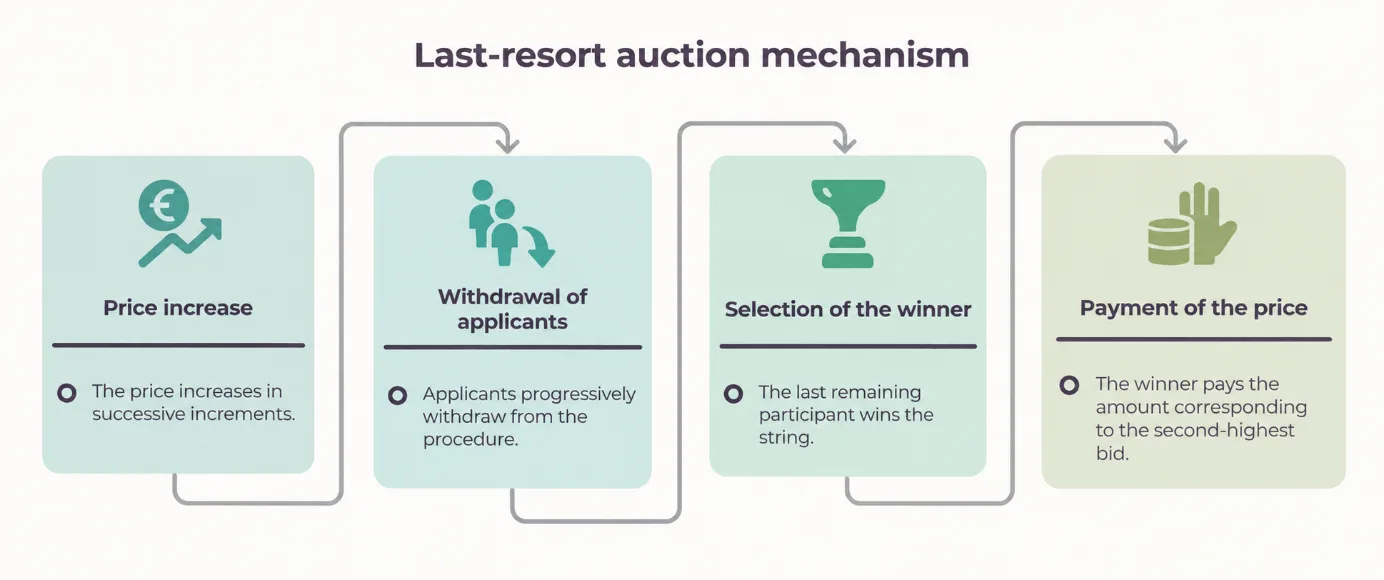
The auction of last resort will use an ascending-clock, second-price method:
the price increases through successive rounds;
applicants progressively leave the auction;
the final remaining participant wins the string;
the successful applicant pays the second-highest bid.
An indirect contention auction may leave more than one application able to proceed towards delegation.
Applicants qualifying for the Applicant Support Program may receive a bid credit of up to 35%, capped at USD 1.75 million per application. The credit is progressively reduced when the winning price exceeds USD 5 million and falls to zero above USD 9 million.
The outcome and use of the proceeds from the 2012 auctions
Sixteen auctions of last resort generated approximately USD 225 million.
ICANN has established a global Grant Program funded by the net proceeds of the 2012 auctions. Its first cycle made USD 10 million available. In 2026, the ICANN Board also authorized aggregate funding of up to USD 9.9 million from those proceeds to support as many as 75 eligible applicants participating in the new round.
The experience of the previous round also demonstrates that the winning bid is only one part of the total investment. Registry operation, contractual compliance, cybersecurity, abuse prevention and user adoption must all be incorporated into the business case.
How should trademark owners prepare for Reveal Day?
Reveal Day will make it possible to identify the applied-for strings, the applicants and the first contention situations. Trademark owners should therefore implement targeted monitoring covering not only identical trademarks, but also variants, translations, transliterations and similar signs.
For companies that have filed an application, a rapid response will be essential: where a replacement string has been designated, they will have fourteen days after Reveal Day to decide whether to activate it.
It is therefore advisable to anticipate now which strings should be monitored, the potential risks involved and the internal decision-making process, so as to be able to react immediately once the applications are published.
Conclusion
The new gTLD application round opened by ICANN in 2026 marks the return of global competition for scarce digital assets. Effective decision-making requires coordination between intellectual property, brand strategy, finance, cybersecurity and registry operations.
Dreyfus Law Firm assists its clients in managing complex intellectual property cases, offering personalized advice and comprehensive operational support for the complete protection of intellectual property.
How much does a new gTLD application cost in 2026?
The standard evaluation fee is USD 227,000 per application. Applicants must also budget for technical, legal, operational and possible auction costs.
Can a trademark owner object to a new gTLD that infringes its rights?
Yes. A Legal Rights Objection may be filed where a rights holder considers that an applied-for string infringes its existing legal rights. This procedure is separate from application comments.
What are the main grounds for objecting to a new gTLD application?
The Applicant Guidebook provides four grounds: String Confusion, Legal Rights, Limited Public Interest and Community objections.Can applicants reach a private settlement?
No. Private auctions, compensated withdrawal agreements and other private contention-resolution arrangements are prohibited under the 2026 Applicant Guidebook.
Does a .brand automatically improve search rankings?
No. Google treats new gTLDs in broadly the same manner as other generic extensions. Their principal value lies in control of the namespace, brand consistency and the identification of official services.
This publication is intended for general public guidance and to highlight issues. It is not intended to apply to specific circumstances or to constitute legal advice.
Following the separation of Sudan and South Sudan in 2011, a trademark must be subject to dual protection so as to be safeguarded throughout the territory of the two countries. Trademarks registered in Sudan are no longer protected in South Sudan. Thus, it is advisable to have two distinct registrations.
The Ministry of Justice of South Sudan is responsible for the completion of formalities under the 1969 Sudanese law. The existing system is expeditious (2 to 3 months to secure a registration certificate) but requires that an application to be filed for each proposed class (mono class system).
Once registered, the trademark will be protected for a renewable period of 10 years in the territory of South Sudan.
Any application filed today will only be legally enforceable once the new law, which is currently being debated in Parliament, shall come into force. However, protection will run retroactively from the filing date.
With the rapid proliferation of social networks and the increased access to virtual currencies, it was inevitable that the two would merge at some point. Indeed, virtual currencies are being increasingly used in networks, particularly for the payment of premium services.
Virtual currencies are characterized by their digital nature. They are stored on electronic media and used by electronic devices. They serve the same purpose as real money, that is, to purchase goods and services. However, they are private currencies and are thus not controlled or regulated by the state. They may be used either for profit or for charity.
These new currencies, which work in parallel with real money, are often network-specific. Facebook Credits and Twitter’s Twollars are amongst the most popular. They have also established themselves in other media, particularly in video games.
There are two systems of virtual currencies:
– open systems where real money can be converted into virtual currency and vice versa;
– closed systems where virtual currency cannot be reconverted back into real money.
In connection with these currencies, new payment methods can be found which are specifically designed for social networks like, for instance, Dwolla. At the same time, “likes”, followers and tweets are being monetized. This concept was used in Marc Jacobs’ pop-up store during the Fashion Week in New York where customers could pay through tweets by using the hashtag #MJDaisychain.
Currently, these currencies are not regulated. However, their evolution and the stakes involved make it very important for a related legal framework to be established. Given their lack of territoriality, an international solution should be found for these currencies to be effectively monitored. This makes the issue a complex one.
Our site uses cookies to offer you the best service and to produce statistics, and measure the website's audience. You can change your preferences at any time by clicking on the "Customise my choices" section.
When browsing the Website, Internet users leave digital traces. This information is collected by a connection indicator called "cookie".
Dreyfus uses cookies for statistical analysis purposes to offer you the best experience on its Website.
In compliance with the applicable regulations and with your prior consent, Dreyfus may collect information relating to your terminal or the networks from which you access the Website.
The cookies associated with our Website are intended to store only information relating to your navigation on the Website. This information can be directly read or modified during your subsequent visits and searches on the Website.
Necessary cookies are absolutely essential for the website to function properly. These cookies ensure basic functionalities and security features of the website, anonymously.
Dreyfus is concerned about protecting your privacy and the Personal Data ("Data"; "Personal Data") it collects and processes for you.
Hence, Dreyfus complies every day with the European Union legislation regarding Data protection and particularly the European General Data Protection Regulation Number 2016/679 of 27 April 2016 (GDPR).
This Privacy Policy is aimed at informing you clearly and comprehensively about how Dreyfus, as Data Controller, collects and uses your Personal Data. In addition, the purpose of this Policy is to inform you about the means at your disposal to control this use and exercise your rights related to the said processing, collection and use of your Personal Data.
This Privacy Policy describes how Dreyfus collects and processes your Personal Data. The collection happens when you visit our Website, when you exchange with Dreyfus by e-mail or post, when exercising our Intellectual Property Attorney and representative roles, when we interact with our clients and fellow practitioners, or on any other occasion when you provide your Personal Data to Dreyfus, in particular when you register for our professional events.


 Written by Nathalie Dreyfus06/11/2014