News

How to effectively protect your trademark on Instagram, Snapchat and TikTok in 2026?

Introduction

Trademark protection on social media has become a major strategic issue as platforms such as Instagram, Snapchat and TikTok have established themselves as essential visibility channels. While this massive exposure represents a powerful acquisition lever, it also leads to a significant increase in infringements of intellectual property rights.

We observe that the most successful companies no longer rely solely on marketing presence: they implement a comprehensive strategy combining visibility, SEO and legal protection. In this context, controlling the risks associated with the use of distinctive signs online has become an operational necessity.

Why have social media become essential for trademarks?

A convergence between visibility, SEO and trademark awareness

Social media now play a central role in the digital ecosystem. They are no longer just communication channels but true extensions of trademark identity, visible both on platforms and in search engine results.

In practice, a well-optimized Instagram or TikTok account frequently appears among the top Google results for trademark-related queries. This presence helps control online image while strengthening credibility with clients and partners.

An engagement-driven performance model

Trademark performance is no longer measured solely by audience size but by the ability to generate engagement, particularly among younger audiences. Interactions (comments, shares, reactions) directly influence content distribution through platform algorithms.

In this context, editorial strategy must align with legal protection: poorly managed viral content can generate as many risks as visibility.

Strategic specificities of Snapchat, Instagram and TikTok

  • Snapchat: encourages spontaneous and authentic communication, ideal for humanizing the trademark.
    • However, despite their ephemeral nature, content can be captured and reused, requiring basic internal safeguards.
  • Instagram: enables the development of a consistent and high-performing trademark image through professional tools.
    • Each published element (photo, caption, hashtag) must comply with trademark law, especially when using third-party distinctive signs.
  • TikTok: offers rapid visibility through a powerful algorithm.
    • This virality increases the risk of misuse or misappropriation of the trademark, requiring active monitoring.

What are the legal risks associated with using a trademark on social media?

Unlawful appropriation of usernames

Fraudulent registration of usernames is one of the most common infringements. Third parties may use identical or similar names to capture traffic or create confusion among users.

This phenomenon, comparable to domain name cybersquatting, requires swift action to prevent trademark dilution.

Counterfeiting and unauthorized commercial use

Social media have become major distribution channels, including for counterfeit goods. Fake accounts reproducing logos or promoting misleading offers are increasingly common.

Such practices infringe exclusive trademark rights and may result in significant financial and reputational damage.

Reputational harm and unfair competition

Beyond traditional infringements, social media facilitate:

  • Rapid dissemination of harmful content;
  • Unauthorized association with a trademark;
  • Exploitation of reputation by third parties.

These situations require a nuanced legal approach combining intellectual property and liability law.

Legal and operational strategies to secure your presence on social media

Anticipate: build a coherent digital portfolio

The first step is to secure all digital touchpoints. We recommend in particular:

  • Filing trademarks with relevant offices, covering appropriate classes and territories;
  • Proactively reserving usernames;
  • Harmonizing identifiers across platforms to ensure consistency and recognition;
  • Checking the availability of distinctive signs before launching campaigns or products.

This proactive approach helps prevent conflicts and ensures consistent trademark communication.

building digital portfolio

Monitor: implement continuous trademark watch

Effective monitoring relies on technological tools capable of detecting infringements in real time. This includes surveillance across social media, marketplaces and emerging channels.

The objective is to identify infringements early and limit their impact.

Act: deploy appropriate legal mechanisms

In case of infringement, several actions may be taken. An initial response typically involves a takedown procedure, i.e. a formal notice to platforms requesting removal of infringing content or accounts.

Where infringement is more serious (impersonation, infringement, fraudulent commercial use), a structured approach is required, including:

  • Sending cease-and-desist letters;
  • Initiating username recovery procedures;
  • Bringing legal actions based on trademark infringement or unfair competition.

A rapid and structured response generally leads to effective outcomes, including content removal or account recovery.

To learn more about trademark monitoring strategies on social media, we invite you to consult our previously published article.

Conclusion

The presence on Instagram, Snapchat and TikTok represents a major strategic opportunity, provided it is supported by an appropriate protection policy. Controlling legal risks not only preserves intangible assets but also strengthens long-term competitiveness.

Dreyfus & Associés assists its clients in managing complex intellectual property cases, offering personalized advice and comprehensive operational support for the complete protection of intellectual property.

Dreyfus & Associés works in partnership with a global network of attorneys specializing in Intellectual Property.

Nathalie Dreyfus with the support of the entire Dreyfus team

FAQ

1. Is a trademark vulnerable if it is not active on social media?
Yes. Lack of active presence facilitates abusive registrations by third parties and complicates recovery actions.

2. How can I prove that a social media account infringes my trademark?
Proof relies on demonstrating likelihood of confusion, unauthorized use and, where applicable, damage. Evidence may include screenshots or monitoring reports.

3. How long does it take to remove a fraudulent account?
It depends on the platform and the strength of the claim. A well-documented takedown may succeed within a few days.

4. Can hashtags constitute trademark infringement?
Yes, when they exploit a protected trademark for commercial purposes without authorization.

5. Is a company liable for content posted by its employees?
Yes, liability may arise in case of unlawful publication.

This publication is intended to provide general guidance and highlight certain issues. It is not intended to apply to specific situations or to constitute legal advice.

Read More

UDRP/URS: Guide to the 10 Best Practices for a Successful Proceeding

Introduction

The UDRP (Uniform Domain Name Dispute Resolution Policy) and the URS (Uniform Rapid Suspension System) are two essential extrajudicial mechanisms for effectively combating cybersquatting and abusive domain name registrations. Administered under the auspices of ICANN, these procedures provide trademark owners with a fast and targeted means of enforcing their rights globally, without resorting to lengthy and costly court actions.

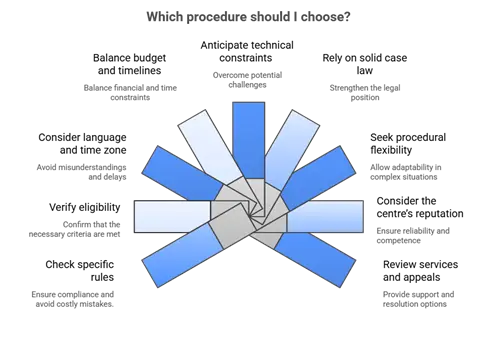
However, the success of any action largely depends on the strategic choice of the arbitration and mediation center. Each institution has its own specific features in terms of procedural rules, timelines, costs, and the quality of its decisions. Given this diversity, it is essential to adopt a methodical approach, based on objective criteria and a careful analysis of your needs.

In this article, we share 10 key tips to help you make this crucial decision and optimise the protection of your digital assets.

Legal framework of UDRP and URS proceedings

Tip 1 : Determine whether your dispute requires a UDRP or a URS

Before initiating any action, it is essential to assess the nature of the infringement. UDRP is appropriate where the objective is the transfer or permanent deletion of the domain name, for instance, in cases of clear cybersquatting. URS, which is faster and less expensive, is limited to temporary suspension and applies only to new gTLDs. A strategic review of the facts, the commercial risk, and long-term objectives will ensure that you choose the most appropriate procedure and avoid wasting time on an unsuitable path.

Tip 2 : Review the Supplemental Rules of the selected center

Each accredited center applies the baseline rules defined by ICANN but adds “Supplemental Rules” that can influence the process. These set deadlines for filing, evidence formats, accepted languages, and proof requirements. A thorough review before filing allows you to anticipate constraints and prepare a compliant case file, reducing the risk of dismissal for procedural defects.

Choosing based on the disputed domain name

Tip 3 : Check the policy applicable to the domain extension

Not all extensions fall under UDRP or URS. Certain ccTLDs voluntarily adopt UDRP (e.g., .tv, .me), while URS applies only to new gTLDs such as .shop, .app, or .paris. Before starting a procedure, confirm the applicability of the rules with the registry of the extension. This is critical to avoid initiating an inapplicable action, which could waste costs and delay enforcement.

Tip 4 : Select a center adapted to the language and time zone

The language of the proceedings directly impacts speed and cost. Choosing a center that operates in your language, or in the registration agreement’s language, avoids high translation costs and reduces the risk of errors. Time zone alignment is also important, as it facilitates communication with panelists and administrative staff particularly for urgent exchanges or submission of additional evidence under tight deadlines.

Assessing costs, timelines, and procedural rules

Tip 5 : Balance budget, urgency, and expected outcome

Costs and timelines vary significantly. URS generally costs between USD 300 and 500 and can conclude in under 20 days, but only provides suspension. UDRP, which is more expensive (often several thousand euros), takes an average of 60–75 days and results in a transfer or permanent deletion. Your choice should be guided by whether you prioritise speed or the permanence of the remedy.

Tip 6 : Anticipate technical and administrative constraints

Some centers require specific electronic formats, online filing tools, or strict file size and format rules. Others still require physical submission of signed documents. Failing to anticipate these requirements can lead to delays or even dismissal of the complaint. Preparing for these in advance ensures smooth procedural progress.

Service quality and legal expertise

Tip 7 : Choose a center with a rich and consistent body of case law

Centers such as WIPO have extensive decision databases and research tools that consolidate international case law. This consistency is invaluable for predicting the likely outcome of a case and crafting a strong argument. A center with few precedents offers less predictability in decision-making trends.

Tip 8 : Opt for a center offering flexibility and adaptability

Some disputes require procedural flexibility, such as extensions of deadlines, acceptance of late-filed evidence, or hearings in an additional language. A center capable of tailoring its process to the complexity of your case can greatly improve your chances of success, especially in multi-respondent or cross-border matters.

Other decisive factors

Tip 9 : Consider the reputation and experience of the center

A center’s reputation is often tied to the quality of its panelists and the consistency of its rulings. An experienced center inspires trust among the parties and can also facilitate enforcement of decisions by registrars and registries. This institutional credibility is a key factor in legal security.

Tip 10 : Assess additional services and avenues for appeal

Some centers provide added value through technical assistance, practical guides, or an appeal mechanism in case of an adverse decision. Such features can be decisive, particularly under URS where an appeal process exists. Evaluating these advantages ensures you select a center offering more than just case management.

Conclusion

Selecting the right arbitration and mediation center for UDRP/URS proceedings is a strategic decision that must account for the nature of the dispute, the domain extension, timelines, costs, language, and the institution’s experience and reputation. Applying these ten tips will maximise your chances of success and secure the protection of your digital assets.

chose udrp procedure

Dreyfus & associés assists clients at every stage of these proceedings, backed by its recognised expertise in Internet and domain name litigation.

Nathalie Dreyfus with the support of the entire Dreyfus team.


FAQ


What is the difference between UDRP and URS ?

UDRP allows transfer or permanent deletion; URS provides only temporary suspension.

How do I know if my domain name is eligible for URS ?

URS applies only to new gTLDs approved by ICANN.

Which center should I choose to maximise my chances of success ?

Select a center with a rich case law history and recognised decision consistency, such as WIPO.

Do costs vary from one center to another ?

Yes, each center sets its own fees and terms.

Can an URS decision be appealed ?

Yes, some centers provide an internal appeal mechanism.

Read More

Trunki, ten years on: from jurisprudential shock to strategic maturity in design law

Introduction

Ten years after the judgment delivered on March 9, 2016 by the UK Supreme Court in PMS International Ltd v. Magmatic Ltd (UKSC/2014/0147), commonly referred to as the “Trunki” case, its full significance can now be properly appreciated. While the decision is today regarded as a leading authority in design law, its outcome and strict reasoning initially took many practitioners by surprise in 2016.

In order to understand its enduring influence, it is necessary to revisit both the factual background and the judicial trajectory of this landmark case.

The facts of the case: confrontation between a registered design and an inspired product

In the mid-2000s, the British company Magmatic Ltd marketed the “Trunki” children’s suitcase, designed as cabin luggage that could also be ridden by children. The product’s commercial success relied heavily on its appearance: a rigid shell with rounded contours, incorporating protruding elements suggestive of the horns of a stylized animal, combined with a smooth and minimalist surface.

To protect this appearance, Magmatic filed a Registered Community Design pursuant to Regulation No 6/2002. The filed representations consisted of computer-generated images depicting a suitcase devoid of visible ornamentation and characterized by marked tonal contrast. No written claim or description accompanied the filing.

In 2013, PMS International marketed a competing suitcase in the United Kingdom under the name “Kiddee Case.” While it adopted the concept of an animal-shaped ride-on suitcase for children and featured similar protrusions at the front, those elements more closely resembled ears or antennae rather than horns. In addition, the Kiddee Case incorporated decorative elements and color combinations absent from Magmatic’s registered representations.

Alleging infringement of its Registered Community Design, Magmatic initiated proceedings under Articles 10 and 19 of Regulation No 6/2002, contending that the Kiddee Case produced the same overall visual impression on the informed user.

Judicial trajectory: a progressive redefinition of the scope of protection in design law

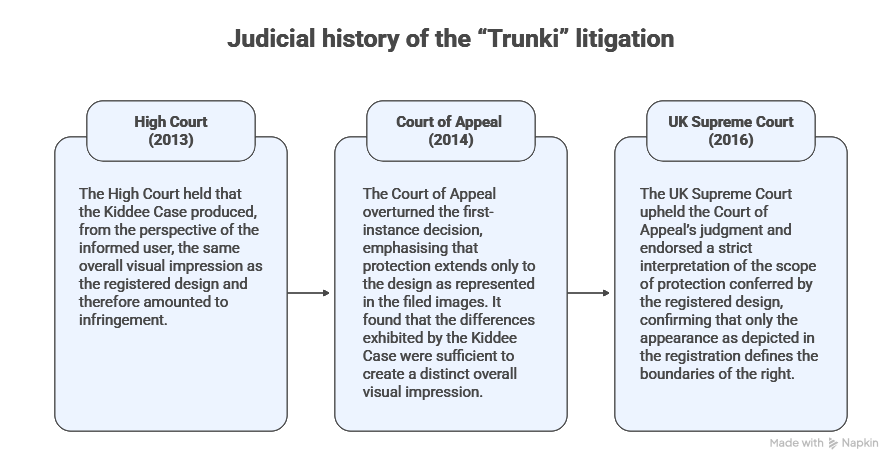
The significance of the case lies as much in its procedural path as in its outcome, revealing initial judicial hesitations concerning the interpretation of the “overall impression” test.

judicial history trunki

The UK Supreme Court ultimately reaffirmed several foundational principles of design law:

  • Protection extends solely to the appearance of the product as represented in the registration.
    In the absence of any written claim, the registered images alone determine the scope of the exclusive right.
  • A registered design does not protect a general idea or product concept.
    The concept of an animal-shaped ride-on suitcase is not, as such, appropriable; only the specific appearance embodied in the representations may be protected.
  • Visible graphical elements, including tonal contrasts and the absence of ornamentation, constitute defining characteristics of the design.
    The monochrome treatment and smooth surface were not neutral features; they contributed to the overall visual impression conveyed by the registered design.

The UK Supreme Court emphasized that the distinction between “horns” and “ears” was not a trivial detail. Consequently, the Kiddee Case did not produce the same overall impression as the protected design, and the infringement claim was definitively dismissed.

This reasoning was consistent with established case law of the Court of Justice of the European Union, notably PepsiCo v Grupo Promer (C-281/10 P, 2010), which confirms that assessment of overall impression must take into account the designer’s degree of freedom and must be based on the visible characteristics of the design as disclosed. In this respect, the UK Supreme Court did not depart from the European framework; rather, it applied its methodological requirements with particular rigor.

A divided reception: rigor in the service of legal certainty

In 2016, the Trunki decision prompted contrasting reactions within professional circles. Many designers and rights holders perceived the ruling as severe, even unsettling. The notion that a product clearly inspired by a commercially successful model could avoid a finding of counterfeiting appeared counterintuitive from an economic and creative standpoint. However, such reactions reflected a persistent confusion between commercial inspiration and legally relevant reproduction.

By contrast, litigation practitioners and design law specialists regarded the judgment as a welcome clarification. The UK Supreme Court unequivocally reiterated that the monopoly conferred by a registered design is strictly confined to the graphical representations filed under Regulation No 6/2002. The judgment reaffirmed that protection extends neither to ideas, nor to market positioning, nor to product concepts, but exclusively to the appearance as objectively fixed in the registration.

Ten years later, this strict approach appears less as a restriction than as a salutary clarification. It has reinforced legal predictability in design litigation and confirmed that the scope of protection cannot exceed what has been formally disclosed and registered.

The emergence of a litigation-conscious filing strategy

The most enduring impact of Trunki lies in its influence on filing strategies. The case served as a revealing reminder that graphical representations are not mere illustrations; they define the very boundaries of the exclusive right.

Since 2016, filing practices have evolved significantly. Applicants increasingly favor line drawings to prevent shading effects, tonal contrasts or decorative details from being interpreted as limiting characteristics. Multiple variants are more systematically filed to encompass different aesthetic iterations of a product. The use of broken lines and visual disclaimers has developed to delineate precisely which features are claimed and which are excluded.

Most importantly, strategic reflection now takes place upstream. Color contrasts, neutral areas and visible structural elements are carefully assessed in light of their potential impact on the overall visual impression. Filing is no longer regarded as a mere administrative formality at the end of the creative process; it has become a structuring legal act undertaken in anticipation of possible litigation and judicial scrutiny by reference to the informed user.

The decision also contributed to a clearer articulation between different intellectual property regimes. This clarification has fostered more sophisticated combined strategies. Companies developing design-driven products now secure, where appropriate, the appearance through registered designs, technical features through patents, and distinctive signs through trademarks including three-dimensional or figurative trademarks. In this respect, Trunki did not merely refine infringement analysis; it professionalized design protection strategy and reinforced the principle that effective protection rests on a comprehensive and coordinated IP approach.

Conclusion

Ten years after its delivery, Trunki no longer appears as a harsh decision but rather as a mature and methodologically clarifying judgment. By reaffirming that the exclusive right arises from and is limited by the filing, the UK Supreme Court firmly anchored design law within a framework of objectivity and predictability.

More than a simple infringement case, Trunki marked a methodological turning point: it shifted the center of gravity of protection to the act of filing itself. In design law, strategy now begins well before litigation.

Dreyfus & Associés assists its clients in managing complex intellectual property cases, offering personalized advice and comprehensive operational support for the complete protection of intellectual property.

Dreyfus & Associés works in partnership with a global network of attorneys specializing in Intellectual Property.

Nathalie Dreyfus with the support of the entire Dreyfus team.

FAQ

1. What is “overall visual impression” in design law?
Overall visual impression refers to the overall perception produced by a design on the informed user. It is not the result of a point-by-point analytical comparison, but rather a holistic assessment of the visible characteristics of the design, taking into account the designer’s degree of freedom in the relevant sector.

2. Who is the “informed user”?
The informed user occupies an intermediate position between the average consumer and the technical expert. This user is familiar with existing designs in the sector, demonstrates a heightened degree of attention, yet does not engage in technical or expert analysis.

3. Does the unregistered community design provide equivalent protection?
No. The unregistered community design offers a shorter term of protection (three years from first disclosure within the European Union) and generally requires proof of deliberate copying.

4. Is the infringer’s intention relevant?
In the context of registered design infringement, intention is in principle irrelevant. The decisive criterion remains whether the contested product produces the same overall visual impression on the informed user.

5. Can a registered design be modified after registration?
Only corrections of clerical errors or obvious inaccuracies are permitted. No substantive modification affecting the visible characteristics of the registered design is allowed after filing. Any alteration of the appearance requires the filing of a new design in order to preserve legal certainty and priority.

6. What is the principal strategic lesson derived from the Trunki case?
That effective design protection is constructed at the filing stage. Litigation cannot remedy an imprecise or poorly structured registration.

The purpose of this publication is to provide general guidance to the public and to highlight certain issues. It is not intended to apply to particular situations or to constitute legal advice.

Read More

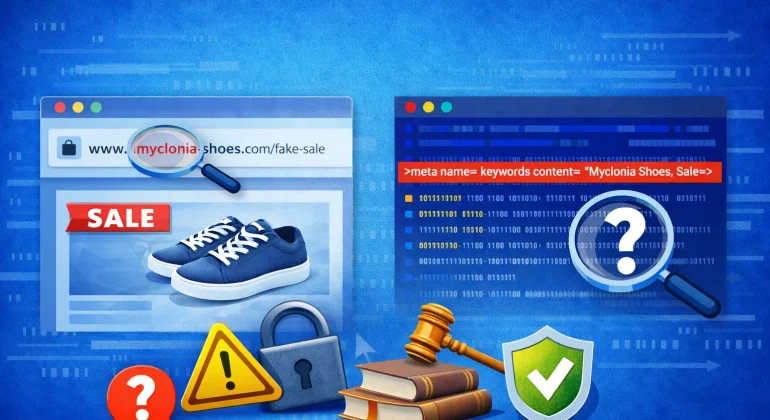
Does the reproduction of a trademark in a URL or in a website’s source code constitute trademark infringement?

Introduction

The reproduction of a trademark in a URL or in the source code of a website raises recurring legal issues for companies confronted with unauthorized digital uses of their distinctive signs.

At a time when online visibility conditions access to the market, such practices directly call into question trademark law, as well as the boundaries between infringement, search engine optimization, lawful technical uses and unfair competition.

The central question appears simple at first glance: does the insertion of a trademark into a URL, an HTML tag or a website’s source code automatically constitute trademark infringement? In practice, the answer is nuanced. It requires a detailed legal analysis of the nature of the use, its economic context and its concrete effects on the relevant public.

Legal qualification of the reproduction of a trademark in a URL

Under both French law and European Union law, trademark infringement requires that several cumulative conditions be met. The trademark must be used in the course of trade, in relation to identical or similar goods or services, and such use must be liable to adversely affect one of the functions of the trademark, foremost among them its essential function of indicating the commercial origin of goods or services.

The analysis is therefore not limited to the mere material reproduction of the sign, but focuses on its economic role and the effect it produces on the perception of the relevant public.

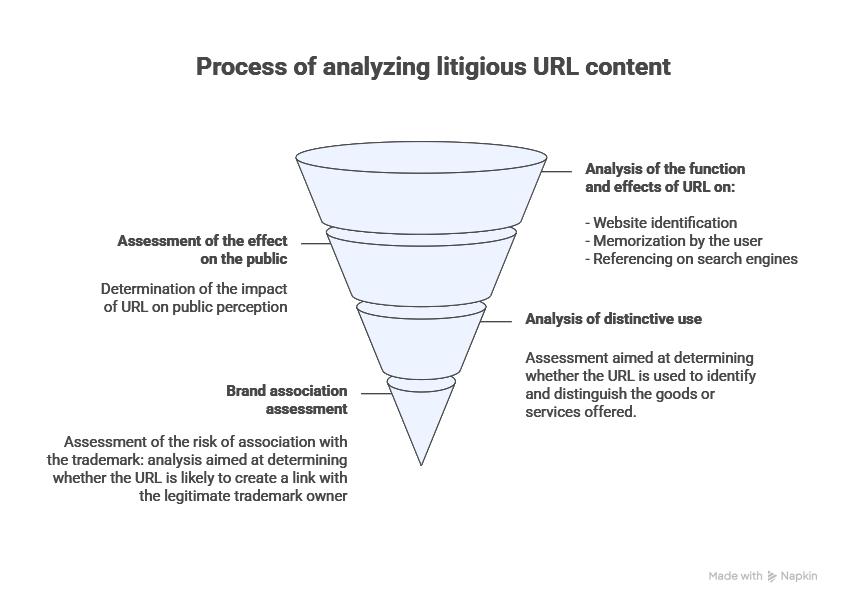
In this context, the presence of a trademark in a URL must be assessed in light of its function and its effects. A URL is not a neutral or purely technical element; it contributes to the identification of the website, its memorability for internet users, and its indexing and ranking by search engines. As such, it constitutes a vector of commercial visibility, the effects of which may be comparable to those of a domain name or a sign displayed directly on a webpage.

Where a trademark is incorporated into the URL of a website offering goods or services, such reproduction may be characterized as use in a distinctive capacity, particularly where it seeks to capture qualified traffic or to create, in the mind of the public, an association with the legitimate trademark owner. In this respect, the URL forms part of the overall commercial presentation of the website and contributes to shaping the perception of the reasonably well-informed and reasonably observant internet user.

process litigious URL

This approach has been upheld by case law, notably in a judgment of January 29, 2016. In Un Amour de Tapis v. Westwing (Paris Court of First Instance, 3rd Chamber, 3rd Section, 29 January 2016, No. 14/06691), the court found trademark infringement on the basis of the unauthorized use of a trademark in the URL of a private sales website in the context of a one-off commercial operation. The court held that such reproduction was likely to create a risk of confusion as to the origin of the goods offered and to give the impression of the existence of a link, endorsement or participation by the trademark owner in the operation at issue.

The decisive impact of URLs on organic search rankings

The use of a trademark in the source code of a website presents a specific and significant feature. Although such use is invisible to the end user, it plays a decisive role in organic search rankings and in the way search engines identify, classify and promote a website’s content.
The source code therefore directly contributes to the visibility of an offer on the market.

The insertion of a trademark into strategic elements such as title tags, meta descriptions, HTML headings or alt attributes may constitute use in the course of trade where it is intended to improve the website’s positioning for searches associated with that trademark. Such use cannot be regarded as purely technical where it pursues an objective of attracting traffic and influencing the behavior of internet users.

Case law now consistently recognizes that the invisible nature of the use does not, in itself, preclude a finding of trademark infringement. In its judgments of March 23, 2010 (CJEU, March 23, 2010, joined cases C-236/08 to C-238/08), the European Union Court of Justice held that the assessment must focus on the effects produced on the economic behavior of internet users, in particular through the results displayed by search engines.

Where the use of a trademark in the source code enables the capture of qualified traffic, diverts the attention of internet users or creates an undue association with the legitimate trademark owner, an infringement of the functions of the trademark may be established, irrespective of the sign’s direct visibility on the page consulted.

The criteria applied to establish trademark infringement

In order to assess whether trademark infringement has occurred, courts carry out an overall assessment of the circumstances of the case.

The first criterion consists in determining whether the trademark is used as a distinctive sign in the URL, that is, as an indicator of commercial origin, rather than as a purely descriptive, informational or strictly necessary reference. The targeted and repeated insertion of the trademark into strategic elements such as the URL or certain component of the source code tends to reveal use as a trademark where it contributes to attracting the public and promoting the offer.

The likelihood of confusion remains a central criterion. It is assessed on a concrete basis, taking into account in particular the full or near-full reproduction of the trademark, the identity or similarity of the goods or services offered, as well as the overall presentation of the website and its digital environment. Taken together, these factors may lead internet users to mistakenly believe that there is an economic, organizational or contractual link with the trademark owner.

Beyond the likelihood of confusion, courts also take into consideration harm to the other functions of the trademark. Unauthorized use may adversely affect its advertising function by unduly exploiting its power of attraction, its investment function by weakening the efforts made by the owner to enhance the value of the sign, or its communication function. Such impairments may be sufficient to establish counterfeiting, even in the absence of immediate confusion.

Lawful uses and the boundary with unfair competition

Not every reproduction of a trademark in a digital environment is necessarily unlawful. Certain uses may be permitted where they are strictly necessary, proportionate and devoid of any distinctive character, in particular for descriptive, informational or fair comparative purposes.

That boundary, however, is a narrow one. Where the use goes beyond what is necessary to inform the public and tends to unduly capture customers or to take unfair advantage of the trademark’s reputation, the risk of a finding of infringement re-emerges.

In practice, where the strict conditions for trademark infringement are not fully met, the conduct at issue may nevertheless fall within the scope of unfair competition or parasitism, particularly where it reveals an intent to capitalize on the reputation of an established operator or to divert its online traffic.

Conclusion

The reproduction of a trademark in a URL or in the source code of a website cannot be only reduced to a purely technical use. Where it influences the visibility of the website, its organic search ranking and the economic behavior of internet users, it may constitute a use in the course of trade that adversely affects the functions of the trademark.

The assessment must remain concrete and based on the actual effects of the use. Regardless of whether the sign is visible or invisible to the user, URLs and source code fully form part of a website’s commercial presentation and may, as such, give rise to a finding of trademark infringement.


Dreyfus & Associés assists its clients in managing complex intellectual property cases, offering personalized advice and comprehensive operational support for the complete protection of intellectual property.

Dreyfus & Associés works in partnership with a global network of attorneys specializing in Intellectual Property.

Nathalie Dreyfus with the support of the entire Dreyfus team.


Q&A


Is it necessary to prove fraudulent intent in order to establish trademark infringement?
No. Trademark infringement is an objective form of liability. While intent may be relevant to the assessment of damages or the measures ordered, it is not a condition for establishing infringement.

Can the use of a competitor’s trademark in a URL be justified by comparative SEO practices?
Very rarely. Lawful comparative practices require information that is fair, objective and proportionate. In practice, the insertion of a trademark into a URL is difficult to justify under these standards.

Is the use of a trademark in a URL for purely internal (back-office) purposes risky?
In principle, no, provided that the URL is neither indexed nor accessible to the public.

Is an action based on unfair competition preferable where the use is described as “technical”?
It may offer greater flexibility in certain situations, particularly where the qualification of trademark infringement is uncertain. Both legal grounds may, however, be relied upon in a complementary manner.

Is the use of a trademark in a URL by an authorized distributor lawful?

This depends on the contractual framework and the conditions of use. In the absence of express authorization, excessive or misleading use may go beyond the distributor’s rights.

Do well-known trademarks benefit from enhanced protection in this context?
Yes. Harm to the investment function or the reputation of the trademark may be established even in the absence of a likelihood of confusion, thereby facilitating enforcement actions.


The purpose of this publication is to provide general guidance to the public and to highlight certain issues. It is not intended to apply to particular situations or to constitute legal advice.
Read More

Reform of South Korean trademark law: what are the major developments since the law of September 1, 2016 ?

Introduction

On February 29, 2016, the National Assembly of the Republic of Korea adopted legislation profoundly reforming the trademark law framework. This reform entered into force on September 1, 2016 and represents one of the most significant developments in South Korean trademark law since the major revisions of the 1990s.

Trademark protection in South Korea is obtained through registration with the Korean Intellectual Property Office (KIPO), the competent administrative authority for intellectual property matters and the functional equivalent of the French INPI.

Since 2016, several successive waves of amendments have pursued the same objective: improving procedural efficiency, introducing greater flexibility for applicants, and strengthening remedies against infringement and intentional misconduct.

The challenge is clear: filing in South Korea is no longer merely about “reserving” a sign. It now requires anticipating a modernized legal framework in which use, coexistence, and procedural speed play a central role.

The pillars of the 2016 reform of South Korean trademark law

A Deliberately more “functional” definition of a trademark

Prior to the reform, Article 2(1)(i) defined a trademark as “a means used on goods related to the business of a person engaged in commercial activities […] to distinguish them from the goods of others.” This definition was accompanied by an exhaustive list of visually recognizable signs, including symbols, characters, illustrations, three-dimensional shapes, or combinations thereof.

This approach, strongly rooted in the requirement of visual perception, had become increasingly ill-suited to contemporary developments in marketing and the identification of products and services.

Since September 1, 2016, Korean law defines a trademark in deliberately functional and abstract terms as “a sign used to identify and distinguish the goods or services of one person from those of another.” The explicit reference to the form of expression has been abandoned. This evolution allows for a broader understanding of distinctive signs, regardless of their mode of perception, and aligns Korean law more closely with international standards.

Removal of the legal standing requirement

Under Korean law, a registered trademark may be cancelled if it has not been put to genuine and continuous use during the three years preceding the cancellation request.

Under the former legislation, Article 73(6) restricted non-use cancellation actions to “interested parties,” requiring applicants to demonstrate a direct and current legal interest.

The reform expressly removed this requirement. Article 119(5) of the revised law now provides that “any third party,” without having to justify a specific interest, may file a non-use cancellation action. This legislative choice marks a clear break with previous practice and reflects a strong commitment to clearing the register of dormant trademarks.

Retroactive effect of judicial cancellation

The reform also amended the former Article 73(7), which provided that trademark rights ceased on the date when the cancellation decision became final. Article 119(6) now introduces retroactive effect: the right is deemed to have ceased as of the filing date of the cancellation request.

This retroactivity significantly strengthens the effectiveness of cancellation actions and their impact on related proceedings, particularly on the examination of subsequent applications.

Modification of the examination of identical or similar trademarks

Korean law prohibits the registration of trademarks identical or similar to earlier registered trademarks. Former Article 7(1)(vii) required examiners to assess similarity as of the filing date. Any subsequent changes affecting the earlier mark, such as cancellation, invalidation, abandonment, or assignment, were irrelevant.

Article 34(2) of the revised law introduces a fundamental change: examination must now be conducted as of the examination date, not the filing date. As a result, a cancellation or invalidation decision issued during the examination process must be taken into account and may allow the later mark to proceed to registration.

Abolition of statutory waiting periods: towards a more streamlined trademark life cycle

The 2016 reform repealed the rule under former Article 8, which imposed a six-month waiting period between the filing of a trademark application and the initiation of a non-use cancellation action against an earlier trademark.

Today, only the criterion of anteriority between the registration application and the cancellation request remains, without any minimum waiting period.

The reform also repealed Article 7(1)(viii), which imposed a one-year waiting period before filing a trademark identical or similar to a cancelled third-party trademark. Its removal contributes to shortening registration timelines and improving system predictability.

New provisions of trademark law in South Korea: Exceptions, letters of consent, and modifications to opposition period

The previous user in good faith: an exception to consumer confusion

The Korean Unfair Competition Prevention Act (UCPA) defines consumer confusion as an act of unfair competition. However, the issue of whether the continued, good faith use of an identical or similar mark before it became widely known constitutes unfair competition has been a subject of debate. The Supreme Court of Korea ruled in 2004 that such use should be considered as unfair competition.

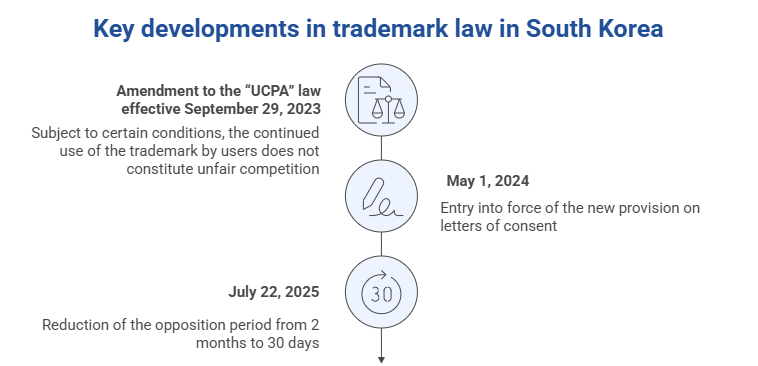
However, the amended Korean Consumer Protection Act (UCPA) introduces an exception for previous users in good faith. It stipulates that, in certain cases, the continued use of the mark by these users does not constitute unfair competition, as long as they used the mark before it became widely recognized and without malicious intent. The law also grants owners of well-known marks the right to request preventive measures to avoid confusion among consumers.

New provision of the 2024 reform: acceptance of letters of consent

A provision that entered into force on May 1, 2024 introduced a legally recognized possibility to accept letters of consent issued by prior rights holders in order to overcome examiner objections based on identity or similarity.

This measure applies to all pending applications and allows applicants to submit a letter of consent to address confusion risks identified by examiners, without immediately resorting to litigation or cancellation proceedings.

On this basis, an applicant facing a provisional refusal based on similarity may:

• submit a letter of consent from the prior trademark owner,
• accompany it with a broader coexistence agreement governing future use,
• or establish contractual restrictions designed to prevent confusion in relevant markets.

This provision enhances flexibility under Korean trademark law and aligns Korean practice with that of other jurisdictions that recognize contractual consent mechanisms.

Key changes in 2025: accelerated opposition proceedings

As of July 22, 2025, the opposition period has been reduced from two months to 30 days for trademarks published from that date onward.

This change has significant implications, as monitoring systems must become more responsive and internal processes detection, assessment, decision-making, and file preparation—must be optimized.

major changes trademarks

Conclusion

The reform of South Korean trademark law represents a decisive shift towards broader, more deterrent, and more internationally aligned protection.

In an economic environment where trademark value is central, this reform requires heightened vigilance and advanced legal expertise in order to transform legislative developments into sustainable competitive advantages.

Dreyfus & Associés assists its clients in managing complex intellectual property cases, offering personalized advice and comprehensive operational support for the complete protection of intellectual property.

Dreyfus & Associés works in partnership with a global network of attorneys specializing in Intellectual Property.

Nathalie Dreyfus with the support of the entire Dreyfus team

Q&A

Is it mandatory to appoint a local representative to file a trademark in South Korea?
Yes. Applicants who have neither domicile nor establishment in South Korea must act through a KIPO-accredited representative. This requirement applies to both national filings and subsequent procedures, including responses to objections, oppositions, and cancellation actions.

What is the term of protection of a trademark in South Korea and how can it be renewed?
A registered trademark is protected for ten years from the date of registration. Upon expiry, the owner must renew the registration to extend protection for a further ten-year period. This process may be repeated indefinitely, subject to compliance with applicable formalities and deadlines.

What are the average timelines for trademark registration in South Korea?
In the absence of objections or opposition, registration generally takes between six and eight months. However, shortened opposition periods and active examination practices may significantly extend the process in contested cases.

Is prior use required before registration?
No. The Korean system is based on the filing principle rather than prior use. However, failure to make genuine use for a continuous three-year period exposes the trademark to cancellation for non-use, now available to any third party.

Does KIPO conduct an ex officio examination of distinctiveness?
Yes. Distinctiveness is examined ex officio. Descriptive, generic, or non-distinctive signs may be refused even in the absence of earlier rights.

This publication is intended to provide general guidance and highlight certain issues. It is not intended to apply to specific circumstances or to constitute legal advice.
Read More

Can a semi-figurative trademark used without its logo constitute genuine use? Key lessons from the “Fuette / Fusette” case law

Introduction: a landmark dispute

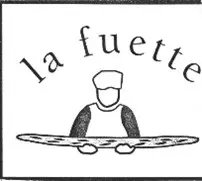
In its decision of February 16, 2016, delivered by the Commercial Chamber of the Cour de cassation, the dispute opposed Le Fournil, the owner of the French semi-figurative trademarkla fuettela fuette nb” designating bread and bakery services and used as a trade name and shop sign, to the company Coup de Pâtes, which marketed a pre-baked bread product called “Fusette.” Claiming that this designation infringed its trademark rights, Le Fournil brought an action for trademark infringement.. In response, Coup de Pâtes sought the revocation of the trademark for lack of genuine use.

The Paris Tribunal de grande instance, upheld by the Paris Court of Appeal declared the revocation of the “La Fuette” trademark. However, the Cour de cassation overturned that decision, providing important clarifications regarding the requirement of genuine use of a trademark. The following article examines this ruling and outlines the practical lessons to be drawn for managing and protecting a trademark.

The legal framework: Article L. 714-5 of the French Intellectual Property Code and the notion of genuine use

Article L. 714-5 of the French Intellectual Property Code provides that the owner of a trademark may be subject to revocation if the trademark has not been put to genuine use for an uninterrupted period of five years, unless there are proper reasons.

Genuine use implies that the use is real, public, and in line with the essential function of the trademark: to guarantee the commercial origin of the goods or services. Evidence may be submitted by any means, provided that it reflects authentic and sufficiently significant commercial exploitation, rather than merely token use.

pillars genuine use

The system also includes a specific rule: use resumed within the three months preceding the filing of a revocation action can only be taken into account if it occurred before the owner became aware of the action or its imminence. This often-overlooked rule plays a decisive role in assessing whether genuine use has been proven.

All these elements show that the assessment of genuine use is highly contextual, depending both on the nature of the goods or services and on the concrete conditions under which the trademark is exploited. These are precisely the aspects on which the decision analysed here offers valuable guidance.

Detailed analysis of the February 16, 2016 ruling of the Cour de cassation

In its judgment of October 11, 2012, the Paris Tribunal de grande instance, followed by the Paris Court of Appeal in its decision of January 17, 2014,revoked the “La Fuette” trademark on the grounds that its use was not genuine: the trademark was neither affixed to the bread nor used with its figurative logo, and the evidence provided (receipts, bags, display panels) merely reflected the bakery’s activity rather than genuine trademark use.

The courts also held that using the verbal element alone altered the distinctiveness of the registered sign. Lastly, certain evidence of use was disregarded because they were dated after the three-month period prior to the revocation action, without verifying whether the trademark holder was aware of that action.

In its judgment of February 16, 2016 (No. 14-15.144), the Commercial Chamber of the Cour de cassation overturned and cancelled the decision of the Paris Court of Appeal.

The need for a complete and coherent body of evidence

The Cour de cassation criticised the lower courts for adopting an excessively restrictive approach to evidence of use.

Since the trademark could not physically be affixed to bread produced in a bakery, it was incumbent upon the Court of Appeal to take into account all relevant supports on which the trademark could also be used: bread bags, labels, advertising materials, the store sign, and invoices linked to the products sold, rather than relying solely on the absence of affixing on the product itself.

The Court reaffirmed that genuine use must be assessed globally, on the basis of a set of converging indicators, rather than a single isolated element.

Use of the verbal element alone: an acceptable modified form of use

Another key aspect of the ruling concerns the use of the term “La Fuette” without its figurative component “ la fuette.”

The Cour de cassation held that Court of Appeal should have determined whether the verbal element constituted the dominant and distinctive component of the semi-figurative trademark. If so, the use of the verbal element alone could be sufficient to demonstrate genuine use, provided that such use does not alter the distinctive character of the registered trademark.

This reasoning is consistent with established European case law, including the landmark Sabel judgment of 11 November 1997 (ECJ, C-251/95), which holds that a “global assessment must be based on the overall impression conveyed by the trademarks, taking into account their distinctive and dominant elements. The perception of the average consumer plays a decisive role, and the consumer normally perceives a trademark as a whole rather than analysing its individual details.”

Considering evidence within the critical three-month period

The ruling also recalls that resumed use within the three months prior to the revocation action can preserve the trademark, but only if the proprietor had not yet become aware of the impending action.

The Court of Appeal had rejected some evidence simply because it was dated after this period. The Cour de cassation held that this was legally incorrect: before excluding such evidence, the appellate judges should have verified whether Le Fournil was aware of the revocation action at the relevant time.

Practical implications for trademark owners

This decision highlights several essential points for effective portfolio management:

  • Semi-figurative trademarks must be used on all supports adapted to the nature of the product, even where the product itself cannot bear the trademark.
  • Evidence of use may consist of a wide variety of documents: receipts, display materials, commercial documentation, packaging, digital and traditional communications.
  • Using only the verbal element may be sufficient where it is the dominant component of the trademark.
  • Timing is critical: any threat of revocation must be anticipated so that a documented and timely resumption of use can be secured.

For more detailed guidance on assessing the genuine use of a trademark, please refer to our previously published article on the subject.

Strategic recommendations

In light of this case law, trademark owners should adopt a rigorous and proactive approach to documenting use. Systematic and dated retention of all materials demonstrating commercial exploitation (packaging, display items, advertising, digital content, invoices) remains essential.

From the moment the trademark is filed, identifying its dominant distinctive element helps guide how the trademark should be used and ensures consistency between the registered sign and its actual use.

If commercial exploitation becomes limited, a documented and timely resumption of use should be organised to avoid revocation. Evidence should always rely on a consistent and converging set of documents rather than a single isolated document.

Finally, when actual use differs from the registered sign, filing complementary variants may be an effective way to secure long-term protection.

Conclusion

The decision of February 16, 2016 adopts a pragmatic approach: genuine use must be assessed in light of commercial reality and the constraints inherent to the product. It also confirms that using only the verbal element of a semi-figurative trademark can amount to genuine use when that verbal element is the dominant component of the sign.

This decision is therefore a key reference for owners of semi-figurative trademarks, particularly where the nature of the product does not allow the sign to be affixed directly. It encourages trademark owners to document use rigorously, make systematic use of all available supports, and develop a proactive and structured evidentiary strategy.


Q&A

1. What is genuine use of a trademark?

It is the real and effective use of the trademark in the course of trade, enabling it to fulfil its essential function of identifying the commercial origin of goods or services.

2. Can a trademark be preserved if the owner proves that the lack of use is due to “proper reasons” under Article L. 714-5?

Yes. Article L. 714-5 explicitly provides that revocation cannot be ordered if non-use is justified by proper reasons. Case law interprets this narrowly: the obstacles must be beyond the owner’s control, directly linked to the trademark, and must objectively prevent its exploitation. Force majeure, administrative bans, pending litigation, or insurmountable regulatory barriers may be accepted; economic or strategic choices are not.

3. How can evidence of use be effectively secured?

The owner should systematically retain dated materials showing commercial use, regularly document actual exploitation, analyse the trademark’s structure to identify its dominant element, and, where necessary, file variants corresponding to the forms actually used.

4. Is use of a modernised version of a trademark (new design, updated typography) considered genuine use?

Yes, provided that the modernisation does not alter the distinctive character of the registered sign. Updated versions, such as changes in typography, simplified graphics, refined styling, are generally acceptable as long as the dominant element remains recognisable. A thorough redesign may, however, break the continuity of use.

5. Can digital use (website, social media) constitute evidence of use?

Yes. Digital materials showing visible and commercially meaningful use of the trademark can be accepted as part of a broader body of evidence demonstrating genuine use

Read More

Long live Marseille! The trademark “P’tit Zef” copies the trademark “Le Petit Marseillais” but the latter is not misleading

Introduction

The decision rendered on April 12, 2016 by the Paris Court of Appeal  in the dispute between the “Le Petit Marseillais” and “Le P’tit Zef” trademarks constitutes a landmark ruling in the field of trademark protection in the cosmetics and hygiene sector. By confirming the distinctiveness of the earlier trademark and sanctioning the imitation embodied by the later trademark, the Court reaffirmed a rigorous approach to addressing parasitic appropriation strategies.

Beyond the specific dispute, this decision illustrates how French courts currently assess the economic value of trademarks, the construction of a coherent commercial identity, and the protection of intangible investments. It forms part of an evolving body of case law aimed at ensuring enhanced legal certainty for rights holders.

Assessment of the validity of the trademark “Le Petit Marseillais”

The company CILAG GmbH International, owner of the trademark “Le Petit Marseillais” , registered in Class 3 for soaps and cosmetic products, initiated counterfeit proceedings against Sir Philippe LE HIR, owner of the trademark “Le P’tit Zef” . In response, the latter sought to invalidate the earlier trademark on the ground that it was deceptive in character.

In the present case, the owner of the “Le P’tit Zef” trademark attempted to justify its position by arguing that the “Le Petit Marseillais” trademark was liable to mislead the public, by suggesting that the products were genuine Marseille soap, whereas this was allegedly not the case. Article L.711-3 of the French Intellectual Property Code provides that a sign may not be adopted as a trademark if it is likely to mislead the public, in particular as to the nature, quality, or geographical origin of the goods or services.

The Court of appeal recalled that the term “Marseille soap,” although deeply embedded in the collective imagination, does not constitute a protected geographical indication but rather refers to a traditional manufacturing method. This conclusion was supported in particular by a Wikipedia page submitted as evidence, according to which Marseille soap is defined by its production process rather than by an exclusive geographical origin. This interpretation is consistent with the regulatory framework overseen by the DGCCRF (branch of the French Ministry of the Economy).

The Court therefore inferred that, in the mind of the average reasonably attentive consumer, the name “Le Petit Marseillais” does not necessarily designate a product manufactured in Marseille or Provence. Instead, it refers to an evocative brand embedded in a recognizable marketing universe, reinforced by the figurative element depicting a child in maritime attire on the product packaging.

This analysis led the court to dismiss the argument alleging that the sign was deceptive and, consequently, to reject the counterclaim for invalidity brought in response, thereby confirming the validity of the “Le Petit Marseillais” trademark as a protectable distinctive sign.

Assessment of the infringing nature of the trademark “Le P’tit Zef”

Once the validity of the earlier trademark had been confirmed, the Court proceeded to analyze the likelihood of confusion between “Le Petit Marseillais” and “Le P’tit Zef,” in light of the products designated, all falling within Class 3.

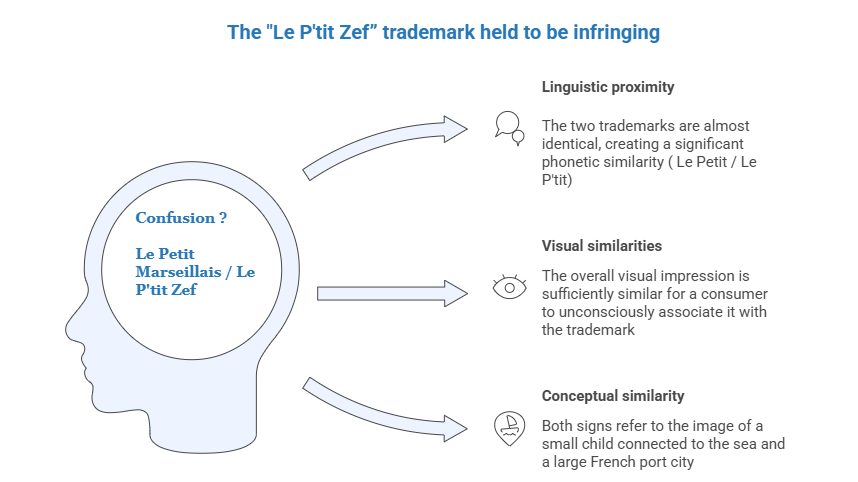
The Court of Appeal first noted that the signs share a strong linguistic similarity in their structure, the initial element of both trademarks being almost identical (“Le Petit” / “Le P’tit”). Although the terms “Marseillais” and “Zef” differ visually and phonetically, this distinction is not sufficient to rule out any likelihood of confusion.

From a conceptual standpoint, the judges considered that both signs refer to comparable images, namely that of a child associated with a major French port city, Marseille for the earlier trademark and Brest for “Le P’tit Zef.” This interpretation led the Court to conclude that the public might perceive “Le P’tit Zef” as a regional variation or thematic extension closely associated with the earlier trademark.

The Court also took into account the figurative elements displayed on the packaging, which showed comparable visual configurations, thereby reinforcing the impression of association between the two trademarks.

This overall assessment led the judges to find the existence of a likelihood of confusion and association and, consequently, to characterize the use of the trademark “Le P’tit Zef” as an infringement of the trademark “Le Petit Marseillais”

trademark infringing

Practical and strategic lessons for trademark owners

The decision of April 12, 2016 confirms, first, that a trademark referring to a region or a traditional product, in this case, Marseille soap, is not, per se, liable to mislead the public, provided that an overall assessment of the elements perceived by consumers, including figurative components, clearly identifies the true origin of the goods and rules out any false geographical representation.

Second, the assessment of likelihood of confusion extends beyond purely verbal elements. The ruling illustrates that a judge’s global analysis include conceptual and figurative elements relating to the visual representation of the signs, thereby strengthening the protection afforded to a strong trademark when a competitor adopts a similar graphic or conceptual universe.

Conclusion

The judgment of April 12, 2016 rendered by the Court of Appeal of Paris confirms that the “Le Petit Marseillais” trademark, registered in Class 3, is not misleading within the meaning of Article L.711-3 of the French Intellectual Property Code, even though it evokes a reputed traditional manufacturing method.

This decision validates a contextual reading of consumer behavior and of the perception of signs as a whole. It also demonstrates that the overall comparability of trademarks may suffice to establish infringement when a competitor develops a similar brand, both visually and conceptually.

Dreyfus & Associés assists its clients in managing complex intellectual property cases, offering personalized advice and comprehensive operational support for the complete protection of intellectual property.

Dreyfus & Associés works in partnership with a global network of attorneys specializing in Intellectual Property.

Nathalie Dreyfus with the support of the entire Dreyfus team

FAQ

1. Can a trademark evoke a geographical origin without being considered misleading?
Yes. A trademark may refer to a region or territory provided that this reference does not lead consumers to believe, incorrectly, that the products actually originate from that place. In this case, the Court held that “Le Petit Marseillais” referred to a marketing universe rather than to a geographical guarantee.

2. Is the actual place of manufacture decisive in assessing trademark validity?
Not systematically. The place of manufacture becomes legally relevant only if the trademark explicitly suggests a protected or certified origin. In the absence of an official geographical indication, a mere discrepancy between the evocation of the sign and the actual production site is insufficient to establish deception.

3. Is the mere use of different terms sufficient to exclude a likelihood of confusion?
No. The presence of different terms does not, in itself, exclude the likelihood of confusion. Judges assess the sign as a whole, including its structure, rhythm, positioning, and overall impact. In this case, despite the differences between “Marseille” and “Zef,” the overall similarity was decisive.

4. Do packaging and commercial presentation influence legal analysis of counterfeiting?
Yes. Courts take into account the overall presentation of products, including graphic elements, colors, illustrations, and visual identity. When these elements reinforce the proximity between two brands, they may contribute to a finding of imitation.

5. What risks does a company face when adopting a trademark too close to that of an established competitor?
It may face counterfeit proceedings resulting in a prohibition on use, withdrawal of products from the market, payment of damages, and, in some cases, destruction of infringing materials. It may also suffer lasting commercial harm due to loss of credibility.

This publication is intended to provide general guidance and to highlight certain issues. It is not intended to address specific situations nor to constitute legal advice.

Read More

How to ensure effective trademark protection in Sint Maarten ?

Introduction

Trademark protection in Sint Maarten represents a strategic issue for companies seeking to secure their intangible assets in the Caribbean. As an autonomous country within the Kingdom of the Netherlands since 2010, Sint Maarten has its own trademark protection system, which is distinct from the Benelux system and does not fall within the territorial scope of the European Union trademark.

Therefore, a rigorous approach is essential for effective trademark protection in Sint Maarten in order to avoid any legal vulnerability or fraudulent exploitation.

What is the legal framework for trademark protection in Sint Maarten?

Since its institutional reform, Sint Maarten has established its own legislation governing trademark rights. Unlike the European Netherlands, trademark protection is not administered by the Benelux Office for Intellectual Property (BOIP). The applicable legal framework is local in nature, although it is strongly influenced by Dutch and European legal standards.

Since January 1, 2015, trademark applications may be filed electronically via the technical infrastructure administered by the BOIP, while legal decisions remain under the authority of the Bureau Intellectuele Eigendom of Sint Maarten (BIE SXM).

This system ensures the existence of a secure electronic register, a modernized filing procedure and efficient administrative management. However, it is important to emphasize that neither a Benelux trademark nor a European Union trademark produces automatic legal effects in Sint Maarten.

How to file a trademark in Sint Maarten?

Before filing a trademark application, conducting a prior art search is essential to identify potential conflicts with existing registered trademarks, locally used trade names, domain names registered under the “.sx” extension, or well-known signs.

Trademark applications are filed online via the platform operated in cooperation with the BOIP.

The application must include the following elements:

• accurate identification of the applicant
• representation of the sign to be protected
• designation of the goods and services according to the Nice Classification
• payment of the official filing fees

The office conducts both a formal and substantive examination, verifying in particular the distinctiveness of the sign and its compliance with legal requirements.

After publication, an opposition period is opened, allowing holders of prior rights to take action. If there is no opposition or refusal to grant the trademark by the office, registration is granted and the trademark is protected.

What rights does a registered trademark confer in Sint Maarten?

Trademark registration grants the owner an exclusive right of use within the territory for the goods and services designated.

This exclusive right enables the trademark owner to prohibit:

• the use of an identical sign for identical goods or services
• the use of an identical or similar sign for identical or similar goods or services where there is a likelihood of confusion in the mind of the relevant public
• the use of a sign that takes unfair advantage of, or is detrimental to, the distinctive character or reputation of the trademark

Protection extends to commercial, advertising, and digital uses. It covers shop signs, promotional materials, online platforms, and similar domain names, particularly those using the “.sx” extension.
Trademark owners may also take action against the use of identical or similar signs for related goods or services when a likelihood of confusion is established.

In the event of infringement, the first step generally consists of sending a cease-and-desist letter requesting voluntary cessation of the unlawful use.

If the infringement persists, legal proceedings may be initiated before the competent courts of Sint Maarten in order to obtain:

• cessation of the infringing acts
• compensation for damages
• and, where appropriate, interim or injunctive relief

Active monitoring of new trademark applications is essential to identify potential conflicts at an early stage. Monitoring “.sx” domain names, local marketplaces, and digital advertising uses is also particularly important in a highly digitalized market.

How to manage trademark disputes and enforcement in Sint Maarten?

The legal framework applicable in Sint Maarten provides several mechanisms for challenging the registration or use of a trademark that infringes prior rights.

An opposition may be based on:

• a prior registered trademark
• a protected trade name
• or any other recognized intellectual property right

The assessment of likelihood of confusion relies on a global analysis that considers the similarity of the signs, the proximity of the goods or services involved, and the perception of the relevant public.

In cases of counterfeiting, the courts of Sint Maarten have jurisdiction to hear the dispute. The principles applied in trademark matters are largely inspired by Dutch and European trademark jurisprudence.

Interaction with international trademark protection

Trademark protection in Sint Maarten must be considered within an international protection strategy.

Neither a European Union trademark nor a Benelux trademark produces direct legal effects in this territory.

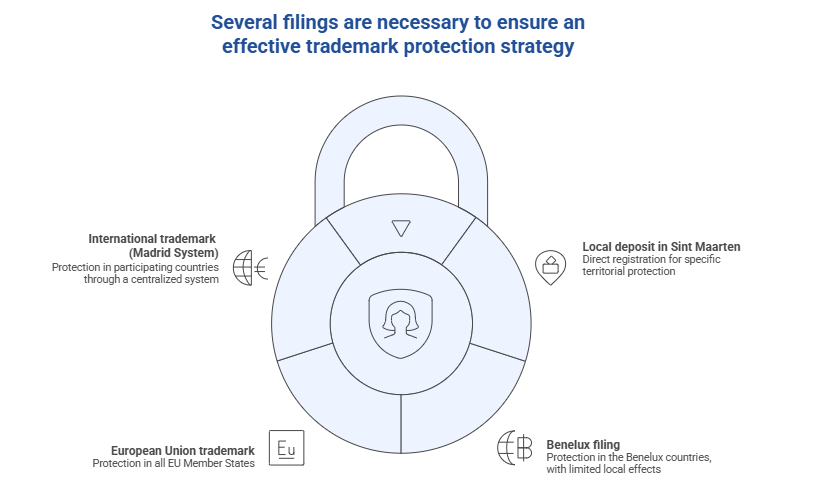
Companies operating in the Caribbean region or internationally should therefore structure a coherent trademark portfolio that may include, depending on their needs:

• a local trademark filing in Sint Maarten
• a Benelux trademark
• a European Union trademark
• and, where appropriate, an international registration through the Madrid System

Such a strategy ensures consistent territorial coverage and reduces the risk of opportunistic trademark registrations in jurisdictions not covered by the main trademark portfolio.

strategy protection trademark

Conclusion

Trademark protection in Sint Maarten relies on an autonomous legal system that requires a specific local filing, as neither European nor Benelux trademarks apply automatically.

Businesses must therefore adopt a proactive strategy in order to prevent conflicts, preserve the economic value of their trademarks, and secure their commercial investments in the Caribbean region.

A coordinated approach combining trademark filings, monitoring, and enforcement mechanisms remains the key to achieving effective and sustainable protection.

Dreyfus & Associés assists clients in managing complex intellectual property matters, providing tailored advice and comprehensive operational support for the full protection of intellectual property rights.

Dreyfus & Associés works in partnership with a global network of intellectual property attorneys.

Nathalie Dreyfus, with the support of the entire Dreyfus team.

Q&A

How long does it take to register a trademark in Sint Maarten?
The processing of a trademark application by the Director of the Sint Maarten Intellectual Property Office takes approximately four months. During this period, the office examines the application to verify compliance with legal and administrative requirements. Once the procedure is completed and no objections arise, the office issues a certificate of registration confirming the trademark owner’s rights.

What is the duration of trademark protection in Sint Maarten?
A registered trademark in Sint Maarten is protected for a period of ten years from the filing date. This protection may be renewed indefinitely for successive ten-year periods, subject to payment of the applicable renewal fees.

Must a trademark be used in Sint Maarten?
Yes. As in many jurisdictions, a registered trademark may be subject to revocation if it is not genuinely used for an extended period. Effective use of the trademark is therefore essential to maintain the validity of the rights.

Can a trademark be protected in Sint Maarten through the Madrid international system?
Yes. Companies with an international protection strategy may use the Madrid System administered by the World Intellectual Property Organization (WIPO). This mechanism allows applicants to file a single international application and designate multiple territories, including Sint Maarten.

Is it necessary to appoint a local representative when filing a trademark in Sint Maarten?
Depending on the applicant’s situation, representation by an intellectual property attorney or specialized lawyer is strongly recommended, particularly when the trademark owner is not established in Sint Maarten. Appointing a representative helps ensure compliance with local legal requirements, optimizes the drafting of the goods and services specification, and anticipates potential objections or oppositions.

This publication is intended to provide general information and highlight certain legal issues. It is not intended to apply to specific situations and should not be construed as legal advice.

Read More

France : The use of third-party trademarks as keywords on the Internet and the limited liability regime of hosting providers

Introduction

The rise of digital marketing and paid search advertising has profoundly transformed the use of trademarks on the Internet. In particular, the purchase of keywords corresponding to third-party trademarks raises significant legal issues at the intersection of trademark law, intermediary liability, and digital law.

This article provides a structured and rigorous analysis of the conditions under which the use of trademarks as keywords is lawful, as well as the limits of the limited liability regime applicable to hosting providers in France.

Use of third-party trademarks as keywords : a regulated principle

The purchase of keywords corresponding to a third-party registered trademark, particularly in the context of paid search campaigns, is not unlawful per se. Both European and French case law have acknowledged the permissibility of such practices, provided that they respect the essential function of a trademark, namely to guarantee the origin of goods or services.

Accordingly, the use of a keyword identical to a trademark is considered lawful where it does not adversely affect that function, does not create a likelihood of confusion in the mind of the average consumer, and does not take unfair advantage of the reputation of the protected sign.

Conversely, such use becomes unlawful where the advertisement displayed creates ambiguity as to the origin of the goods or services or suggests the existence of an economic link with the trademark owner. This is particularly the case where the advertisement reproduces the third party’s trademark or exploits its reputation to divert customers. In such circumstances, courts will find an infringement of the essential function of the trademark, thereby constituting trademark infringement.

Advertiser liability : a principle of general law

An advertiser who selects a keyword corresponding to a trademark incurs direct liability, as it is deemed to be making use of the sign in the course of trade.

Such liability may arise on the basis of trademark infringement within the meaning of Articles L.713-2 et seq. of the French Intellectual Property Code, as well as on grounds of unfair competition or parasitic conduct.

Courts adopt a concrete and contextual analysis, taking into account the content of the advertisement, the perception of the average consumer, and the clarity of the commercial origin of the goods or services. The degree of reputation of the trademark is also a relevant factor, as well-known trademarks benefit from enhanced protection against undue exploitation.

The limited liability regime of hosting providers in France

The legal framework governing hosting providers derives from the French Law of June 21, 2004 on Confidence in the Digital Economy (LCEN), which transposes the EU E-Commerce Directive. This framework establishes a regime of limited liability for technical service providers.

Hosting providers are not subject to a general obligation to monitor the content they store. This principle constitutes a cornerstone of digital law, aimed at preserving innovation and the development of online services.

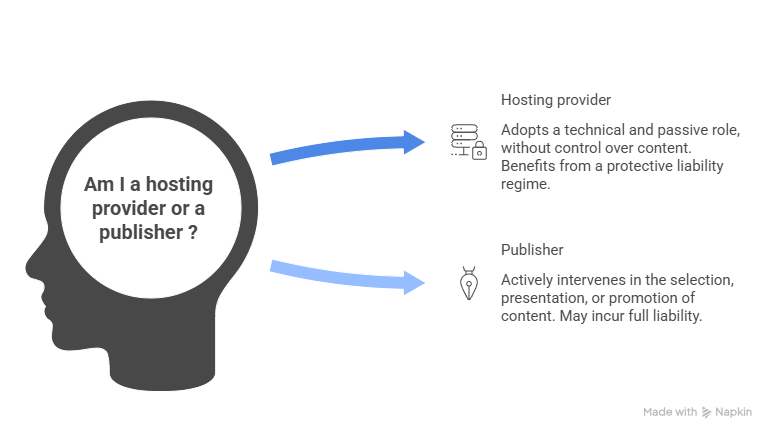
In practice, a search engine or advertising platform is not required to proactively verify the legality of keywords selected by advertisers. The liability of a hosting provider may only be incurred where it has actual knowledge of manifestly unlawful content and fails to act expeditiously to remove or disable access to such content. Such knowledge presupposes a sufficiently precise and legally substantiated notice, followed by a diligent response from the provider.

Conversely, it is deemed to be a publisher where it plays an active role in the selection, presentation, or promotion of content.

Accordingly, a platform involved in optimizing advertisements or actively suggesting keywords may face increased liability exposure.

hosting provider publisher

French and European case law : guiding principles

The general principle was first established by the Court of Justice of the European Union, in its ruling of March 23, 2010, Google France SARL and Google Inc. v Louis Vuitton Malletier (C-236/08).

The Court held that a referencing service provider such as Google does not make “use” of a trademark within the meaning of trademark law where it merely plays a neutral, technical, and passive role. In such circumstances, it may benefit from the limited liability regime provided for under Directive 2000/31/EC.

Under French law, this analysis has been confirmed and further clarified in a decision of the French Supreme Court dated January 20, 2015 (No. 11-28.567). The Commercial Chamber reiterated, on the one hand, the applicability of the limited liability regime to technical service providers acting as hosts, and, on the other hand, the absence of trademark infringement solely on the basis of the use of a sign as a keyword on the Internet.

In that case, SNCF alleged that several competing companies had used its trademarks, including well-known marks, as keywords in order to redirect internet users to their own websites. It also argued that the technical service provider involved could not benefit from hosting provider status due to its allegedly active role, and further claimed the existence of misleading commercial practices suggesting a commercial link.

However, the Cour rejected all of these arguments, holding that the conditions for engaging the liability of the service provider were not met and that the use of trademarks as keywords did not, in itself, constitute an infringement of trademark rights.

French courts thus follow the line of European case law by adopting a concrete approach, based on the actual role played by the service provider and on the perception of the average internet user regarding the origin of the goods or services.

SEO and legal best practices for businesses

An effective strategy requires constant vigilance in the drafting of advertisements and in the use of third-party distinctive signs. Businesses must avoid any ambiguity, refrain from reproducing competitors’ trademarks in advertising content, and implement monitoring and rapid response mechanisms in the event of infringement. A structured approach enables the reconciliation of marketing performance with legal certainty.

Conclusion

The use of third-party trademarks as keywords constitutes a powerful strategic tool, yet one that is strictly regulated. French and European law strike a balance between freedom of online commerce and the protection of intellectual property rights, clearly distinguishing between advertiser liability and that of technical intermediaries.

Dreyfus & Associés assists its clients in managing complex intellectual property matters by providing tailored advice and comprehensive operational support for the full protection of intellectual property rights.

Dreyfus & Associés works in partnership with a global network of specialized intellectual property lawyers.

Nathalie Dreyfus with the support of the entire Dreyfus team.

Q&A

1. Can a company bring legal action even if its trademark does not appear in the advertisement?
Yes. Courts recognize that infringement may be established even without visible reproduction of the sign, where the keyword triggers advertising that exploits the economic value of the trademark.

2. Is achieving a higher ranking than a competitor in sponsored results on the Internet unlawful?
No. Ranking itself is not unlawful; what matters is how the advertisement is perceived by the internet user.

3. Can a platform refuse to remove a contested advertisement?
Yes, where the notice is insufficiently substantiated or does not establish the manifestly unlawful nature of the content. Hosting providers retain a degree of discretion when processing notices.

4. Is the use of similar (but not identical) keywords risky?
Yes. The use of similar signs may incur liability where it creates a likelihood of confusion or exploits the proximity to a protected trademark.

5. Is an action based on unfair competition more effective than trademark infringement?
In certain cases, yes. It allows courts to address conduct that does not strictly meet the criteria for infringement but nonetheless constitutes unfair appropriation of another’s business or parasitic behavior.

This publication is intended for general public guidance and to highlight issues. It is not intended to apply to specific circumstances or to constitute legal advice.

Read More

France: Jane Birkin defends her trademark against Hermès

Recently alerted by the cruel practices endured by crocodiles during their slaughter for the production of the famous Birkin bags from the Hermès fashion house, the singer Jane Birkin informed Hermès about her intention to rename the crocodile-skin handbag bearing her name. The singer no longer wishes her name to be associated with such practices.

The Birkin bag, created in the early 1980s following a meeting between the singer and Jean-Louis Dumas, the chief executive of Hermès at that time is, however, one of the leading bags from the Hermès fashion house since its inception date.

Alongside arousing the curiosity of fans of the luxury brand Hermès, this news has also piqued the interest of lawyers. Indeed, in the face of such news, the question that arises is whether Jane Birkin can legally rename the crocodile-skin bag.

The fact of renaming a designer bag bearing the name of a star is not an isolated practice since there is a myriad of bags bearing the name of their muse. To cite only the most famous, it is noteworthy to mention the following designer handbags namely: So Kelly from Hermès as a tribute to Grace Kelly, Jackie from Gucci, Lady Dior, or B. Bardot from Lancel.

Since these names are associated with handbags, i.e. with goods, they were obviously registered as trademarks. This is the case, for example, for the name Birkin, filed and registered both as a French and international trademark by HERMES INTERNATIONAL since 1997 and the “So Kelly”, filed in 2009. The same holds true for the “Jackie” handbag, which refers to Jackie Kennedy and was filed by the Italian company GUCCIO GUCCI in 2008.

The practice of registering a surname as a trademark has been upheld by legislation and the French courts for a long time.

The surname is a personality right which is inalienable and indefeasible. Yet Article L.711-1, paragraph 2 a) of the French Intellectual Property Code provides that surnames can be registered as a trademark. Moreover, since the 1985 case of Bordas (Cass. Com. March 12, 1985, No. 84-17163), it is settled law that there can be an agreement to the effect of the commercial use of a surname.

Subsequently, the cour de cassation specified the conditions under which a surname could be registered as a trademark. In a judgment datedMay 6, 2003 (Cass. Com. No. 00-18192) the cour de cassation held that a founding partner who has agreed to the inclusion of his name in the company name must also expressly waive his ownership rights and allow the company to register the said surname as a trademark. In other words, the use of the surname of a third party is limited to what has been expressly authorized by the name holder.

Thereafter, the cour de cassation intervened in the Inès de la Fressange case regarding the use of her surname as a trademark by the fashion company bearing her name. After being dismissed from the company, the fashion designer had sought to recover the rights affiliated with her name by invoking the potentially misleading nature of the trademark on the basis of Article L. 714-6 b) of the Intellectual Property Code. She claimed that consumers would be misled into believing that they were buying clothes designed by her. But this was not the stance taken by the cour de cassation which, on the basis of Article 1628 of the Civil Code and the implied warranty against eviction principle, dismissed the designer’s claim (Cass. Com. January 31, 2006, N ° 05-10116).

A few months later, the Court of Justice of the European Union also faced a similar question in the Elizabeth Emanuel case (ECJ March 30, 2006. Aff . C-259 /04. Elizabeth Florence Emanuel v Continental Shelf). The issue in that case concerned the sale by the designer Elizabeth Emanuelof her fashion company bearing her name and the assets attached thereto, including the ELIZABETH EMANUEL trademark. However, following the sale, the fashion designer filed a claim for the revocation of rights against the trademark which was transferred accordingly, deeming that, just as was the case with Madame de la Fressange, the public was confused since she was no longer the designer of the clothes marketed under the trademark.

The Court held that the ELIZABETH EMANUEL trademark was not, in itself, likely to mislead the public as to the origin of the clothes. But the Court opined that it is for the national court to verify whether there is, on behalf of the company holding the trademark, an intention to make the consumer believe that the designer is still involved in the design of clothes. This would thus be tantamount to fraudulent tactics likely to make the company liable.

In the present case, since Jane Birkin is not associated with the design of the handbag, she cannot rely on this approach for the crocodile-skin handbag to be renamed.

It therefore remains to be seen whether the intention to rename the Birkin crocodile-skin handbag can materialize to the extent that the surname of the singer, registered as a trademark, could be considered as part of the assets of the Hermès company. The outcome of this case shall enlighten us.

Furthermore, on 11 September last, the saddler welcomed in a press release that Jane Birkin seemed to be satisfied by the measures adopted by the Hermès house following the controversy appeared this summer.

Can Jane Birkin legally prohibit Hermès from using her name?

Yes. Jane Birkin can oppose the use of her name if it harms her image or was used without her express consent. Under French law, a family name is protected by privacy rights and potentially by trademark law, if registered.

What are the criteria to protect your name as a trademark?

To defend your name, you must demonstrate its notoriety, commercial use, and the risk of confusion or harm to your reputation. This is especially relevant for public figures and celebrities.

Does Hermès have to rename the Birkin bag?

Not necessarily. If Hermès originally obtained consent or the name has become a standalone brand, the use may be legally justified. However, legal opposition from Jane Birkin could force the company to reconsider its use.

Read More