Trademark

The pseudonym: what protection?

As an Alias adopted to preserve anonymity, the pseudonym is frequently used in the public sphere for commercial purposes. This can be, for example, the pen name of an author, the identity under which a painter is known, etc.


French law does not provide any legal status for the pseudonym. However, it is recognized as a right of personality. As such, it enjoys an existence and legal protection.


When the pseudonym is intended for public use, the choice requires particular attention. Therefore there are limits established by law which must be respected. Thus, the pseudonym chosen must not violate public order or morality. The existence of prior rights, such as a registered trademark or prior use of the same pseudonym by another individual, is also a limiting factor.


In addition, Article L. 711-4 of the French Intellectual Property Code states that a sign may not be adopted as a trademark if it infringes an earlier right. These earlier rights include the personality rights of another person, particularly his surname, pseudonym or likeness.


The pseudonym may not only constitute an earlier blocking right for a trademark but may also be registered as a trademark. This has two consequences:


the need to check whether the pseudonym infringes apreviously existing pseudonym used commercially


A pseudonym used in the private sphere raises few problems in practice. The same applies if it is used for a limited period of time. If it is not intended for commercial use, it is not necessary to check the existence of any previous use by a third party.


the protection of a pseudonym may be increased if it is registered as a trademark


Registering a pseudonym as a trademark provides better protection. This registration also leads to its becoming an intellectual property asset in its own right and therefore increases its value. This provides security for the user of the pseudonym as well as for his business partners. It is then easier to carry out commercial operations using this pseudonym (assignment contracts, licensing, marketing operations, etc.)


Dreyfus can assist you in the registering of your trademarks in all countries of the world. Do not hesitate to contact us.

Read More

Generic trademarks: good practices to avoid ‘genericide’

Protecting intellectual property assets is a major concern of companies. Trademarks are a subject of immediate interest, because they allow consumers to associate products and/or services with a specific company. The company is therefore more easily recognized and is more likely to see customers buy its products.


Once a trademark has been duly registered, a company can start to exploit it.  That is when we must be most vigilant. Indeed, a trademark may lose its distinctiveness after its registration, by becoming a generic trademark.


What is a generic trademark?


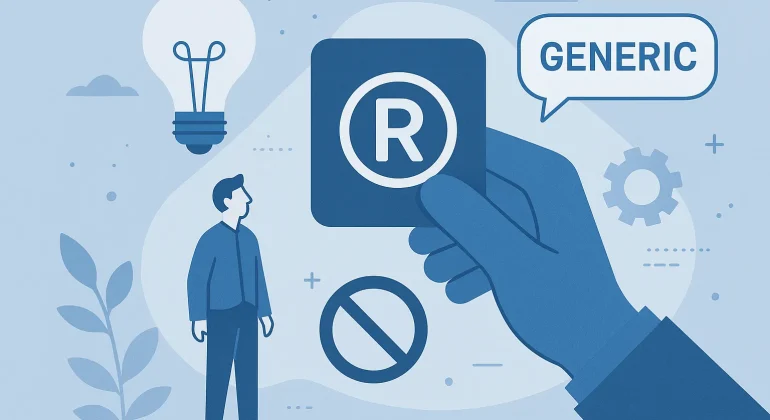
Put simply, a generic trademark is one that has become “The common name in trade for a product or service” One of the main criteria for the validity of a trademark is its distinctiveness (Article L. 711-2 of the French Intellectual Property Code). Under the article L. 714-6 of the French Intellectual Property Code, a generic trademark is devoid of distinctiveness because it has become “The common name in trade for a product or service”.


In other words, a generic trademark is a trademark that has become a common term for a type of product or service. It is used by both consumers and competitors of the trademark to refer to the product or service no matter by whom it has been provided. As a victim of its success, the trademark no longer enables consumers to identify products and services as coming from the company concerned. It falls therefore into the public domain.


As such, the company that created the trademark loses its exclusive right of exploitation. It will no longer be able to oppose the use of its trademark by third parties who seek to use it as the descriptive or ‘generic’ name of the product or service for which it has become famous. This is called genericide of a trademark.


Under the aforementioned article L. 714-6, an action for revocation or cancellation for genericide of a trademark that became generic requires two conditions:

– the trademark must have become the common name of the product or service;

– such use must be caused by the trademark owner, namely mostly his inaction.


Hence, the need for a company to act effectively against any use of its trademark as a generic term. If the owner acts effectively against any generic use, the trademark will continue to be protected by law.


Good practices to prevent a trademark from becoming generic


Acting before any commercialization, is the most effective way to prevent a trademark from becoming generic. It is also advisable not to misuse the trademark later on.


If you have created a totally new product or seek to become a brand leader in a new market, it is imperative to create – or use -a term to designate the new product, as there is a strong risk of confusion between the trademark and the product. For example, Apple’s trademark is iPhone, and the product to which it is applied is a “smartphone”.  Similarly, if a generic term exists but is particularly complex, it is useful to provide a simpler term, where your trademark is the market leader. It is also recommended to use the term defined in this way in agreements with third parties (e.g. letter of commitment, coexistence agreement, etc.).


In addition, the trademark must be used correctly in all circumstances, both externally and internally.


The use of the trademark must be particularly monitored during advertising campaigns. The trademark should be distinguished from the surrounding text promoting the marketed product or service by placing it in BLOCK LETTERS or, by Capitalising the first letter.

Using the trademark as a noun makes it more likely to be confused as the generic name. This practice should be discarded in favour of using it as an adjective. For example; “a Kleenex handkerchief” rather than “a Kleenex”.

Another good practice is to use the ® symbol or the ™ symbol. Although the latter have no legal value in France unlike in the United States, their use on the market is common. Promoting the trademark as an asset belonging to the company discouraging its use as a common term.


A trademark becomes generic mainly because of its misuse by the public. This misuse is not necessarily the result of an intend to harm. As such, it is recommended to carry out advertising campaigns aimed at consumers promoting correct use in order to avoid misuse. Preparing written standards defining the correct use of the trademark that can be easily distributed to third parties (licensees, consumers, etc.) also participates to this public education.

Avoiding misuse of the trademark also requires protection against abusive use of the trademark by third parties. It is therefore necessary to monitor product and service descriptions for new trademark applications and press publications mentioning the trademark.


Finally, because a trademark may be declared generic as a result of the owner’s actions or lack of action, it is in the company’s best interest to ensure that it can prove that it has taken steps to avoid the trademark becoming generic. In this respect, marketing files (advertising costs, unsolicited mentions in the press, etc.), letters of formal notice, summonses or even court decisions are all evidence to be kept.


In short, a potentially generic trademark remains protectable under trademark law if its owner has enforced actions against its misuse and gathered supporting evidences to prove that extent.


Dreyfus can assist you in the management of your trademarks portfolios in all countries of the world. Do not hesitate to contact us.

FAQ

What is a generic trademark?
A trademark that, through being used as a common name to designate a product or service, loses its distinctive function and falls into the public domain.

Can a trademark be protected against genericide?
Yes, by monitoring its use, educating the public and distributors, and ensuring it is always perceived as a trademark and not as a common name.

Can a generic trademark be recovered?
No, once a trademark has become generic and lost its legal protection, it is very difficult — if not impossible — to recover it as a registered trademark.

Read More

Can the Google trademark become a generic term, or does it remain a valid trademark?

Introduction

The term GOOGLE is one of the clearest examples of a trademark that has entered everyday language without, to date, losing its essential legal function. It is common to hear users say that they will “google” a person, a company, a product or a legal issue. For a trademark owner, this linguistic success may appear ambivalent: it reflects exceptional reputation, but it may also raise a risk of genericide.

In Elliott v. Google, the U.S. courts confirmed that the GOOGLE trademark had not become generic for internet search engine services. The case remains a key reference for distinguishing the popularity of a term from the loss of its legal distinctiveness.

Elliott v. Google: an attempt to cancel the GOOGLE trademark

The dispute arose after David Elliott and Chris Gillespie registered several hundred domain names incorporating the term “google”, often combined with trademarks, public figures or places.

Google first obtained the transfer of those domain names through UDRP proceedings. The domain name holders then sought to cancel the GOOGLE trademark, arguing that the term had become a generic verb meaning “to search the Internet”.

Under U.S. law, the analysis is based on the “ primary significance test ”. This consists in determining the main meaning of the sign for the relevant public. If the public still perceives the sign as an indication of commercial origin, the trademark may remain valid. In the Google case, the plaintiffs relied heavily on the verbal use of the term, but failed to prove that the public primarily understood GOOGLE as the generic name for search engines.

In a decision rendered on May 16, 2017, the U.S. Court of Appeals for the Ninth Circuit upheld the decision in favor of Google. The significance of the appellate decision may be summarized as follows:

  • The everyday use of a trademark in ordinary language is not sufficient, in itself, to cause its genericide.
  • The use of a trademark as a verb, for example “to google”, does not automatically mean that the trademark has become a common name.
  • The central criterion is the perception of the relevant public: it must be determined whether the sign primarily designates a commercial origin or a category of goods or services.
  • A very well-known trademark may therefore remain protected, even if it is widely used in everyday language.
  • The decision nevertheless reminds trademark owners of the importance of monitoring and controlling the use of their signs in order to prevent them from gradually becoming generic designations.

What is the approach under French law and European Union law?

French law and European Union law also recognize the mechanism of trademark genericide.

  • In France, Article L.714-6 of the French Intellectual Property Code provides that a trademark owner may be deprived of their rights where the trademark has become, through their own conduct, the usual designation in trade for the relevant product or service. In such a case, the trademark is no longer distinctive, as it no longer enables consumers to identify the commercial origin of the product or service concerned.
  • At European Union level, Article 58(1)(b) of Regulation (EU) 2017/1001 provides for revocation of an EU trademark where, because of acts or inactivity of the proprietor, the trademark has become the common name in the trade for a product or service for which it is registered.

What best practices should be adopted to protect a strong technology trademark against genericide?

The GOOGLE case is particularly useful for companies active in artificial intelligence, SaaS software, digital platforms, mobile applications, marketplaces and specialized search engines. In these sectors, a service may quickly become part of everyday vocabulary.

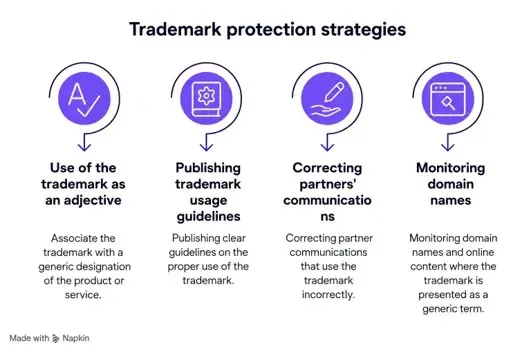
For trademarks known to a significant part of the public, it is essential to regularly remind users that they are not common names, but trademarks designating the products or services they cover, in order to prevent them from becoming generic. What form can this strategy take?

Companies may

  • Use the trademark as an adjective and associate it with a generic designation of the product or service;
  • Publish trademark usage guidelines;
  • Correct partners’ communications;
  • Monitor domain names and online content that present the trademark as a generic term.

  • To learn more about best practices for preventing the genericide of your trademark, we invite you to read our previously published article.

Conclusion

The GOOGLE trademark remains valid because it has not been shown that the public primarily understands it as the generic name for search engines. The use of a trademark as a verb may create a risk, but it is not sufficient, in itself, to establish genericide.

The broader lesson is that the more successful a trademark becomes, the more carefully it must be managed. Trademark owners must monitor uses, correct generic uses and preserve the sign’s function as an indication of commercial origin.

Dreyfus & Associés assists its clients in managing complex intellectual property cases, offering personalized advice and comprehensive operational support for the complete protection of intellectual property.

Dreyfus & Associés works in partnership with a global network of attorneys specializing in Intellectual Property.

Q&A

Is trademark genericide irreversible?

Not necessarily, but it is difficult to reverse once it has taken hold. The more a sign is perceived by the public as a generic term, the harder it becomes to restore its distinctive function. This is why prevention is essential.

Can a trademark become generic only for certain goods or services?

Yes. Genericide is assessed in relation to the goods or services concerned. A trademark may lose distinctiveness for a specific category, while remaining protected for other activities if the public continues to perceive it as an indication of commercial origin in those areas.

Should a start-up be concerned about genericide from the launch of its trademark?

Yes. Even if the risk may seem remote at the beginning, good practices should be implemented from launch: choosing a distinctive trademark, ensuring consistent communication, using appropriate trademark notices, monitoring usage and educating marketing teams. It is easier to prevent banalization than to correct it once it has become established.

Can a company encourage the use of its trademark while avoiding banalization?

Yes, but it must strike the right balance. A company may naturally seek to make its trademark visible and memorable, but it must avoid encouraging its use as a common name. Communication campaigns should therefore strengthen the association between the sign and the company, rather than presenting the trademark as the generic name of the service.

Is a very famous trademark more exposed to the risk of becoming generic?

The more a trademark becomes dominant in its sector, the more likely it is to be used by the public to refer to an entire category of goods or services. Reputation is therefore a commercial asset, but it also requires increased vigilance to prevent the trademark from becoming the common name of the product or service concerned.

Read More